Lute raises $20M for touch-and-vision robot foundation models
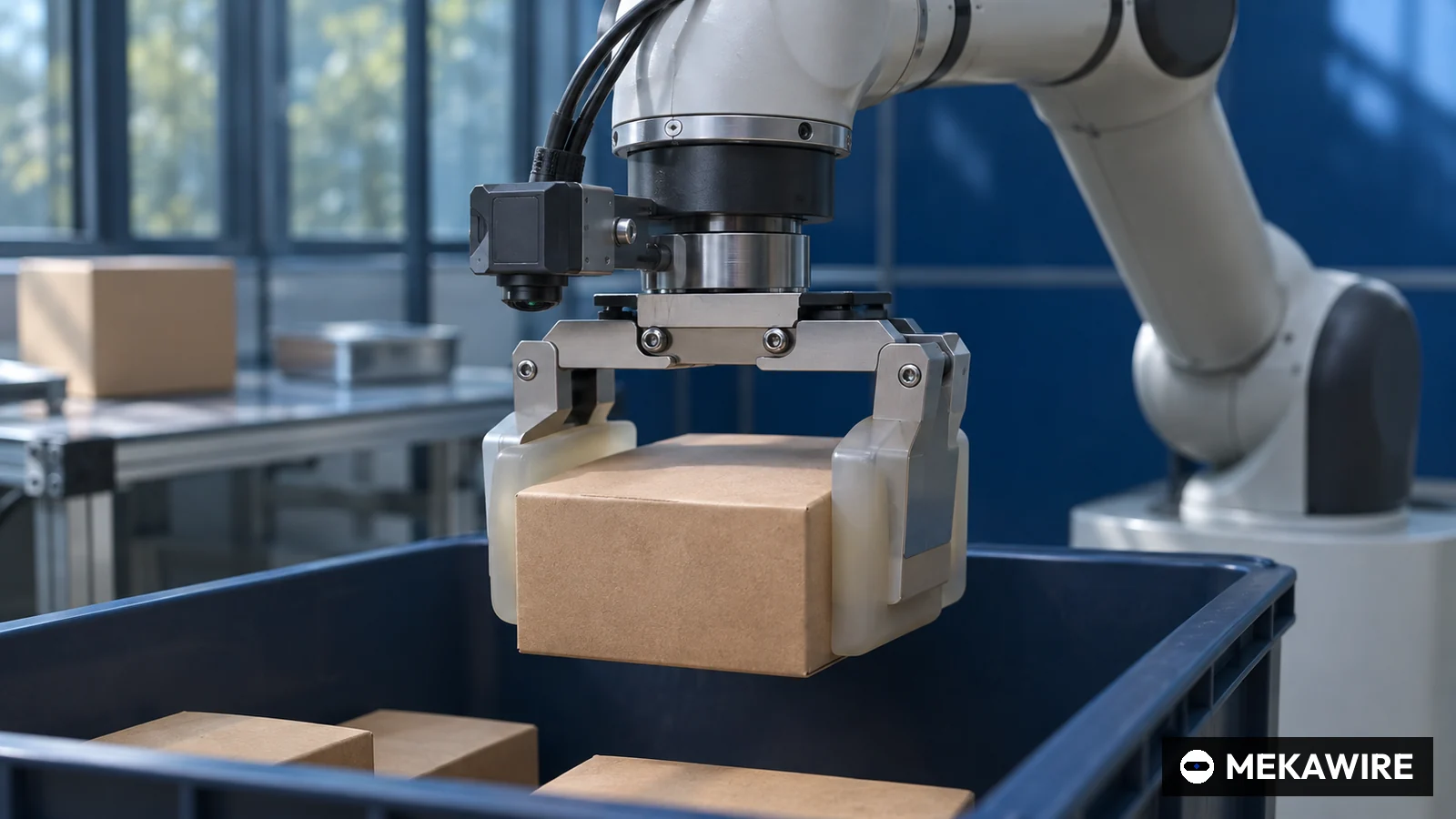
Lute, a physical AI startup with offices in Warsaw and San Mateo that its founders say they started in January 2026, said in a blog post on Nov 25 that it has raised $20 million across seed and pre-seed funding.
OTB Ventures and FORWARD.one co-led the seed round; Credo Ventures and Seedcamp led the pre-seed. Lute builds elastomer-based tactile sensors and foundation models that combine touch with vision. On five internal retail pick-and-place tasks, its first video-action model Lute-0 averaged 75.2% success against 48.8% for Physical Intelligence's π0.5 (MEKAWIRE calc. from the company's figures).
Lute, a physical AI startup with offices in Warsaw and San Mateo, California, said in a blog post on Nov 25 that it has raised $20 million in seed and pre-seed funding. Its founders say they started the company in January 2026. OTB Ventures and FORWARD.one co-led the seed round, and Credo Ventures and Seedcamp led the pre-seed. Inovo VC, Borusan Ventures, ff Venture Capital and Naval Ravikant also took part. The post, signed by co-founders Paweł Budzianowski and Krzysztof Walas, does not split the $20 million between the two rounds and gives no valuation.
What the money buys: touch data at scale
Lute says it will spend the money on collecting more data, training and improving its models and deploying with more customers. Its data comes from compact, elastomer-based tactile sensors that it co-designed with partners and built into a portable collection rig. According to the company, the sensors record where contact happens, the load and the pressure over time, so the robot learns from touch as well as from cameras. Lute is hiring in research, engineering and deployment in Warsaw and San Mateo.
Lute-0 against π0.5, by the company's own numbers
Lute-0 is the company's first video-action model. Lute says it was pre-trained on far less data than Physical Intelligence's π0.5, trains much faster and runs with about twice better latency. The post publishes success rates on five internal retail tasks.
- Fruits pick and place
- 82%
- 72%
- Drinks
- 50%
- 18%
- Deformable snacks
- 98%
- 70%
- Deformable packs
- 70%
- 62%
- Vegetable manipulation
- 76%
- 22%
- Average (MEKAWIRE calc.)
- 75.2%
- 48.8%
Source: Lute blog post, Nov 25, 2026. Company evaluation; average is the simple mean of the five published rates.
As of Nov 25, 2026
Across the five tasks Lute-0 averages 75.2% and π0.5 48.8%, a gap of 26.4 percentage points (MEKAWIRE calc., simple mean of the published rates). These are the company's own evaluations on tasks it chose; no independent benchmark or paper has been published.
Customers: one named sector, no names
Lute says its models already run at Europe's largest automotive parts distributor and that it is working with some of the world's largest retailers to put robots in their sites. It also partners with integrators to deploy on existing robot hardware, starting in health care and manufacturing. None of the customers is named.
MEKAWIRE analysis
Lute's combined $20 million is the second-smallest of the four disclosed amounts in our tactile table, and its case rests on a claim it has not yet shown under controlled conditions: that adding touch lets a robot model learn retail handling with less data.
- Eka Robotics
- Series A
- $150M
- 2026-10-20
- Enact
- Pre-seed
- $30M
- 2026-10-22
- Lute
- Seed and pre-seed
- $20M
- 2026-11-25
- Tangent Robotics
- Pre-seed
- $4.5M
- 2026-09-30
Disclosed amounts from company announcements recorded by MEKAWIRE, as of Nov 26, 2026.
As of Nov 26, 2026
In MEKAWIRE's records, Lute's $20 million sits between Tangent Robotics' $4.5 million pre-seed and Enact's $30 million pre-seed, and far below Eka Robotics' $150 million Series A. The counter-argument is that the π0.5 comparison is self-reported on five tasks; the biggest gaps came on drinks (50% vs 18%) and vegetables (76% vs 22%), where touch should matter most, but the test conditions are not public. Signals to watch: a named retail customer, a technical report on Lute-0, and the next models in the family the company says will combine touch and vision. Our explainer on robot touch covers the sensor makers: Robot touch explained. Company profile: Lute.
- January 2026 per founders; offices in Warsaw and San Mateo
- $20M, seed and pre-seed combined
- About 2x better than π0.5, per Lute
- OTB Ventures, FORWARD.one
- Credo Ventures, Seedcamp
- 75.2% vs 48.8% for π0.5 (MEKAWIRE calc.)