Volvo Cars trains Hexagon's AEON humanoid in Ghent, eyes production use from mid-2027
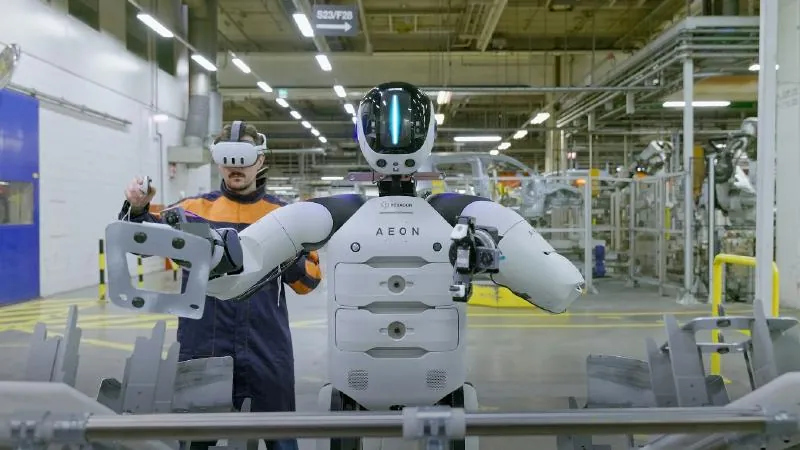
Volvo Cars said on Nov 26, 2026 that it is training and validating Hexagon Robotics' wheeled AEON humanoid on real industrial tasks at its plant in Ghent, Belgium, the first Volvo Cars plant to test humanoid robots.
A pilot with more AEON units is planned for the first half of 2027, and Volvo Cars aims to use the robots in real production from mid-2027. Neither company disclosed the number of robots or financial terms.
Volvo is the second carmaker after BMW Group to put AEON on a factory floor.
Volvo Cars said in a press release on Nov 26, 2026 that it is training and validating Hexagon Robotics' AEON humanoid on real industrial tasks at its car plant in Ghent, Belgium. Ghent is the first Volvo Cars plant where humanoid robots are being tested, the company said, and the aim is to hand the robots repetitive and ergonomically demanding work. Hexagon Robotics, the robotics division of Sweden's Hexagon, published the same news on its own site.
A two-holder insertion task comes first; Volvo aims for production use from mid-2027
The robots are learning on site next to employees and existing automation, according to the release. Training uses imitation learning, in which the robot learns a task by copying how it is done. The first task is inserting components with high precision into two holders. Later stages add handling several parts, moving through the production area and interacting with the plant's automated systems.
Volvo Cars plans to start a pilot at Ghent in the first half of 2027, with more AEON units expected to arrive for a wider range of tasks, and it aims to use the robots in real production from mid-2027. The release gives no unit count, no price and no contract value. Magnus Nilsson, Volvo Cars' Chief Manufacturing Officer, said the humanoid design lets AEON fit into production as it is today, alongside the teams and existing automation.
Volvo's release lists AEON at 1.65 m tall and 60 kg, with wheels in place of feet and a top speed of 2.4 m/s, and says it can carry 10 kg. Hexagon's own product page rates the payload at 15 kg short-term and 8 kg for continuous carrying.
Ghent repeats the sequence BMW ran in Leipzig
MEKAWIRE has followed AEON since its launch. The table below sets Volvo's schedule against the steps Hexagon and BMW Group announced earlier.
- Jun 17, 2025
- Hexagon, Hexagon LIVE Global
- AEON launched; Schaeffler and Pilatus named as pilot partners
- Feb 27, 2026
- BMW Group, Plant Leipzig
- Pilot in high-voltage battery assembly and component production after a first test in Dec 2025
- Jun 15, 2026
- Hexagon Robotics, BMW Plant Leipzig
- AEON starts production tasks; deployment in production planned by end of 2026
- Nov 26, 2026
- Volvo Cars, Ghent
- Training and validation; pilot in H1 2027; real production use aimed for mid-2027
Sources: Hexagon release (Jun 17, 2025), BMW Group release (Feb 27, 2026), Hexagon Robotics (Jun 15, 2026, Leipzig dateline Jun 12), Volvo Cars and Hexagon Robotics (Nov 26, 2026). None of these releases gives an exact unit count.
As of Nov 26, 2026
MEKAWIRE analysis
Volvo has announced a training programme and a pilot with no disclosed fleet size, and in our view AEON's commercial case now rests on whether a second carmaker moves through the same test, pilot and production steps that BMW announced in Leipzig.
BMW's path gives the yardstick. After a first test in December 2025, AEON began production tasks at Leipzig in June 2026, and Hexagon said then that it aimed to have the robot deployed in BMW's production by the end of 2026, about a year after that first test. Volvo aims for production use from mid-2027, roughly seven months after its Nov 26, 2026 training announcement (MEKAWIRE calculation; Hexagon's end-2026 date for BMW and Volvo's mid-2027 date are targets, not results). The strongest counter-argument is the task itself: inserting parts into two holders is work a fixed robot cell already does, so the value of a wheeled humanoid shows only when the later stages, several parts and moving between stations, work. No figure on cost per task or cycle time has been published by either carmaker.
Neither release names a unit count. For Hexagon, Volvo is the second carmaker named as testing AEON in a plant, after BMW Group. Other carmakers have chosen different suppliers, as MEKAWIRE reported: BMW also ran Figure robots in Spartanburg, Audi tested Agile Robots' mobile humanoids in Ingolstadt, and Toyota's Canadian plants signed Agility Robotics.
What to watch
Three signals would test the thesis: whether Hexagon confirms that AEON is deployed in BMW's production by the end of 2026, as it said in June; how many units arrive for Volvo's planned first-half 2027 pilot; and, if production use goes ahead, whether Volvo names the later tasks, moving through the plant and working with its automated systems.
- 1.65 m, 60 kg, on wheels
- 2.4 m/s
- High-precision insertion into 2 holders
- H1 2027, Ghent plant (Belgium)
- Aimed for mid-2027
- Not disclosed