Schaeffler will build humanoid joints for NEURA Robotics and put a mid-four-digit number of its robots into its own plants by 2035
Schaeffler and NEURA Robotics announced on 4 November 2025 that they will jointly develop and supply humanoid components, led by actuators, and signed an offtake agreement under which Schaeffler plans to integrate a mid-four-digit number of humanoids into its global production network by 2035.
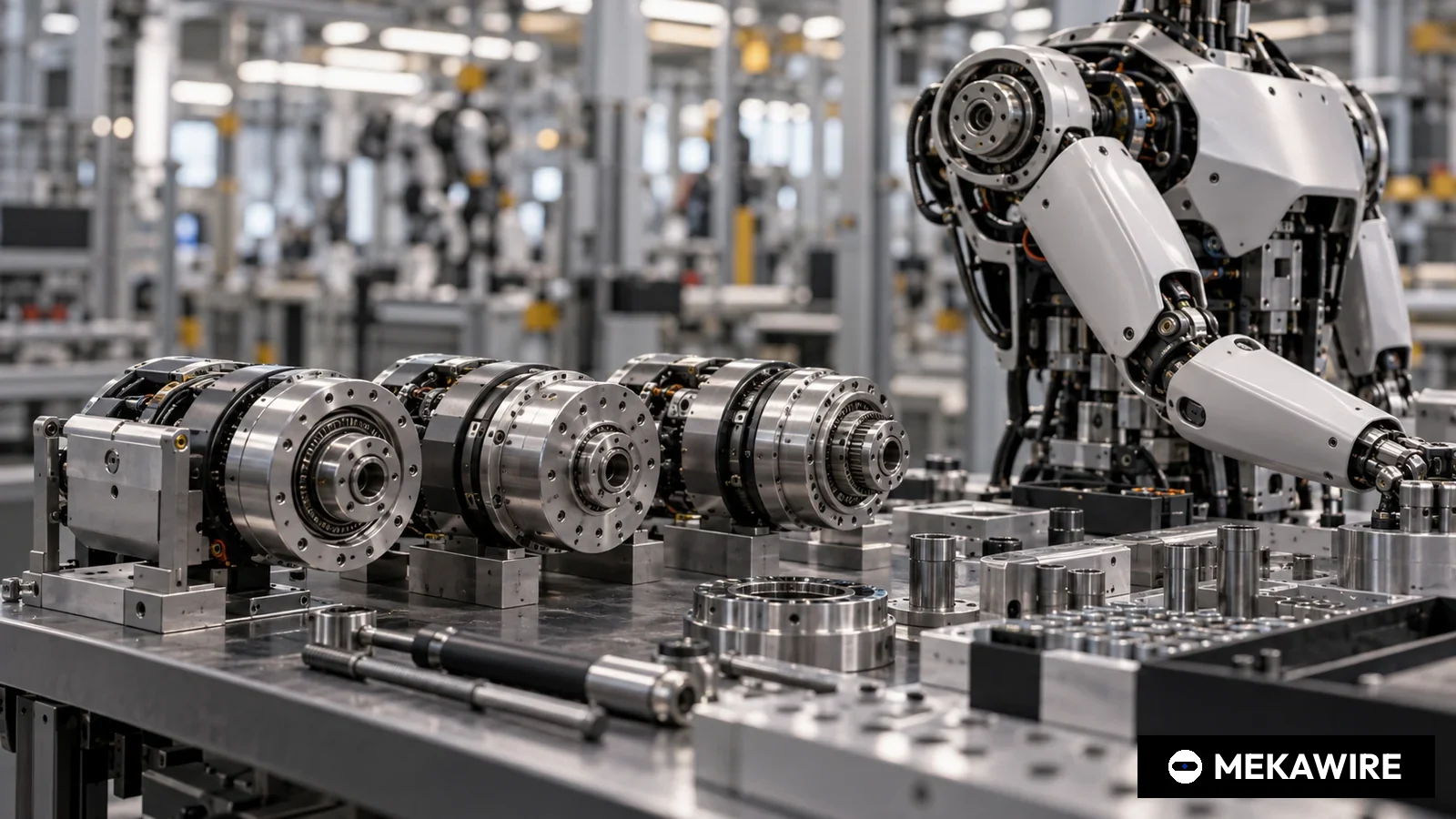
Schaeffler's planetary gear actuators, rated at up to 250 Nm, are designed for the joints of NEURA's 4NE1 humanoid.
Schaeffler, the German bearings and drive technology group, will become both a parts supplier and a large customer of NEURA Robotics under a technology partnership the two companies announced on 4 November 2025. Schaeffler said it plans to integrate a mid-four-digit number of humanoid robots into its production by 2035, giving the Metzingen start-up a named industrial anchor customer for its humanoids.
The agreement has three parts, according to statements published by both companies. They will jointly develop and supply key humanoid components, with actuators at the centre. An offtake agreement covers the integration of humanoid robots into Schaeffler's global production network. Data generated in those deployments will flow into the Neuraverse, which NEURA describes as a global cognitive ecosystem that connects physical AI. Neither company disclosed financial terms, unit prices, the first deployment site or an interim delivery schedule.
On the hardware side, Schaeffler said it is developing planetary gear actuators for humanoid joints such as shoulders, elbows, knees and wrists, with torque ratings of up to 250 Nm. The company said the units are compact and light enough for continuous duty and allow NEURA's 4NE1 humanoid to handle heavy loads. Schaeffler added that it is also working with other humanoid manufacturers, which it did not name, so the supply relationship is not exclusive.
Andreas Schick, Schaeffler's chief operating officer, called humanoid robotics an important growth segment for the group and described NEURA as one of the most innovative companies in Europe. David Reger, NEURA's founder and chief executive, said the commitment from one of Germany's largest and most experienced industrial groups showed that companies have to push new technologies forward actively rather than wait for them to mature.
Schaeffler, founded in 1946 and headquartered in Herzogenaurach in Bavaria, says it employs about 110,000 people at more than 250 locations in 55 countries. NEURA, founded in 2019, raised a EUR 120 million Series B in January 2025 led by Lingotto Investment Management, with Volvo Cars Tech Fund, Delta Electronics, HV Capital and Vsquared Ventures among the other investors. At that point NEURA said it held an order book of EUR 1 billion, employed more than 300 people and had grown revenue tenfold in a year. The company states a goal of five million cognitive and humanoid robots by 2030.
The deal puts a German industrial alongside the carmakers and suppliers that have been picking humanoid partners, and it highlights how thinly NEURA is capitalised next to its US rivals. Figure AI raised USD 1 billion in a Series C at a USD 39 billion post-money valuation in September 2025. Apptronik raised USD 350 million in a Series A in February 2025 and USD 53 million more in March. Agility Robotics' latest disclosed round is a USD 150 million Series B from April 2022, and 1X Technologies' is a USD 100 million Series B from January 2024. Among German robot companies, Agile Robots raised USD 220 million in a Series C in 2021.
- NEURA Robotics
- DE
- 2019
- Series B
- 120
- EUR
- 2025-01-15
- No data
- Agile Robots
- DE
- 2018
- Series C
- 220
- USD
- 2021-09-10
- No data
- Figure AI
- US
- No data
- Series C
- 1000
- USD
- 2025-09-16
- 39,000
- Apptronik
- US
- 2016
- Series A (incl. additional close)
- 403
- USD
- 2025-03-18
- No data
- Agility Robotics
- US
- 2015
- Series B
- 150
- USD
- 2022-04-22
- No data
- 1X Technologies
- US
- 2014
- Series B
- 100
- USD
- 2024-01-13
- No data
Figures as disclosed by each company, not estimated; amounts in original currency, no FX conversion. Apptronik = USD 350m Series A (2025-02-13) + USD 53m additional close (2025-03-18). Figure AI founding year not in verified data. — = not disclosed.
As of Nov 4, 2025
A humanoid's joints are its most expensive and failure-prone parts. Each joint combines an electric motor, a gear stage that multiplies torque, bearings and position sensing in a housing that has to fit a human-sized limb. A planetary gearbox spreads load across several planet gears turning around a central sun gear, which yields high torque in a short, robust package that can tolerate shocks when a robot lifts or squats. Those are the precision mechanics, bearing and electric drive skills on which Schaeffler built its automotive business, which is why actuator makers with car-industry roots are moving into the robot supply chain.
For the global humanoid industry, the agreement is a test of whether the suppliers that built the combustion and electric drivetrain base can become the actuator base for robots. If Schaeffler qualifies its actuators in a robot it also runs in its own plants, it collects wear and failure data on its own components that a pure parts vendor would rarely see, and NEURA gets a reference customer whose factories span 55 countries.
The commitment also leaves much open. It runs for a decade and is expressed as an order of magnitude rather than a firm unit count. No price, plant, product generation or start date was disclosed, and NEURA has not published production volumes for 4NE1. Schaeffler's statement that it works with other humanoid makers means NEURA could face competition for the same deployments inside Schaeffler's network.
The next markers are concrete. Investors should look for the first Schaeffler plant named for 4NE1 work, a start date for actuator series production, the identity of Schaeffler's other humanoid partners, and NEURA's next financing round, which will show whether the offtake helps it close the funding gap with US competitors.
MEKAWIRE analysis
Schaeffler is buying an early seat in the humanoid supply chain at low cost, and the offtake is worth more to NEURA than the actuator business is to Schaeffler in the near term.
The evidence is in the structure. Schaeffler gets a development partner for a new product line, an internal test bed for that product and data rights through the Neuraverse, while committing only to a range of units over ten years without disclosed prices. NEURA, which disclosed EUR 120 million in its last round against US rivals raising up to USD 1 billion, gains a named industrial customer that it can show to investors and other buyers.
The strongest counter-argument is that a decade-long volume range with no disclosed prices from a supplier that also works with other humanoid makers gives NEURA little certainty. If another platform performs better in Schaeffler's plants, the mid-four-digit figure could go elsewhere.
Bull case: Schaeffler's actuators reach series production, 4NE1 proves itself in Schaeffler's lines, and the partnership becomes a template that NEURA sells to other German industrials with the same supplier behind it. Volume from one anchor lowers actuator cost for every robot that follows.
Bear case: 4NE1 stays in pilots, Schaeffler shifts deployments to rival platforms it also supplies, and the 2035 horizon slides. NEURA would then be left with a high-profile logo but little revenue, while competing for capital with far better funded US players.
Signals to watch:
- By end of 2026: whether Schaeffler names the first plant and task for 4NE1 deployment.
- By end of 2026: whether Schaeffler discloses series production of its humanoid actuators and names further robot customers.
- In 2026: NEURA's next funding round, its size and whether Schaeffler participates.
- Deployment data feeds NEURA's Neuraverse
- NEURA 4NE1 humanoid
- Mid-four-digit number of humanoids in Schaeffler production by 2035
- Schaeffler AG (Herzogenaurach) and NEURA Robotics (Metzingen)
- 4 November 2025
- Planetary gear actuators for shoulders, elbows, knees and wrists
- Up to 250 Nm
- EUR 120 million Series B, January 2025, led by Lingotto
- About 110,000 employees, 250+ locations, 55 countries
Why it matters
The agreement pairs two roles that are usually separate in humanoid deals: Schaeffler is to be both an actuator source for NEURA's 4NE1 and a volume user of the robot in its own plants. That double role matters because joints carry much of a humanoid's cost and reliability risk, and a supplier that operates the robots itself carries the operating risk, which shortens the loop between field failures and component redesign.
For NEURA, the deal turns its Neuraverse narrative into a named industrial deployment path with a stated volume. For Schaeffler, it opens a new outlet for its gear, bearing and electric motor capabilities, and Schick framed humanoids as an important growth segment for the group.
Rival analysis
The US leaders compete with far more capital. Figure AI raised USD 1 billion at a USD 39 billion post-money valuation in September 2025, Apptronik raised USD 403 million across its Series A and extension through March 2025, and Agility Robotics and 1X Technologies last disclosed rounds of USD 150 million and USD 100 million. The Schaeffler structure differs from a customer pilot because it ties component supply and a stated deployment volume to the same partner.
In Germany, NEURA's closest peer by profile is Agile Robots in Munich, which last disclosed a USD 220 million Series C in 2021. Schaeffler's statement that it also works with other, unnamed humanoid makers means NEURA must still win each deployment inside Schaeffler's network on performance.
Valuation context
NEURA did not disclose a valuation with its EUR 120 million Series B in January 2025. Figure AI's USD 39 billion post-money valuation in September 2025 sets the top of the market; Apptronik raised USD 403 million in its Series A and its extension through March 2025 without a disclosed valuation. NEURA's disclosed EUR 1 billion order book as of January 2025 was large relative to its capital, but the composition of that book has not been broken out.
The Schaeffler offtake adds a quantifiable demand signal that NEURA can use in its next round. Investors will discount it for the ten-year horizon, the absence of pricing and Schaeffler's freedom to deploy rival robots, but a named German industrial customer typically supports a higher multiple than an unnamed order book.
Supply-chain implications
Humanoid joints draw on strain wave gears, cycloidal and RV reducers, planetary gearboxes, roller screws for linear joints and frameless torque motors, with Japan's Harmonic Drive Systems and Nabtesco long established in precision reducers. Schaeffler's planetary gear actuators rated up to 250 Nm add a European source with automotive production discipline for the rotary joints of shoulders, elbows, knees and wrists.
The open question is cost. Automotive suppliers can industrialise at volume, but humanoid volumes are still small. Being its own customer is one way for Schaeffler to create early volume for its actuator line, and supplying other humanoid makers in parallel spreads fixed costs across platforms.
Signals to watch
First, any named Schaeffler plant and task for 4NE1, with headcount or unit numbers. Second, a start date for series production of Schaeffler humanoid actuators and the names of other robot customers. Third, NEURA's next financing round: size, lead investor and whether Schaeffler takes equity.
Also watch whether NEURA signs comparable supply and offtake pairs with other German suppliers or carmakers, which would indicate the Schaeffler deal is a template rather than a one-off.
Analyst view
Thesis: the partnership is a credible, low-cost option for Schaeffler and a meaningful validation for NEURA, but it is not yet evidence of humanoid volume demand in European factories. Confidence: medium. The terms are disclosed by both parties on their own channels, the actuator specification is concrete, and Schaeffler is a credible industrial customer.
Confidence is not high because the volume is a range over ten years, no price or first site is disclosed, the partner is non-exclusive, and NEURA has not published production figures for 4NE1. Upgrade if Schaeffler names a first plant with units in 2026; downgrade if Schaeffler's other humanoid partners appear in its plants first.
Questions you should be asking
Is the offtake agreement binding at a minimum volume, or is the mid-four-digit figure a target? Which Schaeffler plants and which tasks come first, and when do the first 4NE1 units arrive?
Will Schaeffler's actuators be sold to NEURA at arm's length or under a joint development cost share, and who owns the intellectual property? Which other humanoid makers is Schaeffler supplying, and could they displace NEURA in Schaeffler's own plants?