London's Humanoid hands its HMND 01 robot to SAP's AI agent in a live car-parts plant, the first outside control of its KinetIQ stack
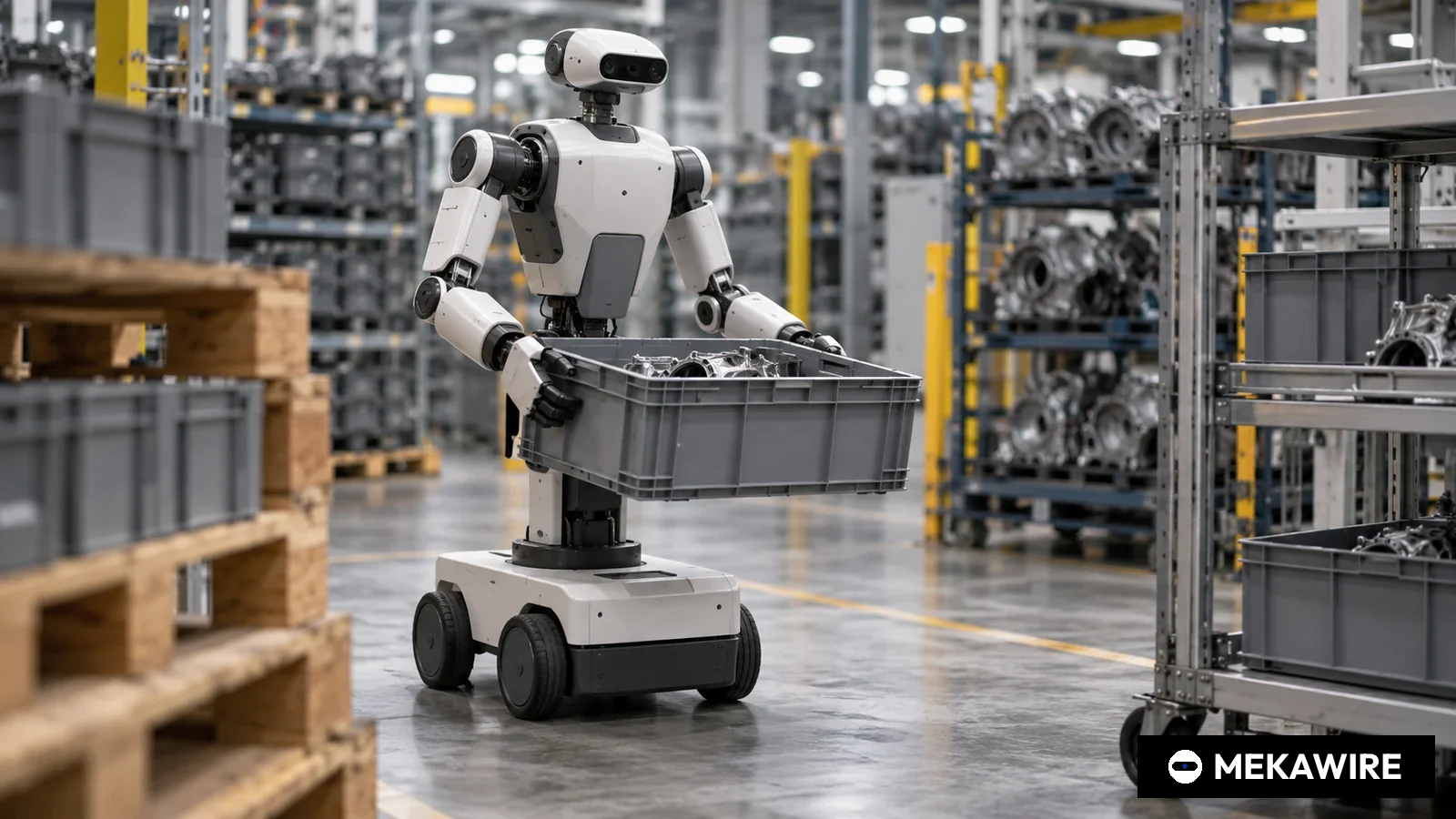
UK robotics start-up Humanoid said on 30 March 2026 that its wheeled HMND 01 Alpha completed a January to February proof of concept with SAP and Turkish seat maker Martur Fompak, taking orders from SAP's AI agent in live production.
It was the first time an enterprise system controlled a Humanoid robot externally, through the four-layer KinetIQ AI framework the company unveiled on 5 February.
Humanoid, the London robotics company founded in 2024 by Artem Sokolov, said on 30 March 2026 that its wheeled HMND 01 Alpha robot had completed a proof of concept inside a live automotive production facility, taking its work orders from an AI agent built by SAP rather than from its own software. The trial, run with SAP and the Turkish seating supplier Martur Fompak International during January and February, was the first time a Humanoid robot was controlled from outside by an enterprise system in live production, according to the company.
The task was narrow and typical of plant logistics. Humanoid said the robot received instructions from SAP's AI agent, navigated on its own to pallets, picked KLT boxes and delivered them to trolleys in repeated order-fulfilment cycles. It handled three different tote types within an 8 kg dual-arm payload limit. Humanoid did not name the plant, and it did not publish cycle times, pick rates or error rates for this trial.
The link between the two systems ran through KinetIQ, the AI framework Humanoid unveiled on 5 February. Humanoid said KinetIQ integrated directly with SAP's application programming interfaces, which let the robot behave as one more agent in the factory's planning system. Lukasz Ostrowski, head of embodied AI and robotics at SAP, described the approach under the name Embodied Joule and said it marked a fundamental shift in how robots understand business needs. Sokolov said in the same release that the point was humanoid robots working in real production while connected to enterprise systems.
KinetIQ is built as four stacked layers that run at different speeds, according to Humanoid's technical description. System 3 is a fleet agent working on a timescale of seconds; it treats each robot as a tool, allocates tasks across wheeled and bipedal machines and talks to facility management software. System 2 runs on each robot, uses an omni-modal language model to read the scene and the instruction, and breaks goals into sub-tasks while checking progress and calling for human help when needed. System 1 is a vision-language-action (VLA) model that predicts target poses at 5 to 10 Hz and executes action chunks at 30 to 50 Hz. System 0 is a whole-body controller trained by reinforcement learning purely in simulation, running at 50 Hz, which Humanoid said needed about 15,000 hours of simulated experience.
- System 3
- Fleet agent: task allocation across robots, link to facility systems
- Agentic fleet orchestrator
- seconds
- System 2
- Robot-level reasoning and task decomposition
- Omni-modal language model
- seconds to under a minute
- System 1
- Low-level task execution (pick, place, pack, locomotion)
- Vision-language-action model
- 5 to 10 Hz predictions, 30 to 50 Hz action chunks
- System 0
- Whole-body control and balance
- Reinforcement learning in simulation (about 15,000 hours)
- 50 Hz
As described by Humanoid on 5 February 2026.
As of Mar 30, 2026
The SAP trial was the third industrial outing for the robot in a quarter. On 20 January Humanoid reported a proof of concept at Ford's innovation centre in Cologne, where the wheeled HMND 01 handled totes for kitting with 8 kg loads and manipulated thin sheet-metal body parts with both arms. The company said the robot ran for one hour without interruption, double the target, reached 97% reliability in autonomous pick-and-place and made 83 picks an hour against a target of 50, after one hour of on-robot data collection. At NVIDIA's GTC conference on 20 March it showed two wheeled robots fetching items on voice request and handing them to each other, built with NVIDIA Isaac Sim, Isaac Lab, Jetson and the Isaac GR00T N1.7 VLA model.
The industrial base behind the company also widened. On 13 January Schaeffler, the German motion technology group, signed a strategic partnership under which it will supply actuators to Humanoid, including strain wave gear actuators for the upper body and linear and rotary actuators for joints, and plans to bring several hundred humanoids into its global production network over five years. Humanoid says it employs more than 200 engineers and researchers across London, Boston and Vancouver and aims to become the leading general-purpose industrial humanoid company within two years.
SAP is not betting on a single robot maker. NVIDIA has described a demonstration at SAP's Sapphire conference in Orlando in which Joule agents ran on NEURA Robotics' 4NE1 humanoid for tasks such as inventory audits and shelf restocking. That makes Germany's NEURA a direct rival for the same enterprise channel. Among European robot companies with disclosed funding, Munich's RobCo raised a $100 million Series C on 29 January, while US humanoid makers such as Apptronik, with a $520 million Series A extension in February, and Figure, valued at $39 billion after a $1 billion Series C in September 2025, are far better capitalised.
- Humanoid
- GB
- 2024
- No data
- No data
- No data
- No data
- RobCo
- DE
- No data
- Series C
- 100,000,000
- No data
- 2026-01-29
- Agile Robots
- DE
- 2018
- Series C
- 220,000,000
- No data
- 2021-09-10
- ANYbotics
- CH
- 2016
- Additional funding
- 60,000,000
- No data
- 2024-12-12
- Exotec
- FR
- 2015
- Series D
- 335,000,000
- 2,000,000,000
- 2022-01-17
- Apptronik
- US
- 2016
- Series A extension
- 520,000,000
- No data
- 2026-02-11
- Figure AI
- US
- No data
- Series C
- 1,000,000,000
- 39,000,000,000
- 2025-09-16
Figures as disclosed by the companies or investors as of 30 March 2026, not estimated. — means not disclosed in the sources reviewed.
As of Mar 30, 2026
The open questions are commercial. Humanoid has not said whether Martur Fompak will buy or lease robots, how many, or at what price. The partners said only that the next steps are further on-site validation, a joint assessment of results, an evaluation of deployment at Martur Fompak facilities and more complex use cases. The 8 kg payload in the trial is modest next to the loads automotive logistics often involves, and no throughput figures were given for the SAP run.
MEKAWIRE analysis
Humanoid's real product in this trial was not the robot but the plug into SAP, and that interface could matter more to European factories than walking legs.
Evidence for the thesis is in the release itself. The headline achievement was external control by an enterprise system, not a new motion skill, and KinetIQ's top layer was designed from the start to receive task requests and standard operating procedures from facility software. For a plant that already runs material flows through SAP, a robot that accepts orders in the same language removes an integration project that has historically eaten much of the cost of automation.
The strongest counter-argument is that the interface is easy to copy. SAP has already shown Joule on NEURA's 4NE1, and any well-funded rival can expose an API to an ERP system. If integration becomes a commodity, the contest returns to hardware cost, payload and uptime, where Humanoid has published little.
Bull case. KinetIQ's split between a fleet agent and per-robot VLA control lets Humanoid sell one software layer across wheeled and bipedal machines, and the Ford and SAP trials give it reference customers in German and Turkish automotive supply chains. With Schaeffler both as actuator supplier and buyer, the company has a route to volume components and to a first fleet.
Bear case. Three proofs of concept in a quarter are not a purchase order. The trials used light payloads and short runs, and a wheeled base with two arms competes with cheaper mobile manipulators and fixed automation that plant managers already trust.
Signals to watch.
- Whether Martur Fompak announces a paid deployment after the joint assessment the partners promised.
- Hannover Messe in April 2026, where SAP, Schaeffler and German robot makers are likely to show competing physical AI integrations.
- Humanoid's next funding disclosure, which would show whether investors price it as a software company or a hardware maker.
- HMND 01 Alpha Wheeled
- Founded 2024 by Artem Sokolov, 200+ staff, London, Boston, Vancouver
- SAP AI agent via KinetIQ API integration, first external enterprise control in live production
- SAP, Martur Fompak International
- 30 March 2026
- January to February 2026
- 5 February 2026, four layers (System 0 to System 3)
- 8 kg dual-arm limit, three tote types
- 83 picks per hour vs target of 50, 97% reliability
- about 15,000 hours of simulated experience, 50 Hz
Why it matters
The Martur Fompak trial is small, but it tests the assumption that will decide whether humanoids sell in Europe's automotive supply chain. Plants there run material flow through ERP and manufacturing execution systems, and the expensive part of most automation projects is not the robot but the integration with those systems. Humanoid's claim is that KinetIQ's fleet layer makes the robot a native participant in SAP's planning, so a work order can flow to a machine as it would to a forklift driver.
If that holds in production, the buying decision shifts from a capital project run by an automation integrator to a software configuration run by the plant's IT and logistics teams. That is a faster sales cycle and a recurring software relationship, which is why both SAP and Humanoid presented the result as an interface milestone rather than a dexterity milestone.
Rival analysis
SAP's most visible robotics partner before this trial was NEURA Robotics, whose 4NE1 humanoid ran Joule agents in a demonstration NVIDIA described at SAP's Sapphire conference. NEURA, founded in 2019 in Germany, has a broader hardware range including cobots, while Humanoid concentrates on a wheeled and a bipedal HMND 01 sharing one software stack. Being the second humanoid maker in SAP's ecosystem is useful but not exclusive.
Outside Europe, Figure and Apptronik have more capital and their own automotive pilots, and NVIDIA's GR00T models give every rival a common VLA baseline. Humanoid itself used GR00T N1.7 in its GTC demonstration. Differentiation therefore rests on the System 2 and System 3 layers and on the speed of on-site learning, where the Ford trial reported one hour of on-robot data collection.
Valuation context
Humanoid had not published a funding round or valuation on the pages MEKAWIRE reviewed as of 30 March 2026. Comparable European disclosures in the quarter include RobCo's $100 million Series C on 29 January. In the United States Apptronik closed a $520 million Series A extension on 11 February, and Figure was valued at $39 billion post-money after its $1 billion Series C in September 2025.
The gap matters because humanoid programmes consume capital in hardware iterations. A company with three industrial proofs of concept, a Schaeffler purchase intention for several hundred units and an SAP integration has the reference set that late-stage investors look for, but the price will depend on evidence of paid fleets.
Supply-chain implications
Schaeffler's 13 January agreement covers strain wave gear actuators for the upper body, shoulders and arms and linear and rotary actuators for joints, for both wheeled and bipedal designs. That gives Humanoid a European source for the components that dominate a humanoid's bill of materials and puts it in competition with Japanese reducer makers' customers and Chinese vertically integrated rivals.
On compute, the GTC demonstration ran on NVIDIA Jetson at the edge with Isaac Sim and Isaac Lab for simulation, and the whole-body controller was trained entirely in simulation. The software stack is therefore tied to NVIDIA's toolchain, which lowers development cost but leaves Humanoid exposed to the same supplier as most of its rivals.
Signals to watch
First, a paid deployment decision at Martur Fompak, which the partners framed as the outcome of their joint assessment. Second, published throughput and uptime for the SAP trial, which the 30 March release did not include. Third, any move by SAP to make Embodied Joule a product with listed robot partners and pricing.
On the hardware side, watch the first Schaeffler plant to receive HMND 01 units under the five-year plan, and whether the bipedal Alpha moves from R&D platform to industrial trials.
Analyst view
Thesis: Humanoid is building its case on enterprise integration and fleet software rather than on hardware leadership, and the SAP trial is the clearest evidence so far that the approach works in a live plant. Confidence: medium. The integration claim comes from both partners and is specific about the task flow, which supports it. Confidence is held back because no throughput, uptime or cost figures were published for the SAP run, the plant was not named and there is no purchase commitment yet.
The Ford Cologne numbers, 83 picks an hour and 97% reliability over one hour, are encouraging but short. A one-hour run tells little about the shift-length reliability and maintenance load that decide factory economics.
Questions you should be asking
Will Martur Fompak buy, lease or pay per task, and at what fleet size? What were the pick rate and intervention rate in the SAP trial? Does KinetIQ's System 3 integrate with SAP only through custom work, or through a standard connector other plants can switch on?
How much of System 1 is Humanoid's own model and how much rests on NVIDIA GR00T? And when will the 8 kg dual-arm payload used in the trials rise to cover heavier automotive parts?