Schaeffler signs on as both actuator supplier and customer of London's Humanoid, planning several hundred robots in its plants over five years
Schaeffler and UK start-up Humanoid agreed on 13 January 2026 a five-year technology partnership that combines a supply contract for Schaeffler strain wave gear actuators with a purchase arrangement for humanoid robots. The German motion technology group said it would integrate several hundred humanoids into its global production network, and within a week Humanoid published pilot results from Siemens in Erlangen and Ford in Cologne.
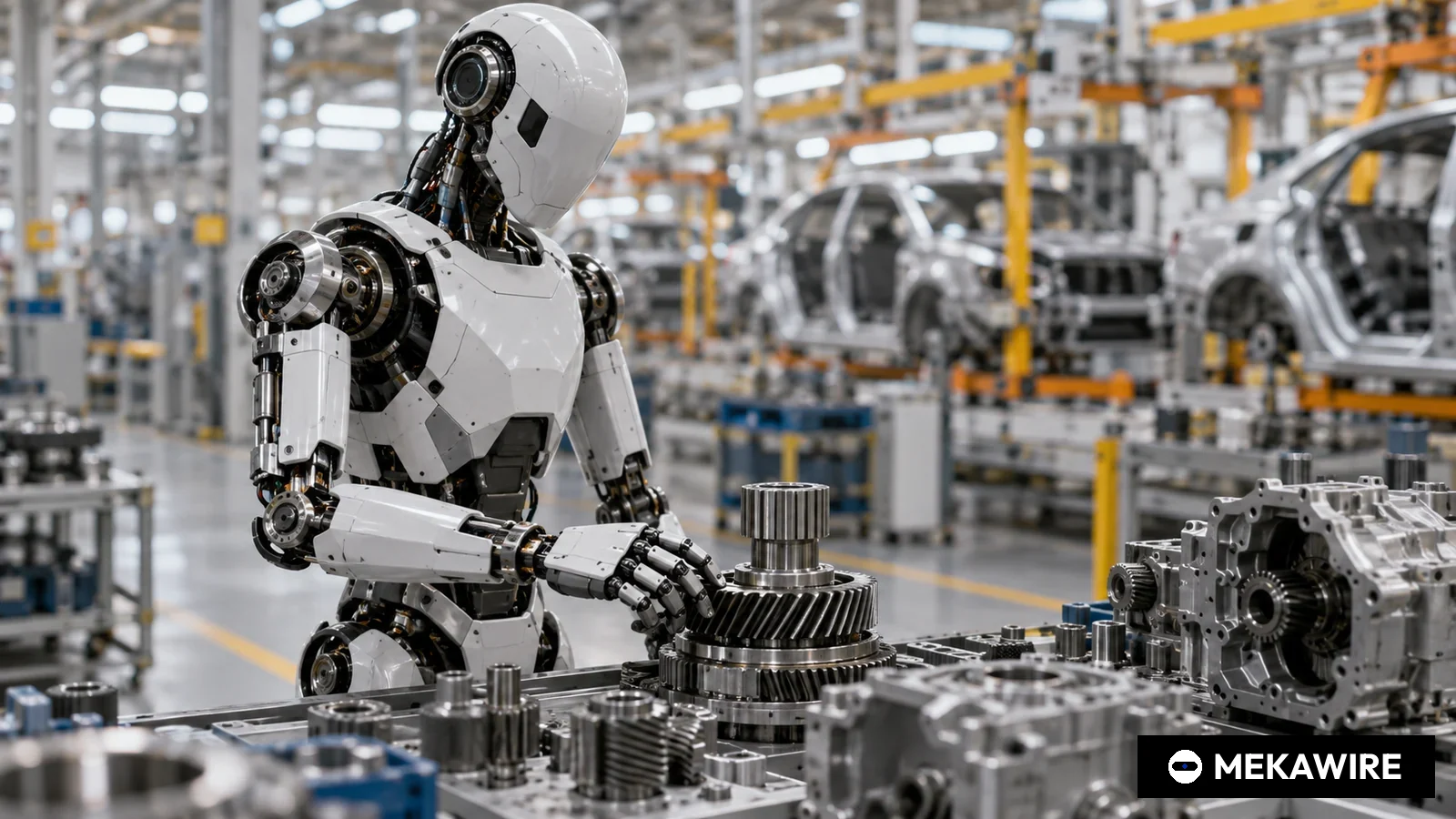
Schaeffler AG, the Herzogenaurach-based maker of bearings, drive systems and automotive components, agreed on 13 January 2026 to supply actuators to London-based Humanoid and to buy the start-up's robots for its own factories. The two companies said the five-year partnership would bring several hundred humanoids into Schaeffler's global production network, making the German group one of the first large European industrials to sign up as component supplier and end user of the same humanoid maker.
According to Schaeffler's release, the alliance rests on two agreements, a supply contract for actuators and a purchase arrangement for humanoids destined for its plants. Humanoid's own announcement adds the operating terms. Schaeffler becomes the preferred supplier of actuators for Humanoid's wheeled platform, the partners will develop joint components together, gather training data through teleoperation and synthetic data generation, and train robot skills for Schaeffler's processes. Deployment is phased, with a beta validation stage in 2026 and 2027, followed by a gamma stage on a robot-as-a-service basis and an option to buy robots outright later. Neither company disclosed financial terms.
The component at the centre of the deal is Schaeffler's strain wave gear actuator. Schaeffler said the unit runs with zero backlash and low friction, allows cables to be routed entirely inside the actuators and limbs, and was designed for high-volume production. The robot it will go into is the HMND 01 Alpha Wheeled, which Humanoid lists at 220 cm tall, 300 kg, with 29 degrees of freedom, a 15 kg payload, a top base speed of 2 m/s and an average runtime of four hours. It can carry a 12-degree-of-freedom five-finger hand or a single-axis parallel gripper and runs KinetIQ, Humanoid's four-layer AI stack built on NVIDIA compute.
Humanoid used the following days to show the robot working in German plants. On 15 January it said a two-week deployment at the Siemens Electronics Factory in Erlangen, which Siemens treated as customer zero, met every target in a tote-to-conveyor destacking task, with 60 tote moves per hour, pick-and-place and autonomous success rates above 90%, daily uptime above eight hours and unbroken autonomous runs of more than 30 minutes across two tote sizes. On 20 January it reported results from the Ford Innovation Centre in Cologne, where the robot handled 8 kg totes for kitting and used both arms to move thin sheet-metal body parts. Humanoid said it reached 97% reliability in fully autonomous pick-and-place, 83 units per hour against a target of 50, and a one-hour uninterrupted run, twice the target, after one hour of on-robot data collection.
- Siemens Electronics Factory
- Erlangen, Germany
- Tote-to-conveyor destacking
- 60
- No data
- 90
- Ford Innovation Centre
- Cologne, Germany
- Tote kitting and sheet-metal handling
- 83
- 50
- 97
- Martur Fompak with SAP
- Not disclosed
- KLT pallet-to-trolley picking
- No data
- No data
- No data
Figures as disclosed by Humanoid on 15 January, 20 January and 30 March 2026. Siemens success rate disclosed as above 90%, shown as the lower bound 90. Not independently audited.
As of Oct 1, 2026
A third pilot, disclosed on 30 March, added enterprise software to the picture. Over January and February the robot picked KLT boxes from pallets and placed them on trolleys at a Martur Fompak automotive supplier site in live production, handling three tote types. Tasks were issued by SAP Business AI and SAP Extended Warehouse Management through the SAP Joule agent layer, which Humanoid described as the first time an external enterprise system had controlled its robot in production. No throughput figures were published for that trial.
Humanoid was founded in 2024 by Artem Sokolov and said at the time of the deal that it employed more than 200 engineers and researchers in London, Boston and Vancouver. Schaeffler, founded in 1946, reported revenue of EUR 23.5 billion for 2025, an EBIT margin before special items of 4.0% and 110,753 employees on 3 March 2026. On the same day it said it wants up to 10% of revenue by 2035 to come from new activities such as humanoid robotics and defence, and listed partnerships with four humanoid makers, among them Agility Robotics, Leju Robotics and Humanoid. Chief executive Klaus Rosenfeld framed the Humanoid deal as a way to gain an attractive European partner in that market.
The competitive field is crowded and better funded across the Atlantic. Figure AI raised USD 1 billion in its Series C at a USD 39 billion post-money valuation in September 2025, and Apptronik closed a USD 520 million Series A extension in February 2026. In Europe, Italy's Generative Bionics announced EUR 70 million in December 2025, while Sweden's Hexagon is pushing its AEON humanoid into automotive plants. Humanoid's pitch rests less on capital than on fast industrial pilots with recognisable German names.
- Humanoid
- GB
- 2024
- Series A
- 152
- 1.35
- 2026-07-21
- Figure AI
- US
- No data
- Series C
- 1000
- 39
- 2025-09-16
- Apptronik
- US
- 2016
- Series A extension
- 520
- No data
- 2026-02-11
- Sereact
- DE
- 2021
- Series B
- 110
- No data
- 2026-04-27
- Generative Bionics
- IT
- No data
- Seed
- 81
- No data
- 2025-12-09
Amounts as disclosed by the companies and recorded in the MEKAWIRE dataset; — where not disclosed. Generative Bionics announced EUR 70 million. No estimates.
As of Oct 1, 2026
The technology choice matters. A strain wave gear uses a flexible toothed ring that deforms inside a rigid outer gear, giving high reduction ratios in a compact, light housing with almost no play, which is why such gears sit in robot arm joints where position accuracy matters. Schaeffler brings decades of precision bearing and gear manufacturing at automotive volumes, and the wheeled HMND 01 sidesteps the balance and fall risks of bipedal walking, a pragmatic fit for flat factory floors.
The open questions are substantial. Several hundred robots over five years is a modest number for a group with more than 110,000 staff, and no unit price, service fee or minimum volume was disclosed. All pilot metrics were reported by Humanoid and its partners after runs measured in hours or weeks, not shifts over months. A 300 kg machine working near people will also have to clear European machinery safety rules before wide use.
What followed set the timeline to watch. On 22 April Schaeffler agreed to integrate at least 1,000 AEON humanoids from Hexagon Robotics over seven years. On 13 May Schaeffler and Humanoid expanded their pact to a four-digit number of wheeled robots by 2032 and a seven-digit number of actuators over five years, covering more than half of Humanoid's joint actuator demand through 2031, with first systems due live before the end of 2026 at Herzogenaurach and Schweinfurt. On 21 July Humanoid raised USD 152 million at a USD 1.35 billion post-money valuation, with Schaeffler and Bosch among the investors.
MEKAWIRE analysis
Schaeffler's double role as supplier and customer turns its own plants into a test bench for its actuator business, and that loop matters more for Humanoid than any single pilot figure.
The evidence is in the sequence. Schaeffler signed on 13 January, set a 10% revenue goal for new businesses including humanoids on 3 March, scaled the Humanoid deal to four digits on 13 May and invested in the July round. Each step deepened its exposure, and the May terms gave Humanoid a single supplier for more than half of its actuator needs through 2031.
The strongest counter-argument is that Schaeffler is hedging, not betting. It works with four humanoid makers and has promised at least 1,000 AEON units to Hexagon, so Humanoid is one of several horses and could lose share if a rival's robot proves cheaper per shift.
Bull case. If the beta phase confirms Siemens and Ford style reliability on real shifts, Humanoid gains a reference customer with a global production network and a supplier whose volume lowers its bill of materials. RaaS revenue from Schaeffler would then underwrite production before outside customers scale.
Bear case. Pilot metrics measured over hours may not survive three-shift operation, and RaaS pricing could leave thin margins for a company with more than 250 staff. If Schaeffler's actuators find bigger buyers elsewhere, its loyalty as a customer may fade.
- Signal 1: first Humanoid systems live at Herzogenaurach before 31 December 2026, as promised in May.
- Signal 2: end of the initial deployment phase in June 2027 and any disclosed uptime or units per hour from it.
- Signal 3: Schaeffler's 2026 annual report in March 2027 and whether it quantifies humanoid actuator revenue for the first time.
- 5 years
- Beta validation 2026 to 2027, then robot-as-a-service, later purchase option
- Schaeffler AG (Germany) and Humanoid (UK)
- 13 January 2026
- Strain wave gear actuators, Schaeffler preferred supplier for the wheeled platform
- Not disclosed
- 83 units per hour vs target 50, 97% reliability
- Several hundred humanoids in Schaeffler plants
- 60 tote moves per hour, above 90% success
- EUR 23.5 billion
Why it matters
Most humanoid deals announced in 2025 and early 2026 were pilots or memoranda with a single robot or a handful of units. The Schaeffler agreement is different in structure because it binds a tier-one automotive supplier into the robot's bill of materials and its deployment plan at once. That gives Humanoid a supplier with an incentive to see the robot succeed and a customer whose plants double as a showroom for the actuators.
For Schaeffler, the deal is a way to turn a mature competence in precision gears and bearings into a growth story at a time when its core automotive business is flat. Revenue of EUR 23.5 billion in 2025 against EUR 24.3 billion pro forma a year earlier shows why the board set a target of up to 10% of sales from new fields by 2035.
Rival analysis
Humanoid competes with US players that have far more capital. Figure's USD 39 billion post-money valuation and Apptronik's USD 520 million extension dwarf Humanoid's later USD 152 million round. Its edge is speed of industrial validation in Europe, three German or automotive pilots disclosed in one quarter, and a wheeled design that avoids the hardest part of bipedal locomotion.
Inside Schaeffler's own supply chain the rival is Hexagon Robotics, whose AEON received a commitment of at least 1,000 units over seven years in April. Schaeffler's portfolio approach means Humanoid must keep earning its place on cost and uptime.
Valuation context
No price was attached to the January deal. Humanoid's later Series A of USD 152 million at a USD 1.35 billion post-money valuation, with total funding of USD 270 million, implies investors priced it at roughly 5 times capital raised (1.35 / 0.27), a ratio well below Figure's but typical for a company with commercial contracts and no disclosed revenue.
Schaeffler's participation as investor in that round, after becoming supplier and customer, completes a three-way alignment that public investors will watch when the group starts reporting robotics figures.
Supply-chain implications
Strain wave gears are a precision niche in which Japan's Harmonic Drive Systems gave the technology its common trade name. Schaeffler's entry with an actuator that integrates gear, motor, power electronics and encoder, as described in its April Hexagon release, offers European humanoid makers a regional source.
The May expansion to a seven-digit number of actuators over five years shows the scale Schaeffler expects. For Humanoid it reduces single-component risk but concentrates more than half its actuator demand through 2031 on one supplier.
Signals to watch
The first operational robots at Herzogenaurach before the end of 2026 and the June 2027 end of the initial phase are the dates that will show whether pilot reliability holds in production.
Schaeffler's results in March 2027 may break out robotics revenue. Any additional outside customer for Schaeffler humanoid actuators beyond its four partners would confirm the supplier strategy.
Analyst view
Thesis. The supplier-customer loop gives Humanoid a more credible path to volume than most European rivals, but the economics remain unproven. Confidence medium, because the partnership terms and follow-on deal are confirmed on primary pages, while all performance data are self-reported and no prices are public.
We would upgrade to high if Schaeffler publishes fleet uptime or cost per task from its plants in 2027, and downgrade if the beta phase is extended beyond 2027.
Questions you should be asking
What is the RaaS fee per robot per month and who carries the risk of downtime? How many of the several hundred robots, later four digits, are committed rather than optional?
Will Humanoid's bipedal variant use the same Schaeffler actuators, and how will Schaeffler manage conflicts between its four humanoid partners when allocating actuator capacity?