Nabtesco's robot gear orders rise for a fourth straight quarter, doubling component profit as China and Korea EV projects return
Nabtesco, which estimates it supplies about 60% of the joint reducers in medium and large industrial robots, said component segment orders rose 16.2% to ¥82.4 billion in 2025 and operating income more than doubled to ¥5.4 billion. The Tokyo-listed company forecasts precision reduction gear sales of ¥88.2 billion in 2026, with robot demand recovering mainly in the second half, while its Changzhou plant already runs at 115% utilisation.
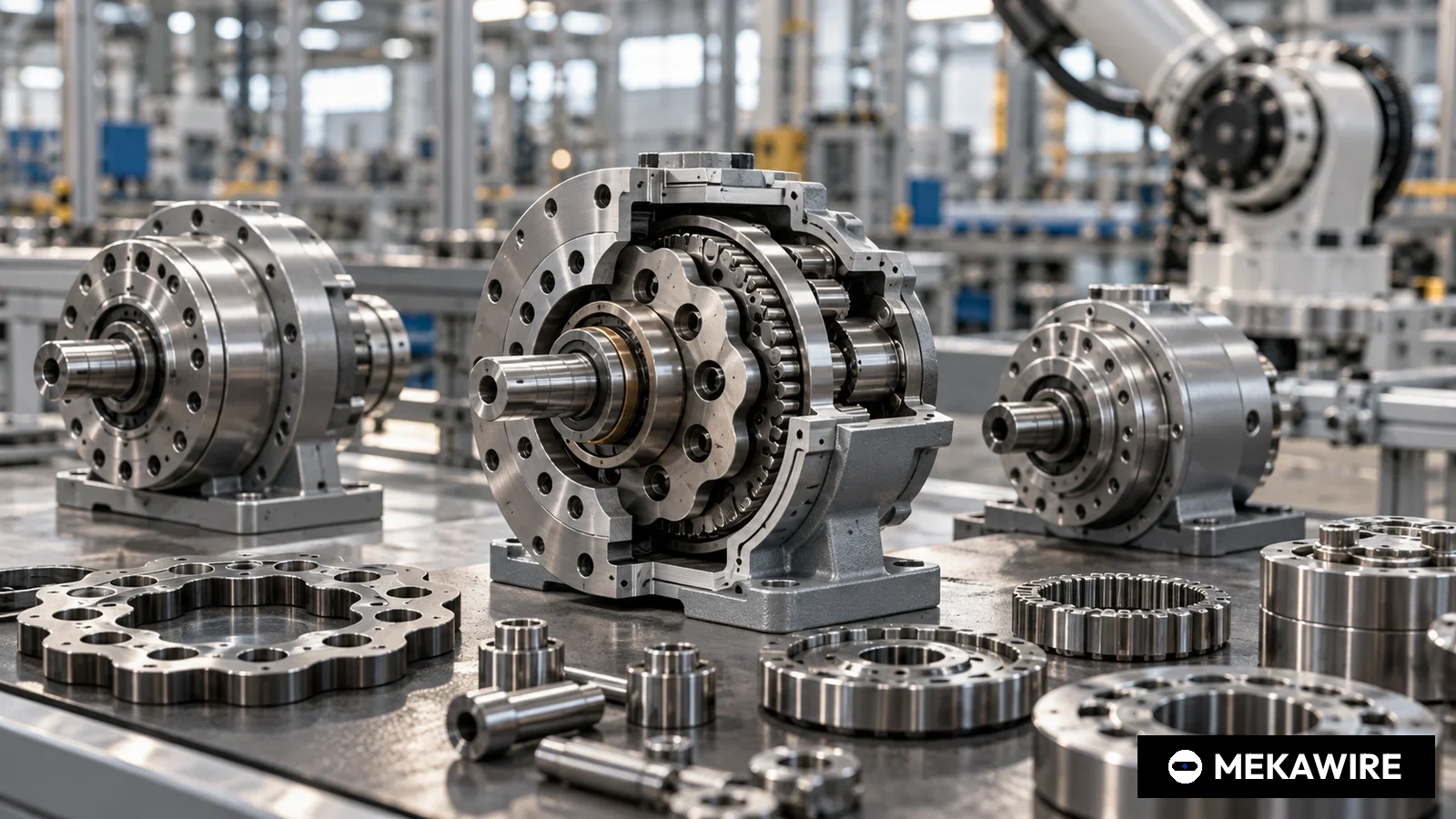
Nabtesco, the Japanese maker of the RV precision reduction gears that sit in the joints of most heavy industrial robots, said on February 12, 2026 that orders in its component solutions segment rose 16.2% to ¥82.43 billion in the year to December 2025, as robot makers finished working down inventories and Chinese and South Korean electric vehicle producers resumed factory projects. Segment operating income rose 103.2% to ¥5.42 billion, according to the company's summary of consolidated financial statements filed with the Tokyo Stock Exchange.
Sales in the segment grew 17.3% to ¥79.33 billion and the operating margin widened to 6.8% from 3.9% a year earlier. Precision reduction gears alone generated ¥78.6 billion, up from ¥66.9 billion, according to the results briefing material dated February 19. The segment's order backlog stood at ¥19.67 billion at the end of December, up from ¥16.56 billion a year earlier.
The quarterly pattern matters more than the annual total. Nabtesco said precision reduction gear orders grew quarter on quarter in each quarter of 2025, by 2%, 9%, 4% and 11%, and that fourth-quarter intake was 28% higher than a year earlier. The company described the fourth quarter as the strongest of the year. It said finished inventories at industrial robot customers had returned to appropriate levels, while demand outside robots, such as machine tools and automation equipment, stayed flat because of US tariffs.
At group level, Nabtesco reported orders of ¥323.25 billion, up 10.8%, sales of ¥307.91 billion, up 9.8%, and operating income of ¥20.73 billion, up 60.3%. Net income attributable to owners rose 55.1% to ¥15.70 billion. The figures exclude the hydraulic equipment business, which Nabtesco reclassified as a discontinued operation after agreeing to sell 70% of it to Italy's Comer Industries; the share transfer took place in January 2026, according to the briefing. Operating income absorbed a ¥1.32 billion loss on liquidating railway equipment subsidiaries and a ¥989 million goodwill impairment at Deep Sea Technologies, its Greek marine software unit.
For 2026 the company guides to group sales of ¥327.0 billion and operating income of ¥27.7 billion, a 33.6% increase and an 8.5% margin. The component segment is forecast to reach ¥88.6 billion in sales and ¥7.0 billion in operating income, with precision reduction gears at ¥88.2 billion. The first half is expected to be soft, with component sales of ¥41.8 billion and a 6.5% margin, before what Nabtesco expects to be a second-half recovery led by automotive capital spending. It expects small-scale projects in China and South Korea to continue and investment in Europe and the United States to pick up.
Capacity is now the constraint in China. Nabtesco's three precision reduction gear plants can make 1.15 million units a year, split between Tsu in Japan with 890,000 units, Changzhou in China with 170,000 and the Hamamatsu plant that opened in August 2024 with 90,000. Utilisation at Changzhou rose from 95% in the first quarter of 2025 to 115% in the fourth, while Tsu reached 70%, the company said, measured on a basis of 20 working days a month and three shifts. Sales to buyers in China rose 32.4% to ¥43.40 billion across the group, while sales to Europe slipped 1.3% to ¥59.67 billion.
The RV reducer is a two-stage cycloidal gearbox that combines a planetary stage with an eccentric, or planocentric, crank mechanism. It is built for stiffness, accuracy and shock resistance, which is why it dominates the shoulder and base joints of welding and painting robots carrying 20 kilograms or more. Nabtesco names FANUC, Yaskawa Electric, Kawasaki Heavy Industries, KUKA and ABB Robotics among its robot customers. Strain wave gears from Harmonic Drive Systems and China's Leaderdrive are lighter and more compact and are typically used in wrists, cobots and humanoids.
That is the market Nabtesco now wants. In December 2025 it unveiled two compact lines at iREX in Tokyo, the RVmini series of strain wave gears and the Monocrank series, aimed at low-torque applications including collaborative and humanoid robots. In the February briefing it said it would offer a six-axis set, including wrist axes, for robots with payloads under 20 kilograms. The company said cumulative RV production has passed 14 million units.
Rivals are moving at different speeds. Harmonic Drive Systems reported on February 10 that sales for the nine months to December 2025 rose 4.5% to ¥42.18 billion, with orders up 13.7% to ¥44.00 billion, and that reducer sales grew 7.1%. Its China segment sales fell 28.9% as industrial robot demand there weakened, while its Japan segment grew 22.3% on robot and semiconductor equipment customers. Leaderdrive reported revenue of 406.65 million yuan for January to September 2025, up 47.36%, which it attributed to growth in orders and capacity.
- Nabtesco, component solutions segment
- Jan to Dec 2025
- JPY
- 79,325
- 17.3
- 5420
- Operating income
- 16.2
- Nabtesco, precision reduction gears
- Jan to Dec 2025
- JPY
- 78,600
- 17.5
- No data
- No data
- No data
- Harmonic Drive Systems, group
- Apr to Dec 2025
- JPY
- 42,183
- 4.5
- 1191
- Operating income
- 13.7
- Harmonic Drive Systems, reducers
- Apr to Dec 2025
- JPY
- 32,717
- 7.1
- No data
- No data
- No data
- Leaderdrive, group
- Jan to Sep 2025
- CNY
- 406.65
- 47.36
- 93.67
- Net profit attributable to shareholders
- No data
Figures as disclosed in company filings: Nabtesco summary of consolidated financial statements and results briefing (Feb 12 and 19, 2026), Harmonic Drive Systems third-quarter tanshin (Feb 10, 2026), Leaderdrive third-quarter report (Oct 31, 2025). Nabtesco reducer revenue change derived as 78.6 / 66.9 minus 1, from rounded billions. Periods and profit measures differ, so rows are not directly comparable.
As of Feb 12, 2026
Risks remain. The 2026 plan leans on a second-half recovery that Nabtesco itself has not yet seen in orders, and its assumption of ¥20.50 per yuan makes profits sensitive to China. The company estimates that a one-yen move against the yuan shifts annual sales by ¥1.46 billion and operating income by ¥221 million. Price pressure from Chinese reducer makers, which supply domestic robot builders, is a further unknown.
- Tsu, Japan
- 890
- 60
- 65
- 70
- 70
- Changzhou, China
- 170
- 95
- 110
- 110
- 115
- Hamamatsu, Japan
- 90
- No data
- No data
- No data
- No data
Company disclosure in the FY2025 results briefing. Utilisation assumes 20 working days a month and three shifts. Hamamatsu started operating in August 2024 and is described as gradually expanding production; no ratio disclosed.
As of Feb 19, 2026
MEKAWIRE analysis
Nabtesco's 2025 numbers mark the end of the industrial robot inventory correction, but its margin recovery depends on whether it can move from heavy robot joints into the small, light actuators that cobots and humanoids need.
The evidence for a cyclical turn is consistent. Four consecutive quarters of sequential order growth, a 28% year-on-year jump in the fourth quarter, a fuller backlog and a Chinese plant running above nominal capacity all point the same way, and Harmonic Drive Systems' 13.7% order growth confirms that the reducer cycle has bottomed across suppliers.
The strongest counter-argument is that the recovery is narrow. It rests on EV projects in China and South Korea, Europe was flat, non-robot demand did not grow, and the company guides to a weaker first half. A component margin of 7.9% in 2026 would still be well below the 11.3% it earned in 2022.
Bull case. Automotive capital spending returns in Europe and the United States in the second half, Hamamatsu fills up and spreads its fixed costs, and RVmini wins design slots in cobot and humanoid programmes. Nabtesco then reaches its Project 10 target of a group margin of at least 10% in 2027.
Bear case. Chinese EV investment slows after a burst of projects, Chinese reducer makers undercut RV prices at home, and the compact lines arrive late into a strain wave market where Harmonic Drive Systems and Leaderdrive already hold customers. The component segment then stalls below 8% margin.
Signals to watch.
- First-quarter 2026 precision reduction gear orders, to see whether the sequential growth survives the guided first-half dip
- Changzhou utilisation and any capacity decision there during 2026
- First design wins for RVmini or Monocrank announced by cobot or humanoid makers before the end of 2026
- ¥80 for 2025, ¥82 forecast for 2026
- Sales ¥327.0 billion, operating income ¥27.7 billion
- 1.15 million units a year (Tsu 890,000, Changzhou 170,000, Hamamatsu 90,000)
- +11% quarter on quarter, +28% year on year
- 115%
- ¥82.43 billion, +16.2%
- ¥78.6 billion in 2025, forecast ¥88.2 billion in 2026
- ¥5.42 billion, +103.2%, margin 6.8%
- About 60% (company estimate)
Why it matters
Nabtesco is the closest thing the industrial robot industry has to a single point of supply for heavy joints. By its own estimate it holds about 60% of the market for reducers in medium and large industrial robots, and its customer list includes FANUC, Yaskawa, Kawasaki, KUKA and ABB Robotics. Its order intake therefore acts as an early indicator of robot builds, because robot makers order gears before they assemble arms.
The 2025 data show that indicator turning decisively. Orders rose sequentially in all four quarters and fourth-quarter intake was 28% above the prior year. Combined with Harmonic Drive Systems' 13.7% order growth for April to December, the evidence points to the end of the customer inventory correction that Nabtesco described.
Rival analysis
Harmonic Drive Systems and Nabtesco serve different joints. HDS's strain wave gears suit wrists, small arms, semiconductor equipment and humanoid hands, while RV gears serve the base, shoulder and elbow of heavy arms. Their regional exposure diverged in 2025. HDS's China segment sales fell 28.9% for April to December, while Nabtesco's sales to Chinese buyers rose 32.4% for the calendar year. The two companies define regions differently, HDS by the location of its subsidiaries and Nabtesco by the location of the buyer, so the comparison is directional only.
Leaderdrive is the fastest grower among listed peers, with revenue up 47.36% in the first nine months of 2025, but from a far smaller base of 406.65 million yuan. Its growth comes from domestic robot makers and humanoid programmes, the same customers Nabtesco targets with RVmini. Nabtesco's entry into strain wave gears puts it in direct competition with both rivals for the first time.
Valuation context
Nabtesco's component margin of 6.8% in 2025 compares with 11.3% in 2022 and 7.5% in 2023, according to the company's segment trend. The 2026 forecast of 7.9% would recover only part of that gap, largely because the Hamamatsu plant adds depreciation before it reaches volume. The company cited about ¥1.2 billion of added depreciation and tax costs at Hamamatsu in its 2025 profit bridge.
Capital returns are meant to support the shares while margins rebuild. Nabtesco plans a ¥10 billion buyback in 2026 and a dividend of ¥82 a share, up from ¥80, in line with a policy of a dividend on equity ratio of about 3.5%. Its Project 10 programme targets a group operating margin of at least 10% in 2027, against 8.5% forecast for 2026.
Supply-chain implications
Precision reducers are among the most concentrated links in the robot supply chain. Nabtesco's capacity of 1.15 million units a year is spread over two Japanese plants and one in Changzhou, China. Changzhou ran at 115% of nominal capacity in the fourth quarter, measured on 20 days a month and three shifts, which means Chinese robot makers that need local supply are competing for a constrained plant, while the Japanese plants still have room at 70% utilisation.
This matters for lead times. If Chinese EV and robot projects keep growing, Nabtesco must either ship from Japan, raising cost and delivery time, or add capacity in China. Domestic Chinese reducer makers are positioned to compete for any demand Nabtesco cannot serve locally.
Signals to watch
First, first-quarter 2026 precision reduction gear orders, which will show whether sequential growth continues into the period Nabtesco guided as soft. Second, any statement on Changzhou expansion. Third, Harmonic Drive Systems' results for the year to March 2026 against its unchanged forecast of ¥57.0 billion in sales and ¥1.5 billion in operating income.
Fourth, customer announcements naming RVmini or Monocrank in cobot or humanoid joints. Fifth, European and US automotive capital spending in the second half, which Nabtesco's forecast assumes will recover.
Analyst view
Thesis. The robot reducer cycle has turned, and Nabtesco is the cleanest listed proxy for heavy industrial robot builds, but its longer-term value depends on winning share in light actuators where it is a newcomer. Confidence is medium.
Reasons for medium confidence. The order data are strong and confirmed by a competitor, which supports the cyclical call. Against that, the 2026 guidance relies on a second-half recovery not yet visible in orders, the growth is concentrated in Chinese and Korean EV projects, and there is no disclosed customer for the compact lines.
Questions you should be asking
Will Nabtesco expand Changzhou or rely on Japanese plants to meet Chinese demand? How will it price RVmini against Chinese strain wave makers that sell into domestic humanoid programmes? Can Hamamatsu reach high utilisation in 2026 without a broad recovery in Europe and the United States?
How exposed is the order book to a small number of Chinese and Korean EV projects, and what happens to intake if those projects finish in 2026?