NVIDIA opens its Cosmos world models to robot and car makers at CES 2025, with Figure, Agility, XPENG and Uber among the first users
NVIDIA on 6 January 2025 launched Cosmos, a platform of world foundation models, video tokenizers and data-curation tools that generate physics-aware video for training robots and autonomous vehicles, releasing the first models under a licence that permits commercial use. It named 14 robotics and self-driving developers plus Uber as early adopters, and the same day unveiled an Isaac GR00T Blueprint that turns a few human demonstrations into large synthetic motion datasets for humanoids.
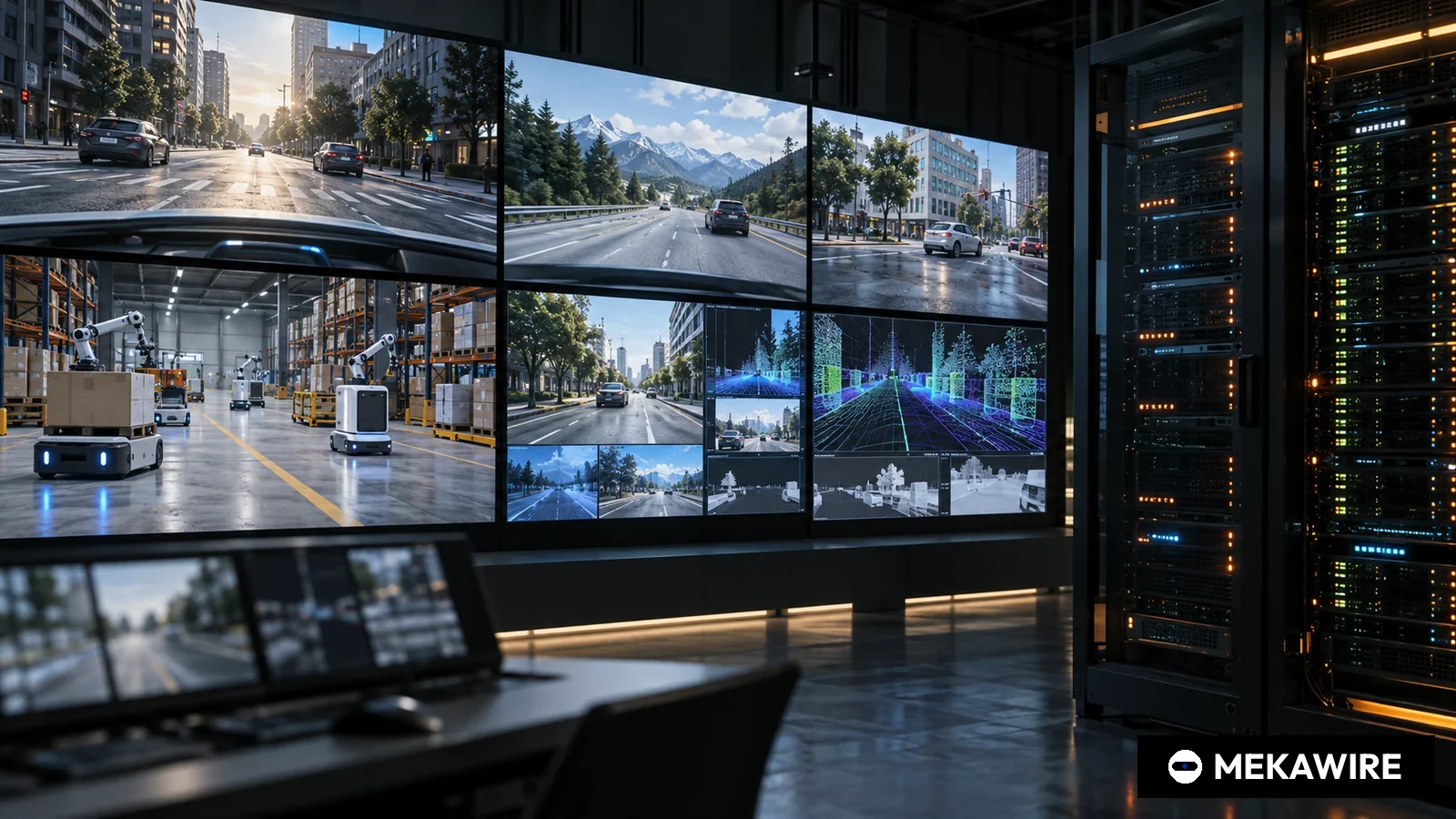
NVIDIA used its CES 2025 keynote on 6 January 2025 to launch Cosmos, a platform of world foundation models, video tokenizers and data-processing tools built to generate physics-aware video for training robots and autonomous vehicles. The company released the first Cosmos models under its NVIDIA Open Model License, which permits commercial use, and named 14 robotics and self-driving developers plus Uber as early adopters. On the same day it unveiled the Isaac GR00T Blueprint, a set of simulation workflows that turn a small number of human demonstrations into large synthetic motion datasets for humanoid robots.
The scale claims were large. In its launch blog, NVIDIA said the Cosmos models were trained on 9,000 trillion tokens drawn from 20 million hours of real-world human interactions, environment, industrial, robotics and driving data. The accompanying preprint, posted to arXiv on 7 January 2025 as paper 2501.03575, describes curating about 20 million hours of raw video at resolutions from 720p to 4K into roughly 100 million clips for pre-training and about 10 million for fine-tuning. NVIDIA said its NeMo Curator pipeline can process those 20 million hours in 14 days on Blackwell GPUs or 40 days on Hopper GPUs, against more than three years for a CPU-only pipeline, and that the Cosmos tokenizer delivers 8 times more total compression and 12 times faster processing than leading tokenizers.
NVIDIA grouped the models into three tiers. Nano is meant for real-time, low-latency inference at the edge, Super serves as a performant baseline, and Ultra targets maximum fidelity and the distillation of custom models. The first open checkpoints, published on Hugging Face as Cosmos 1.0, came in two architectures. Diffusion models with 7 billion and 14 billion parameters generate video from text (Text2World) or extend an input image or video (Video2World). Autoregressive models with 4 billion and 12 billion parameters predict future frames, with 5 billion and 13 billion parameter Video2World variants that also accept text. According to NVIDIA's model cards, the 7B diffusion model outputs 121 frames, about five seconds at 24 frames per second, at 1280x704 pixels and needs roughly 380 seconds on a single H100 GPU, while the 4B autoregressive model turns 9 input frames into 24 new frames at 1024x640 in about 62 seconds.
- Cosmos-1.0-Diffusion-7B-Text2World
- Diffusion
- Text
- 7
- Cosmos-1.0-Diffusion-14B-Text2World
- Diffusion
- Text
- 14
- Cosmos-1.0-Diffusion-7B-Video2World
- Diffusion
- Image or video plus text
- 7
- Cosmos-1.0-Diffusion-14B-Video2World
- Diffusion
- Image or video plus text
- 14
- Cosmos-1.0-Autoregressive-4B
- Autoregressive
- Image or video
- 4
- Cosmos-1.0-Autoregressive-5B-Video2World
- Autoregressive
- Image or video plus text
- 5
- Cosmos-1.0-Autoregressive-12B
- Autoregressive
- Image or video
- 12
- Cosmos-1.0-Autoregressive-13B-Video2World
- Autoregressive
- Image or video plus text
- 13
Model names and parameter counts as published by NVIDIA on Hugging Face model cards; figures disclosed, not estimated.
As of Oct 2, 2026
NVIDIA made the models available through Hugging Face, its NGC catalog and GitHub, with access through the NVIDIA API catalog, NIM microservices to follow and deployment on DGX Cloud. The company said Cosmos Guardrails screen prompts before generation and check generated videos afterwards, and that videos produced with the autoregressive and diffusion models on its API catalog carry an invisible watermark so they can be identified as AI-generated.
The adopter list in NVIDIA's release reads 1X, Agile Robots, Agility, Figure AI, Foretellix, Fourier, Galbot, Hillbot, IntBot, Neura Robotics, Skild AI, Virtual Incision, Waabi and XPENG, along with Uber. NVIDIA said Waabi would use Cosmos for data curation and simulation evaluation in autonomous driving, and that Hillbot would use it to generate terabytes of 3D environments for robot training. Pras Velagapudi, chief technology officer of Agility, said in the release that Cosmos lets the company generate and augment photorealistic scenarios for training without as much expensive real-world data capture. Uber chief executive Dara Khosrowshahi said working with NVIDIA could help speed up the timeline for safe and scalable autonomous driving.
NVIDIA founder and chief executive Jensen Huang framed the launch as a turning point. “The ChatGPT moment for robotics is coming,” he said in the release, arguing that world foundation models matter to robots and autonomous vehicles the way large language models matter to chatbots, but that few developers have the expertise and resources to train their own. “We created Cosmos to democratize physical AI and put general robotics in reach of every developer,” he said.
The Isaac GR00T Blueprint, announced the same day, has three workflows. GR00T-Teleop captures human movements through an Apple Vision Pro headset in a digital twin, with a simulated robot mirroring them to produce ground-truth data. GR00T-Mimic multiplies those demonstrations into a larger synthetic motion dataset. GR00T-Gen, built on NVIDIA Omniverse and Cosmos, expands the data further through domain randomization and 3D upscaling. Policies are trained in Isaac Lab, NVIDIA's open-source robot-learning framework. NVIDIA said Boston Dynamics and Figure had started adopting Isaac GR00T, invited humanoid hardware and software makers to apply for early access to its humanoid developer program, and cited an expectation that the humanoid robot market will reach $38 billion over the next decade.
NVIDIA later put numbers on the approach. A developer blog, revised during 2025, said GR00T-Mimic generated 780,000 synthetic trajectories, equivalent to 6,500 hours of human demonstration, in 11 hours, and that combining synthetic with real data improved performance by 40% compared with real data alone. At Computex on 18 May 2025, NVIDIA said a follow-on GR00T-Dreams blueprint built on Cosmos Predict models let its researchers develop the GR00T N1.5 humanoid model in 36 hours, against about three months of manual data collection.
Cosmos extended a stack NVIDIA had been assembling for years, with Omniverse for digital twins, Isaac Sim and Isaac Lab for simulation and training, and Jetson modules for on-robot compute. Each layer feeds GPU demand in data centres, which is where NVIDIA earns most of its money. The robotics adopters were mostly venture-backed companies still short of volume revenue. According to MEKAWIRE's verified company data, Figure's last disclosed round before CES was a $675 million Series B in February 2024, and Skild AI had raised $300 million at a $1.5 billion valuation in July 2024.
- Figure AI
- US
- Series B
- 675,000,000
- No data
- 2024-02-29
- Skild AI
- US
- Series A
- 300,000,000
- 1,500,000,000
- 2024-07-09
- Agility Robotics
- US
- Series B
- 150,000,000
- No data
- 2022-04-22
- 1X Technologies
- US
- Series B
- 100,000,000
- No data
- 2024-01-13
- Virtual Incision
- US
- Series C extension
- 30,000,000
- No data
- 2023-09-19
Latest round announced before 6 January 2025, from MEKAWIRE verified company data based on company and investor announcements; unknown = null; figures disclosed, not estimated.
As of Oct 2, 2026
Cosmos arrived weeks after two prominent generative world and video models. Google DeepMind unveiled Genie 2 on 4 December 2024 as a foundation world model that generates action-controllable 3D environments for training embodied agents, consistent for up to a minute, without a broad public release. OpenAI opened Sora Turbo to ChatGPT Plus and Pro subscribers on 9 December 2024, generating up to 20 seconds of 1080p video. Cosmos differed on two counts. Its weights could be downloaded under a licence allowing commercial use, and it was pitched at robot and vehicle training data rather than consumer video.
In plain terms, a world model takes the recent past, as video frames plus an optional text prompt, and predicts what happens next. Cosmos tokenizers compress video into compact tokens. Diffusion models refine noise into a whole clip at once, while autoregressive models predict tokens step by step, as a language model predicts words. The preprint positions the pre-trained models as general-purpose bases that developers post-train on their own data, such as a specific robot's cameras or a car's sensor rig, to obtain a customised simulator or a way to evaluate policies before testing them on hardware.
The open questions were substantial. NVIDIA did not publish field results showing that robots trained on Cosmos video outperform those trained on real data, and generated video can look plausible while breaking physics. NVIDIA's own pages described the training corpus differently, with the GR00T blog citing 18 quadrillion tokens including 2 million hours of driving, robotics, drone and synthetic footage, against 9,000 trillion tokens from 20 million hours in the Cosmos blog. Generation is expensive, at minutes of H100 time per five-second clip, and the NVIDIA Open Model License is the company's own licence rather than a standard open-source one.
MEKAWIRE analysis
Cosmos was NVIDIA's bid to make synthetic video the default training input for robots, which converts every robot maker's data shortage into demand for NVIDIA GPU hours.
The pieces released on 6 January 2025 cover the whole data loop, from curation in NeMo Curator and compression in the tokenizer to generation in the world models and robot-specific multiplication in GR00T-Mimic and GR00T-Gen. Every speed claim NVIDIA made was tied to its own hardware generations. Giving the weights away under a commercial-use licence removed friction at the cheap end, while training and inference stayed on Hopper and Blackwell. The follow-through fits this reading. Cosmos Predict fed GR00T-Dreams by May 2025, and MEKAWIRE has since covered Cosmos Reason 2 at CES 2026 and the on-device Cosmos 3 Edge in July 2026.
The strongest counter-argument is that leading humanoid developers have built their own models and data pipelines. MEKAWIRE reported in January 2026 that 1X runs NEO on an in-house 14-billion-parameter video world model, and Figure has built its Helix models on its own stack. A model trained mainly on driving and general video may also miss contact-rich manipulation, the hardest part of robot learning. If real robot data stays the binding constraint, Cosmos becomes an augmentation tool rather than a platform.
Bull case. Synthetic data proves cheaper than teleoperation fleets for most tasks, and Cosmos becomes the default base that robot makers post-train, much as open language models became defaults for chatbot builders. NVIDIA then captures value on both the training and the on-robot side.
Bear case. The best-funded developers keep their world models proprietary, and smaller adopters use Cosmos only for evaluation and augmentation. Physics errors in generated video limit transfer to real hardware, and Cosmos remains a showcase that sells GPUs without setting a standard.
- January 2027, CES: whether NVIDIA reports Cosmos usage figures such as downloads or paying customers rather than partner logos.
- November 2026, NVIDIA fiscal third-quarter results: any disclosure that ties robotics and automotive revenue to physical AI software.
- Pending, Agility Robotics' planned Nasdaq listing through Churchill Capital XI: what its filings say about spending on synthetic data and NVIDIA compute.
- NVIDIA Open Model License, commercial use permitted
- arXiv 2501.03575, posted 7 January 2025
- 6 January 2025, CES keynote
- 14 robotics and AV developers plus Uber
- Diffusion 7B and 14B; autoregressive 4B, 5B, 12B and 13B
- 20 million hours in 14 days on Blackwell, 40 days on Hopper
- GR00T-Teleop, GR00T-Mimic, GR00T-Gen
- 9,000 trillion tokens from 20 million hours of data
Why it matters
Cosmos marked the point where NVIDIA stopped treating robot training data as the customer's problem and started selling a pipeline for manufacturing it. Before January 2025, NVIDIA's robotics offer centred on simulators and on-robot chips. Cosmos added a generative layer between them, so a developer could take a few real recordings, expand them in Omniverse and Cosmos, and train a policy in Isaac Lab without leaving NVIDIA's software or hardware.
The timing mattered too. Humanoid funding was accelerating, and nearly every startup faced the same bottleneck of too little robot interaction data. By publishing weights under a commercial-use licence and naming 15 adopters on day one, NVIDIA positioned Cosmos as the neutral default for that bottleneck before any rival could.
Rival analysis
Google DeepMind's Genie 2, shown on 4 December 2024, produced action-controllable 3D worlds for agent training but stayed a research preview. OpenAI's Sora Turbo, opened to paying ChatGPT users on 9 December 2024, aimed at creative video and offered no downloadable weights. Neither was packaged with a curation pipeline, tokenizers and robot-specific workflows.
The real competition came from adopters' own ambitions. Well-funded humanoid developers such as Figure and 1X later built in-house models, as MEKAWIRE has reported, which limits Cosmos's role at the top end. NVIDIA's advantage is breadth, because one base model can serve AV, industrial and humanoid customers at once.
Valuation context
NVIDIA did not attach revenue figures to Cosmos, and the models were free to download, so the economic effect shows up indirectly in data-centre GPU demand and DGX Cloud usage. The relevant valuation story is on the adopter side. Figure's last pre-CES round was a $675 million Series B in February 2024 and Skild AI's was a $300 million Series A at $1.5 billion in July 2024, per MEKAWIRE verified data. Both later raised far larger rounds.
If synthetic data lowers the cost of building robot skills, it raises the value of capital-light software developers relative to hardware-heavy ones. That partly explains why investors later paid up for robot-brain companies.
Supply-chain implications
Cosmos ties the robot data supply chain to NVIDIA silicon at several points. Curation is quoted at 14 days on Blackwell versus 40 on Hopper, and single-clip inference at roughly 380 seconds on an H100 for the 7B diffusion model. Teleoperation input runs through Apple Vision Pro in the GR00T Blueprint, a notable dependency on a third-party device.
For AV players such as Waabi, Foretellix and Uber, Cosmos offers a way to multiply rare driving scenarios without new fleet mileage. For robot makers, it shifts spending from data-collection staff and hardware toward cloud GPU time.
Signals to watch
Watch whether NVIDIA begins to publish usage metrics for Cosmos, such as downloads or the number of commercial post-trained derivatives, at CES 2027 in January. Watch NVIDIA's fiscal third-quarter results in November 2026 for any segment disclosure that isolates robotics.
On the adopter side, filings tied to Agility Robotics' planned Nasdaq listing through Churchill Capital XI may show how much a humanoid maker spends on compute and synthetic data. Any peer-reviewed paper showing measured sim-to-real gains from Cosmos-generated data would be the strongest signal of all.
Analyst view
Thesis: Cosmos is strategically sound and has already shaped NVIDIA's later robotics releases, but its value to robot makers remains an augmentation story until field results prove otherwise. Confidence: medium.
Reasons for medium confidence. The product lineage from Cosmos to GR00T-Dreams, Cosmos Reason and Cosmos 3 Edge is verified on NVIDIA's own pages, which supports the platform thesis. Against that, NVIDIA's pages give inconsistent descriptions of the training corpus, no independent field benchmarks were published at launch, and the best-funded adopters have since built their own world models.
Questions you should be asking
How much of the 20 million hours of training video involved robots handling objects, as opposed to driving or general footage? NVIDIA's pages did not break this down, and its two blogs gave different token and hour counts.
What measured gain did early adopters such as Agility, Waabi or Hillbot see from Cosmos data on real hardware? Will NVIDIA keep the Open Model License terms stable as derivatives become commercially important, and how will customers verify that generated data is free of rights problems?