Prensilia opens pre-orders for NH1 Era, an industrial robot hand with 70 N thumb force
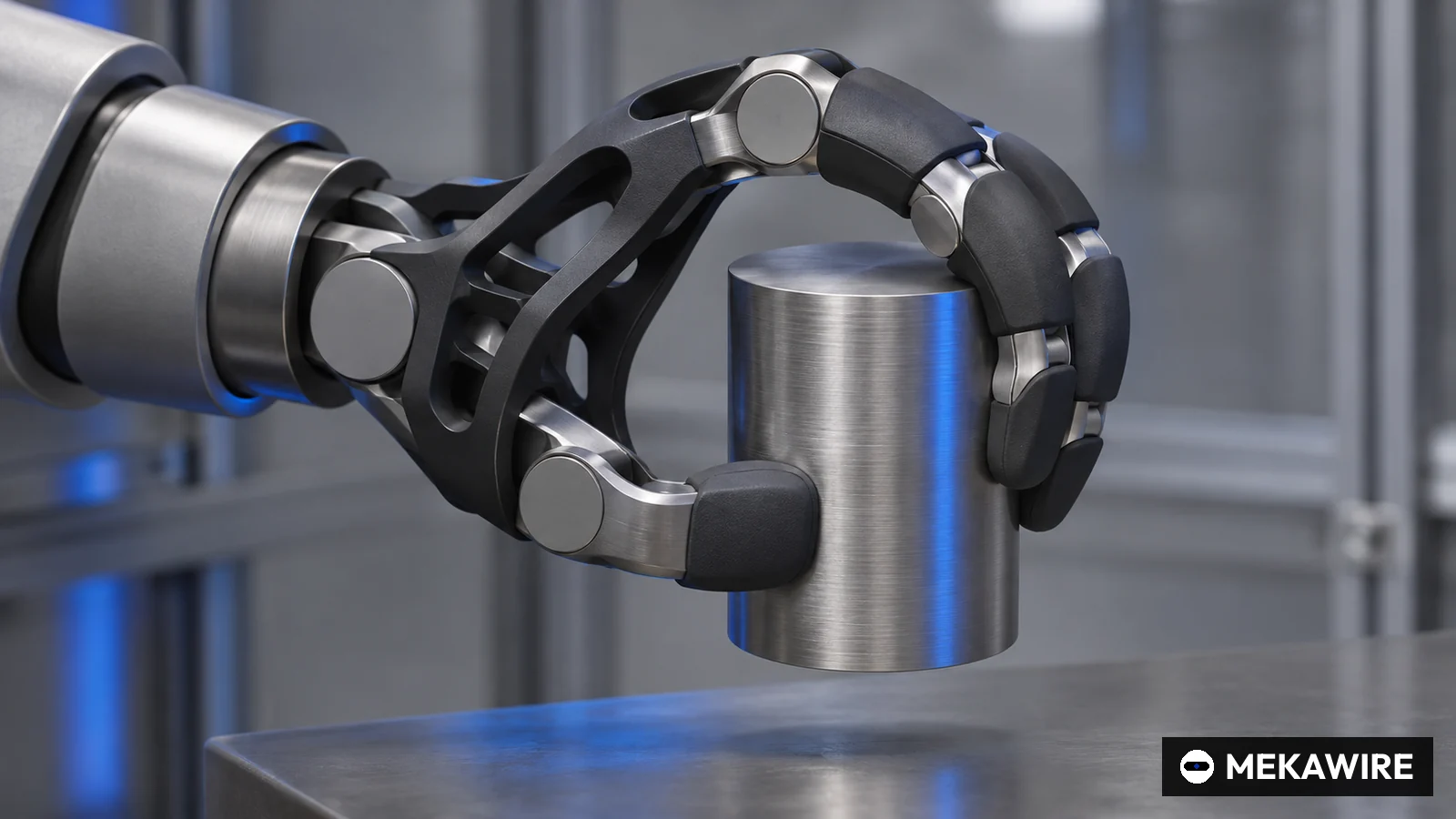
Prensilia, a robot-hand maker in Pontedera, Italy, has opened pre-orders for NH1 Era, a hand for robot arms and humanoids that the company says delivers up to 70 N of thumb fingertip force in every grasp mode and holds a 36 kg hanging payload.
The product page lists underactuated fingers, tri-axis fingertip force sensors, input voltage up to 48 V and ROS libraries, but gives no price, delivery date or degrees-of-freedom count.
Prensilia, a 2009 spin-off of Pisa's Scuola Superiore Sant'Anna, has opened pre-orders for NH1 Era, a robotic hand it describes on its product page as engineered for industry and built for robot arms and humanoids. Customers can reserve a unit from the first production batch without payment. Robotics & Automation News reported on Nov 27 that the hand was unveiled at SPS 2026 in Nuremberg.
What the product page specifies
Prensilia lists four design drivers. The fingers are underactuated, so they wrap mechanically around parts of different shapes and sizes, and the hand supports several grasp modes, which the company says lets one end effector handle rigid, fragile and variable parts without a tool change. A non-backdrivable link-and-gear transmission is meant, in the company's words, to minimise performance degradation over time with no overheating issues; the page states a 36 kg hanging payload with a safety factor of 1.5 and says the hand withstands accidental impacts and drops.
Grip force reaches up to 70 N at the thumb fingertip in every grasp mode, about 7.1 kgf by MEKAWIRE's conversion. Tri-axis fingertip force sensors support closed-loop force control that the company puts at plus or minus 0.2 N. The mechanical interface is ISO 9409-1, the standard robot flange, or a humanoid wrist mount; power input runs up to 48 V, communication uses RS-485 and Ethernet-based protocols, and ROS control and simulation libraries come ready to use.
The page names five uses: automated end-of-line testing of buttons, touchscreens and knobs in avionics, automotive, white goods and medical devices; machine tending; kitting and assembly on high-mix, low-volume lines; handling fragile parts; and sharing tools with human workers, with special-purpose gloves fitted over the fingers.
- IH2 Azzurra
- 2011
- Research
- Five-axis, human-sized hand with actuation, sensing and control inside the palm
- Mia Hand
- 2024, prosthesis and industrial versions
- Prosthetics and industry
- Listed as a prosthesis and as an industrial hand
- NH1 Era
- Nov 2026, pre-orders for batch 1
- Robot arms and humanoids
- Up to 70 N thumb fingertip force, 36 kg hanging payload, ROS libraries
Source: Prensilia company history and NH1 Era product page; Mia Hand launch year as given by Prensilia's managing director to ARTES 4.0. 70 N is about 7.1 kgf (MEKAWIRE calc., 70 divided by 9.81).
What is not disclosed
The page gives no price, no delivery date, no finger or joint count and no cycle-life figure. Robotics & Automation News wrote that the fingers "can also be equipped" with force sensors, while the product page presents the sensors as part of the hand; whether they are standard or optional is not stated in either place.
MEKAWIRE analysis
Prensilia is selling ruggedness rather than joint count: an underactuated, force-sensing hand that physical-AI teams could train on and then leave on the production line.
Several hands MEKAWIRE has covered this autumn compete on dexterity, such as the Wonik Allegro Hand V6 F to Xiaomi's 21-DoF hand. Prensilia's pitch is the opposite trade: mechanical adaptation, a standard flange and a stated payload, aimed at the integrator who now buys parallel grippers and tool changers. The strongest counter-argument is that underactuated fingers give up in-hand manipulation, which is what many robot-learning teams want to train. Signals to watch: a price and delivery date for batch 1, a named humanoid maker fitting the wrist mount, and published cycle-life data.
- ISO 9409-1 flange or humanoid wrist
- Up to 70 N at the fingertip in every grasp mode (about 7.1 kgf, MEKAWIRE calc.)
- Pre-orders for batch 1, no payment; price and date not disclosed
- Plus or minus 0.2 N with tri-axis fingertip sensors
- Up to 48 V; RS-485 and Ethernet-based protocols
- 36 kg, safety factor 1.5