Robot Era raises CNY1 billion from Samsung, Singtel and others, pushing its valuation past CNY10 billion
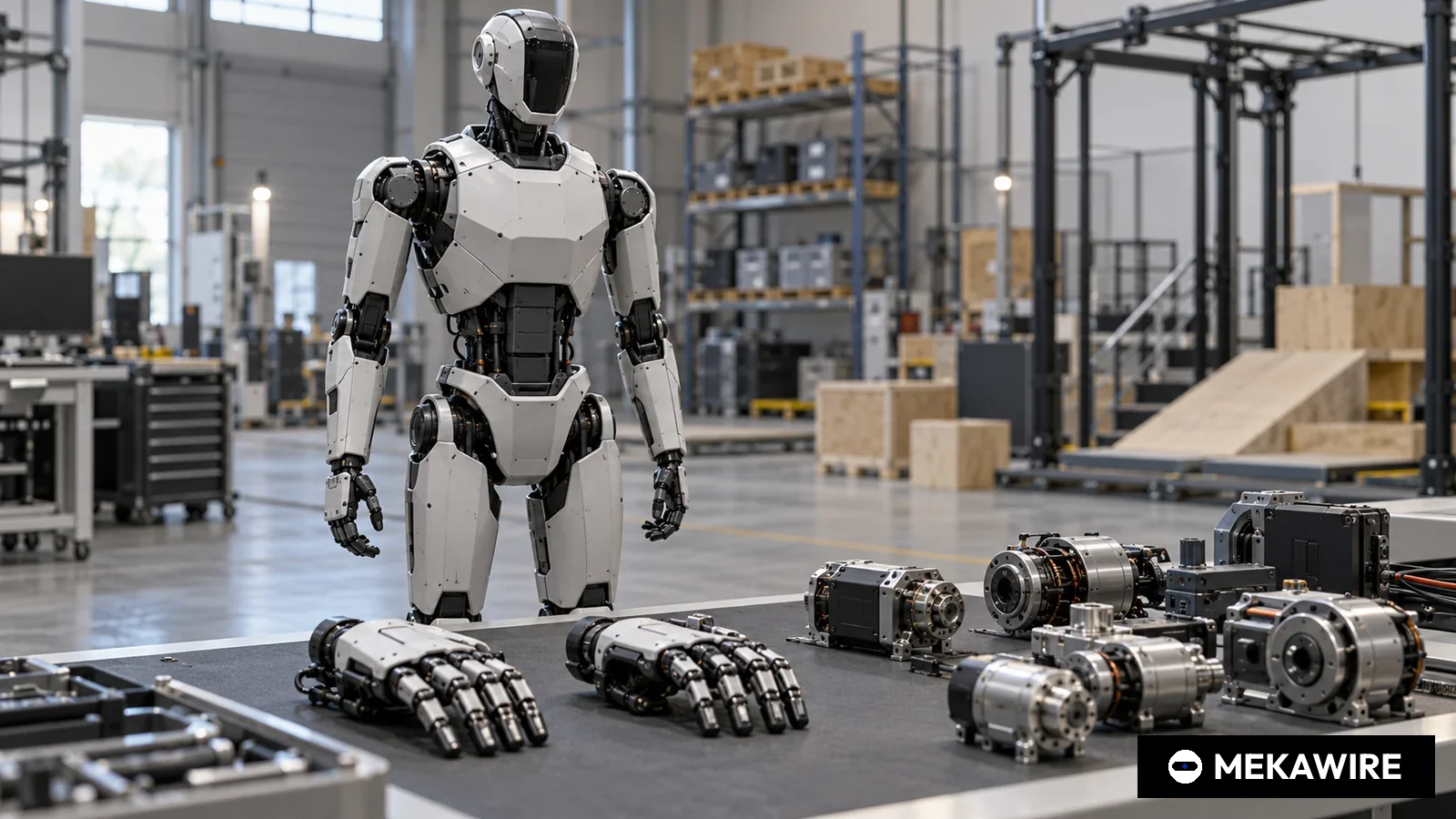
Tsinghua spin-out Robot Era closed a CNY1 billion strategic round two months after its previous financing, with Samsung, Singtel and a Woori Financial Group investment arm among new backers. The Beijing humanoid maker reports more than CNY500 million in cumulative orders, half from overseas, and sold close to 1,000 dexterous hands in 2025.
Robot Era, the Beijing humanoid developer spun out of Tsinghua University, said on March 5 that it has closed a CNY1 billion strategic financing round that values the company at more than CNY10 billion, according to an account published by the Zhongguancun Science City authority in Beijing's Haidian district. The round brings in Samsung, Singapore telecoms group Singtel and an investment arm of South Korea's Woori Financial Group, making it one of the few Chinese embodied-AI financings with sizeable participation from Asian strategic investors outside China.
The Haidian authority said the round closed only two months after the company's previous financing. Besides the three foreign names, new investors include CICC Porsche, SMIC-affiliated Juyuan Capital, Fenghe Capital, Wuxi Venture Capital, GF Qianhe and Hongrui Group, while existing shareholders CDH VGC and Tsinghua Holdings' Tiancheng put in more money. Robot Era now counts 16 industrial investors, the authority said, among them Geely Capital, Alibaba, Lenovo, Haier, BAIC and Shijijinyuan.
The company said the money will go mainly into faster technology iteration and scaling up products, with e-commerce, industrial manufacturing and pharmaceutical distribution named as the target industries. It disclosed cumulative orders of more than CNY500 million, with overseas business making up half of the total, and said nine of the world's ten most valuable technology companies are customers. Its dexterous hand, which it sells as a standalone product, shipped close to 1,000 units in 2025. A single order from the logistics sector exceeded CNY50 million, and Robot Era said operating efficiency in some logistics scenarios has reached 70%. A cross-border inspection system developed with SF Express is already in use by customs for checking cross-border goods.
The company and its hardware
Robot Era was founded in August 2023 and incubated at Tsinghua's Institute for Interdisciplinary Information Sciences. According to the Haidian authority it is the only humanoid robot maker in which Tsinghua University holds equity. At CES in Las Vegas in January the company showed what it calls a six-product lineup. The L7 full-size biped stands 171 cm tall, weighs 70 kg, has 55 degrees of freedom and carries 20 kg with both arms. The Q5 is a wheeled humanoid with 44 degrees of freedom aimed at service work. The XHAND1 is a five-fingered, fully direct-drive hand with 12 active degrees of freedom, 80 N of grip force per hand and a stated lifting capacity of up to 25 kg. Robot Era said at the time it had delivered more than 600 units in total and named Skild AI, Humanoid, Extend Robotics, UC Berkeley, MIT and ByteDance Seed as XHAND1 users.
- L7 full-size humanoid
- 171
- 70
- 55
- 20
- No data
- Q5 wheeled humanoid
- No data
- No data
- 44
- No data
- No data
- XHAND1 dexterous hand
- No data
- No data
- 12
- 25
- 80
From Robot Era's CES 2026 release of 2026-01-08. L7 payload is for both arms combined; XHAND1 degrees of freedom are active DoF; XHAND1 lift is the stated maximum. Blank = not disclosed.
As of Mar 5, 2026
The direct-drive design matters for the economics. Most dexterous hands route motion through tendons or small gearboxes, which add backlash and wear; a direct-drive finger puts the motor at the joint, trading some torque density for precise, back-drivable force control that learning-based grasping policies can exploit. Selling the hand to other robot developers, including a US foundation-model company such as Skild AI, gives Robot Era revenue from rivals' research budgets while its own humanoids are still in early deployment.
Where it sits among Chinese peers
The financing lands in a week of large Chinese embodied-AI rounds. Galbot, another Haidian company, announced a CNY2.5 billion round at a CNY20 billion valuation earlier the same week, with the state's national AI industry fund among the backers. In Shenzhen, X Square Robot said on January 12 it had raised CNY1 billion in a Series A++ round from ByteDance, HongShan and Shenzhen Capital Group, and LimX Dynamics disclosed a USD200 million Series B on February 2. In the United States, Skild AI raised USD1.4 billion at a USD14 billion valuation in January.
- Robot Era
- CN
- 2023
- Strategic
- 1000
- CNY
- 10
- 2026-03-05
- Galbot
- CN
- 2023
- Unnamed round
- 2500
- CNY
- 20
- 2026-03-02
- X Square Robot
- CN
- No data
- Series A++
- 1000
- CNY
- No data
- 2026-01-12
- LimX Dynamics
- CN
- No data
- Series B
- 200
- USD
- No data
- 2026-02-02
- Skild AI
- US
- 2023
- Series C
- 1400
- USD
- 14
- 2026-01-14
Figures as disclosed by companies or Chinese government pages, not estimated or converted. Robot Era valuation disclosed only as exceeding CNY10 billion, so 10 is a floor. Implied maximum dilution = round amount / post-money: Robot Era at most 10% (1 / 10), Galbot 12.5% (2.5 / 20). Galbot amount and valuation per the Zhongguancun Science City authority; LimX Dynamics and Skild AI per company releases.
As of Mar 5, 2026
For Korea, Japan and Southeast Asia the more telling detail is the investor list. Samsung, a Woori Financial Group vehicle and Singtel add capital from outside the domestic state funds, carmakers and internet groups that led most Chinese rounds this quarter. With overseas customers already accounting for half of orders, Robot Era is positioning itself as an exporter rather than a supplier to the domestic market alone.
The disclosures leave gaps. The company did not break out how much of the CNY500 million in orders has been delivered or recognised as revenue, did not name the nine technology customers and did not say whether the new money values it at a premium to the earlier round beyond the CNY10 billion threshold. Order books in Chinese humanoids often include framework agreements that convert slowly, and the 70% efficiency figure was given for some scenarios only, without a stated baseline.
MEKAWIRE analysis
Robot Era is building a hardware export business around its dexterous hand while Chinese rivals compete for domestic state capital, and this round buys it the foreign strategic shareholders that strategy needs.
The evidence is in the mix. Half of orders come from overseas, the hand is sold into US labs and companies including Skild AI and MIT, and three of the ten new investors are Korean or Singaporean corporates. Galbot, by contrast, drew a state AI fund, Sinopec and SAIC in its latest round, which points toward domestic industrial deployment.
The strongest counter-argument is scale. Robot Era's valuation floor of CNY10 billion is half of Galbot's CNY20 billion, its disclosed deliveries of more than 600 units are modest for a company at that valuation, and a component business selling roughly 1,000 hands a year is small relative to a valuation above CNY10 billion.
Bull case: the XHAND1 becomes a default research and production hand outside China, Samsung and Singtel open procurement channels in Korea and Southeast Asia, and the L7 converts logistics pilots such as the SF Express customs system into repeat fleet orders. In that case the company can justify a further step-up before a listing.
Bear case: export controls or tariffs on Chinese robot components cut off the overseas half of the order book, and the domestic market rewards players with larger state backing. Orders that are mostly framework agreements would then leave revenue well short of the headline figures.
- Signal 1: whether Robot Era discloses 2025 revenue or delivered units alongside orders by mid-2026.
- Signal 2: whether Samsung or Singtel announce a commercial deployment or distribution deal with Robot Era in 2026.
- Signal 3: whether XHAND1 shipments in 2026 move materially beyond the roughly 1,000 units shipped in 2025, reported at year end.
- Strategic, CNY1 billion
- August 2023, Tsinghua IIIS incubation
- 2026-03-05
- More than CNY10 billion
- More than CNY500 million, 50% overseas
- Samsung, Singtel, a Woori Financial Group investment arm
- 16
- Close to 1,000
Why it matters
Robot Era's CNY1 billion round matters less for its size than for who wrote the cheques. Chinese humanoid financings in early 2026 were dominated by domestic state funds, carmakers and internet platforms. This round adds Samsung, Singtel and a Woori Financial Group vehicle, giving a Chinese humanoid developer strategic shareholders from South Korea and Singapore.
The disclosed operating metrics also suggest a different business shape. Half of more than CNY500 million in orders is overseas, and the company sells its dexterous hand as a component to other developers, including Skild AI in the United States. That makes Robot Era partly a supplier to the global humanoid industry, not only a competitor in it.
Rival analysis
Galbot, also based in Haidian, raised CNY2.5 billion at a CNY20 billion valuation days earlier with the national AI industry fund, Sinopec, CITIC, SAIC and SMIC Juyuan among backers. Its stated traction is in retail: more than 100 convenience stores across more than 20 cities and 40 smart pharmacies in 24 cities, according to the Haidian authority. Robot Era is smaller on valuation but more export-oriented.
X Square Robot in Shenzhen raised CNY1 billion in January and is positioned as a model company built around its WALL-A model, backed by ByteDance, Meituan and Alibaba. LimX Dynamics raised USD200 million in February. Robot Era's differentiation against these peers is hardware breadth: a full-size biped, a wheeled humanoid and a standalone hand with outside customers.
Valuation context
The disclosed valuation is a floor: more than CNY10 billion. On that basis the new CNY1 billion represents at most 10% of post-money equity, compared with 12.5% for Galbot's CNY2.5 billion at CNY20 billion. The company did not disclose the price of the round before this one, so a step-up cannot be calculated from primary data.
Against disclosed orders of more than CNY500 million, the valuation is at least 20 times cumulative orders. Orders are not revenue and the company has not published audited financials, so any revenue multiple would be an estimate and is not given here.
Supply-chain implications
The XHAND1 is fully direct-drive, which shifts demand toward small high-torque motors, encoders and motor drivers at each finger joint rather than reducers or tendon systems. Shipments of close to 1,000 hands in 2025 make Robot Era a meaningful buyer of micro actuators for its size.
SMIC Juyuan's participation links the round to China's semiconductor investment network, and Samsung's presence could matter for sensors, memory and compute if a supply relationship follows. Neither company has announced such a relationship.
Signals to watch
First, whether Robot Era publishes revenue or delivered units for 2025 or 2026, which would show how fast the CNY500 million order book converts. Second, any announced deployment or distribution agreement with Samsung, Singtel or Woori in their home markets. Third, a listing preparation step such as a tutoring filing with a securities regulator.
Also watch the SF Express customs inspection system for expansion beyond its first sites, and the XHAND1 customer list for additions among US and European humanoid developers.
Analyst view
Thesis: Robot Era is the most export-oriented of the Beijing humanoid start-ups, and the foreign strategic investors in this round support that position. Confidence: medium. Reasons for medium rather than high: the key commercial figures are orders and customer counts supplied by the company and repeated by a local government authority, with no audited revenue; the valuation is disclosed only as a floor; and the nine technology customers are unnamed.
The company's ability to sell its hand to rivals is the clearest independent evidence of product quality, since buyers such as Skild AI and MIT are named. The next test is whether the full-size L7 and the logistics systems produce repeat orders at scale.
Questions you should be asking
How much of the more than CNY500 million in cumulative orders had been delivered and recognised as revenue by March 2026?
Which Samsung entity invested, and is there a commercial agreement attached to the investment?
What was the valuation of the previous round two months earlier, and what multiple step-up does the new price imply?
How exposed is the overseas half of the order book to US or European restrictions on Chinese robotics hardware?