Teradyne's robotics arm shrinks 16% to $308 million in 2025 and restructures about 400 jobs as AI test demand lifts the group
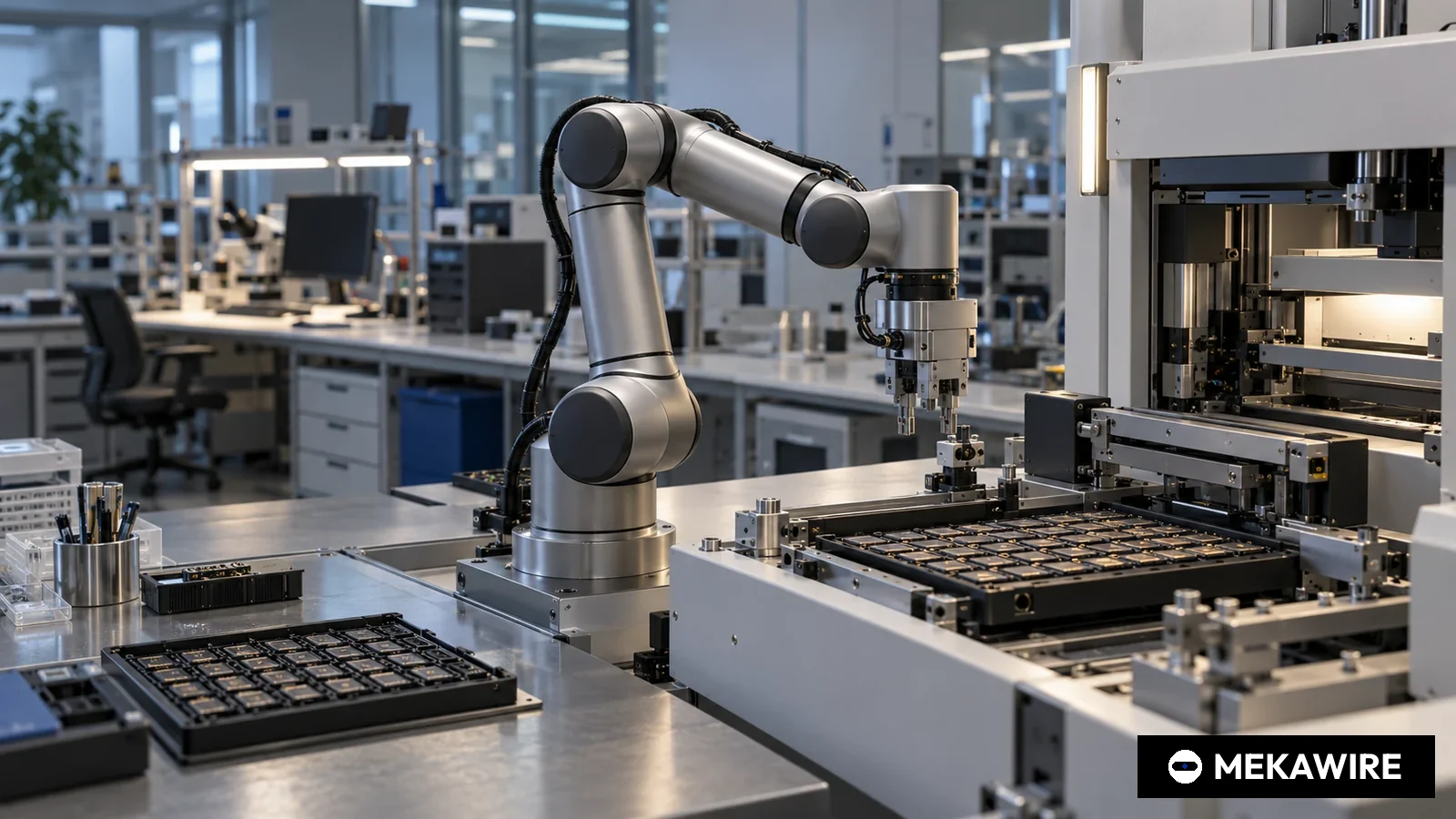
Teradyne said its Universal Robots and MiR unit booked $89 million of revenue in the fourth quarter of 2025, up about 19% on the third quarter but below $98 million a year earlier. Full year robotics revenue fell to $308 million from $365 million, and restructuring in the unit affected about 400 employees, while group revenue rose 44% in the quarter on AI chip test demand.
Teradyne said its robotics business, which makes Universal Robots collaborative arms and MiR autonomous mobile robots, booked $89 million of revenue in the fourth quarter of 2025, a sequential rise of about 19% that still left the unit below its $98 million of a year earlier. The figures came in results the Massachusetts test-equipment maker published on February 2, 2026, alongside a record quarter driven by chips for artificial intelligence.
For the full year, Robotics revenue fell to $308 million from $365 million in 2024, a decline of about 16%, according to Teradyne's earnings presentation. The unit's share of group sales shrank to 8% in the fourth quarter from 13% a year earlier, because the rest of the company grew so quickly. Group revenue reached $1,083 million in the quarter, up 44% year on year, and $3,190 million for 2025.
Teradyne also disclosed the cost of shrinking the robot business. Restructuring in Robotics affected about 200 employees in the fourth quarter and about 400 over 2025, the company said, and the quarter carried $10.9 million of severance and a $3.3 million asset impairment tied to that programme.
- Q4 2024
- 98
- 753
- 13
- Q3 2025
- 75
- 769
- 10
- Q4 2025
- 89
- 1083
- 8
- FY2024
- 365
- 2820
- 13
- FY2025
- 308
- 3190
- 10
Non-GAAP figures from Teradyne's Q4 2025 earnings presentation (February 2, 2026). Share = Robotics revenue / group revenue as disclosed by Teradyne. Figures disclosed, not estimated.
As of Oct 1, 2026
Chief executive Greg Smith said the quarter beat the top of the company's guidance range on AI demand in compute, networking and memory, and that Semiconductor Test, Product Test and Robotics all grew sequentially. Semiconductor Test contributed $883 million and Product Test $110 million of fourth quarter revenue. For the first quarter of 2026 Teradyne guided to revenue of $1,150 million to $1,250 million and non-GAAP earnings of $1.89 to $2.25 per share, without a separate robotics forecast.
Robotics has been part of Teradyne since it bought Danish cobot pioneer Universal Robots, founded in 2005, and later MiR, also based in Odense. In its 2025 annual report Teradyne says Universal Robots has sold more than 110,000 cobots and MiR more than 11,000 AMRs worldwide. The current line runs from the UR3e to the UR30 arms and from the MiR250 to the MiR1350 and the MiR1200 pallet jack.
The presentation framed the unit around what it called opportunities in physical AI and advanced robotics. In the long-range target model, built around group revenue of about $6 billion, Teradyne said robotics should grow faster on skilled labour shortages, reshoring and the build-out of data centre equipment, and that it is realigning sales toward e-commerce, logistics, semiconductors and electronics.
The contrast with the other Western robot franchise up for strategic change is stark. ABB, which reported its own results on January 29, 2026, is selling its Robotics division to SoftBank Group for an enterprise value of $5.375 billion, with closing expected in mid-to-late 2026. ABB said that division had 2024 revenue of $2.3 billion, an operational EBITA margin of 12.1% and about 7,000 employees, roughly six times the size of Teradyne's robot arm by sales.
- Teradyne Robotics (Universal Robots, MiR)
- 365
- 308
- No data
- No data
- ABB Robotics (sale to SoftBank pending)
- 2300
- No data
- 5375
- 2.34
Teradyne figures from its Q4 2025 presentation; ABB figures from ABB's divestment release of October 8, 2025. EV / revenue = 5,375 / 2,300. ABB did not disclose FY2025 Robotics revenue separately in its Q4 2025 release. Figures disclosed, not estimated.
As of Oct 1, 2026
For the cobot market the numbers matter because Universal Robots is one of the largest independent cobot brands, competing with FANUC's CRX line and a fast-growing group of Chinese makers such as JAKA, Elite Robots and Dobot. The fourth quarter suggests demand has stabilised from the 2025 trough, but not that the unit has returned to the growth it showed before 2024.
The main open question is profitability. Teradyne's release does not give a robotics operating result in its summary tables, and the company did not set a segment revenue target for 2026. Investors therefore have to judge the turnaround on revenue and on restructuring spending, which together point to a smaller and more focused robot business rather than an expanding one.
MEKAWIRE analysis
Teradyne is running Universal Robots and MiR for cash discipline and vertical focus, not for scale, at the moment the rest of the industrial robot market is being repriced around physical AI.
The evidence is in the disclosed numbers. Full year revenue fell 16% to $308 million, restructuring affected about 400 employees, and the share of group sales dropped to 8% as AI test demand lifted the rest of Teradyne. A unit that management valued for growth would not be restructured on this scale.
The strongest counter-argument is the sequence. Teradyne said Robotics grew for three consecutive quarters in 2025, ending at $89 million in the fourth, and management now ties the unit to physical AI, data centre build-outs and reshoring, all themes with real capital behind them.
Bull case: a leaner cost base meets recovering factory spending in Europe and North America, and Universal Robots' installed base of more than 110,000 cobots becomes the default platform for AI software firms that need a safe, open arm. Revenue back above $100 million a quarter in 2026 would show operating leverage.
Bear case: Chinese cobot makers keep undercutting on price, the restructuring removes sales capacity just as demand turns, and the unit stays a small appendix to a semiconductor test company. ABB's $5.375 billion sale shows a buyer exists for scale robot businesses, which could invite questions about whether Teradyne should keep its own.
Signals to watch:
- Teradyne first quarter 2026 results in late April 2026, and whether Robotics passes the $98 million of Q4 2024.
- Closing of SoftBank's acquisition of ABB Robotics, which ABB expects in mid-to-late 2026.
- Any segment profit disclosure in Teradyne's 2026 quarterly filings showing whether restructuring has improved robotics profitability.
- February 2, 2026
- About 200 employees in Q4 2025, about 400 in FY2025
- More than 110,000 UR cobots and 11,000 MiR AMRs sold
- $1,150 million to $1,250 million revenue
- $1,083 million, up 44% year on year
- $308 million (FY2024: $365 million)
- $89 million (Q4 2024: $98 million; Q3 2025: $75 million)
- $10.9 million severance, $3.3 million asset impairment
- 8% in Q4 2025 (13% in Q4 2024)
Why it matters
Teradyne owns the best known independent cobot brand in the West, and its robotics numbers are one of the few clean public reads on collaborative robot demand outside Japan and China. A 16% fall in 2025 revenue to $308 million, combined with restructuring that affected about 400 employees, tells the market that the cobot category did not escape the industrial capex slowdown of 2024 and 2025.
The quarter also shows how far Robotics has slipped inside Teradyne. At 8% of fourth quarter revenue it is now a minor contributor to a group whose valuation rests on AI test demand. That changes how management allocates capital and attention, and it shapes how customers and integrators judge the long term commitment behind Universal Robots and MiR.
Rival analysis
The closest Western comparison is ABB Robotics, which ABB is selling to SoftBank Group for an enterprise value of $5.375 billion. ABB disclosed 2024 division revenue of $2.3 billion and an operational EBITA margin of 12.1%, so ABB Robotics is roughly six times larger than Teradyne Robotics by sales and profitable at the operating level. In cobots specifically, Universal Robots competes with FANUC's CRX series, ABB's GoFa and SWIFTI arms and Chinese entrants including JAKA, Elite Robots, Dobot and AUBO.
MiR competes in mobile robots with a broad field that includes Chinese AMR makers and warehouse automation specialists. Teradyne's shift toward e-commerce, logistics, semiconductors and electronics puts MiR and UR more directly into the accounts that warehouse and electronics automation vendors already serve.
Valuation context
ABB's sale gives the only fresh public price point for a scaled Western robot business: $5.375 billion against $2.3 billion of 2024 revenue, or about 2.3 times sales. Teradyne does not break out a robotics valuation, and its robotics revenue of $308 million in 2025 would not support a similar multiple without a credible path back to growth and a positive margin.
Inside Teradyne the robotics unit now matters more for its losses and restructuring charges than for its revenue. The fourth quarter charges of $10.9 million for severance and $3.3 million for impairment are small relative to group net income of $257.2 million in the quarter, which lets management keep the unit while it tests the physical AI thesis.
Supply-chain implications
Universal Robots arms rely on harmonic reducers, servo motors, encoders and safety-rated controllers, much of which comes from Japanese and European component suppliers, while MiR vehicles use lidar, safety scanners and battery packs. Teradyne does not disclose its supplier base, but lower volumes in 2025 reduce its purchasing leverage just as Chinese cobot makers build domestic reducer and motor supply.
The realignment toward semiconductor and electronics customers is notable because those are Teradyne's own test customers. Cross selling cobots into semiconductor back end and electronics assembly could give Robotics access to buyers that already trust the parent company.
Signals to watch
The first test is the first quarter of 2026, due in late April. A robotics figure above $98 million would mean the unit has returned to year-on-year growth for the first time in the disclosed series. A second signal is any disclosure of segment profit, which would show whether a restructuring that affected roughly 400 employees has improved profitability.
Outside Teradyne, the closing of SoftBank's acquisition of ABB Robotics in mid-to-late 2026 will set a new owner strategy for one of Universal Robots' largest rivals, and physical AI partnerships between robot makers and model developers will show whether open cobot platforms gain share.
Analyst view
Thesis: Teradyne is managing Robotics for focus and cost rather than scale, and the 2026 question is whether the leaner unit can grow without new investment. Confidence: medium. The revenue trend and restructuring are verified in Teradyne's own disclosures, but the company gives no segment profit and no robotics guidance, which limits how precisely the turnaround can be judged.
We would upgrade our view if Robotics returns to year-on-year growth by mid 2026 and Teradyne discloses an improving segment result. We would downgrade it if revenue stalls below $90 million a quarter while the AI test business keeps absorbing management attention.
Questions you should be asking
What is the operating result of the Robotics segment after the 2025 restructuring, and when does Teradyne expect it to be profitable? How much of the fourth quarter recovery came from Universal Robots versus MiR, and from which regions?
How will Teradyne turn its physical AI framing into products, partnerships or software revenue? Would Teradyne consider strategic alternatives for Robotics after ABB's sale to SoftBank showed what a scaled robot business can fetch?