UBTech signs Ras Al Khaimah MoU to test humanoids in the Gulf, with no units or price
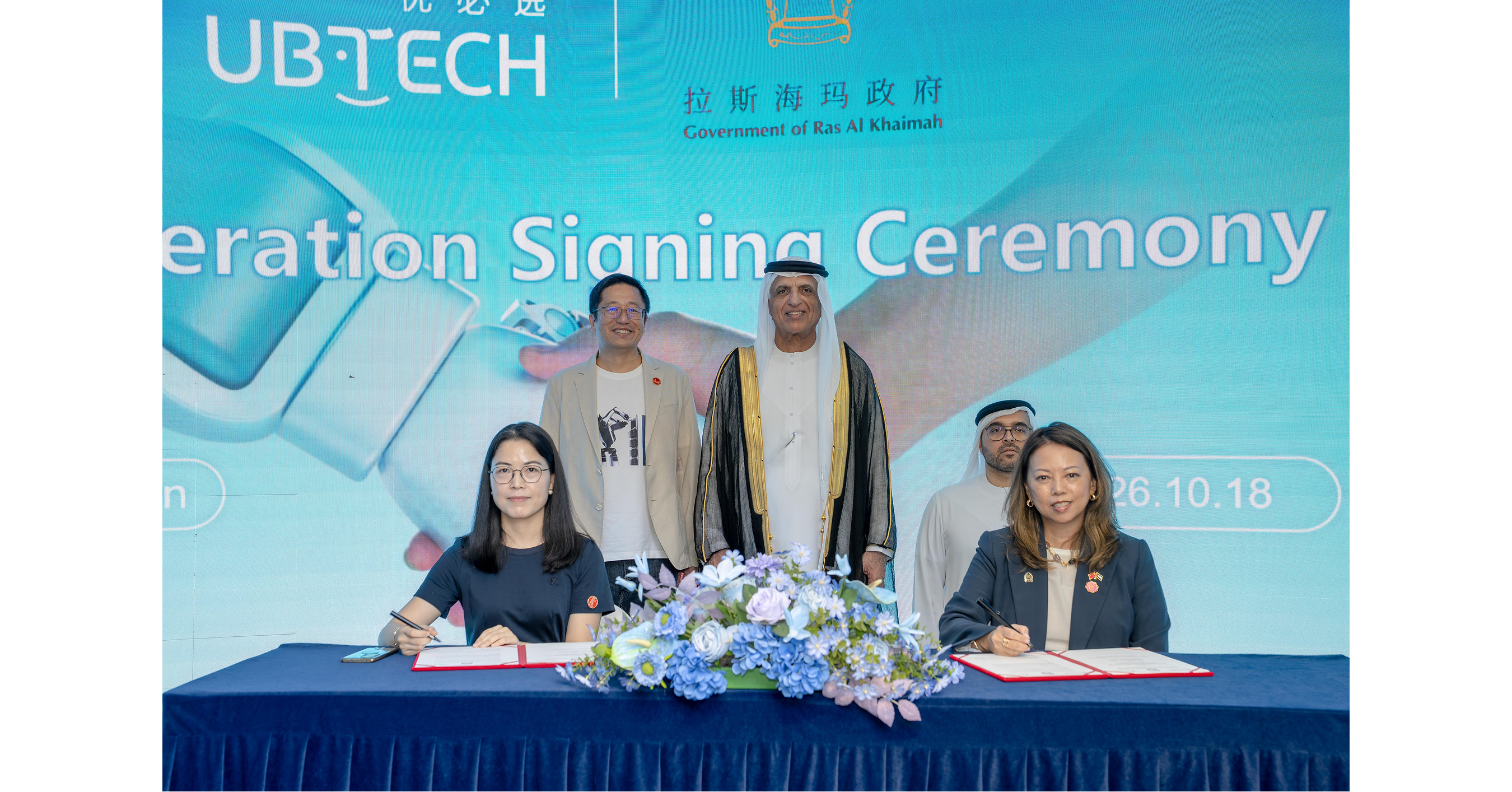
UBTech Robotics signed an MoU with the Government of Ras Al Khaimah to send humanoid robots and engineering teams to the emirate for live trials in industrial assembly, public services, elder care and cultural sites, and to study a humanoid climate research initiative for the Gulf, the parties said in a press release on Oct 19.
The release gives no robot count, money or dates. UBTech sold 921 full-size humanoids in the first half of 2026, about 31% of its stated capacity on an annualised basis.
UBTech Robotics, the Shenzhen humanoid maker listed in Hong Kong, has signed a memorandum of understanding with the International Relations Office of the Government of Ras Al Khaimah to test, demonstrate and deploy its humanoid robots in the emirate, the two sides said in a press release on Oct 19. Ras Al Khaimah's ruler, Sheikh Saud bin Saqr Al Qasimi, watched the signing in Shenzhen at the start of a week-long official visit to South China. [Company profile](/companies/ubtech-robotics), and the MEKAWIRE explainer [What is UBTech?](/news/what-is-ubtech-humanoid-robot-sales-revenue-walker-s2-funding-rivals-explained-20261016).
The agreement lists four kinds of work, a climate research study and an engineering team on the ground. It lists no number of robots, no money and no dates. That gap decides what the deal is worth to a company whose humanoid sales now carry almost half of its revenue.
UBTech sends robots and engineers; the emirate offers a sandbox
Under the MoU, UBTech will deploy humanoid robots and specialised engineering teams in Ras Al Khaimah to run live demonstration projects. The first trials are planned in automated industrial assembly, public-facing services, AI-assisted elder care and cultural spaces. The emirate will provide a live testing sandbox and what the release calls progressive regulatory frameworks, and will connect research institutions with industry. The parties will also study whether to set up a Ras Al Khaimah Humanoid Robotics Climate Research Initiative, which would use the emirate's environmental and operating conditions to validate robot performance for the UAE and the wider Gulf.
Alma Au Yeung, Greater China affairs adviser in the ruler's office, and Claudia Chen, UBTech's overseas sales director, signed the document. UBTech's chief financial officer Jimmy Zhang and an undersecretary of the UAE Ministry of Investment attended. The release says nothing about purchase orders, leasing or how costs are shared, so the question is what UBTech gets from it if not an order.
The order book it is trying to widen
UBTech sold 1,079 full-size Walker-class humanoids in 2025 and 921 in the first half of 2026, when humanoids brought in RMB590.3 million of its RMB1,269.1 million revenue, according to the filings in MEKAWIRE's database. A single customer supplied 24% of first-half revenue. The company states a capacity of more than 6,000 full-size humanoids a year; at the first-half pace, annualised, it uses about 31% of that.
- Full-size humanoids sold
- 1,079
- 921
- Humanoid revenue
- RMB820.6m
- RMB590.3m
- Share of group revenue
- 41.0%
- 46.5%
- Revenue per humanoid (MEKAWIRE)
- RMB760,500
- RMB640,900
- Stated capacity used, annualised (MEKAWIRE)
- n/a
- about 31%
Revenue per humanoid = humanoid revenue / units sold. Capacity used = H1 units x 2 / 6,000 stated annual capacity. Disclosed figures from UBTech's filings, not estimates.
As of Oct 19, 2026
Revenue per humanoid fell from about RMB760,500 in 2025 to RMB640,900 in the first half, a drop of about 16% by MEKAWIRE's calculation. Falling prices and idle capacity both push a maker toward new markets, and the Gulf is one of the few where governments offer test sites and regulatory cover rather than just purchase tenders.
MEKAWIRE analysis
The Ras Al Khaimah deal is a market-entry permit, not a sale; its value to UBTech depends on whether the climate initiative becomes a funded programme with a robot count.
Gulf states have courted robot companies before, but through capital or single sites. Qatar's sovereign fund invested in Mujin's $233 million Series D first close in December 2025, and NAVER LABS said in September that robot services in a Saudi smart building run on its software. UBTech's deal is the first in our database in which a Gulf government offers itself as a test bed for humanoids.
- Mujin (Japan)
- Qatar Investment Authority
- Investor in the $233m Series D first close
- Dec 2, 2025
- NAVER LABS (Korea)
- A smart building in Saudi Arabia
- Robot service logic runs on its FLOW tool and ARC brain
- Sept 4, 2026
- UBTech (China)
- Government of Ras Al Khaimah
- MoU for trials, demonstrations and a climate research study
- Oct 19, 2026
Verified rows from company releases and blogs; no amounts are attached to the NAVER LABS and UBTech links.
As of Oct 19, 2026
The strongest counter-argument is that framework agreements of this kind rarely carry numbers, and a demonstration fleet can stay a demonstration fleet. Until an order, a lease or a research budget is announced, the revenue effect is zero. What a Gulf test site can offer that Chinese factories cannot is performance data from outdoor conditions that buyers in the region will ask for before they sign volume contracts.
The bull case: the climate initiative becomes a paid testing and certification programme, the emirate leases a fleet, and UBTech uses the data to bid for industrial projects in Saudi Arabia and the UAE. The bear case: the robots appear at receptions and museums, and the deal adds visibility but no revenue line, while the largest customer's 24% share keeps the business concentrated.
What would change our view
Three signals would settle it. First, an announcement that sets up the climate research initiative with a budget or a partner institution. Second, the first deployment site in Ras Al Khaimah with a stated number of robots. Third, whether UBTech's 2026 annual results, expected on a similar schedule to the 2025 results published on Mar 31, 2026, break out Middle East revenue.
- In Shenzhen, witnessed by the Ruler of Ras Al Khaimah; release dated Oct 19, 2026
- International Relations Office of the Government of Ras Al Khaimah and UBTECH Robotics Limited
- Feasibility study for a Ras Al Khaimah Humanoid Robotics Climate Research Initiative
- Industrial assembly, public-facing services, AI-assisted elder care, cultural spaces
- Robot count, contract value, timeline
- 921 full-size humanoids sold; humanoid revenue RMB590.3m of RMB1,269.1m
- Deploy humanoid robots and specialised engineering teams in Ras Al Khaimah for live demonstrations
- Live test sandbox and regulatory frameworks, links between research institutions and industry
Why it matters
UBTech is, by disclosed revenue, the largest listed seller of full-size humanoids, but runs well below its stated capacity and relies on one customer for about a quarter of revenue. A foreign government test site is a route to a second market, and the Gulf, where governments buy and regulate at the same time, is where a reference deployment can turn into public procurement faster than in Europe or the US.
Rival analysis
UBTech is using a government-to-company route into a new region. Japan's Mujin reached the Gulf through Qatar's sovereign fund as an investor, and Korea's NAVER LABS through a building software deployment. None of these links carries a disclosed robot count, so UBTech's first site will be the comparison point.
Valuation context
No money is attached to the MoU, so it does not change UBTech's disclosed numbers. The relevant comparables are its own: revenue per humanoid fell about 16% from 2025 to H1 2026 and equity placings, not profits, fund its capacity. A Gulf programme matters to valuation only if it adds units at prices above the H1 2026 average of about RMB640,900.
Supply-chain implications
Trials in the Gulf will test thermal management, dust sealing and battery performance in conditions Chinese factory deployments do not face. Those are component questions for actuators, battery packs and cooling; any redesign for heat would show up first in its supplier choices.
Signals to watch
A budget or partner institution for the Ras Al Khaimah Humanoid Robotics Climate Research Initiative; the first deployment site with a robot count; Middle East revenue in UBTech's 2026 annual results; any similar MoU by UBTech with Saudi or Abu Dhabi bodies in the same visit.
Analyst view
Thesis: a market-entry permit, not a sale. Confidence: low to medium, because the release has no numbers and UBTech's overseas sales are not broken out in the data we hold. We would raise it if a funded research programme or a lease appears within six months.
Questions you should be asking
How many robots will UBTech deploy, and who pays for them? Which Walker models are planned for the industrial assembly trials? Will the climate initiative publish test protocols that other makers can use? Does UBTech plan local assembly or service in the UAE?