ABB plans to spin off its US$2.3 billion robot business as a separate listed company in 2026
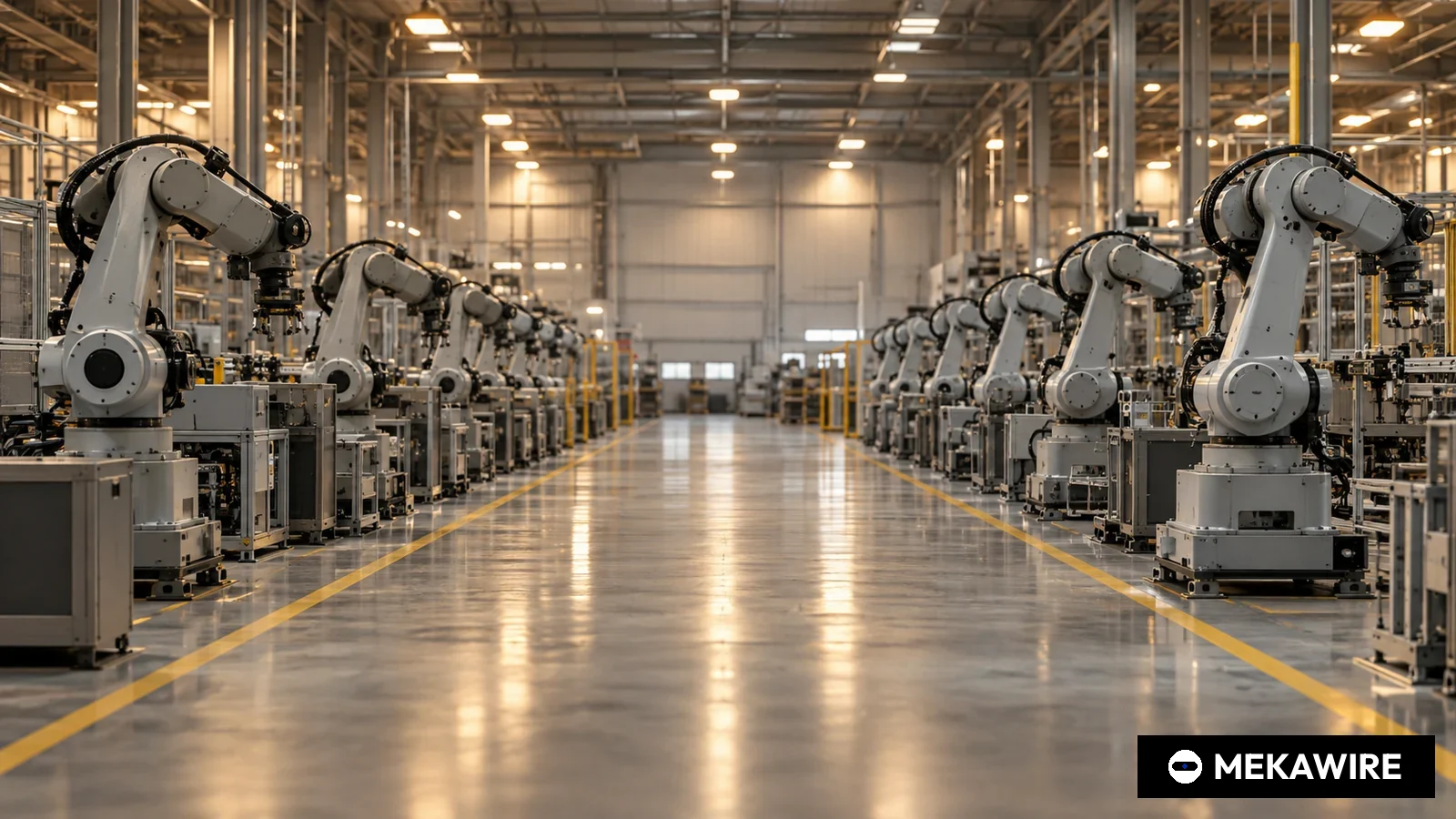
ABB said on 17 April 2025 it will propose a full spin-off of its Robotics division at its 2026 AGM, with trading in the new company planned for the second quarter of 2026. The division, which ABB calls the global number two in robotics, had about US$2.3 billion of 2024 revenue and a 12.1% operational EBITA margin, while its business area's first-quarter margin fell to 9.9% even as orders rose 14%.
ABB will propose to spin off its Robotics division as a separately listed company, the Swiss engineering group said in Zurich on 17 April 2025, alongside its first-quarter results. The board intends to put a full, 100% spin-off to shareholders at the 2026 annual general meeting, with the new company expected to start trading in the second quarter of 2026. Existing ABB shareholders would receive Robotics shares as a dividend in kind, in proportion to their holdings, and ABB would keep no stake.
The business being separated
ABB said the Robotics division generated revenue of about US$2.3 billion in 2024, roughly 7% of group revenue, with an operational EBITA margin of 12.1%. It employs about 7,000 people. In its results presentation the company described the unit as the global number two in the robotics industry and said more than 80% of its offering is enabled by software or AI. The division sells industrial robots, collaborative robots and autonomous mobile robots, and ABB said about two thirds of its sales are direct and about 18% come from service.
ABB said the division has kept a double-digit operational EBITA margin in most quarters since the first quarter of 2019 and lifted gross margin by 600 basis points over 2022 to 2024. It manufactures in Sweden, China and the United States, which serve as regional hubs for Europe, Asia and the Americas, and a new European hub in Sweden starts operating in 2025. Capital expenditure for the business totalled about US$200 million over 2019 to 2024, according to the presentation.
How the split works
Robotics today sits with the Machine Automation division inside the Robotics & Discrete Automation business area. Under the plan, Machine Automation will move into ABB's Process Automation business area from the first quarter of 2026, which ABB said offers clear sales and technology synergies in software and control. After the spin-off ABB would be organised in three business areas. The company did not say on which exchange the Robotics shares would list, and it did not disclose separation costs or the capital structure of the new company beyond describing it as strong.
Chief executive Morten Wierod said there were limited business and technology synergies between Robotics and ABB's other divisions and that the robot business has different demand and market characteristics. Chairman Peter Voser said a separate listing would let both companies create customer value, grow and attract talent under more focused governance and with their own capital allocation.
A weak quarter with better orders
The first-quarter numbers published the same morning show why investors may value the robot business differently from the rest of ABB. Robotics & Discrete Automation booked orders of US$799 million, up 14% (17% on a comparable basis), but revenue fell 14% to US$744 million and operational EBITA dropped 35% to US$74 million. The margin fell 330 basis points to 9.9%, which ABB attributed mainly to lower volumes in Machine Automation. The order backlog stood at US$1.518 billion, 21% lower than a year earlier, and the book-to-bill ratio was 1.07.
ABB said the business area turned a corner in the quarter. Robotics orders rose at a double-digit pace despite a difficult automotive segment, helped by customers adding production in new countries, particularly for paint systems, and by demand from consumer electronics, food and beverage, fashion and industrial machinery. Orders rose sharply in the Americas and in Asia, Middle East and Africa, and fell at a low single-digit rate in Europe. The group as a whole booked US$9.213 billion of orders and US$7.935 billion of revenue, with an operational EBITA margin of 20.2%, nearly double the margin of the robotics business area.
The competitive field
- ABB
- Robotics division
- 2024-12
- USD
- 2,300
- No data
- 12.1
- Operational EBITA
- FANUC
- ROBOT division
- 2025-03
- JPY
- 329,566
- -13.5
- No data
- No data
- Yaskawa Electric
- Robotics segment
- 2025-02
- JPY
- 237,413
- 1.2
- 10
- Segment operating profit
- KUKA
- Group
- 2024-12
- EUR
- 3,700
- -7.9
- 2.1
- EBIT
Figures as disclosed by each company. ABB revenue is stated as about US$2.3bn. Yaskawa margin = segment operating profit ¥23,751m / segment revenue ¥237,413m; KUKA margin = EBIT €76.5m / sales €3.7bn (rounded sales); both margins are MEKAWIRE calculations. Margin definitions differ and are not directly comparable. KUKA figures cover the whole group.
As of Apr 23, 2025
A listed ABB Robotics would join a small group of public pure plays and parents with large robot units. FANUC reported robot division sales of ¥329.6 billion for the year to March 2025, down 13.5%, citing weaker EV-related and general industry demand in China and lower sales in Europe and the Americas. Yaskawa Electric's robotics segment grew 1.2% to ¥237.4 billion in the year to February 2025, with segment operating profit of ¥23.8 billion. KUKA, owned by China's Midea, said sales fell 7.9% to €3.7 billion in 2024 and EBIT more than halved to €76.5 million.
Risks and open questions
The separation lands at a cyclical low. ABB itself described the automotive segment as challenging, and FANUC blamed weak demand in China for its lower robot sales. ABB has not yet said where the shares will trade, how much debt the new company will carry, or what stand-alone costs it will bear once it loses group functions. The plan also needs shareholder approval at the 2026 AGM.
What to watch
ABB's second-quarter results in July 2025 will show whether Robotics orders keep growing and whether the business area margin recovers from 9.9%. Before the 2026 AGM, ABB will need to publish a listing venue, a capital structure and separate financial statements for the unit. Machine Automation moves to Process Automation from the first quarter of 2026, and the first trading day is targeted for the second quarter of 2026.
MEKAWIRE analysis
ABB is betting that a pure robotics stock will earn a better valuation than a division whose margins dilute a 20% group, but it is launching the separation from a trough that tests that story.
The evidence for the logic is in the gap between the two businesses. The Robotics & Discrete Automation area earned a 9.9% operational EBITA margin in the first quarter against 20.2% for the group, and ABB's own presentation highlights that Robotics has a different cycle, driven by automotive and electronics capital spending rather than electrification and grid demand. Separating it removes a drag from ABB's ratio and gives investors a direct way to own a global number two in industrial robots.
The strongest counter-argument is timing and scale. Robotics revenue of about US$2.3 billion and an order backlog that has fallen 21% year on year leave little cushion for stand-alone costs, and a listed robot maker will be compared directly with FANUC and Yaskawa, whose robot units are of similar size and which report their robot results with a longer public record.
Bull case. Orders up 17% on a comparable basis mark the bottom of the cycle, and the unit lists in 2026 into a recovery with margins back above 12%. A pure play with more than 80% software or AI enabled products attracts investors who want industrial automation exposure outside Japan and China.
Bear case. Automotive stays weak, Chinese rivals take share in Asia, and stand-alone costs push margins into single digits. The listing then comes at a discount, or ABB looks for a buyer instead.
Signals to watch.
- July 2025: ABB's second-quarter results, Robotics orders and the business area margin.
- Late 2025 to early 2026: ABB's choice of listing venue and the first separate financial statements for Robotics.
- Second quarter of 2026: the AGM vote and the planned first trading day.
- Orders (US$ m)
- 799
- 701
- 14
- Revenues (US$ m)
- 744
- 864
- -14
- Operational EBITA (US$ m)
- 74
- 113
- -35
- Operational EBITA margin (%)
- 9.9
- 13.2
- No data
- Order backlog (US$ m)
- 1518
- 1918
- -21
As reported by ABB on 17 April 2025. Change is nominal US$; comparable order growth was 17% and comparable revenue change -11%. Margin fell 330 basis points.
As of Apr 17, 2025
- Proposal to 2026 AGM; trading planned for Q2 2026
- about 7,000
- 100% spin-off, shares distributed as dividend in kind; ABB keeps no stake
- 17 April 2025, Zurich, with Q1 2025 results
- not disclosed
- moves to Process Automation from Q1 2026
- about US$2.3 billion, about 7% of ABB Group
- orders US$799m (+14%), revenue US$744m (-14%), margin 9.9%
- 12.1%
- more than 80%
Why it matters
The spin-off would create one of the few listed pure-play industrial robot makers outside Japan and China. ABB calls the division the global number two in robotics, and its separation would give investors a European-headquartered alternative to FANUC and Yaskawa Electric, whose robot units sit inside larger listed groups, and to KUKA, which is controlled by Midea.
For ABB the move is about the group multiple as much as about robots. The Robotics & Discrete Automation business area earned a 9.9% operational EBITA margin in the first quarter of 2025 while the group earned 20.2%. Removing the robot cycle, which follows automotive and electronics capital spending, leaves ABB as an electrification and automation group with steadier demand.
Rival analysis
FANUC's robot division reported ¥329.6 billion of sales for the year to March 2025, down 13.5%, with weaker demand in China's EV and general industries and lower sales in Europe and the Americas. Yaskawa's robotics segment held up better, growing 1.2% to ¥237.4 billion in the year to February 2025 on backlog of large system projects and wafer transfer robots for semiconductors, with segment operating profit down 5.6% to ¥23.8 billion.
KUKA reported 2024 sales down 7.9% to €3.7 billion and EBIT down 51.6% to €76.5 million, while orders rose 1.3% to €4.1 billion and it reported record sales in Asia. ABB Robotics, at about US$2.3 billion of 2024 revenue and a 12.1% margin, sits in the same size band as FANUC's robot unit and is more profitable than KUKA on the disclosed measures, though the margin definitions differ.
Valuation context
ABB disclosed no valuation for the unit and no listing price. What investors can work with is revenue of about US$2.3 billion in 2024, an operational EBITA margin of 12.1%, a record of double-digit margins in most quarters since the start of 2019, and a gross margin that rose 600 basis points over 2022 to 2024. Those figures put annual operational EBITA in the region of US$280 million, a MEKAWIRE calculation from the rounded revenue and the margin.
The first quarter of 2025 complicates the picture. The business area's revenue fell 14% and its backlog fell 21% to US$1.518 billion, while orders rose 14%. A buyer of the listed shares in 2026 will be pricing a recovery that, on these numbers, has only just begun in orders and not yet in revenue.
Supply-chain implications
ABB builds robots in Sweden, China and the United States, and the presentation says a new European hub in Sweden starts in 2025. That footprint matters under US tariffs. Wierod said 75% to 80% of ABB's US sales are produced locally, and ABB announced US$120 million of new US manufacturing investment with the results, although the release did not allocate it by division.
Like its rivals, ABB Robotics depends on precision reducers, servo motors and drives from a concentrated supplier base. A stand-alone company will need its own purchasing scale and transitional agreements with ABB for shared functions, none of which were described in the April announcement.
Signals to watch
July 2025 brings ABB's second-quarter results, where the key figures are Robotics order growth, the business area margin against 9.9% in the first quarter, and any update on separation costs. The group guided to a broadly stable operational EBITA margin of about 19% in the second quarter.
Before the 2026 AGM, ABB must name a listing venue, publish separate historical financial statements and set out the capital structure and management of the new company. Machine Automation's move to Process Automation from the first quarter of 2026 will also show how cleanly the two businesses can be separated.
Analyst view
Thesis: the spin-off is a credible way to unlock value for ABB shareholders, but the robot business is entering the process at a cyclical low and its stand-alone valuation will hinge on whether first-quarter order growth turns into revenue in the second half of 2025. Confidence: medium.
Reasons: the rationale, structure, timetable and key 2024 figures are disclosed by ABB, and order momentum is visible. Against that, ABB has not disclosed the listing venue, separation costs, debt allocation or stand-alone costs, and peer data from FANUC and KUKA show the industry still contracting in 2024.
Questions you should be asking
Where will ABB Robotics list, and will it be included in the indices that hold ABB today? How much debt and how many pension or lease obligations will move with the unit?
What stand-alone costs will the new company carry once it leaves ABB's shared services, and how will that affect the 12.1% margin of 2024? Will the Robotics order growth of the first quarter, driven by the Americas and Asia, offset continued weakness in European and automotive demand?