Toyota's Canadian car plants sign Agility Robotics to a paid Digit humanoid service after a pilot
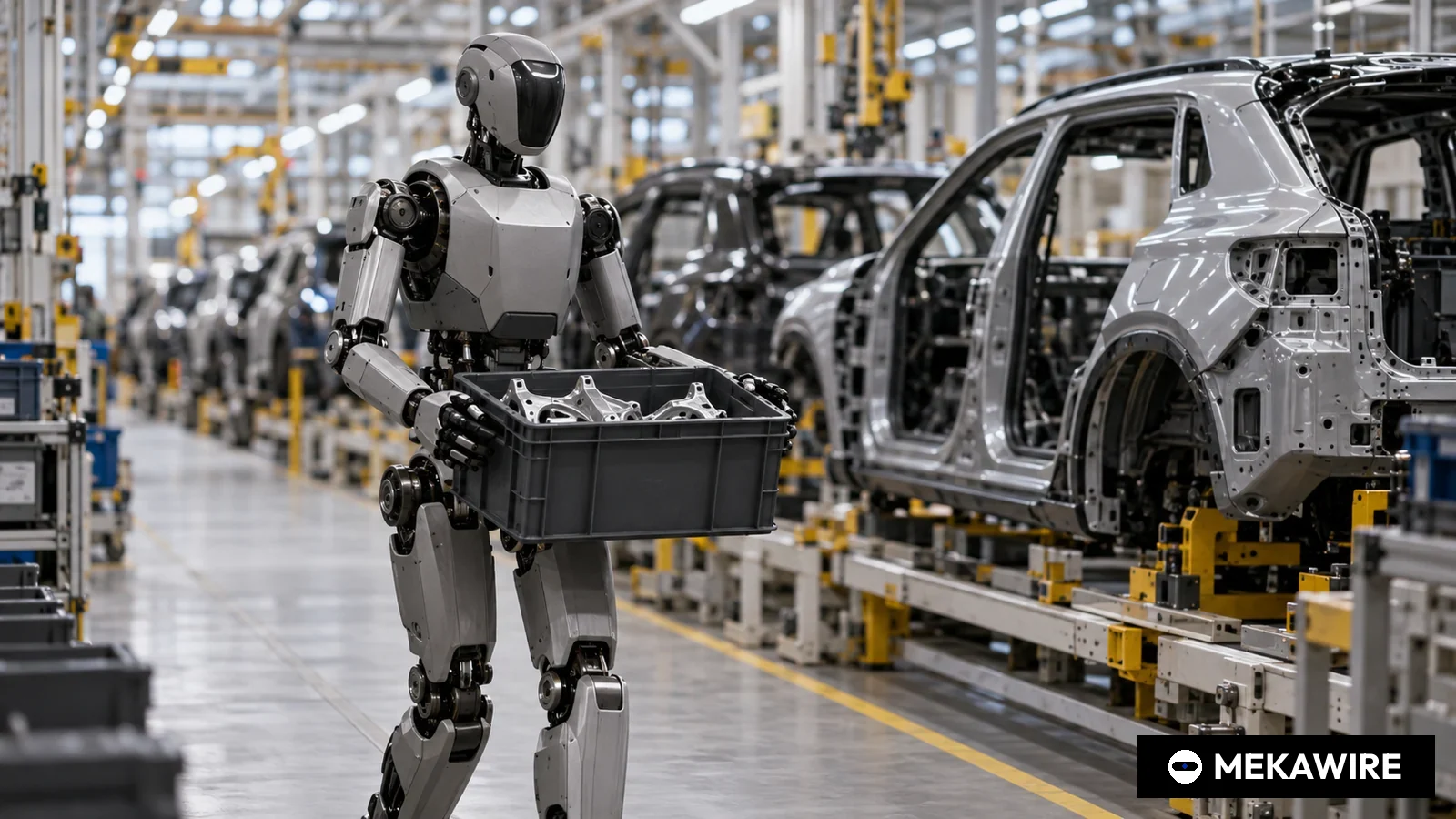
Toyota Motor Manufacturing Canada has signed a Robots-as-a-Service agreement with Agility Robotics to deploy Digit humanoids in manufacturing, supply chain and logistics work at its Cambridge and Woodstock plants in Ontario, following a pilot.
Neither company disclosed fleet size, contract value or term. The deal adds a Toyota vehicle plant to a Digit customer list that already includes GXO, Schaeffler, Amazon and Mercado Libre, as rivals tie up with BMW, Mercedes-Benz and Hyundai.
Toyota Motor Manufacturing Canada (TMMC) has signed a commercial Robots-as-a-Service (RaaS) agreement with Agility Robotics to put the Oregon company's Digit humanoid to work at its vehicle plants in Cambridge and Woodstock, Ontario, the companies said on 19 February 2026. The contract follows a pilot in which TMMC tested Digit, and it covers manufacturing, supply chain and logistics operations, according to Agility's announcement.
Neither side disclosed how many robots TMMC will take, what it will pay, how long the agreement runs or how long the pilot lasted. Under a RaaS contract the customer pays a recurring fee for robots, software and support instead of buying the hardware. Agility first used that structure with logistics group GXO in June 2024, in a deal the two companies described at the time as the first formal commercial deployment of humanoid robots. The Toyota fleet will be run through Agility Arc, the company's cloud platform for managing Digit robots and connecting them to plant systems.
The announcement did not list specific jobs. The companies said they would study automating tasks on automotive production lines that are extremely repetitive and physically taxing. Tim Hollander, president of TMMC, said the plant chose Digit after evaluating a number of robots and expects it to improve the working experience of team members and raise operating efficiency. Peggy Johnson, Agility's chief executive, said the next generation of Digit would be the first cooperatively safe humanoid, meaning a robot designed to work next to people rather than inside fenced or separated zones. Agility gave no release date for that version.
TMMC is a large account for a humanoid start-up to land. Toyota Canada said on 23 January 2026, when TMMC began building the sixth-generation RAV4, that the operation assembled more than 535,000 vehicles in 2025 and employs more than 8,500 people. The new RAV4 is sold only as a hybrid. Toyota's fact sheet for the subsidiary lists Corolla, RAV4 and Lexus RX models among its output and stamping, body weld, paint and plastics among its processes.
Agility, founded in 2015 and headquartered in Salem, Oregon, with offices in Pittsburgh and Palo Alto, opened a 70,000-square-foot humanoid factory called RoboFab in Salem in September 2023 and said it was designed eventually to build more than 10,000 robots a year. Its last round confirmed on a company page was a $150 million Series B in April 2022 led by DCVC and Playground Global. Schaeffler made a minority investment in November 2024 and said it intended to buy Digit robots for its global plant network, with Agility citing a goal of humanoids across Schaeffler's 100 plants by 2030. In December 2025 Mercado Libre signed a commercial agreement to deploy Digit in San Antonio, Texas, when Agility said Digit had moved more than 100,000 totes in live commerce operations. Amazon is also a named customer.
Car factories have become the main proving ground for Western humanoid makers. Figure AI said on 19 November 2025 that its F.02 robots spent 11 months at BMW's Spartanburg plant, running 10-hour shifts Monday to Friday, logging more than 1,250 hours, loading more than 90,000 parts and contributing to the production of more than 30,000 BMW X3 vehicles. Hyundai Motor Group said at CES on 5 January 2026 that it would deploy Boston Dynamics' Atlas at its Georgia Metaplant from 2028 for parts sequencing, adding component assembly from 2030, and would build capacity for 30,000 robot units a year by 2028. Mercedes-Benz said in March 2025 it was making a low double-digit-million-euro investment in Apptronik and testing the Apollo humanoid in Berlin-Marienfelde; Apptronik announced a $520 million Series A extension on 11 February 2026, eight days before the Toyota news.
- Agility Robotics
- 2015
- Toyota Motor Manufacturing Canada (RaaS, Feb 2026)
- 150
- 2022-04-22
- No data
- Figure AI
- No data
- BMW Spartanburg (F.02, 11 months to Nov 2025)
- 1000
- 2025-09-16
- 39
- Apptronik
- 2016
- Mercedes-Benz (investor, Apollo tests in Berlin)
- 520
- 2026-02-11
- No data
- Boston Dynamics
- 1992
- Hyundai Motor Group (owner, Atlas at Georgia Metaplant from 2028)
- No data
- No data
- No data
- 1X Technologies
- 2014
- None disclosed
- 100
- 2024-01-13
- No data
Rounds are the latest disclosed on a company or investor page; Apptronik's figure is its Series A extension. Boston Dynamics is a Hyundai subsidiary with no separate round. Figures disclosed, not estimated; — means not disclosed.
As of Feb 19, 2026
The choice of vendor stands out because Toyota's own research arm backs a rival platform. Toyota Research Institute and Boston Dynamics announced a partnership in October 2024 to train large behavior models on Atlas, with the stated aim of teaching humanoids new dexterous, whole-body skills quickly. TMMC's decision to lease Digit for its plant floor shows that, at least in Canada, Toyota's procurement is following plant-level trials rather than group research ties.
Digit is built for moving materials inside existing workflows. Agility says it integrates with autonomous mobile robots, conveyors and warehouse management software, and its public deployments have centred on tote handling. In car plants the closest disclosed comparisons are BMW's sheet-metal loading with Figure and Hyundai's planned parts sequencing with Atlas, both jobs that move parts to the line rather than assemble them.
The open questions are commercial. Without a fleet size, the contract cannot be weighed against Agility's factory capacity or against Hyundai's 30,000-unit plan. Johnson's safety claim applies to a future Digit, so the current fleet will still need the separation and supervision that plant safety rules require. It is also unclear whether Toyota's other North American plants, or its Japanese factories, will run trials of their own.
The next markers are the launch of the next-generation Digit, any disclosure of fleet numbers at TMMC, and whether Agility raises fresh capital to match rivals that have closed rounds of $500 million or more in the past six months.
MEKAWIRE analysis
The TMMC contract matters less for its size, which neither side will state, than for showing that a carmaker with its own humanoid research ties will still pay an outside vendor for a robot service once a plant has tested it.
The evidence is in the sequence. TMMC ran a pilot, evaluated several robots by its president's account, and then signed a recurring service contract rather than a further trial. That is the same path GXO took in 2024 and Mercado Libre took in 2025, and it suggests Agility's commercial model, which bundles hardware, fleet software and support, is the product customers are buying.
The strongest counter-argument is that undisclosed contracts can be very small. A handful of robots on a subscription would generate little revenue, and humanoid makers have an incentive to announce brand-name customers early. Until Agility reports fleet counts or revenue, the deal is a signal of intent more than proof of scale.
Bull case: Toyota is among the world's largest vehicle producers, and a successful Canadian deployment could be copied across its North American plants, giving Agility a reference customer in automotive alongside Schaeffler in components. A next-generation Digit cleared to work alongside people would widen the jobs available beyond fenced logistics cells.
Bear case: Rivals are better funded, with Figure valued at $39 billion after its September 2025 round and Apptronik adding $520 million in February 2026, while Agility's last company-confirmed round dates from 2022. Hyundai's plan to build its own robots in volume shows that the largest carmakers may prefer captive suppliers, leaving start-ups with pilots and small fleets.
Signals to watch:
- 2028: Hyundai begins Atlas parts sequencing at its Georgia Metaplant, the first large test of a carmaker-owned humanoid against leased services such as Digit.
- 2030: Schaeffler's stated horizon for humanoids across its 100 plants, the largest disclosed Digit commitment.
- May 2026: Toyota Motor's full-year results, expected that month, the first opportunity for management to comment on humanoids in its plants.
- Manufacturing, supply chain and logistics operations
- Cambridge and Woodstock, Ontario
- Toyota Motor Manufacturing Canada (TMMC)
- 19 February 2026
- Robots-as-a-Service, signed after a pilot
- More than 8,500
- More than 535,000 vehicles
- Not disclosed
- GXO, Schaeffler, Amazon, Mercado Libre
- $150 million Series B, April 2022
Why it matters
Automotive plants are where humanoid makers need to prove they can earn recurring revenue, because carmakers run the most standardised, measured and safety-audited production lines. A paid service contract at a Toyota subsidiary, signed after a pilot, is the kind of reference that later customers in automotive and components will ask for.
The deal also extends Agility's model beyond warehouses. Its earlier contracts with GXO and Mercado Libre were in logistics and fulfilment. Schaeffler brought it into components manufacturing. TMMC moves Digit into a vehicle assembly operation with more than 8,500 employees and more than 535,000 vehicles a year of output.
Rival analysis
Figure has the most detailed public record in a car plant, with 11 months at BMW Spartanburg, more than 1,250 operating hours and more than 90,000 parts loaded, according to its November 2025 report. Its September 2025 Series C of $1 billion at a $39 billion post-money valuation gives it far more capital than Agility has disclosed.
Hyundai is vertically integrating: it owns Boston Dynamics, has Hyundai Mobis supplying actuators, and plans capacity for 30,000 robots a year by 2028. Apptronik has Mercedes-Benz as investor and test customer and raised $520 million in February 2026. Agility's edge is that it has run paid RaaS contracts since 2024 and has a dedicated factory, but its disclosed funding trails each of these rivals.
Valuation context
No valuation was disclosed with the Toyota agreement, and Agility's last company-confirmed equity round was the $150 million Series B in April 2022. That leaves the company's value unconfirmed on a primary page as of February 2026.
For comparison, Figure's September 2025 round was priced at $39 billion post-money. Apptronik said its February 2026 extension was priced at three times its Series A valuation but gave no dollar figure. Any new Agility round would be judged on whether contracts such as TMMC convert into disclosed fleet numbers and recurring revenue.
Supply-chain implications
Digit is built at Agility's RoboFab in Salem, Oregon, a 70,000-square-foot facility the company said in 2023 would eventually reach more than 10,000 robots a year. A North American customer served from an Oregon factory keeps hardware logistics simple, and the RaaS model means Agility retains ownership and maintenance of the robots.
The Schaeffler relationship matters on the supply side as well: Schaeffler is a motion technology supplier and an Agility investor, and it has said it intends to deploy Digit in its own plants. Agility has not disclosed its actuator suppliers. Software runs through Agility Arc, which connects Digit to conveyors, mobile robots and warehouse management systems.
Signals to watch
The first signal is fleet disclosure. If Agility or Toyota gives robot counts at TMMC, the contract can be measured against Agility's factory capacity and against Hyundai's planned volumes.
The second is the next-generation Digit that Johnson described as cooperatively safe. Its launch timing and any third-party safety evaluation will decide whether Digit can move from separated logistics cells to work next to people on assembly lines. The third is funding: rivals raised $520 million to $1 billion in the six months before this deal.
Analyst view
Thesis: the TMMC contract is a credible commercial validation for Agility in automotive, but its economic weight cannot be judged until fleet size or revenue is disclosed. Confidence: medium. The pilot-then-contract sequence and Toyota's scale support the positive reading; the absence of any number limits it.
We would raise confidence if Toyota extends Digit to other plants or if Agility discloses recurring revenue. We would lower it if the next-generation Digit slips without a date or if Agility fails to close new financing while Figure, Apptronik and Hyundai scale.
Questions you should be asking
How many Digit robots will TMMC run, at which of its plants first, and for which tasks? What is the contract term and the monthly fee per robot?
Will Toyota's plants in the United States or Japan run their own trials, and how does TMMC's choice sit alongside Toyota Research Institute's work with Boston Dynamics on Atlas? When will the next-generation Digit ship, and which safety standard will Agility use to support its claim that it can work alongside people?