Doosan Robotics' 2025 loss widens to 59.5 billion won as cobot arm sales halve, and it puts $16 million more into its US solutions arm
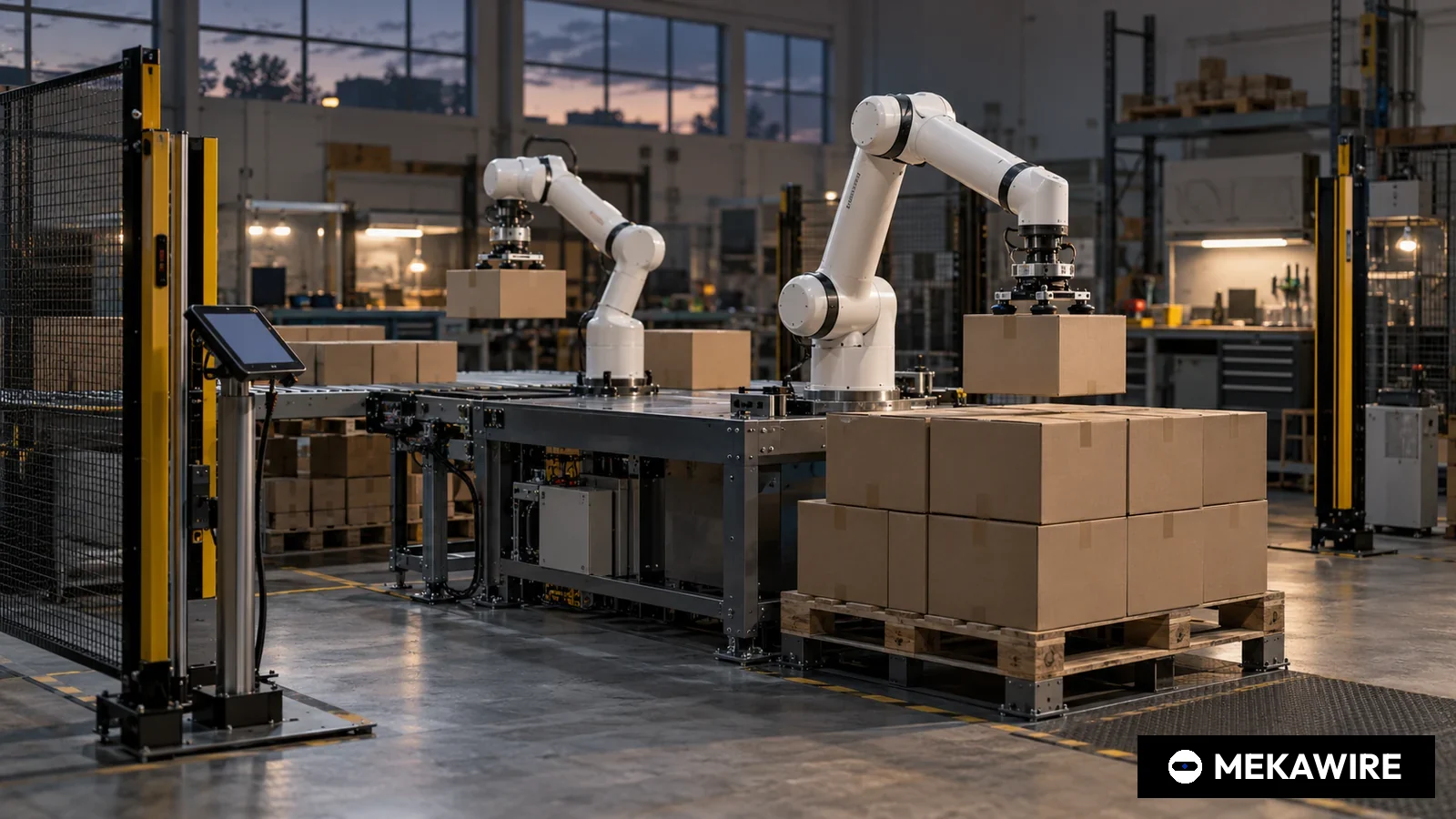
Doosan Robotics reported 2025 consolidated revenue of KRW 32.98 billion, down 29.6%, and an operating loss of KRW 59.47 billion, according to its DART filings. Sales of its core cobot arms roughly halved as North American demand fell about 50% under tariff uncertainty.
On 26 March 2026 the board approved a USD 16.0 million capital injection into Doosan Robotics Americas, the former ONExia, to expand its factory on the back of a USD 14.9 million order backlog.
Doosan Robotics, the collaborative robot maker controlled by Korea's Doosan group, closed 2025 with a wider loss and a much smaller arm business, and spent the first quarter of 2026 shifting money toward the US systems integrator it bought last September. The company reported consolidated revenue of KRW 32.98 billion for 2025, down 29.6% from KRW 46.83 billion, in a preliminary filing to Korea's DART disclosure system on 11 February 2026. Its operating loss widened to KRW 59.47 billion from KRW 41.20 billion, and its net loss to KRW 55.50 billion from KRW 36.56 billion.
The annual report filed on 18 March shows where the revenue went. Sales of cobot arms, the product Doosan built its name on, fell to KRW 19.89 billion from KRW 38.89 billion in 2024 and KRW 45.93 billion in 2023. Parts and other sales were KRW 7.08 billion. A new automation solutions segment, made up of end of line packaging cells and custom machine integration, contributed KRW 6.01 billion after the ONExia deal closed. Gross profit fell to KRW 4.42 billion, which works out to a gross margin of 13.4% against 20.4% a year earlier, while selling, general and administrative costs rose 25.9% to KRW 63.89 billion.
The company blamed weak demand in advanced markets amid external uncertainty, the opening of an R&D centre and new research hiring, and one-off acquisition costs. In the management discussion it was more specific, saying tariff policy cut its North American sales by about 50%. Research spending reached KRW 8.41 billion, equal to 26% of revenue, and Doosan wrote off KRW 1.47 billion of capitalised development costs for projects it halted, including an in-house parts programme. It ended the year with 255 employees.
The ONExia purchase is the centre of the new strategy. Doosan took 87.98% of the Pennsylvania integrator on 17 September 2025 for KRW 32.34 billion in cash, according to the business combination note. It booked KRW 12.66 billion of identifiable net assets, including KRW 11.66 billion of intangibles, and KRW 19.68 billion of goodwill, so goodwill accounted for 60.9% of the price. At the end of 2025 ONExia was merged with Doosan's own US sales company, Doosan Robotics Americas LLC, and the surviving entity now operates as Doosan Robotics Americas, Inc. under chief executive Andrew Cook.
On 26 March 2026 the board approved taking part in a rights issue at that subsidiary. Doosan will buy 4,854 new shares for USD 15,998,686.92, or KRW 23.93 billion at the day's reference rate of 1,495.60 won per dollar, with payment due on 30 March. Its stake rises to 94.12%. The stated purpose is to relocate and expand the factory because of a growing order backlog and to widen the North American business. The automation solutions unit reported USD 19.11 million of orders at the end of 2025, of which USD 4.22 million had been delivered, leaving a backlog of USD 14.88 million.
The subsidiary's own numbers explain why it needed cash. The filing shows year end 2025 assets of KRW 43.87 billion against liabilities of KRW 42.76 billion, leaving equity of KRW 1.11 billion, on revenue of KRW 19.06 billion and a small net loss of KRW 0.13 billion. The auditor, JLK LLP, gave a qualified opinion on those statements, a detail the parent disclosed without explanation.
Doosan Robotics was founded on 31 July 2015 and listed on the KOSPI market on 5 October 2023. It says it reached the global top four in cobot unit sales in 2021 and sells mostly through dealers abroad. Its five largest customers accounted for 16.68% of 2025 revenue. The strategy it now describes has two layers: plug and play robot solutions that bundle arm, software and AI so customers skip a separate integrator, and an "Industrial Humanoid" programme aimed at skilled tasks in specific factory settings rather than general purpose work. Its R&D log lists obstacle avoidance motion built with NVIDIA's cuRobo and Isaac Sim, and a paid app store inside its Dart-Suite software.
Korean rivals had a very different year. Rainbow Robotics reported 2025 revenue of KRW 34.12 billion, up 76.4%, citing its dual arm robots, with an operating loss of KRW 2.48 billion and a net profit of KRW 1.43 billion. Robotis, which sells actuators to humanoid builders, grew revenue 29.64% to KRW 38.94 billion and swung to an operating profit of KRW 3.36 billion on North American exports. Neuromeka, the closest listed cobot peer, saw revenue fall 25.0% to KRW 18.95 billion with an operating loss of KRW 14.86 billion. On those filings Doosan, once the largest of the group by sales, now ranks behind both Rainbow and Robotis.
- Doosan Robotics
- 32.98
- 46.83
- -29.6
- -59.47
- -55.5
- 2026-02-11
- Rainbow Robotics
- 34.12
- 19.35
- 76.4
- -2.48
- 1.43
- 2026-02-27
- Robotis
- 38.94
- 30.04
- 29.64
- 3.36
- 5.38
- 2026-01-28
- Neuromeka
- 18.95
- 25.27
- -25
- -14.86
- -21.99
- 2026-03-12
Preliminary consolidated K-IFRS figures from each company's DART filing on changes of 30% or more in revenue or profit, rounded to KRW 0.01 billion; negative values are losses. Change % as disclosed. Figures disclosed, not estimated.
As of Oct 1, 2026
The balance sheet gives Doosan time. Cash and short term financial instruments totalled KRW 197.14 billion at the end of 2025, down from KRW 275.22 billion, after KRW 17.3 billion of operating cash outflow and KRW 90.2 billion of investment outflows that included the ONExia deal. Total liabilities rose to KRW 50.78 billion, lifting the debt ratio to 14.57% from 4.77%. The remaining cash equals about 3.3 times the 2025 operating loss.
- Cobot arms
- 45.93
- 38.89
- 19.89
- Parts and other
- 7.11
- 7.94
- 7.08
- Automation solutions (EOL/CMI)
- No data
- No data
- 6.01
- Total
- 53.04
- 46.83
- 32.98
From the FY2025 annual report (DART, 2026-03-18), consolidated. Automation solutions consolidated from ONExia's acquisition on 2025-09-17. Figures disclosed, not estimated.
As of Oct 1, 2026
The open questions concern the US bet. The company has not disclosed the new factory's location, size or cost, nor how much of the backlog is expected to convert in 2026. It has not explained the qualified audit opinion at the subsidiary. And the arm business, which still produced most of revenue, faces the same tariff and pricing pressure in the US and Europe that cut it in half. Doosan gave no 2026 earnings guidance in its filings.
MEKAWIRE analysis
Doosan Robotics is trying to turn a shrinking cobot hardware business into a US automation integrator, and 2025 shows the hardware is falling faster than the integrator is growing.
The evidence is in the mix. Arm revenue dropped KRW 19.0 billion in one year while the acquired solutions business added KRW 6.0 billion in its first three and a half months. The company paid KRW 32.3 billion for ONExia, then committed another USD 16.0 million within six months to expand its plant, which means the integrator now absorbs more capital than the whole arm segment earns in gross profit.
The strongest counter-argument is that solutions revenue is stickier and higher value than selling arms through dealers. A USD 14.9 million backlog against a three and a half month contribution of KRW 6.0 billion suggests the US unit could deliver a full year of revenue comparable to the parent's arm sales, with Doosan capturing the integration margin that used to go to third parties.
Bull case: the Americas unit converts its backlog in 2026, the new factory lifts capacity, and standardised end of line cells using Doosan arms raise volume and selling prices together. Losses narrow as R&D hiring stops growing and the cash pile of KRW 197 billion covers the transition with room to spare.
Bear case: the arm decline continues as Chinese and Danish rivals compete on price, and the solutions unit stays thinly capitalised with a qualified audit behind it. Goodwill of KRW 19.7 billion becomes an impairment risk if US orders slow, and the humanoid programme adds cost before it adds revenue.
- Q1 2026 results on DART, expected in May 2026: whether arm revenue stabilises and how much the solutions segment contributes in a full quarter.
- The subsidiary's 2026 factory relocation: site, capacity and capex disclosure in the half year report due in August 2026.
- The FY2026 annual report in March 2027: the goodwill impairment test on the Americas unit and whether the qualified opinion is cleared.
- KRW 8.41 billion, 26% of revenue
- 87.98% for KRW 32.34 billion, closed 17 Sep 2025
- KRW 32.98 billion (down 29.6%)
- KRW 55.50 billion
- KRW 19.89 billion (2024: KRW 38.89 billion)
- USD 14.88 million at end 2025
- KRW 59.47 billion (2024: KRW 41.20 billion)
- Down about 50% (company)
- USD 16.0 million, approved 26 Mar 2026, stake to 94.12%
- KRW 197.14 billion at end 2025
Why it matters
Doosan Robotics was the flagship of Korea's cobot export story when it listed in 2023, and its 2025 filings show that model under strain. A 48.9% fall in arm revenue in one year, against growth at Rainbow Robotics and Robotis, means the Korean robot market has moved from cobot arms toward humanoid platforms and components, and the largest cobot maker by brand has not followed yet.
The response is a strategic pivot from component seller to solution owner. By buying ONExia and then funding its expansion, Doosan is making the US integration business its main growth engine. That is a familiar path for robot makers facing commoditisation, but Doosan is taking it while losing KRW 59 billion a year, which makes execution in the US the variable that matters most for the stock and for Korea's cobot ambitions.
Rival analysis
Among Korean listed peers, Rainbow Robotics now has the momentum, with revenue up 76.4% on dual arm robots and a near break even result. Robotis has positioned itself as an actuator supplier to humanoid makers and turned profitable. Neuromeka, the most direct cobot competitor, shrank 25.0% and lost KRW 14.86 billion at the operating level, so the cobot squeeze is sector wide rather than specific to Doosan.
Globally, Doosan competes with Universal Robots, whose parent Teradyne reported USD 89 million of robotics revenue in Q4 2025, and with fast growing Chinese makers that win on price. Doosan's answer of owning the integration layer in the US puts it closer to system integrators than to arm makers, a crowded field where scale and local service count.
Valuation context
The ONExia price of KRW 32.34 billion for 87.98% compares with identifiable net assets of KRW 12.66 billion, so 60.9% of the price was goodwill. The follow on injection of KRW 23.93 billion takes Doosan's total cash commitment to the US unit to about KRW 56.3 billion in seven months, against a unit that reported KRW 19.06 billion of 2025 revenue and KRW 1.11 billion of equity.
At group level, consolidated equity of KRW 348.6 billion and cash of KRW 197.1 billion give a cushion, but accumulated deficit reached KRW 192.2 billion at the end of 2025. Investors are therefore paying for the future solutions and humanoid strategy, not for current earnings, and the filings offer no near term profit guidance.
Supply-chain implications
The arm business relies on dealers for most overseas sales, which leaves Doosan exposed to channel inventory swings and to US tariffs on Korean made hardware. Moving value into US based integration and a relocated US factory partly hedges tariff risk, because more of the final system is assembled and sold locally.
Doosan wrote off a parts in-sourcing development project in 2025, which suggests it will keep buying key components such as reducers and drives from external suppliers rather than building them. Its software work leans on NVIDIA tools, cuRobo for motion planning and Isaac Sim for simulation, which ties its AI roadmap to the NVIDIA ecosystem used by most Western and Japanese peers.
Signals to watch
The first full quarter of consolidated solutions revenue will show whether the backlog converts at a pace that offsets arm weakness. A second signal is any disclosure of the US factory site and capex, which would size the commitment beyond the USD 16 million already approved.
Third, the audit status of Doosan Robotics Americas matters: a qualified opinion at a newly merged subsidiary is not unusual, but clearing it in the 2026 audit would reduce perceived integration risk. Finally, watch whether the Industrial Humanoid programme produces customer pilots, since it is the main narrative behind the company's valuation.
Analyst view
Thesis: Doosan Robotics is buying growth in the US to replace a cobot arm business that halved in 2025, and the bet is plausible but early. Confidence: medium. The filings verify the direction and the money committed, and the cash pile removes near term funding risk.
Confidence is not higher because the company has given no guidance, the US unit carries a qualified audit opinion, and the evidence for solutions growth rests on one quarter and a USD 14.9 million backlog. If arm revenue keeps falling at 2025 rates, the solutions unit would need to grow several times over to stabilise group revenue.
Questions you should be asking
Where will the relocated US factory be, how large is it, and what is the full capex beyond the USD 16.0 million injection?
What was the basis for JLK LLP's qualified opinion on Doosan Robotics Americas' 2025 statements, and has it been resolved?
How much of the USD 14.88 million backlog is scheduled for delivery in 2026, and what share of those systems use Doosan arms?
When does the company expect R&D and SG&A growth to level off, and what revenue level does it need to break even?