Google DeepMind launches Gemini Robotics, turning Gemini 2.0 into a robot controller and signing Apptronik as its humanoid partner
Google DeepMind on 12 March 2025 introduced Gemini Robotics, a vision-language-action model built on Gemini 2.0 that issues motor commands, and Gemini Robotics-ER, a spatial reasoning model for robot makers. The lab said the action model more than doubles performance on a generalization benchmark against other leading models, named Apptronik as its humanoid partner and opened Gemini Robotics-ER to four trusted testers including Boston Dynamics and Agility Robotics.
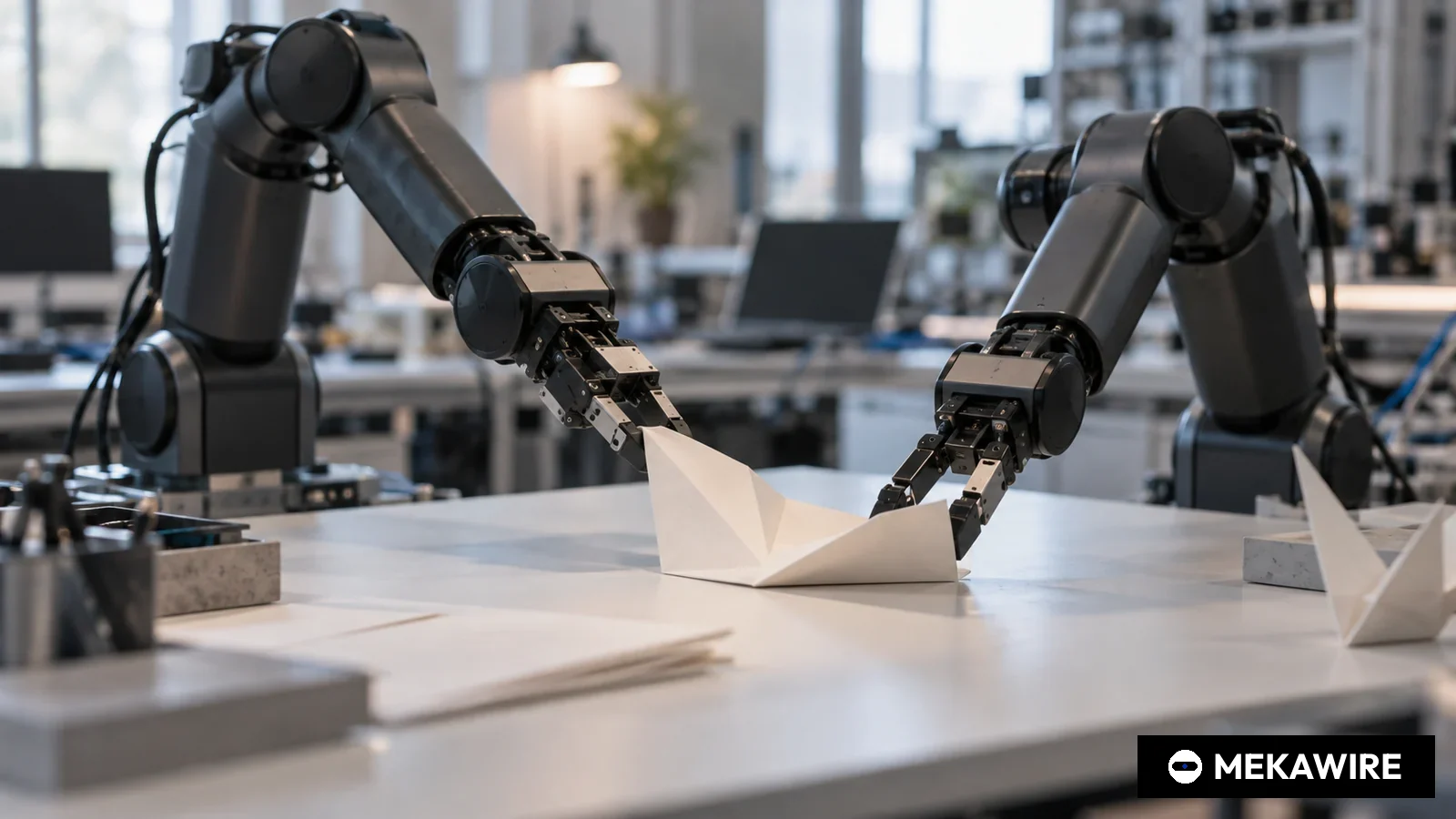
Google DeepMind on 12 March 2025 introduced two robot models built on its Gemini 2.0 family, the most direct attempt so far by a frontier AI lab to turn a general multimodal model into the controller of a physical machine. Gemini Robotics is a vision-language-action (VLA) model that adds physical actions as an output, so the same network that reads a camera feed and a spoken instruction also drives a robot's arms. Gemini Robotics-ER, short for embodied reasoning, is a vision-language model tuned for spatial understanding that robot makers can connect to their own controllers.
The company gave two headline numbers. In the announcement, written by Carolina Parada, Google DeepMind said Gemini Robotics more than doubles performance on a comprehensive generalization benchmark compared with other state-of-the-art VLA models. It said Gemini Robotics-ER, when used end to end to perceive, plan and generate code for a robot, reaches a success rate two to three times that of Gemini 2.0. The technical report released with the models says the action system runs at an effective 50 Hz, with a cloud-hosted backbone answering in under 160 milliseconds and end-to-end latency from raw observation to a chunk of low-level actions of about 250 milliseconds.
Most of the training robot data came from Google DeepMind's own fleet of ALOHA 2 bi-arm robots. According to the report, teleoperators collected thousands of hours of expert demonstrations across thousands of tasks over 12 months, and the lab mixed that with web documents, code, images, audio and video. In demonstrations the model folded an origami fox and packed a snack into a Ziploc bag. The report says the model learns new short-horizon tasks from as few as 100 demonstrations; after specialisation on 2,000 to 5,000 episodes per task it packed a lunch box with a 100% success rate over 20 trials. Google DeepMind also showed it adapted to a bi-arm Franka platform and to Apptronik's Apollo humanoid.
For the reasoning model the lab built a new open benchmark, ERQA, with 400 multiple-choice visual questions about the physical world, published on GitHub under a CC BY 4.0 licence. In the report's baseline results Gemini 2.0 Flash scored 46.3%, Gemini 2.0 Pro Experimental 48.3%, OpenAI's GPT-4o 47.0% and Anthropic's Claude 3.5 Sonnet 35.5%; chain-of-thought prompting lifted Gemini 2.0 Pro Experimental to 54.8%. On pointing, the skill a robot needs to know where to grasp, Gemini Robotics-ER scored 71.3 on Paco-LVIS against 46.1 for Gemini 2.0 Flash and 16.2 for GPT-4o, and it reached 48.3 AP@15 on SUN-RGBD 3D detection.
- Gemini Robotics-ER
- 71.3
- 49.5
- 45
- 48.3
- Gemini 2.0 Flash
- 46.1
- 25.8
- 33.8
- 30.7
- GPT-4o
- 16.2
- 5
- 20.6
- No data
- Claude 3.5 Sonnet
- 12.4
- 7.2
- 16.2
- No data
- Molmo 72B
- 47.1
- 12.5
- 63.8
- No data
Scores as reported in Tables 3 and 4 of the Gemini Robotics technical report (arXiv preprint 2503.20020). Pointing scores are accuracy, the share of predicted points that fall inside the ground-truth mask. 3D detection was not reported for GPT-4o, Claude 3.5 Sonnet or Molmo 72B, so null. Benchmarks selected and run by Google DeepMind, not independently replicated.
As of Oct 1, 2026
The commercial wrapper is a partner programme rather than a product. Google DeepMind said it is working with Apptronik, the US humanoid maker, to build the next generation of humanoid robots with Gemini 2.0. Apptronik had raised a US$350 million Series A on 13 February 2025, led by B Capital and Capital Factory with Google participating, and described a strategic collaboration with Google DeepMind's robotics team. Gemini Robotics-ER went to a group of trusted testers: Germany's Agile Robots, Agility Robotics, Boston Dynamics and France's Enchanted Tools. The VLA itself was not made generally available, and no pricing was given.
Google DeepMind, Alphabet's London-based AI lab, has run robot learning research for years, and the data behind this release came from its own ALOHA 2 bi-arm robots. What changed in March 2025 is the starting point. Instead of training a robot policy and attaching language later, the lab began from Gemini 2.0, which already knows what a Ziploc bag is and how a lunch box closes, and taught it to act.
The race it joined is crowded. Figure AI published Helix on 20 February 2025, a two-part model in which a 7-billion-parameter vision-language model reasons at 7 to 9 Hz and an 80-million-parameter policy drives a 35-degree-of-freedom upper body at 200 Hz, trained on about 500 hours of teleoperation and running entirely on embedded GPUs inside the robot. Physical Intelligence distributes its π0 models through the openpi repository with base checkpoints pretrained on more than 10,000 hours of robot data; the Gemini Robotics report used a re-implementation of π0 as one of its baselines. Six days after the Google launch, on 18 March, NVIDIA released Isaac GR00T N1 at GTC as an open, customizable humanoid model and said it generated 780,000 synthetic trajectories in 11 hours, improving performance by 40% when combined with real data.
- Gemini Robotics
- Google DeepMind
- 2025-03-12
- 50
- No data
- Not released; Gemini Robotics-ER to trusted testers
- Helix
- Figure AI
- 2025-02-20
- 200
- 500
- Proprietary (System 2 built on an open-weight 7B VLM)
- Isaac GR00T N1
- NVIDIA
- 2025-03-18
- No data
- No data
- Open, customizable
- π0 (openpi)
- Physical Intelligence
- No data
- No data
- 10,000
- Open (Apache-2.0 code)
Figures as disclosed by each developer on its own pages: Google DeepMind blog and technical report (effective control rate 50 Hz; robot data described only as thousands of hours, so null), Figure Helix page (System 1 at 200 Hz, about 500 hours of teleoperation), NVIDIA newsroom (GR00T N1 rate and real-data hours not disclosed; 780,000 synthetic trajectories), openpi repository (base checkpoints pretrained on 10k+ hours, entered as 10,000 as a floor; announcement date not confirmed on a primary page, so null). Not estimated.
As of Oct 1, 2026
Plainly put, there are two ways to use the release. A robot maker can hand the whole job to Gemini Robotics, which takes pixels and words in and puts joint commands out. Or it can keep its own motion control and ask Gemini Robotics-ER the questions that classical software struggles with, such as where to put a gripper on a mug, which way a drawer opens or what path to follow, and receive points, boxes and trajectories back. The second path is the one Google opened to outside companies first, which says something about how cautious the lab is about handing over direct motor control.
For the global industry the significance is the business model on display. Google DeepMind is positioning itself as a supplier of robot intelligence to many hardware makers at once, including companies that compete with each other, much as Android supplied phone software. That puts it in direct contest with Figure, which builds its own model for its own robot, and with NVIDIA, which gives models away to sell chips and simulation tools.
The open questions are substantial. The headline generalization claim is relative and measured on Google's own benchmark against baselines the authors chose, including their own re-implementation of a rival's model. The split architecture depends on a cloud backbone and a network link, which factories and homes cannot always guarantee. Not every benchmark went Google's way. On Where2Place pointing, the open Molmo 72B model scored 63.8 against 45.0 for Gemini Robotics-ER. Google DeepMind addressed safety with a dataset it calls ASIMOV for evaluating semantic safety and with what it calls data-driven constitutions, but neither substitutes for certified low-level safety controllers on real machines.
MEKAWIRE analysis
Gemini Robotics shows Google intends to sell the robot brain rather than the robot, and its success will be measured by how many hardware makers build on it rather than by benchmark leads.
The evidence is in how the launch was structured. The release names one humanoid partner and four trusted testers that build very different machines, from industrial arms to legged robots and service robots, and it publishes an open benchmark, ERQA, that invites the field to measure itself on Google's terms. A lab that wanted its own robot would not hand early access to Boston Dynamics and Agility Robotics.
The strongest counter-argument is that vertical integration may win. Figure's Helix runs on board, at four times the control rate Google disclosed, on a robot whose hardware the model team can change. Integrated players control the data loop, and in robotics the data loop may matter more than the size of the pretrained model.
Bull case: Gemini's internet-scale knowledge gives robots common sense no robotics company can collect on its own, and the ER model becomes the default perception and planning layer that dozens of manufacturers call through an API. Google then earns a platform position before any single hardware maker reaches scale.
Bear case: latency, connectivity and safety certification keep cloud-dependent control out of factories, while open models from NVIDIA and Physical Intelligence give hardware makers good-enough brains they can run and modify locally. Gemini Robotics then stays a research showcase.
- By Google I/O on 20 and 21 May 2025: whether Gemini Robotics-ER moves from trusted testers to a developer API.
- Through 2025: whether Google DeepMind ships a version of the action model that runs on the robot without a cloud link.
- Through 2025 and 2026: whether Apptronik's Apollo reaches paid deployments running Gemini models, the first real test of the partner strategy.
- Gemini Robotics (VLA) and Gemini Robotics-ER (embodied reasoning), both built on Gemini 2.0
- 12 March 2025
- No general release or pricing announced
- Effective 50 Hz; about 250 ms end-to-end latency; backbone under 160 ms
- 2x to 3x the success rate of Gemini 2.0
- ERQA, 400 questions, CC BY 4.0
- More than double the performance of other leading VLA models on Google's generalization benchmark
- Apptronik (Apollo)
- Agile Robots, Agility Robotics, Boston Dynamics, Enchanted Tools
- Thousands of hours of ALOHA 2 teleoperation over 12 months
Why it matters
Until March 2025 the most capable multimodal models from the large AI labs reasoned about images and text but did not drive motors. Gemini Robotics is the first time one of the three or four frontier labs put its flagship model family directly into a robot's control loop and published a technical report with latency, data and benchmark figures. That moves the competitive frontier in robot foundation models from start-ups and chipmakers to a company with Google's compute, data and distribution.
It also reframes what a robot maker needs to own. If a general model can supply perception, spatial reasoning and task planning through an API, hardware makers can concentrate on actuators, safety and cost, and buy intelligence. The four trusted testers and the Apptronik partnership are the first test of whether manufacturers accept that division of labour.
Rival analysis
Figure AI is the clearest strategic opposite. Helix, published three weeks earlier, runs a 7-billion-parameter model and an 80-million-parameter policy on embedded GPUs in the robot, controls 35 degrees of freedom at 200 Hz and was trained on about 500 hours of teleoperation. Figure sells robots and keeps the model; Google sells neither robots nor, yet, the model, and is building a partner bench instead.
NVIDIA and Physical Intelligence attack from the open side. NVIDIA's GR00T N1, released on 18 March 2025, is free and customizable because NVIDIA monetises chips, Omniverse and Cosmos. Physical Intelligence's openpi checkpoints, pretrained on more than 10,000 hours, give any lab a capable baseline it can fine-tune. Google's advantage is the breadth of Gemini's world knowledge; its disadvantage is that partners cannot inspect or run the action model themselves.
Valuation context
Alphabet does not report robotics revenue or investment, so there is no direct valuation read. The partner layer is where capital is visible. Apptronik raised US$350 million in a Series A on 13 February 2025 led by B Capital and Capital Factory, with Google participating, and added US$53 million on 18 March 2025, according to the company. Agile Robots last disclosed a US$220 million Series C in 2021, and Agility Robotics a US$150 million Series B in 2022.
Among model developers, Figure raised US$675 million in its 2024 Series B and Skild AI raised a US$300 million Series A at a US$1.5 billion valuation in July 2024. Those numbers show investors were already paying for robot brains before Google's entry; the launch raised the bar that independent model start-ups must clear to justify those valuations.
Supply-chain implications
The data supply chain matters more here than parts. Gemini Robotics depends on teleoperated demonstrations from a fleet of ALOHA 2 robots collected over 12 months. Teleoperation labour and the bi-arm rigs themselves are the inputs that scale the model, and the report's finding that 2,000 to 5,000 episodes specialise a task puts a price on each new skill.
On the compute side, the split design places the heavy model in Google's cloud and a small action decoder on the robot. That lowers the on-board compute bill for partners compared with Figure's dual embedded GPUs or NVIDIA's Jetson route, but it shifts cost to connectivity and to Google's inference fees, which were not disclosed.
Signals to watch
The first signal is access. Gemini Robotics-ER went to four trusted testers; a developer API would show Google is ready to compete for the perception and planning layer across the industry. Google I/O on 20 and 21 May 2025 is the natural venue.
The second is architecture. A version of the action model that runs on the robot without a cloud backbone would remove the main objection from factory and home customers. The third is Apptronik: paid deployments of Apollo running Gemini models would be the first commercial proof of the partner strategy.
Analyst view
Thesis: Google DeepMind has the strongest general model in robotics as of March 2025 but has not yet shown a route to revenue, and the partner strategy will take at least two years to prove. Confidence: medium.
Reasons for medium rather than high: the technical report is detailed and the ERQA and pointing results are reproducible, which supports the capability claim. Against that, the headline generalization figure is relative and self-measured, the VLA is not available to outsiders, and integrated rivals such as Figure run faster control loops on board. The confidence would rise with an API, an on-device model and a named commercial deployment.
Questions you should be asking
How will Google price access to Gemini Robotics and Gemini Robotics-ER, and will partners be able to fine-tune the action model on their own data without sharing it with Google?
What happens to control quality when the network link degrades, and how does the on-board decoder fail safe? Who owns the demonstration data collected on partner robots? And will Google DeepMind submit the models to independent benchmarks that it did not design?