Hyundai Mobis wins first robotics customer as Atlas actuator supplier to Boston Dynamics
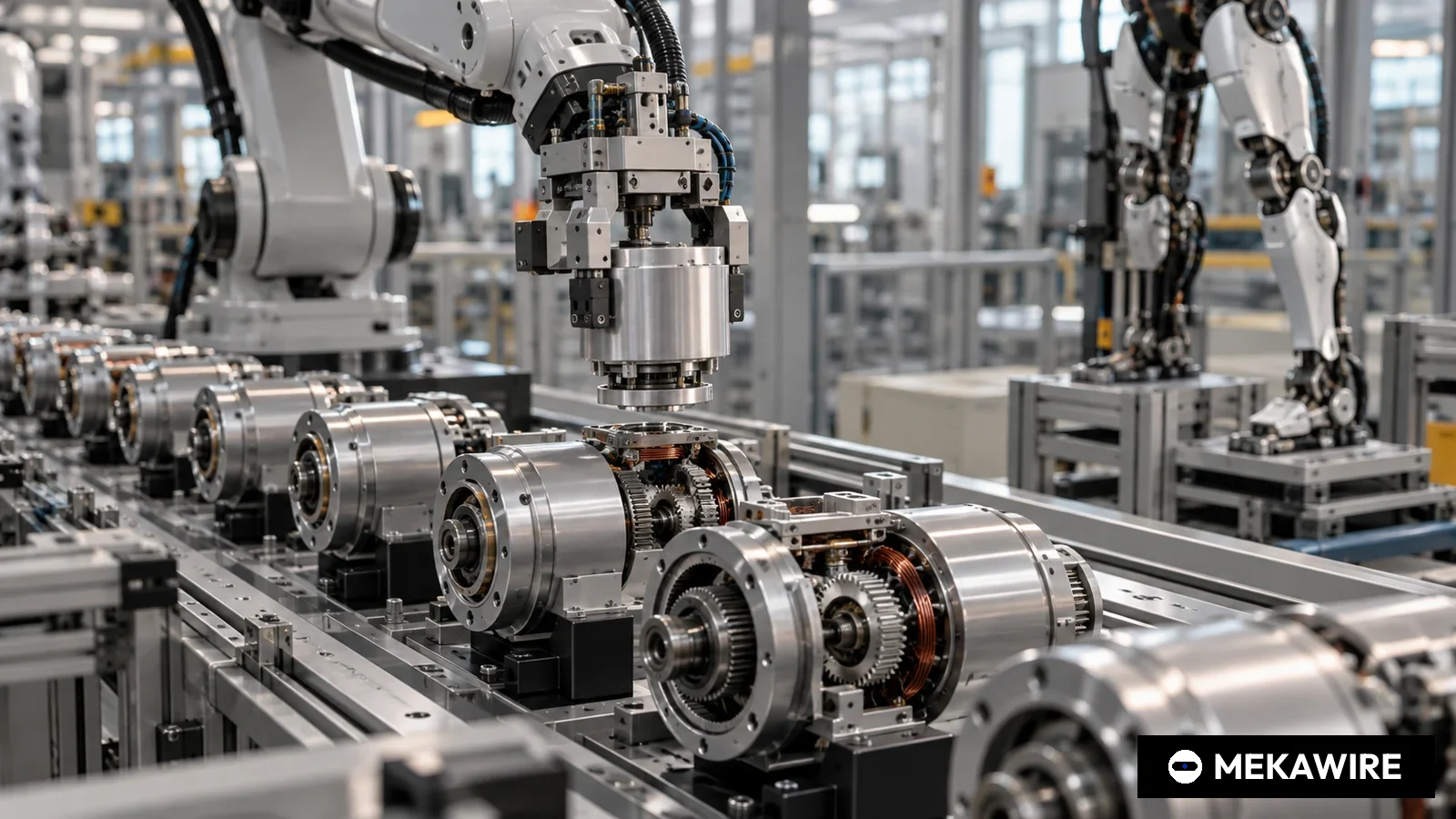
Hyundai Mobis will supply actuators for the production version of Boston Dynamics' Atlas humanoid under a framework announced at CES on January 7, 2026, its first robotics customer. The Hyundai parts maker says actuators make up more than 60% of a humanoid's material cost, and plans to extend the tie-up to grippers, sensors, controllers and battery packs as Hyundai Motor Group targets 30,000 robots a year by 2028.
Hyundai Mobis, the auto parts maker inside Hyundai Motor Group, said on January 7, 2026 that it will supply actuators for the production version of Boston Dynamics' Atlas humanoid. The agreement, announced at CES in Las Vegas as a strategic collaboration framework, gives Hyundai Mobis its first customer for robot components and places a Korean tier-one supplier at the centre of the group's plan to build humanoids in volume.
The economics explain the move. Hyundai Mobis says actuators account for more than 60% of the material cost of a humanoid robot. The company puts the global robotics market at about 75 trillion won today and expects it to grow by nearly 17% a year to roughly 800 trillion won by 2040. Hyundai Motor Group, for its part, said on January 5 that it aims to build a US robot plant with capacity for 30,000 units a year by 2028, inside a US investment plan of $26 billion over four years from 2025 and a Korean plan of 125.2 trillion won over five years from 2026.
Under the framework, Hyundai Mobis will deliver actuators once Atlas enters mass production. In its Korean release of January 8, the company said the two sides plan to extend the cooperation to hand grippers, sensors, controllers and battery packs, and that Boston Dynamics had weighed its component design skills, reliability testing system and record of mass production to global quality standards. Neither company disclosed volumes, prices, contract length or financial terms.
Se Uk Oh, who leads robotics at Hyundai Mobis, described the deal as a step toward a stronger global supply base for robot components. Zack Jackowski, who runs the Atlas business at Boston Dynamics, said actuators are what allow a humanoid to move and that Hyundai Mobis' automotive experience would help build a reliable component supply chain.
The robot those parts go into was shown two days earlier. Boston Dynamics said the product Atlas has 56 degrees of freedom, lifts 50 kg, reaches 2.3 metres and works between minus 20°C and 40°C, and that it can walk to a charging station and swap its own battery. Production started immediately, according to the company, and every Atlas unit for 2026 is already committed to Hyundai's Robotics Metaplant Application Center (RMAC) and to Google DeepMind, with more customers to be added from early 2027. Hyundai Motor Group plans to put Atlas on parts sequencing at its Georgia Metaplant from 2028 and on component assembly by 2030.
Hyundai Mobis first signalled the move at its CEO Investor Day on August 27, 2025, when it said it would enter the actuator market by drawing on its steering business, because robot actuators and electric power steering share core components. At the same event it set targets of more than 8% annual sales growth and an operating margin of 5% to 6% by 2027. Its January release said about 200 customer representatives from North America and Europe visited its private CES booth over four days.
Rival humanoid makers are building their own supply bases. Figure AI said in March 2025 that the first line at its BotQ plant could make up to 12,000 humanoids a year and that its supply chain could scale to 100,000 robots or 3,000,000 actuators within four years. Agility Robotics said its RoboFab plant in Salem, Oregon would reach more than 10,000 robots a year at full capacity. In Japan, precision reducer makers such as Harmonic Drive Systems and Nabtesco have long supplied the gearing inside industrial robot joints, and the humanoid build-out tests whether integrators buy such parts or source whole actuator modules.
- Hyundai Motor Group / Boston Dynamics
- Atlas, US robot plant
- 30,000
- No data
- 2026-01-05
- Figure AI
- BotQ first-generation line
- 12,000
- 100,000
- 2025-03-15
- Agility Robotics
- Digit, RoboFab Salem (full capacity)
- 10,000
- No data
- 2023-09-18
Figures as disclosed by each company, not estimates. Hyundai target is 30,000 units a year by 2028 (Hyundai Motor Group, 2026-01-05). Figure: up to 12,000 a year on the first BotQ line and a supply chain it says can scale to 100,000 robots or 3,000,000 actuators within four years (2025-03-15). Agility: more than 10,000 a year at full RoboFab capacity (2023-09-18). Hyundai Mobis has not disclosed actuator volumes.
As of Oct 1, 2026
An actuator in this sense is a packaged joint: an electric motor, a reduction gear, position and torque sensors and drive electronics that turn a controller's command into a measured movement. Boston Dynamics describes the new Atlas as fully electric with fully rotational joints, which puts the burden of strength, precision and endurance on dozens of such modules. Electric power steering performs a similar task in a car, converting a signal into precise torque thousands of times a day for years, which is the overlap Hyundai Mobis is betting on.
For the industry, the deal shows a carmaker group keeping its costliest humanoid subsystem in house, in the way it secures modules for vehicles. If Hyundai Motor Group reaches 30,000 robots a year and each Atlas carries dozens of actuators, the volume would resemble an automotive component programme more than a robotics one, although none of the parties has published a per-robot actuator count or price.
The open questions are material. The companies have not said who owns the actuator design, how many units Hyundai Mobis will produce, or when Atlas reaches mass production beyond the 2026 allocation. Hyundai Mobis has reported no robotics revenue, and its only disclosed robot customer is an affiliate. The broader market forecast of 800 trillion won by 2040 is the company's own estimate.
The dates to watch are the opening of RMAC in 2026, the first non-captive Atlas customers in early 2027, the 30,000-unit capacity target in 2028, and Atlas moving into component assembly at the Georgia Metaplant by 2030.
MEKAWIRE analysis
Hyundai is wiring the humanoid supply chain the way it wired its car supply chain, with the most expensive subsystem placed inside the group from day one.
The evidence is in the sequencing. Hyundai Mobis announced its actuator ambition in August 2025, Hyundai Motor Group fixed a 30,000-unit capacity target on January 5, and two days later Hyundai Mobis was named Atlas supplier with grippers, sensors, controllers and battery packs on the follow-on list. Hyundai Motor Group says Hyundai Mobis is also tasked with standardising key components for the robot supply chain.
The strongest counter-argument is that captive supply can trap cost and quality inside the family. Figure's 3,000,000-actuator ambition shows rivals expect the same volume curve, and if an outside specialist builds a cheaper or more durable joint, an affiliate contract offers Boston Dynamics less room to switch.
Bull case. Atlas ramps on schedule, the RMAC and Google DeepMind deployments validate the hardware in 2026, and Hyundai Mobis turns a steering-derived actuator line into a business that later sells to robot makers outside the group. The 60% cost share means each production gain lands directly in the robot's bill of materials.
Bear case. Humanoid demand stays at pilot scale through 2028, the 30,000-unit plant runs well below capacity, and Hyundai Mobis carries tooling and engineering cost for a product with one affiliated buyer. Outside robot makers then treat the group's parts as a rival's components and look elsewhere.
- 2026: RMAC opens and the first fully committed Atlas units are delivered
- Early 2027: Boston Dynamics adds Atlas customers beyond Hyundai and Google DeepMind
- 2028: Hyundai's 30,000-unit US capacity target and Atlas parts sequencing at the Georgia Metaplant
- Boston Dynamics (Atlas humanoid)
- Hyundai Mobis
- January 7, 2026, CES Las Vegas
- 56 degrees of freedom, 50 kg lift, 2.3 m reach
- Not disclosed
- Hand grippers, sensors, controllers, battery packs
- Fully committed to Hyundai RMAC and Google DeepMind
- 30,000 units a year by 2028
- More than 60% (Hyundai Mobis)
Why it matters
The actuator is the part of a humanoid that sets cost, strength and service life, and Hyundai Mobis says it represents more than 60% of material cost. Whoever supplies it at automotive scale controls most of the bill of materials. Hyundai Motor Group has now assigned that role to an affiliate with decades of high-volume production behind it.
The deal also converts Hyundai Motor Group's robotics plan from an R&D story into a supply chain with named roles. According to the group's January 5 release, Boston Dynamics designs the robot, Hyundai Motor and Kia supply factories and production data, Hyundai Mobis supplies actuators and standardises components, and Hyundai Glovis handles logistics.
Rival analysis
Figure AI and Agility Robotics have disclosed their own plant capacities (12,000 and more than 10,000 units a year respectively), and Figure has said its supply chain could reach 3,000,000 actuators within four years. Neither has a tier-one automotive supplier inside the same corporate group, which is Hyundai's structural difference.
Japanese incumbents such as Harmonic Drive Systems and Nabtesco supply precision reducers for robot joints. If humanoid makers move to buying complete actuator modules from automotive-style integrators, component makers that sell only gears face pressure to move up into modules or to partner with integrators.
Valuation context
No financial terms were disclosed, so the deal cannot be valued. Hyundai Mobis' own guidance from August 2025 (more than 8% annual sales growth and a 5% to 6% operating margin by 2027) does not break out robotics.
Investors therefore have only proxies: the 30,000-unit capacity target, the 60% cost share and the company's 800 trillion won market estimate for 2040. Each is a company figure, and none translates into revenue until per-robot content and pricing are disclosed.
Supply-chain implications
An Atlas actuator combines a motor, reducer, sensors and drive electronics. Hyundai Mobis says these share core components with electric power steering, which suggests it can reuse motor, control and gear know-how and existing quality systems.
The follow-on list of hand grippers, sensors, controllers and battery packs would extend Hyundai Mobis' content well beyond joints. If executed, Boston Dynamics would rely on one affiliate for most of the robot's hardware, concentrating both savings and risk.
Signals to watch
RMAC opening in 2026 and the first Atlas deliveries there; additional Atlas customers from early 2027; the 30,000-unit US plant by 2028; Atlas at the Georgia Metaplant from 2028 for parts sequencing and by 2030 for component assembly.
On the supplier side, any disclosure by Hyundai Mobis of robotics revenue, actuator volumes, a dedicated production line, or a customer outside Hyundai Motor Group would mark the shift from captive supplier to merchant supplier.
Analyst view
Thesis: the Atlas actuator deal is the first concrete proof that Hyundai Motor Group intends to own the humanoid bill of materials, not merely the robot brand.
Confidence: medium. The roles, targets and timelines are documented in primary releases from Hyundai Mobis, Hyundai Motor Group and Boston Dynamics. Confidence is not high because volumes, pricing, design ownership and the Atlas production rate beyond the fully committed 2026 allocation are undisclosed, and the only customer is an affiliate.
Questions you should be asking
How many actuators does one Atlas use, and what share of them will Hyundai Mobis make rather than assemble from bought-in reducers and motors? Who owns the actuator intellectual property?
Will Hyundai Mobis sell actuators to humanoid makers outside the group, and on what timeline? How will Boston Dynamics price Atlas for customers from 2027 given captive component costs?