Hyundai Motor Group pledges KRW125.2 trillion in Korea to 2030, adding a robot foundry and a physical AI test center
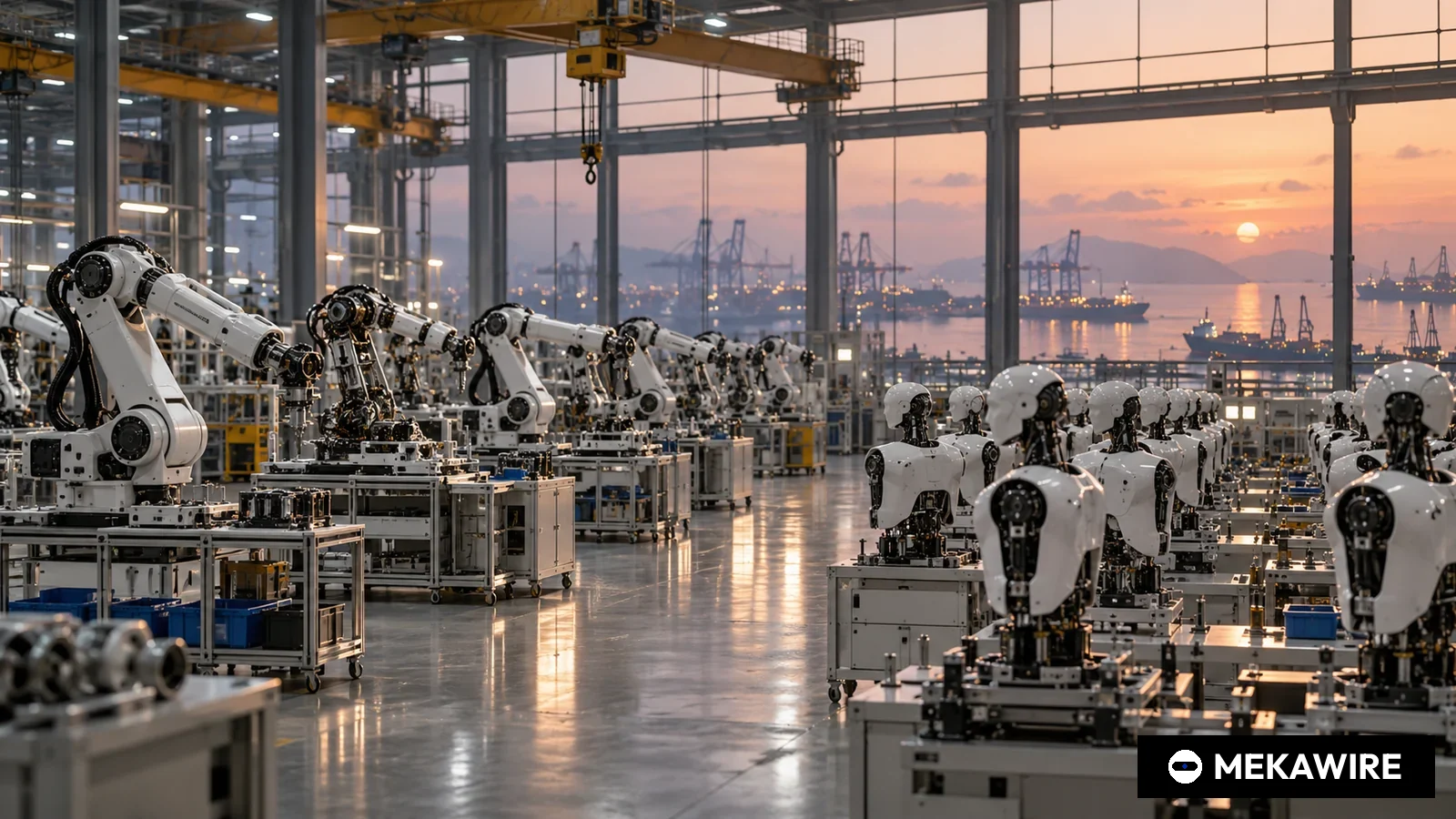
Hyundai Motor Group said on 16 November 2025 it will invest KRW125.2 trillion in South Korea from 2026 to 2030, its largest domestic commitment and KRW36.1 trillion more than in the previous five years.
The plan puts KRW50.5 trillion into future businesses including AI, robotics and hydrogen, and lists a robot manufacturing and foundry facility, a Physical AI Application Center and a petabyte-scale AI data center that is still under review.
Hyundai Motor Group said on 16 November 2025 that it would invest KRW125.2 trillion in South Korea over the five years from 2026 to 2030, the largest domestic pledge in its history, and put robots trained by artificial intelligence close to the centre of the programme. The group said the figure is KRW36.1 trillion higher than the KRW89.1 trillion it invested at home in 2021 to 2025.
According to the group's release, KRW50.5 trillion is earmarked for future businesses, which it defines as AI, software-defined vehicles, electrification, robotics and hydrogen. A further KRW38.5 trillion goes to research and development and KRW36.2 trillion to capital spending on production facilities and the Global Business Center in Seoul. The group put average annual investment at KRW25.04 trillion, against about KRW17.8 trillion in the previous period, an increase of more than 40 percent.
- Future businesses (AI, SDV, electrification, robotics, hydrogen)
- 50.5
- 40.3
- Research and development
- 38.5
- 30.8
- Capital spending (plants, Global Business Center)
- 36.2
- 28.9
- Total
- 125.2
- 100
Share = category / 125.2, rounded to one decimal. Robotics spending is not disclosed separately within future businesses.
As of Oct 1, 2026
The robotics items are specific in purpose but not in money. Hyundai said it will build a robotics manufacturing and foundry facility that can produce complete robot systems in house and offer contract production to small and medium-sized companies. It will set up a Hyundai Motor Group Physical AI Application Center to check the completeness and safety of robots trained by AI on large volumes of behavioural data, and to serve as a testbed before those robots go into real work. The group also said it is reviewing a high-power AI data center with petabyte-scale storage for training data generated by physical AI robots and autonomous vehicles. It did not give a site, a capacity or a separate budget for any of the three.
A fourth item concerns the supply base. Hyundai said it will support research and development of robot components by its existing automotive parts suppliers, so that they can enter the robotics business and localise core components in Korea. The release does not name the parts or the suppliers.
The timing was political as well as industrial. On the same day President Lee Jae Myung hosted a public-private meeting on the follow-up to the Korea-US tariff negotiations with the heads of seven groups, including Hyundai Motor Group chairman Euisun Chung, according to the presidential office briefing. Lee asked the companies to keep investing at home while they expand in the United States and to pay attention to regional economies. The tariff agreement, announced by the government on 29 October 2025, set a 15 percent US tariff on Korean cars and a USD350 billion investment package made up of USD200 billion in cash investment and USD150 billion in shipbuilding cooperation, with cash outflows capped at USD20 billion a year.
The Korean plan sits beside a larger robot commitment in America. On 26 August 2025 the group raised its US investment for 2025 to 2028 to USD26 billion, USD5 billion above the figure it gave in March, and said the money includes a US robotics facility with annual capacity of 30,000 units for design, manufacturing, testing and deployment. On 31 October 2025 Hyundai and NVIDIA said they would invest about USD3 billion together to support Korea's physical AI cluster, built around 50,000 NVIDIA Blackwell GPUs, Hyundai's Physical AI Application Center, an NVIDIA AI Technology Center and physical AI data centers, under a memorandum signed with the Ministry of Science and ICT.
- Hyundai Motor Group, Korea plan
- 2026-2030
- 125.2
- KRW trillion
- 5
- 25.04
- Hyundai Motor Group, previous Korea period
- 2021-2025
- 89.1
- KRW trillion
- 5
- 17.82
- Samsung, Korea plan
- next 5 years
- 450
- KRW trillion
- 5
- 90
- Hyundai Motor Group, US plan
- 2025-2028
- 26
- USD billion
- 4
- 6.5
- Hyundai Motor Group and NVIDIA, Korea physical AI cluster
- not disclosed
- 3
- USD billion (approx.)
- No data
- No data
Annual average = amount / years, in the unit shown. Amounts as disclosed by the companies on 16 Nov 2025, 26 Aug 2025 and 31 Oct 2025; no currency conversion. The NVIDIA figure is a joint Hyundai and NVIDIA amount with no stated period.
As of Oct 1, 2026
Hyundai's robot business rests on Boston Dynamics, in which the group took an 80 percent controlling stake in June 2021 at a valuation of USD1.1 billion, with SoftBank keeping 20 percent through an affiliate. The 16 November release does not mention Boston Dynamics by name, nor does it say which affiliate will run the foundry or the application center.
Among Korean peers, Samsung announced the same day that it would invest KRW450 trillion at home over five years, led by five production lines at Pyeongtaek Complex 2 due to run fully from 2028 and Samsung SDS AI data centers in the Jeolla region with 15,000 GPUs by 2028. Samsung's announcement did not mention robots. Abroad, the best-funded humanoid developers are building their own production; Figure AI raised more than USD1 billion in a Series C at a USD39 billion post-money valuation in September 2025.
In plain terms, physical AI means software models that learn to move and handle objects from recorded behaviour, simulation and video rather than from hand-written instructions. That approach needs large storage for sensor logs and video, which is why the data center is specified in petabytes, and it produces robots whose behaviour is hard to certify in advance. A dedicated center that tests such robots before they reach a factory floor is the industrial equivalent of a crash-test lab.
The open questions are material. The data center is only under review, the robot spending is not broken out from the KRW50.5 trillion, and the bulk of the total also funds car plants, steel and hydrogen. Hyundai listed nearer milestones elsewhere in the plan: the Ulsan dedicated EV plant is due to be completed in 2026, a hydrogen fuel cell plant is due to start in 2027 and an SDV Pace Car is due in the second half of 2026. The first robotics detail to watch is a site and capacity for the foundry.
MEKAWIRE analysis
Hyundai is splitting its robot business across the Pacific, sending volume assembly to a 30,000-unit US plant while keeping training data, safety validation and the component base in Korea, which makes its parts suppliers the real test of the robotics part of this plan.
The evidence is in what each plan contains. The US plan carries the only disclosed robot output figure, 30,000 units a year. The Korean plan carries the items that sit upstream of assembly: a data center for robot training data, a center that certifies AI-trained robots, a foundry open to smaller firms and a programme to move car-parts suppliers into robot components. The NVIDIA agreement of 31 October supplies the compute for that upstream work.
The strongest counter-argument is that the robotics lines are small and undefined inside a pledge dominated by vehicles, R&D and capital spending, and that the Korean announcement partly responds to a presidential request after a tariff deal. On that reading the robot items are placeholders rather than a strategy.
Bull case. If the foundry and supplier programme take hold, Korea gains a domestic source of actuators and other core parts that serves both the US plant and other robot makers, and the application center becomes a de facto standard for certifying AI-trained robots. Hyundai would then earn from robots it does not assemble itself.
Bear case. Without disclosed budgets, the data center could stay on review and the foundry could shrink to a pilot line, while the US plant pulls engineering talent and orders overseas. Suppliers would then lack the volumes needed to justify robot-part investment.
Signals to watch:
- 2026: a site, capacity and operator for the robotics manufacturing and foundry facility.
- 2026: a final investment decision on the petabyte-scale AI data center, now under review.
- Second half of 2026: the first named auto-parts suppliers moving into robot components under Hyundai's programme.
- KRW36.1 trillion
- 16 November 2025
- Robot manufacturing and foundry facility; Physical AI Application Center; AI data center under review
- KRW36.2 trillion
- 30,000 units a year, within USD26 billion for 2025 to 2028
- KRW38.5 trillion
- 2.47 million units (2.18 million in 2024)
- KRW89.1 trillion
- KRW125.2 trillion
- KRW50.5 trillion
Why it matters
This is the first time Hyundai Motor Group has written robot manufacturing, robot certification and robot training data into a domestic investment plan of this size. Until now the group's robotics story was told mainly through Boston Dynamics in the United States and the 30,000-unit US facility in the August 2025 plan. The 16 November plan gives Korea a defined role in that business, even if the money behind each item is not disclosed.
The plan also links three announcements made within three weeks: the 29 October tariff agreement, the 31 October NVIDIA agreement on 50,000 Blackwell GPUs and the 16 November pledge. Read together, they show the group placing compute and validation in Korea and volume assembly near its US car plants.
For the Korean robot industry the most consequential line may be the supplier programme. Hyundai's automotive supply base is one of the largest industrial networks in the country, and an explicit invitation to move into robot components gives those firms a customer signal they have lacked.
Rival analysis
Samsung's KRW450 trillion plan, announced the same day, is more than three times larger but is built around memory chips, AI data centers at Samsung SDS and batteries, and does not mention robots. Hyundai therefore owns the most explicit domestic robot-manufacturing pledge among Korea's largest groups as of 16 November 2025.
Outside Korea, humanoid developers such as Figure AI, which closed a Series C of more than USD1 billion at a USD39 billion post-money valuation in September 2025, are building their own production capacity. Hyundai's distinctive asset is that it is its own first customer: it can deploy robots in its car plants, as the August plan says the US facility will design, make, test and deploy them.
The weakness relative to rivals is disclosure. Neither the foundry capacity in Korea nor the spending on robots is broken out, which makes it hard to compare the Korean commitment with the explicit unit figure in the US plan.
Valuation context
Hyundai took 80 percent of Boston Dynamics in June 2021 at a USD1.1 billion valuation, with SoftBank keeping 20 percent through an affiliate. That remains the last valuation the group disclosed for its robotics arm in the documents reviewed here.
At the group level, the Korean plan implies average annual investment of KRW25.04 trillion, compared with about KRW17.8 trillion a year in 2021 to 2025. The US plan implies about USD6.5 billion a year over 2025 to 2028. Neither figure isolates robotics, so any valuation argument for the robot business rests on future disclosures rather than on this release.
Supply-chain implications
The plan names three supply-chain levers. The foundry facility would make complete robot systems and accept contract work from small and medium-sized firms, lowering the capital needed for a start-up to build hardware. The supplier programme targets existing automotive parts makers and asks them to localise core robot components. The application center would sit between the two, certifying that AI-trained robots behave safely before deployment.
Hyundai did not list which components it means. In robots the cost and performance bottlenecks are typically actuators, precision reducers, sensors and compute, and car-parts makers already handle motors, gears and electronics at volume. Whether they can meet robot tolerances and costs at low early volumes is the open point.
On compute, the NVIDIA agreement provides the GPUs, while the AI data center in this plan would hold the training data. Power for a high-power data center is not addressed in the release.
Signals to watch
The first signal is a site and capacity for the robotics manufacturing and foundry facility, which the release describes but does not locate. The second is a final decision on the AI data center, which the group says it is reviewing.
The third is the supplier programme becoming concrete, in the form of named suppliers, funding or joint development agreements for robot components. A fourth, indirect signal is progress at the US robotics facility with 30,000 units of annual capacity, since Korean-made components would most naturally flow there.
Dated milestones elsewhere in the plan, including completion of the Ulsan dedicated EV plant in 2026, the SDV Pace Car in the second half of 2026 and the hydrogen fuel cell plant in 2027, will show whether the group keeps to the schedules it published.
Analyst view
Thesis: the Korean plan turns Korea into the data, validation and components base for Hyundai's robots while volume assembly goes to the United States. Confidence is medium. The direction is clear from the content of the two plans and the NVIDIA agreement, but the absence of robot budgets, sites and capacities in Korea means the scale of the domestic role cannot yet be measured.
What would raise confidence is a disclosed capacity for the Korean foundry and named suppliers. What would lower it is the data center staying under review into 2027 or the foundry being described only as a pilot line.
Questions you should be asking
How much of the KRW50.5 trillion for future businesses is allocated to robotics, and over which years?
Which affiliate will own and operate the foundry and the Physical AI Application Center, and what role will Boston Dynamics play in Korea?
Will the application center's safety tests be offered to other robot makers, and will they be aligned with Korean or international certification schemes?
How will the high-power AI data center be supplied with electricity, and where will it be located?