Ocado pockets £261 million from Kroger site closures and cuts £150 million of costs to turn cash positive
Ocado Group's technology unit lifted revenue 13% to £561.2 million and its EBITDA margin to 25% in the year to November 2025, but Kroger closed three US fulfilment centres in January and paid £261 million in closure fees.
The British automation group guided technology revenue down to about £500 million for FY26, plans to cut about £150 million of costs with significant job losses, and expects to turn cash flow positive in the second half.
Ocado Group said on 26 February 2026 that it expects to turn cash flow positive during the second half of its 2026 financial year and that a significant number of roles will no longer be required, as the British warehouse robotics group absorbed the closure of three Kroger fulfilment centres in the United States and reset its technology business around fewer, more profitable sites.
For the 52 weeks to 30 November 2025, the London-listed company reported group revenue of £1,361.5 million, up 12.1%, and group adjusted EBITDA of £178.0 million, compared with £111.7 million a year earlier. Technology Solutions, the division that licenses Ocado's robotic Customer Fulfilment Centres (CFCs) to grocers, grew revenue 13.0% to £561.2 million, and its adjusted EBITDA margin rose to 25.0% from 16.2%. Statutory profit before tax was £402.9 million, but the results statement shows that figure includes a £782.6 million gain from revaluing Ocado Retail when it was deconsolidated. Underlying cash outflow widened to £213 million from £199 million, and the company ended the year with £740.0 million of cash and gross liquidity of £1.04 billion.
The Kroger reset dominates the release. According to Ocado, Kroger closed the CFCs in Frederick, Maryland, Pleasant Prairie, Wisconsin, and Groveland, Florida, in January 2026 after a review of its ecommerce business identified them as underutilised. Five Kroger sites remain live, in Monroe, Ohio, Dallas, Atlanta, Denver and Detroit, and a Phoenix site is still scheduled for FY26 or FY27. Ocado received £261 million of closure fees from Kroger in January and February 2026, which it describes as payment in lieu of future capacity fees for closed or cancelled sites. Canadian partner Sobeys closed its Calgary CFC, keeping Toronto and Montreal, and paid £18 million.
The guidance shows what the closures cost. Ocado expects Technology Solutions revenue of about £500 million in FY26 with an EBITDA margin of about 30%, both excluding closure fees. It forecasts a full-year underlying cash outflow of around £200 million excluding those fees, turning positive during the second half, and full-year positive cash flow in FY27. Capital expenditure is guided at about £250 million. Aggregate technology spend and support costs are to fall by about £150 million by FY27, and chief executive Tim Steiner wrote that a significant number of roles will no longer be required. The company booked £14.8 million of organisational restructuring costs in FY25 and did not publish a headcount figure.
The operating base was broadly flat. Ocado ended the year with 30 live sites, made up of 26 CFCs and four smaller Zoom sites, carrying 122 modules against 123 a year earlier, while average live modules rose 4.3% to 121. International weekly CFC volumes at partners grew 26%, and the company said 72 million orders were shipped worldwide on its platform in FY25. Scheduled go-lives include Busan for Lotte and a second Tokyo site for AEON in FY26, followed by Barcelona, a third Tokyo site and Seoul in FY27 or FY28. Ocado also said exclusivity arrangements have concluded in most markets, which it presented as freedom to sign new partners.
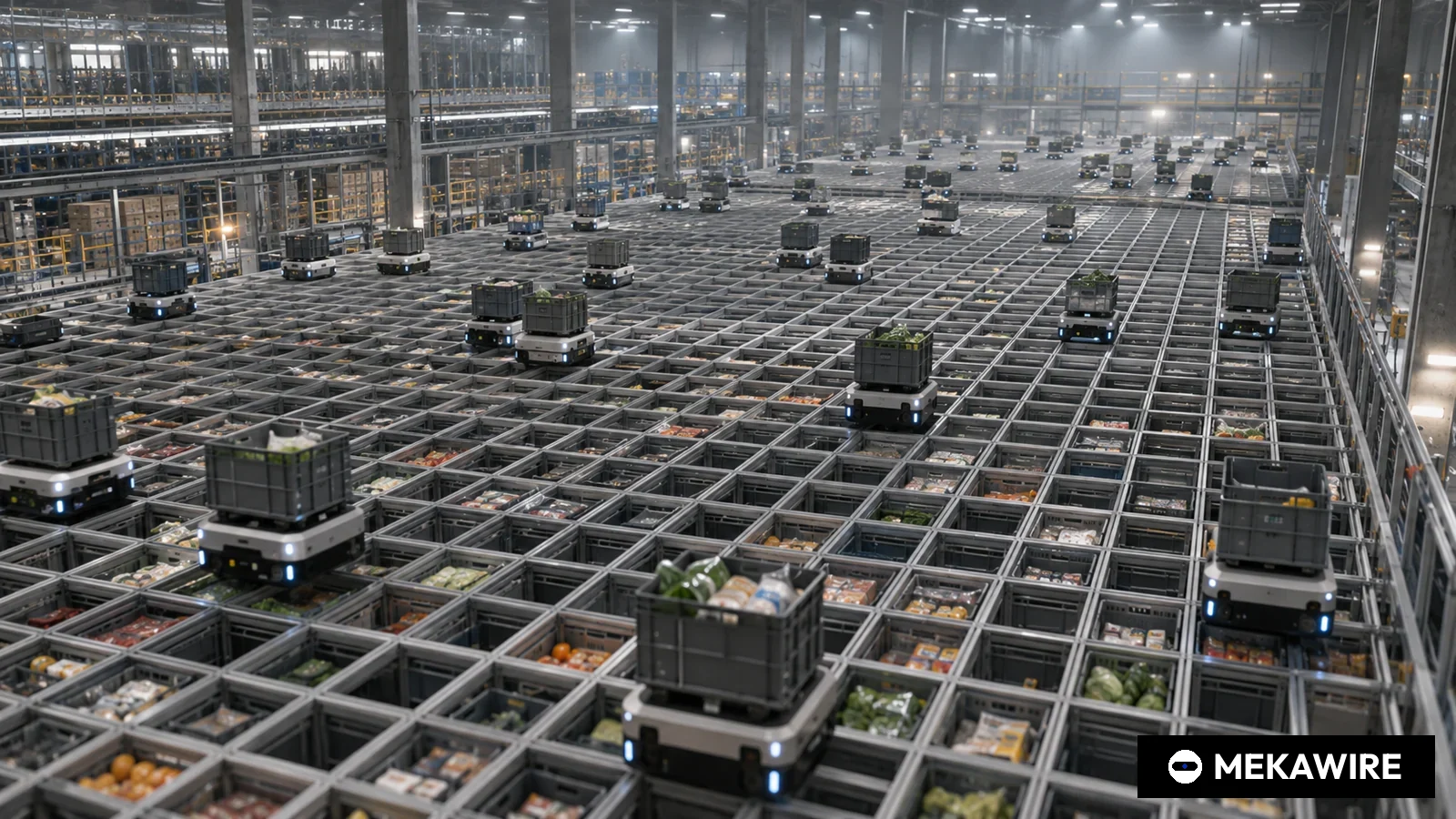
The technology explains why Ocado believes it can raise margins on a smaller network. A CFC stores goods in crates stacked inside a large grid, with battery-powered bots running on top to fetch and deliver crates. Ocado's On-Grid Robotic Pick (OGRP) arms pick items straight from those crates on the grid, removing a manual picking step, and are now live in 10 CFCs; Ocado says its most advanced site picks about 50% of volumes robotically. Automated frame loading runs in 12 CFCs, the new 600 Series bots are described as the lightest and most efficient Ocado has built, and the Luton CFC reached a record 318 units per hour. Store Based Automation, a smaller format for retail stores, enters trials in FY26.
Outside grocery, Ocado Intelligent Automation generated £35.6 million of revenue, including the sale of equipment for a McKesson storage facility in Canada, and signed a second storage contract with Gap Inc. The group also collected £58 million in final receipts from its litigation settlement with AutoStore during FY25.
The comparison with listed rivals is instructive. AutoStore, the Norwegian cube storage supplier with which Ocado settled a patent dispute, reported 2025 revenue of $538.6 million, down 10.4%, at a 42.3% adjusted EBITDA margin, with about 1,900 systems in 65 countries. Symbotic, which automates Walmart distribution centres, reported fiscal 2025 revenue of $2,247 million and adjusted EBITDA of $147 million. KION's Supply Chain Solutions segment reported 2025 revenue of €3,071.4 million at a 6.0% adjusted EBIT margin and order intake of €3,599 million. Ocado's technology margin sits well below AutoStore's product model but far above the systems integrators.
- Ocado Group (Technology Solutions)
- 2025-11-30
- GBP
- 561.2
- Adjusted EBITDA
- 140.3
- 25
- AutoStore
- 2025-12-31
- USD
- 538.6
- Adjusted EBITDA
- 228.1
- 42.3
- Symbotic
- 2025-09-27
- USD
- 2247
- Adjusted EBITDA
- 147
- 6.5
- KION Group (Supply Chain Solutions)
- 2025-12-31
- EUR
- 3071.4
- Adjusted EBIT
- 183.2
- 6
Figures as disclosed in each company's full-year results release; currencies not converted. Symbotic margin derived as adjusted EBITDA / revenue (147 / 2247). KION reports adjusted EBIT, not EBITDA, so its margin is not directly comparable.
As of Oct 1, 2026
The risks are concentrated. Ocado's FY26 revenue guide implies the technology unit shrinks by roughly 11% before any new partner signs, and its cash plan depends on partners filling capacity they have already paid for. A further Kroger review, delays at the Asian sites or slower take-up of robotic picking would push the cash turn into FY27.
MEKAWIRE analysis
Ocado has proved its robots can run a profitable fulfilment network, but the Kroger closures show the business is now limited by how much grocery volume partners can route through each site rather than by the technology.
The evidence sits in the numbers. Technology Solutions margin climbed almost nine points to 25.0% while modules were flat, OGRP reached 10 sites, and partners paid £279 million in combined closure fees rather than keep running sites below capacity. Ocado's own FY26 guide trades revenue for margin, which is what a mature licensing business does when its largest customer retrenches.
The strongest counter-argument is that the closures are a one-off clean-up. Kroger kept five sites and a sixth in Phoenix, the closure fees cover a large share of a year's cash burn, and the end of exclusivity lets Ocado sell to any US grocer it chooses.
The bull case is that a leaner Ocado with about £150 million less cost, a 30% technology margin and new sites in Busan, Tokyo and Seoul reaches positive cash flow in FY27 without new capital, and that robotic picking at 50% of volumes becomes the standard across its network. That would make the CFC a high-margin licence comparable to AutoStore's model.
The bear case is that grocery ecommerce in the United States stays too thin to fill large central sheds, other partners follow Kroger and Sobeys in closing sites, and the job cuts slow product development just as AutoStore, Symbotic and Chinese suppliers compete for the same buyers. In that scenario the closure fees become a bridge to nowhere.
Signals to watch:
- Busan (Lotte) and Tokyo 2 (AEON) go-lives within the financial year ending November 2026.
- Whether cash flow turns positive in the second half of FY26, as guided, and lands at around £200 million outflow for the full year.
- Any new US or European partner signed before the Phoenix CFC opens in FY26 or FY27.
- positive in H2 FY26, full-year positive FY27
- 3 closed Jan 2026, 5 live, Phoenix due FY26/FY27
- c.£150m technology and support costs by FY27
- OGRP live in 10 CFCs; best site c.50% of volumes
- £1,361.5m, +12.1% (52 weeks to 30 Nov 2025)
- £261m, Jan to Feb 2026
- £561.2m, +13.0%
- c.£500m revenue, c.30% EBITDA margin, excl. closure fees
- 25.0% (FY24: 16.2%)
Why it matters
Ocado is the most complete test of whether a robotics vendor can license an entire automated warehouse as a recurring-fee product. FY25 showed the model can produce a 25.0% EBITDA margin in the technology unit, yet the same year its largest partner decided three sites were not worth running. For anyone underwriting warehouse robotics, the lesson is that utilisation risk sits with the vendor even when the contract shifts capex to the customer.
The £261 million Kroger payment also sets a reference point for what large take-or-pay robotics contracts are worth when they unwind. Ocado describes it as payment in lieu of future capacity fees, which means the contractual protection worked, but the recurring stream it replaces is gone from FY26 guidance.
Rival analysis
AutoStore sells a modular cube storage product through integrators and reported a 42.3% adjusted EBITDA margin on $538.6 million of 2025 revenue, despite a 10.4% revenue decline. Its model avoids building whole sites, so it carries less exposure to a single retailer's network decisions than Ocado. Symbotic, at $2,247 million of fiscal 2025 revenue and $147 million of adjusted EBITDA, is larger but far lower margin and is concentrated on Walmart. KION's Supply Chain Solutions segment books project revenue of €3,071.4 million at a 6.0% adjusted EBIT margin.
Ocado's differentiation is vertical integration: bots, grid, picking arms, routing software and the Ocado Retail operating know-how. The end of exclusivity in most markets lets it chase grocers that previously would have been off limits, but it also means partners can mix Ocado with rival systems.
Valuation context
No new equity was raised and the release gives no market valuation. On the disclosed numbers, the £261 million Kroger fee equals about 46.5% of FY25 Technology Solutions revenue (261 / 561.2), and the combined £279 million from Kroger and Sobeys exceeds the guided FY26 underlying cash outflow of about £200 million. FY26 guidance of about £500 million implies a technology revenue decline of roughly 10.9% (500 / 561.2 minus 1), while a 30% margin on that base implies about £150 million of EBITDA, slightly above the £140.3 million earned in FY25.
The balance sheet remains geared: borrowings excluding leases were £1,486.2 million and lease liabilities £302.2 million against £740.0 million of cash, a net debt figure of £1,048.4 million as disclosed. The path to FY27 positive cash flow matters because refinancing those borrowings is easier from a cash generative position.
Supply-chain implications
Ocado designs its own bots, grid and picking arms, so its supply chain exposure sits in sourcing grid structures, motors, batteries and arm components rather than in buying finished robots. Lower module additions, about 10 in FY26 and 10 to 15 in FY27 according to guidance, mean lower volumes for those suppliers.
The shift towards robotic picking and lighter 600 Series bots is meant to reduce the cost per module, which is central to winning partners in Asia, where Lotte and AEON sites are due. Store Based Automation trials extend the same components into smaller footprints.
Signals to watch
The first test is the go-live of Busan for Lotte and Tokyo 2 for AEON, both scheduled for FY26, which ends in November 2026. Delays there would delay capacity fees and the cash turn.
The second is whether Ocado signs a new US grocer now that Kroger exclusivity has rolled off, and whether Kroger confirms the Phoenix CFC timetable. The third is the share of picks made robotically across the network, which Ocado reports by site and which underpins its labour cost pitch.
Analyst view
Thesis: Ocado has moved from a growth story to a cash story, and FY26 will be judged on cost delivery rather than new modules. Confidence: medium. The cost target, margin guide and closure fees are disclosed and largely in management's control, which supports the call. Confidence is not high because the cash turn depends on partners' order volumes and on the timing of Asian go-lives, neither of which Ocado controls, and because the release gives no headcount detail to judge how deep the cuts go.
We would treat any further site closure by a major partner as a sign that the central CFC model has a structural ceiling in low density markets, and any new partner signing in the United States as evidence that the end of exclusivity has real commercial value.
Questions you should be asking
How many of the 163 modules ordered at sites in operation are now at risk of never being installed, given the Kroger and Sobeys closures? How much of the £150 million cost reduction comes from headcount versus lower R&D capitalisation, which Ocado plans to limit to about 20% of recurring revenue from FY27?
Will the end of exclusivity bring new partners in the United States and continental Europe, and can robotic picking at 50% of volumes be replicated at older sites without a heavy retrofit bill?