Physical Intelligence pitches its π models as a shared robot brain, with Weave and Ultra as first proof at 96.4% autonomy
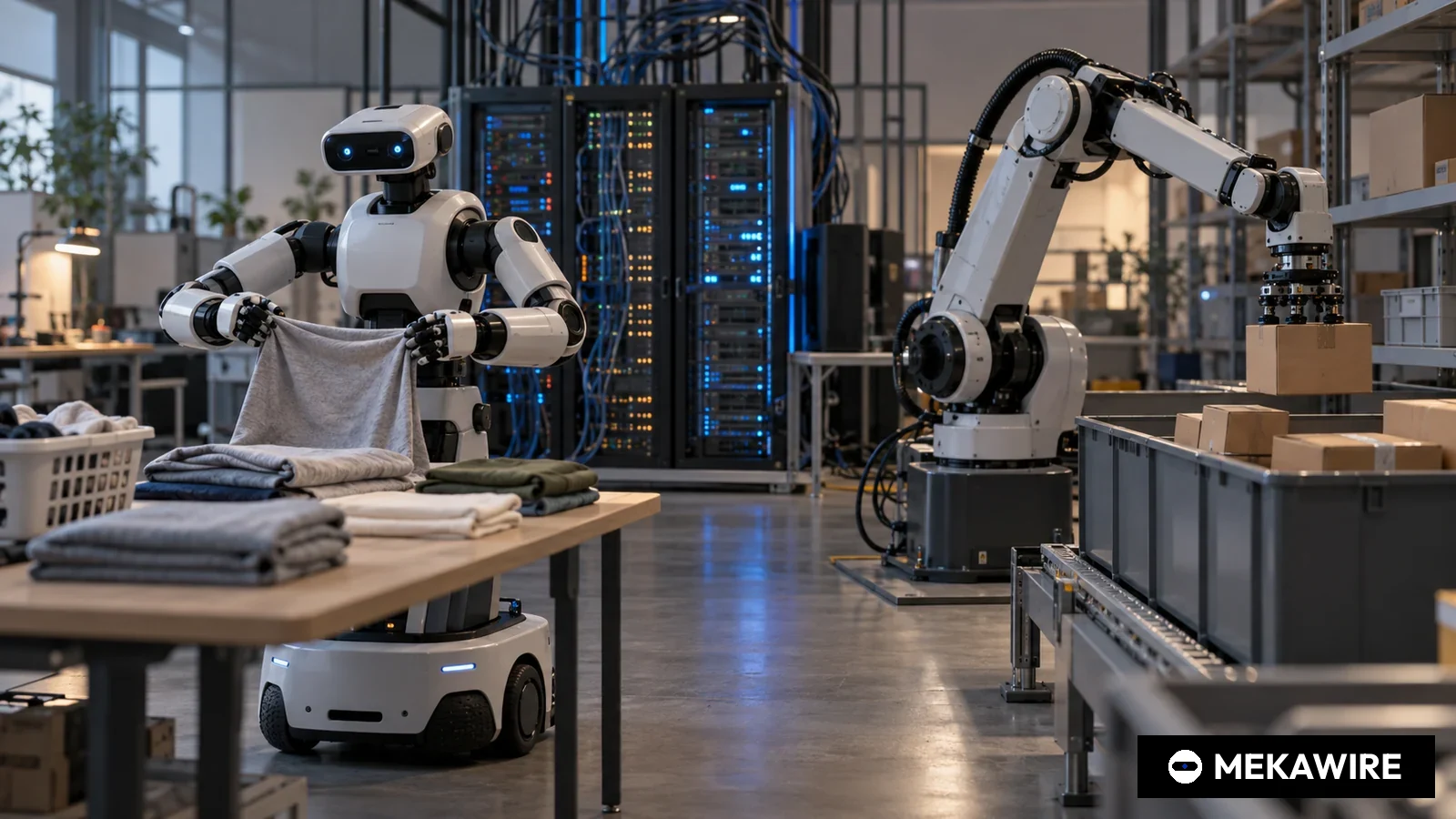
Physical Intelligence on February 24, 2026 laid out its plan to sell general-purpose robot models as a ready-made ‘physical intelligence layer’ for other robot makers, the way developers call language models through an API.
It named home robot maker Weave and warehouse robot maker Ultra as partners, reporting a full packing shift at 96.4% autonomy and a 50% cut in laundry-folding interventions, but gave no pricing or access terms.
Physical Intelligence, the US start-up that has raised one of the largest war chests in robot software, set out its commercial thesis in public on February 24, 2026. In a post titled “The Physical Intelligence Layer”, the company argued that its general-purpose robot models should become a reusable layer that other companies build robot products on, in the same way that software developers now call large language models through an API instead of training their own. It backed the argument with field results from two robot makers, Weave and Ultra, both running its π0.6 model.
The headline numbers came from those two partners. At a customer site of Ultra, which builds warehouse robots, π0.6 packed e-commerce orders for a full shift at 96.4% autonomy, Physical Intelligence said. At Weave, which builds home robots, π0.6 lifted the share of time the robot folded laundry without help compared with the earlier π0.5, and adding Weave’s own data into pre-training cut missed grasp sequences by 42% and human interventions per full laundry load by 50%, according to the company. Physical Intelligence did not disclose prices, API terms, availability dates or whether model weights would be shared with partners.
What was announced
The post named four models as candidates for the layer: π0, π0.5, π0.6 and π*0.6. Physical Intelligence said it works with companies that specialise in deploying robots, both to show that its models perform in real settings and to stress-test how general they are across tasks and environments. For Ultra, the company said π0.6 raised the packing success rate over π0.5 and that adding Ultra pre-training data raised order-packing throughput, measured in items per hour; the absolute throughput figures appeared only in a chart. Physical Intelligence added that it is working with “a number of other partners” it plans to name later.
The two partners sit at opposite ends of the market. Weave describes itself as a builder of robots for the home; its website says its stationary Isaac 0 laundry-folding robot ships across California and that the Isaac 1 home robot is due to start shipping in fall 2026. Ultra builds industrial AI robots that slot into existing workstations. Its OP1 packs, sorts and kits items for up to 24 hours a day on a 5 by 5 foot footprint with a payload of up to 10 lb and plugs into a standard 120V outlet, according to Ultra, which says the robot is built in New York and offers customers a three-month trial.
The company behind the models
Physical Intelligence is led by co-founder and chief executive Karol Hausman; its founding team includes Lachy Groom, Sergey Levine, Chelsea Finn, Brian Ichter, Quan Vuong and Adnan Esmail, according to CapitalG, the Alphabet growth fund that led its Series B announced on November 20, 2025. Investor Outset Capital said that round raised $600 million at a $5.6 billion valuation, with Lux Capital, Thrive Capital, Jeff Bezos, Index Ventures and T. Rowe Price taking part. CapitalG described π0.6 as a model that learns through instruction, coaching and then autonomous practice, and said success rates exceed 90% on tasks such as making espresso and folding laundry.
Rivals take different routes
The pitch puts Physical Intelligence in direct competition with other suppliers of robot brains, each with a different business model. Skild AI raised $1.4 billion at a valuation above $14 billion in January 2026 on the promise of one model that can run any robot body. Rhoda AI left stealth on March 10 with a $450 million Series A for a model pre-trained on internet video for factory robots. Figure keeps its Helix model in-house and released Helix 02 for whole-body control of its own humanoid in January. NVIDIA, for its part, released GR00T N1.6 as an open model at CES, and Google DeepMind supplies its Gemini Robotics models to hardware partners such as Agile Robots, which signed a research pact in March.
- Physical Intelligence
- US
- Series B
- 600
- 5.6
- 2025-11-20
- Skild AI
- US
- Series C
- 1400
- 14
- 2026-01-14
- Figure AI
- US
- Series C
- 1000
- 39
- 2025-09-16
- Rhoda AI
- US
- Series A
- 450
- No data
- 2026-03-10
- FieldAI
- US
- Two rounds combined
- 405
- No data
- 2025-08-20
- Dyna Robotics
- US
- Series A
- 120
- No data
- 2025-09-15
Figures as disclosed by the companies or their investors, not estimated. Physical Intelligence amount and valuation per investor Outset Capital; date per lead investor CapitalG. — = not disclosed. Rounds announced after March 31, 2026 excluded.
As of Oct 1, 2026
How the layer is meant to work
The models in question are vision-language-action models: networks that take camera images and a plain-language instruction and output motor commands. A partner collects demonstrations on its own robot and task, fine-tunes the shared model, and ships the result. The Weave and Ultra figures show a second step that matters commercially. The biggest gains came when partner data was folded back into Physical Intelligence’s pre-training, which suggests that every deployment can improve the base model for everyone, and that the supplier of the base model gains from each customer’s data.
A week later, on March 3, the company showed how it intends to stretch the layer to longer jobs. Its Multi-Scale Embodied Memory system, described in an arXiv paper with co-authors from Stanford University, UC Berkeley and MIT, adds a compressed video memory for recent detail and text summaries for longer-range events to π0.6, which uses Google’s Gemma 3 4B model as its language backbone. The paper reports tasks such as kitchen clean-up and making a grilled cheese sandwich with memory spanning up to 15 minutes.
What it means for the industry
If the layer works as described, the entry ticket for a robot start-up shrinks from building a full AI stack to building hardware, collecting task data and integrating a model. That would shift value toward whoever owns the most capable base model and the widest pool of deployment data. The open questions are large. Physical Intelligence has published no commercial terms, the results come from two partners and are self-reported, and 96.4% autonomy over a shift still implies human help for part of the time. Data rights, the cost of inference on the robot and liability when a licensed model fails remain undisclosed.
MEKAWIRE analysis
Physical Intelligence is betting that robotics will follow the language-model industry into a split between a few base-model suppliers and many application builders, and its February post is the first public evidence that paying robot makers will accept that split.
The evidence is the structure of the results rather than their size. Both partners gained most when their data went into the shared pre-training mix, which is the mechanism that would let a model supplier pull away from rivals as it signs customers. Choosing one home and one warehouse partner was also deliberate, signalling generality across very different settings.
The strongest counter-argument is that robot hardware is far less standardised than software, so the cost of fine-tuning and integration may stay high enough that serious robot makers keep their own models, as Figure does with Helix.
Bull case: more partners are named through 2026, at least one publishes independent metrics, and Physical Intelligence turns its partner data into a lead that Skild AI and open models cannot match. Its $5.6 billion valuation would then look modest next to Skild AI’s $14 billion.
Bear case: partners remain small, open models from NVIDIA and others close the performance gap, and robot makers refuse to hand over task data. The layer then becomes a research showcase rather than a revenue line.
- By mid-2026: whether Physical Intelligence names the “other partners” and any large industrial customer among them.
- During 2026: whether any commercial terms, pricing or API access are disclosed.
- Fall 2026: whether Weave’s Isaac 1 ships on schedule and what model it runs.
- February 24, 2026
- Full packing shift at 96.4% autonomy with π0.6
- Missed grasps down 42%, interventions per load down 50% with Weave data in pre-training
- Series B, $600 million at $5.6 billion valuation, led by CapitalG (Nov 2025)
- Weave (home robots), Ultra (warehouse robots)
- Not disclosed
- Multi-Scale Embodied Memory (MEM), March 3, 2026, memory up to 15 minutes
- π0, π0.5, π0.6, π*0.6
Why it matters
Until February 2026 Physical Intelligence was known mainly for research releases and open-sourcing π0. The partner post is the first time it defined a customer and a product: robot makers that deploy hardware, buying a general model as a component. That reframes the company from a lab into a would-be platform supplier and sets up a direct contest with Skild AI, which pitches the same idea with more capital.
The disclosure also shows where the commercial value is expected to come from. The largest gains in both case studies came from mixing partner data into pre-training, not from the off-the-shelf model alone. A supplier that can attract deployment data from many partners can improve faster than one that trains on its own robots, so partner count becomes a competitive metric in its own right.
Rival analysis
Skild AI is the closest like-for-like rival and the best funded, with a $1.4 billion Series C at a post-money valuation of $14 billion in January 2026, about 2.5 times Physical Intelligence’s $5.6 billion. Rhoda AI, with $450 million in fresh Series A money, targets factory robots with a video-pretrained model. These three compete for the same robot-maker customers.
Figure represents the vertically integrated alternative, building the robot and the Helix model together and keeping the model in-house. NVIDIA and Google DeepMind sit in a third position, offering open or partner-licensed models (GR00T, Gemini Robotics) that commoditise the base layer. Physical Intelligence must stay ahead of free NVIDIA models while persuading integrators that its model is worth paying for.
Valuation context
On disclosed figures, Physical Intelligence’s $5.6 billion post-money valuation from November 2025 is 40% of Skild AI’s $14 billion and 14% of Figure’s $39 billion from September 2025 (ratio = company post-money / peer post-money). Rhoda AI, Dyna Robotics and FieldAI have disclosed round sizes but not valuations.
The gap with Skild AI is notable because both sell the same idea. Investors appear to have paid more for Skild AI’s disclosed commercial traction at the time; the partner post is Physical Intelligence’s first public attempt to show comparable deployments.
Supply-chain implications
The layer model shifts the robot supply chain. Hardware makers such as Weave and Ultra keep the body, sensors and customer relationship, while the base model, training compute and the pooled data sit with Physical Intelligence. π0.6 uses Google’s Gemma 3 4B as its language backbone, according to the MEM paper, which links the stack to Google’s open-weight model family.
For component suppliers, a common model favours robots built from low-cost, standard parts, since intelligence no longer has to be engineered per product. Ultra’s OP1, which runs from a 120V outlet and fits a 5 by 5 foot footprint, is an example of hardware designed to be cheap to deploy rather than mechanically advanced.
Signals to watch
Partner announcements are the first signal. Physical Intelligence said it was working with other partners it would name soon; the identity and scale of those partners, especially any large logistics or manufacturing company, will show whether the layer has buyers beyond start-ups.
The second is commercial disclosure: pricing, API access, or on-robot versus cloud inference. The third is research cadence. MEM on March 3 showed the company is extending models to tasks longer than ten minutes, a prerequisite for full-shift work in homes and factories.
Analyst view
Thesis: Physical Intelligence has the strongest research team among independent robot-model suppliers and has now shown a credible business model, but it trails Skild AI on capital and has not proven that customers will pay. Confidence: medium.
Reasons for medium confidence: the case studies are specific and measured against a prior model, which raises their credibility, and the data-flywheel effect appears in both. Against that, both results are self-reported, the partners are small, absolute throughput numbers were not given, and no revenue or contract value has been disclosed.
Questions you should be asking
Who owns partner data once it enters Physical Intelligence’s pre-training, and can a partner withdraw it? Will the models run on the robot or through a cloud API, and what is the latency and cost per robot hour?
How does π0.6 performance hold across a fleet rather than a single site or shift? And will Physical Intelligence open π0.6 weights as it did with π0, or keep the commercial layer closed?