Qualcomm agrees to buy PickNik, steward of open-source MoveIt, to pull robot motion software onto its Dragonwing chips
Qualcomm Technologies said on 23 September 2026 it had agreed to acquire PickNik Inc., the Boulder, Colorado company behind the MoveIt manipulation framework and its commercial MoveIt Pro platform. Terms were not disclosed. Qualcomm pledged to keep MoveIt 1 and MoveIt 2 open source and hardware agnostic while integrating PickNik's software more tightly with its Dragonwing robotics processors and Arduino boards.
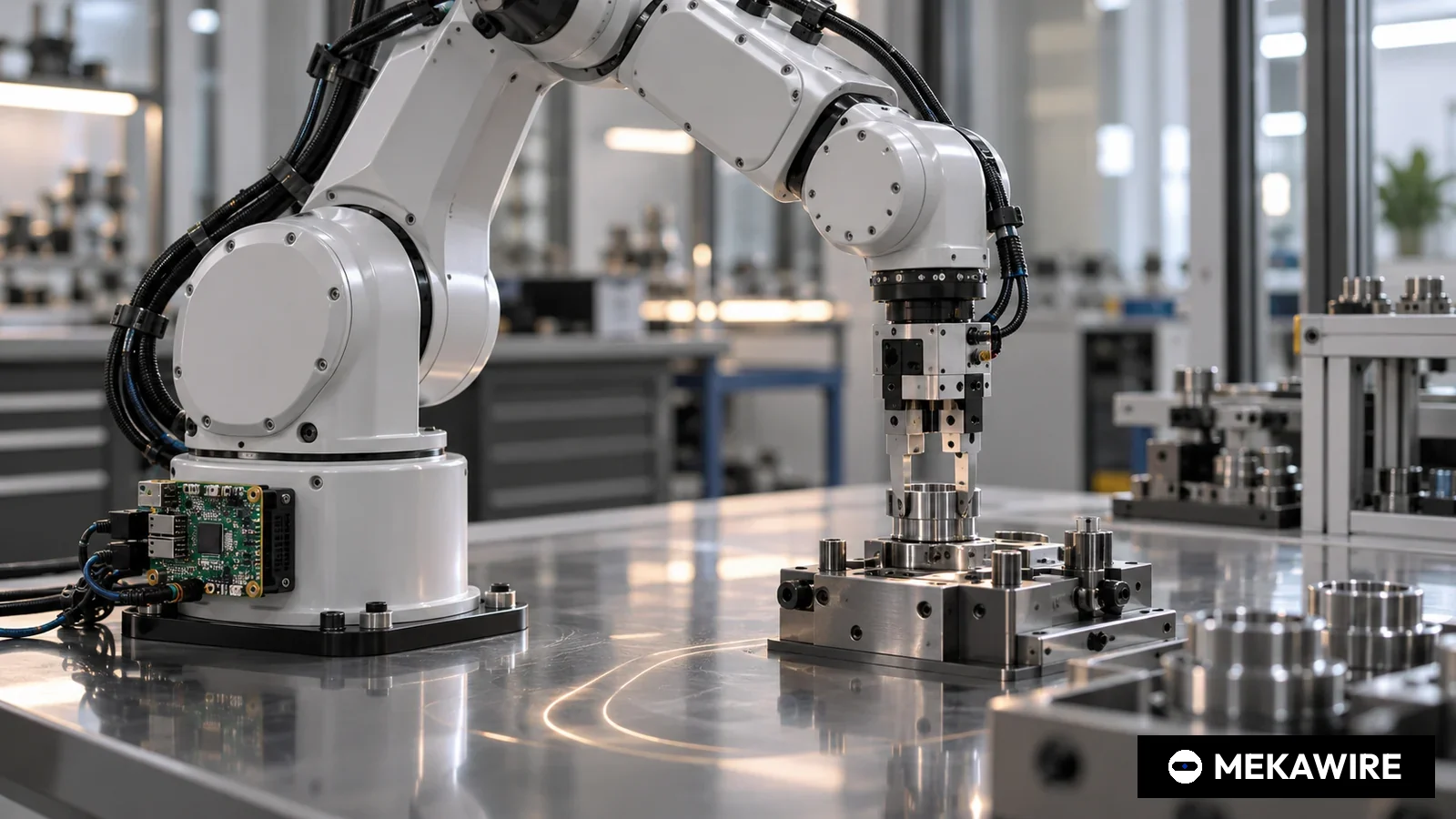
Qualcomm Technologies said on 23 September 2026 that it had agreed to acquire PickNik Inc., the Boulder, Colorado software company that has stewarded MoveIt, one of the most widely used open-source frameworks for planning how robot arms move. The deal, unveiled at ROSCon in Toronto, gives the chipmaker control of the software layer that sits between an AI model's decision and a robot's joints. Qualcomm said it would integrate that software more closely with its Dragonwing robotics processors while keeping MoveIt open.
Neither company disclosed a price. Qualcomm's release said the closing is subject to customary closing conditions and gave no target date, and a post by PickNik founder Dave Coleman on the same day contained no financial terms either. The purchase is the third developer-focused acquisition Qualcomm has announced in under a year, after Arduino agreed on 7 October 2025 to join the company and Qualcomm agreed on 24 June 2026 to buy the AI software firm Modular. Terms were withheld in both of those deals as well.
- Arduino
- Acquisition
- 2025-10-07
- Open-source boards; UNO Q runs on Dragonwing QRB2210
- No data
- Subject to regulatory approval; listed as completed by Qualcomm in January 2026
- NEURA Robotics
- Strategic investment
- 2026-06-10
- Cognitive and humanoid robots; Neuraverse platform
- 1,400,000,000
- Round total up to $1.4bn; Qualcomm share not disclosed
- Modular
- Acquisition
- 2026-06-24
- AI software across CPU, GPU, NPU and ASIC
- No data
- Close expected in second half of 2026
- PickNik
- Acquisition
- 2026-09-23
- MoveIt and MoveIt Pro manipulation software
- No data
- Subject to customary closing conditions
Values as disclosed on primary pages; — means not disclosed. The NEURA figure is the total Series C round size announced by NEURA, not Qualcomm's contribution.
As of Oct 1, 2026
Qualcomm attached three public commitments to the deal. MoveIt 1 and MoveIt 2 are to remain open source under their existing license, with community-driven roadmaps. Qualcomm said it intends to keep supporting MoveIt on third-party hardware, describing the framework's hardware-agnostic design as a key enabler. And MoveIt, MoveIt Pro and future PickNik technologies are set to become more closely integrated with Dragonwing, which Qualcomm said should give developers on its chips first-class, optimised support for motion planning, manipulation, perception and kinematics, and a shorter path from vision-language-action models (VLAs) and vision-language models (VLMs) to real-time control.
The deal also reaches into the hobbyist and education market. Qualcomm said MoveIt integration with Arduino would start with the Arduino VENTUNO Q boards, with the stated aim of reaching millions of developers. The two companies said they would show MoveIt Pro running on VENTUNO Q and Dragonwing hardware at ROSCon. Both are founding members of the Open Source Robotics Alliance (OSRA), and Qualcomm said it intends to keep driving Space ROS, a hardened version of ROS for critical uses such as space exploration.
PickNik was founded in 2015 by Coleman as a consulting shop for MoveIt, according to his post, and was financed early on through the European Union's ROSin programme, the US Small Business Innovation Research programme and Acutronic Robotics. MoveIt itself began at Willow Garage, the robotics lab that closed in 2014. Coleman wrote that the project now counts more than 560 contributors across 40 repositories, about 6,700 GitHub stars and 4,400 forks, and two core papers cited more than 1,700 times. He listed deployments ranging from NASA missions and surgical robots to warehouse logistics, cell therapy manufacturing, strawberry picking and airport baggage handling. The company's commercial product, MoveIt Pro, ships with a Behaviors Hub of more than 600 pre-built skills, according to its website. Dave Grant is chief executive and Coleman is chief product officer.
Nakul Duggal, Qualcomm's executive vice president and group general manager for automotive, industrial and embedded IoT, and robotics, called software "the connective tissue that turns great hardware into great robots" and said the aim was to make it easier to build robot applications on Dragonwing while keeping MoveIt open. Coleman said joining Qualcomm would let PickNik expand investment in MoveIt as an AI training platform for robotics. In his post he gave the technical rationale more bluntly, arguing that capable AI models need to run on the robot in real time and within a power budget rather than in a data centre.
That argument explains why a chip company wants a motion planner. A VLA model can decide that a robot should pick up a part, but something still has to turn that intent into a collision-free path, solve the arm's kinematics and stream joint commands at control rates. MoveIt does that work, and today it runs on whatever processor a robot builder chooses. If Qualcomm can make the planner, perception and an on-board model run fastest and most efficiently on Dragonwing, it gains a reason for robot makers to standardise on its silicon without closing the software.
The acquisition fits a robotics push that Qualcomm has built in public during 2026. At CES on 4 January it introduced the Dragonwing IQ10 Series for humanoids and advanced mobile robots and named Figure, KUKA Robotics, VinMotion, Booster, Advantech, AutoCore and Robotec.ai among those working with it. Its IQ10 robotics reference design, described in a May 2026 product brief, is rated at up to 700 TOPS (sparse) with 18 Oryon CPU cores, a safety island and a ROS 2 software stack on Ubuntu. On 10 June NEURA Robotics named Qualcomm Technologies as a strategic investor and technology partner in a Series C round of up to $1.4 billion, and the Arduino UNO Q board already runs on a Dragonwing QRB2210 processor.
The obvious rival is NVIDIA, whose Jetson AGX Thor module went on sale on 25 August 2025 with a stated 2,070 FP4 teraflops at 130 watts and a $3,499 developer kit. NVIDIA listed Agility Robotics, Amazon Robotics, Boston Dynamics and Figure among early adopters and said more than 2 million developers use its robotics stack. Software is the other front. A day before Qualcomm's announcement, Intrinsic, which said in February 2026 that it was joining Google, released Intrinsic Core under the Apache 2.0 license, including motion planning, grasp planning and Gazebo simulation services for FANUC and Universal Robots arms. Intrinsic had already bought the commercial arm of Open Robotics in December 2022, while the ROS, Gazebo and Open-RMF intellectual property stayed with the non-profit Open Source Robotics Foundation.
- Dragonwing IQ10 robotics reference design
- Qualcomm
- 700
- TOPS (sparse)
- No data
- No data
- 2026-05
- Dragonwing Q-8750
- Qualcomm
- 77
- TOPS
- No data
- No data
- 2026-01
- Dragonwing Q-7790
- Qualcomm
- 24
- TOPS
- No data
- No data
- 2026-01
- Jetson AGX Thor
- NVIDIA
- 2070
- FP4 TFLOPS
- 130
- 3499
- 2025-08-25
Vendor-stated peak figures from each vendor's own pages. Units and numeric precision differ, so figures are not directly comparable. — means not stated on the cited primary page.
As of Oct 1, 2026
The open questions are about trust and neutrality. PickNik's MoveIt Pro customers build on many kinds of compute, and Qualcomm has not said how it will price MoveIt Pro or whether optimised features will appear first, or only, on Dragonwing. Open Robotics said on 28 September that it expects MoveIt to stay open and pointed to Qualcomm's earlier investment in its work, but the community will judge by maintainer activity, release cadence and whether pull requests that favour other chips keep landing. Integration is also unproven, because Qualcomm has given no timetable for the Dragonwing optimisations or the VENTUNO Q support beyond the ROSCon demonstration.
Three things will show whether the strategy works. The first is a closing announcement, which Qualcomm has not dated. The second is the first MoveIt 2 releases after closing, which will show whether the license, governance and maintainer roster are unchanged. The third is CES in January 2027, where Qualcomm's robotics partners from this year could show whether MoveIt Pro on Dragonwing has moved from booth demo to shipping product.
MEKAWIRE analysis
Qualcomm is buying the developer on-ramp to robot manipulation, betting that owning the most familiar open motion stack will pull robot makers toward Dragonwing more effectively than raw TOPS can.
The evidence is in the sequence. Arduino brought a large base of hobbyist and student developers and a board already built on a Dragonwing chip. Modular brought software that runs AI models across different accelerators. PickNik brings the planning and control layer that robotics engineers already know from ROS. Each deal moves Qualcomm further from selling a processor and closer to selling the whole path from model to motor, which is the position NVIDIA has occupied with Jetson and its robotics software.
The strongest counter-argument is that open source limits what Qualcomm can capture. MoveIt stays hardware agnostic under its existing license, so a robot maker can keep running it on NVIDIA or x86 compute, and Intrinsic has just released a competing Apache 2.0 stack backed by Google. If Qualcomm keeps its promises strictly, the acquisition buys goodwill and engineering talent rather than lock-in.
Bull case. Optimised MoveIt Pro and VLA pipelines on Dragonwing become the easiest way to ship a manipulation product within a tight power budget, and Qualcomm's existing partners such as Figure, KUKA and NEURA adopt them. Arduino and VENTUNO Q then feed a new generation of developers who learn robotics on Qualcomm hardware first.
Bear case. PickNik's engineers spend the next year on integration while MoveIt Pro customers on rival hardware drift to Intrinsic Core or NVIDIA's tools. Any sign that MoveIt is tilting toward Dragonwing could split the community, and the undisclosed price leaves investors unable to judge whether the deal earns its cost.
Signals to watch:
- Q4 2026: whether Qualcomm announces completion of the PickNik deal, and whether the Modular deal closes within the second half of 2026 as Qualcomm guided.
- First MoveIt 2 release after closing: whether the license, maintainer list and steering process on GitHub are unchanged.
- CES, January 2027: whether Dragonwing IQ10 partners demonstrate MoveIt Pro in products rather than reference designs.
- Not disclosed
- PickNik Inc. (PickNik Robotics), Boulder, Colorado, founded 2015
- Subject to customary closing conditions; no date given
- Qualcomm Technologies, Inc. (subsidiary of Qualcomm Incorporated, NASDAQ: QCOM)
- 23 September 2026, at ROSCon Toronto (release datelined San Diego)
- MoveIt, MoveIt Pro and future PickNik technology with Dragonwing robotics platforms; Arduino starting with VENTUNO Q
- MoveIt 1 and MoveIt 2 stay open under existing license, community roadmaps, third-party hardware support
- Dragonwing IQ10 unveiled 4 January 2026; strategic investor in NEURA Robotics' Series C of up to $1.4bn (10 June 2026)
- 560+ contributors, 40 repositories, about 6,700 GitHub stars, 4,400 forks
Why it matters
Motion planning is the least glamorous part of the robot stack and one of the stickiest. Engineers who have built a cell on MoveIt carry its configuration files, kinematics plugins and planning pipelines from project to project, and many of them learned robotics on it at university. By buying the company that stewards the framework, Qualcomm acquires familiarity with a large share of the world's manipulation developers, something that would take years to build through developer relations alone.
The timing matters because robot software is being rebuilt around foundation models. VLA models produce goals and coarse actions, and a planner still has to turn them into safe trajectories at control rates. Qualcomm's release explicitly names the path from VLAs and VLMs to planning, manipulation and real-time control, which shows it sees MoveIt as the bridge between model inference on its NPUs and the robot's actuators.
Rival analysis
NVIDIA is the reference point. Jetson AGX Thor, available since 25 August 2025, is rated at 2,070 FP4 teraflops at 130 watts, and NVIDIA says more than 2 million developers use its robotics stack, with Agility Robotics, Amazon Robotics, Boston Dynamics and Figure among early Thor adopters. Qualcomm's IQ10 reference design is rated at up to 700 TOPS (sparse). The units differ, so the numbers do not compare directly, but Qualcomm's pitch rests on power efficiency, safety features and now software, not on peak throughput.
Google's Intrinsic is the software rival. Its Intrinsic Core, released on 22 September 2026 under Apache 2.0, covers motion planning, grasp planning, pose estimation using NVIDIA FoundationPose, and Gazebo simulation, with support for FANUC and Universal Robots. That overlaps directly with MoveIt Pro's ground. Figure appears on both NVIDIA's Thor adopter list and Qualcomm's CES partner list, a reminder that leading robot makers keep more than one silicon supplier.
Valuation context
No price was disclosed by Qualcomm or PickNik, and PickNik's funding history on its own pages is limited to the early grant and partner money Coleman described. MEKAWIRE has not found a disclosed valuation for PickNik on a primary page, so any figure would be an estimate and is omitted here.
For context, Qualcomm withheld terms on all three recent developer acquisitions, Arduino, Modular and PickNik. The only disclosed figure in its 2026 robotics moves is NEURA Robotics' Series C round total of up to $1.4 billion, in which Qualcomm's individual contribution was not stated. Deals of this kind are small against Qualcomm's balance sheet and are best read as strategic positioning rather than revenue purchases.
Supply-chain implications
The deal touches the compute and software layers rather than components. Robot makers that adopt Dragonwing would buy modules or reference designs from Qualcomm and its board partners such as Advantech, which Qualcomm named at CES. The IQ10 reference design is a fully enclosed 176 x 125 x 75 mm unit with integrated cooling rated for minus 10 to 70 degrees Celsius, aimed at mobile robots and humanoids.
On the low end, Arduino's UNO Q pairs a Dragonwing QRB2210 with an STMicroelectronics STM32U585 microcontroller. Adding MoveIt to VENTUNO Q extends that dual-processor pattern to manipulation. The integration could reduce the engineering cost for small arm makers and integrators that currently pair third-party compute with MoveIt themselves.
Signals to watch
Watch for the closing notice and any regulatory filings, though no filing has been referenced so far. Watch MoveIt's GitHub organisation for changes to the license file, maintainer list or contribution rules after closing, and watch whether PickNik's MoveIt Pro pricing or supported hardware list changes.
On the commercial side, watch whether Qualcomm's CES 2026 robotics partners, including Figure, KUKA Robotics, VinMotion and Booster, or its portfolio company NEURA Robotics, announce MoveIt Pro on Dragonwing deployments. Also watch the Modular closing, which Qualcomm guided for the second half of 2026, because Modular's cross-accelerator software and MoveIt together would form most of a model-to-motor stack.
Analyst view
Thesis: Qualcomm is assembling a full robotics software stack through acquisition so that Dragonwing competes with NVIDIA Jetson on developer convenience rather than only on silicon, and PickNik is the most important piece for manipulation. Confidence: medium.
The reasons for medium confidence are that the strategic intent is stated plainly in Qualcomm's release and is consistent with its CES launch, its NEURA investment and the Arduino and Modular deals. Against that, there is no integration timetable, no pricing for MoveIt Pro under Qualcomm, and the open-source pledge limits lock-in. The outcome depends on execution in 2027 more than on the deal itself.
Questions you should be asking
Will MoveIt Pro remain available and supported on NVIDIA Jetson and x86 platforms on the same terms, or will some features become Dragonwing exclusive? How will governance of MoveIt change now that PickNik, its longtime steward, becomes part of Qualcomm?
What is the timetable for VENTUNO Q support, and will it target education and hobby users or small commercial arms? Did any PickNik investors or customers hold rights that affect the deal, and will Qualcomm disclose the price in a later filing?