ABB Robotics puts its AI Robot Trainer into apparel sorting, claiming up to 75% less commissioning work
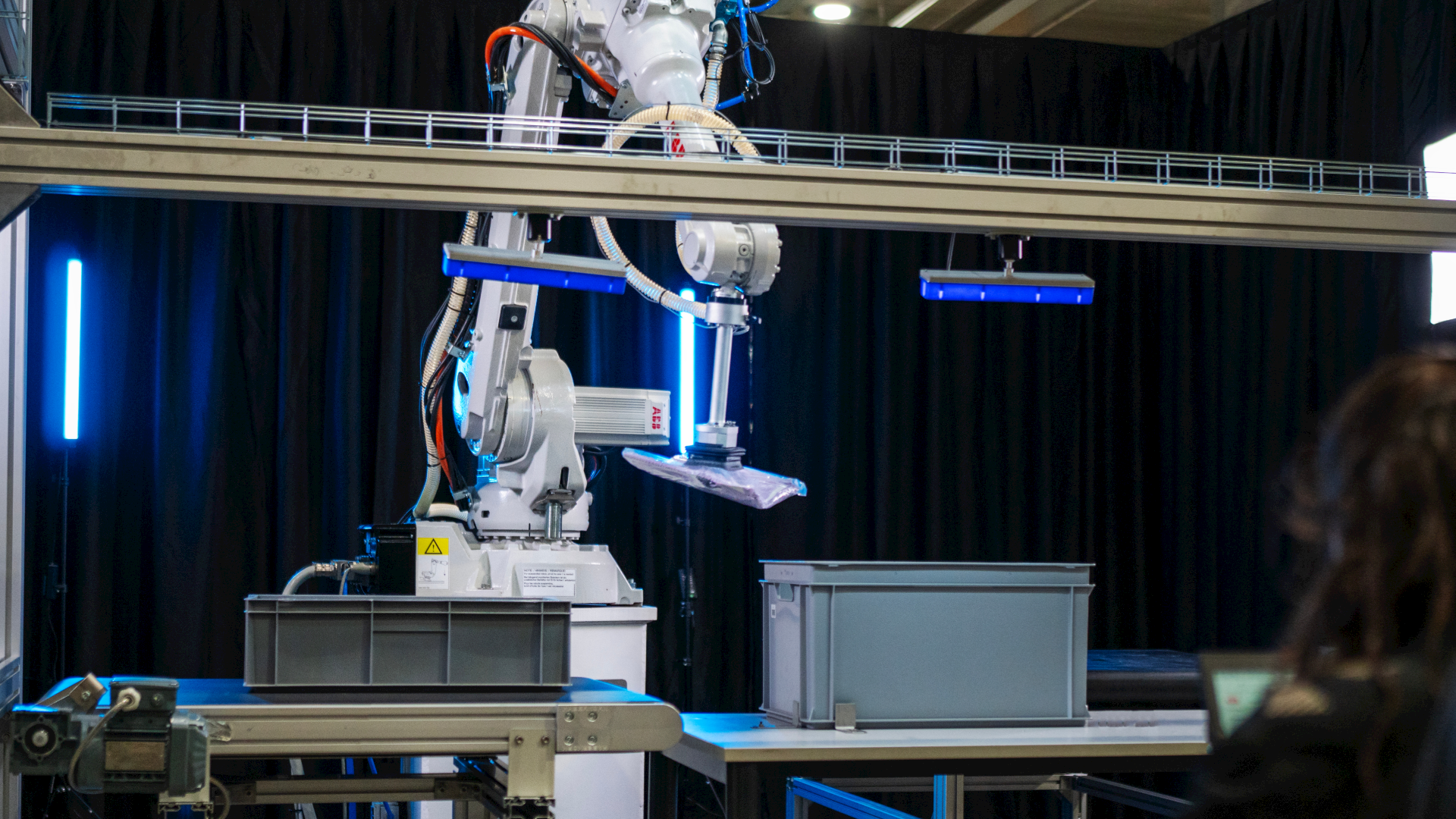
ABB Robotics said on Oct 15 it has added its AI Robot Trainer to the Fashion Inductor module, calling it the company's first end-to-end vision-based physical AI product. ABB says the upgrade cuts engineering and commissioning effort by up to 75% on a cell that sorts up to 1,300 garments an hour, and that the same retraining approach will spread to more vision applications through the first quarter of 2027.
ABB Robotics is pitching physical AI to the people who actually install robots. The Swiss robot maker said in a press release on Oct 15, 2026 that it has built its AI Robot Trainer into Fashion Inductor, a ready-made cell that picks garments and parcels and feeds them into sorting systems, and that the combination cuts engineering and commissioning effort by up to 75%. ABB calls it its first end-to-end vision-based industrial physical AI solution.
The claim matters because commissioning, not hardware, is where many logistics robot projects stall. Apparel is the hard case: bags, folded items and transparent packaging change shape, colour and reflectivity with every season. The question this article answers is what ABB has actually shipped, how it compares with the start-ups that sell AI picking, and why the timing coincides with ABB Robotics changing owners.
What ABB says the module does
According to the release, Fashion Inductor already handled up to 1,300 items per hour per cell, with picking accuracy targets above 99.5%, using ABB's AI-based Automatic Path Planning and application-specific vision. The upgrade adds pre-trained, fashion-specific vision models and tools for fast retraining, so a system integrator can adapt the cell when products change without in-house AI specialists.
ABB also added a digital twin, described as an exact replica of the module software, that connects its Application Controller Platform, Automatic Path Planning, AI Robot Trainer and the RobotStudio simulation suite. The company says this speeds commissioning and lets integrators add third-party parts such as grippers. ABB did not disclose prices, customers, the number of cells installed or how the 75% figure was measured.
The mechanism is a closed retraining loop, not a bigger model
The technical idea is lifecycle management. ABB describes a loop that watches robot performance on the floor, flags anomalies, generates new training data, retrains the cell's vision model and pushes the update back to the robot. RobotStudio carries the virtual design and validation; the OmniCore controller runs the result in production. In plain terms, ABB is selling the tooling to keep a vision model accurate after go-live, which is where integrators usually lose margin.
The release positions the product as the first step in a broader rollout: the same AI Robot Trainer approach will extend to other ABB vision-based applications through the first quarter of 2027, as part of what ABB brands Autonomous Versatile Robotics. ABB Robotics employs about 7,000 people, the release says.
How it compares with the AI picking start-ups
ABB is entering a field that venture-backed companies have worked for years. In MEKAWIRE's database, the disclosed rounds of AI picking and robot-vision specialists are modest next to ABB's scale: Nomagic raised a USD 44 million Series B in February 2025, Pickle Robot USD 50 million in November 2024, Plus One Robotics USD 50 million in March 2023, and Paris-based Inbolt USD 12.5 million in September 2026. ABB Robotics reported USD 2,331 million of revenue in 2025, according to ABB's fourth-quarter release covered by MEKAWIRE in January.
- ABB Robotics
- CH
- Revenue USD 2,331m (2025)
- 2026-01-29
- Robots, cobots, AMRs; Fashion Inductor with AI Robot Trainer
- Nomagic
- PL
- Series B USD 44m
- 2025-02-26
- AI pick-and-place for e-commerce
- Pickle Robot
- US
- Series B USD 50m
- 2024-11-20
- Truck unloading
- Plus One Robotics
- US
- Series C USD 50m
- 2023-03-06
- Vision software for parcel picking
- Inbolt
- FR
- Round USD 12.5m
- 2026-09-30
- AI robot guidance vision
Disclosed figures from verified MEKAWIRE rows; ABB revenue from ABB's Q4 2025 release. Funding and revenue are different measures and are shown for scale only.
As of Oct 17, 2026
The incumbents are moving in the same direction. Hitachi and FANUC said on Sep 30, 2026 that they would pair Hitachi's edge AI chips with FANUC robots for a global physical-AI rollout from fiscal 2027.
MEKAWIRE analysis
ABB is not trying to out-model the AI start-ups; it is trying to make AI vision a maintainable feature of a controller it already sells, so integrators stay on ABB hardware.
The evidence is in what the release emphasises: digital twin, RobotStudio, OmniCore and retraining, all ABB-owned layers, rather than a named foundation model or benchmark. That is the playbook of a hardware incumbent defending its installed base. The strongest counter-argument is that a 75% saving claimed by the vendor, without a stated baseline, is a marketing number; integrators will judge it on the first projects.
The timing adds a second layer. ABB agreed in October 2025 to sell the robotics division to SoftBank Group for USD 5.375 billion, with completion expected in the second half of 2026 according to ABB's January results. A buyer paying about 17 times 2024 EBITDA needs a software story, and a product line with recurring retraining fits it.
Bull case: the loop works, integrators cut deployment time, and ABB turns AI vision into a reason to choose its controllers across logistics. Bear case: start-ups with cross-brand software keep the most demanding picking jobs, and ABB's tools stay tied to ABB arms.
What to watch
Three signals will test the thesis: named Fashion Inductor customers and measured commissioning times; the next ABB vision applications to gain AI Robot Trainer before the end of Q1 2027; and the closing of the SoftBank deal, after which ABB Robotics' product priorities may be set in Tokyo rather than Zurich.
- Fashion Inductor module upgraded with AI Robot Trainer
- Same approach to more ABB vision applications through Q1 2027
- Up to 75% less engineering and commissioning effort
- Up to 1,300 items per hour per cell; picking accuracy target above 99.5%
- ABB Robotics press release, Oct 15, 2026
- Pre-trained fashion vision models, rapid retraining, digital twin linked to RobotStudio
- Price, customers, installed cells, baseline for the 75% figure
- Sale to SoftBank Group for USD 5.375bn, completion expected H2 2026 (ABB, Jan 2026)
- OmniCore controller
Why it matters
Commissioning and re-tuning after go-live are the hidden cost in vision-guided logistics cells. If ABB's closed loop holds up, it shifts value from one-off integration labour to software that ABB controls, and makes ABB controllers stickier for integrators who would otherwise mix brands.
The product is also the first concrete delivery under ABB's Autonomous Versatile Robotics label, which matters for how the SoftBank-owned business will be valued.
Rival analysis
AI picking start-ups such as Nomagic, Pickle, Plus One and Covariant built their businesses on software that works across robot brands and on data pooled from many sites. ABB's answer is integration depth: path planning, simulation, controller and retraining in one stack. That suits integrators already standardised on ABB, but gives less to sites that run FANUC, Yaskawa or KUKA arms.
Among incumbents, FANUC has opened its robots to ROS 2 and NVIDIA tools and, with Hitachi, plans edge-AI robot cells from fiscal 2027. ABB's move is narrower but already a product rather than a partnership.
Valuation context
SoftBank agreed to pay USD 5.375bn, about 2.3 times ABB Robotics' 2025 revenue of USD 2,331m and about 17 times 2024 EBITDA. AI picking specialists have raised tens of millions per round. A credible AI software layer inside ABB's installed base is one way for the new owner to argue for a software-like multiple on part of the business, but no revenue for AI Robot Trainer has been disclosed.
Supply-chain implications
The value sits in software and vision models, but deployment still depends on cameras, grippers and compute at the cell. ABB says the digital twin lets integrators add third-party grippers. The release names no chip or camera suppliers.
Signals to watch
Named customer deployments with measured commissioning time; additional ABB vision applications gaining AI Robot Trainer before the end of Q1 2027; the SoftBank closing date and any change in ABB Robotics' product roadmap afterwards.
Analyst view
Thesis: ABB is turning AI vision into a controller feature to defend its installed base. Confidence: medium. The product exists and the architecture is coherent, but the headline saving is vendor-measured, there are no named customers, and the competitive set includes software that runs on any arm.
Questions you should be asking
What baseline produced the 75% commissioning reduction, and on how many projects? Is AI Robot Trainer licensed per cell, per site or bundled? Can the retraining loop run on non-ABB cameras and grippers? How will SoftBank's ownership change investment in this line?