Skild AI unveils the Skild Brain, a single robot foundation model it says can drive quadrupeds, humanoids and arms alike
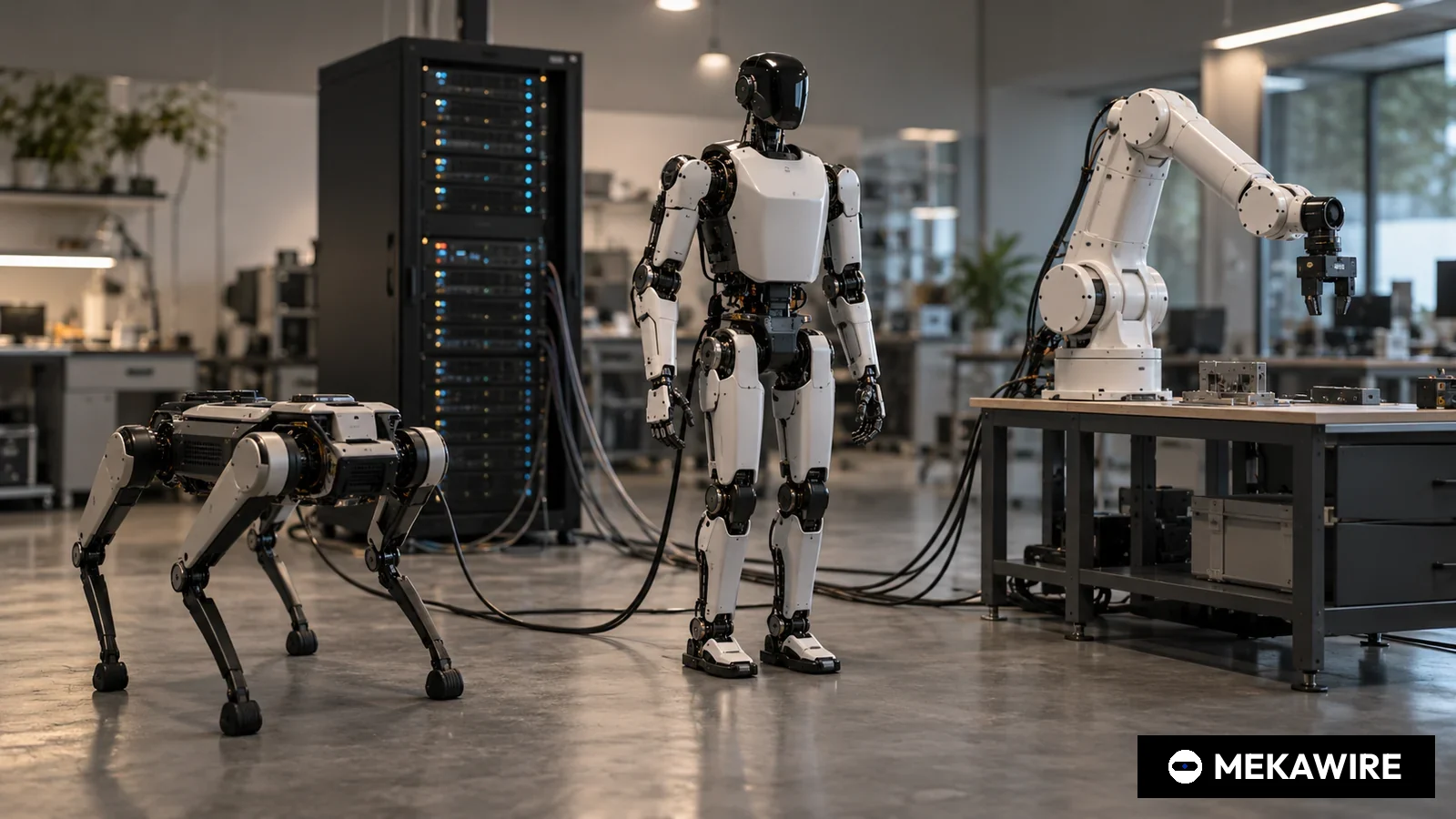
Skild AI on July 29, 2025 named and described its robotics foundation model, the Skild Brain, a two-layer system pre-trained on simulation and internet video that the company says runs across quadrupeds, humanoids, table-top arms and mobile manipulators.
The launch carried no customers or prices, but set out the body-agnostic strategy that later underpinned a $14 billion-plus valuation and more than $100 million in annual recurring revenue.
Skild AI, the US start-up backed by SoftBank Group and Jeff Bezos, on July 29, 2025 put a name to the product it had been building since 2023. In a post titled "Building the general-purpose robotic brain", the company said its robotics foundation model, the Skild Brain, runs on quadrupeds, humanoids, table-top arms and mobile manipulators, and described it as a step toward a single "omni-bodied" brain that is not tied to any robot type or task.
The launch came twelve months after Skild AI emerged from stealth on July 9, 2024 with a $300 million Series A at a $1.5 billion valuation, led by Lightspeed Venture Partners, Coatue, SoftBank Group and Bezos Expeditions. The July 2025 post carried no price, customer list or benchmark table. It set out an architecture, a data thesis and a release plan, and it published the company's 2024 results as the first in a series of demonstrations promised for the following month.
According to Skild AI, the Skild Brain is hierarchical. A low-frequency, high-level policy handles manipulation and navigation decisions and passes commands to a high-frequency, low-level policy, which converts them into joint angles and motor torques for the specific body it is driving. The company said the model is trained on diverse data, tasks and hardware, then fine-tuned and distilled to fit each deployment.
The more pointed part of the post was its argument about data. Skild AI wrote that many rivals start from a vision-language model and add less than 1% real robot data, and said such systems show semantic generalisation in pick-and-place tasks but lack physical common sense. Its own answer is to pre-train on large-scale simulation and internet video, then post-train on targeted real-world data. The company said useful scale means trillions of examples, and estimated in a footnote that even if the whole population of the earth collected data it would take years to reach 100 trillion trajectories.
Skild AI was founded in 2023. Its leaders, chief executive Deepak Pathak and Abhinav Gupta, are researchers whose earlier work on self-supervised grasping, curiosity-driven exploration and learning from human video is cited in the post. The company said its staff had previously built production systems at Anduril, Tesla, Nvidia, Meta, Kitty Hawk, Google, Everyday Robotics and Amazon. Its Series A investors also included Sequoia, Felicis, Menlo Ventures, General Catalyst, Carnegie Mellon University and two Amazon funds.
The Skild Brain entered a field that had filled quickly in the first half of 2025. Figure AI introduced Helix on February 20, 2025, pairing a 7-billion-parameter vision-language model running at 7 to 9 Hz with an 80-million-parameter control policy at 200 Hz, trained on about 500 hours of teleoperation. Google DeepMind released Gemini Robotics, built on Gemini 2.0, on March 12, 2025, with Apptronik as its humanoid partner. NVIDIA announced Isaac GR00T N1 on March 18, 2025 as an open humanoid foundation model with a similar two-system design. Physical Intelligence, which later raised a CapitalG-led Series B, competes for the same customers.
In plain terms, the two-layer design separates deciding from doing. The slow layer works out where to go or what to grasp; the fast layer keeps the body balanced and moving at a much higher rate. Figure, NVIDIA and Skild AI all use a version of this split. What Skild AI claims as different is the breadth of bodies the lower layer can drive and the source of its training data, which leans on simulation and video rather than on a language model with a thin layer of robot data on top.
The company backed the claim with releases in the weeks that followed. On August 6, 2025 it showed a humanoid using the Skild Brain to climb stairs and cross obstacles from camera images and joint feedback alone, with no mapping or pre-planning, including stairs only 3 cm deeper than the robot's foot. On September 24, 2025 it said it had trained a controller across 100,000 simulated robot bodies and that the model adapted zero-shot to robots it had never seen, recovering within 2 to 3 seconds after its knees were locked and within 7 to 8 seconds after a limb was shortened.
The open questions at launch were commercial. Skild AI disclosed no paying customers, no unit numbers and no third-party evaluation, and its demonstrations were videos selected by the company. Its central claim, that simulation and human video can substitute for scarce robot data, was contested by rivals who rely on teleoperation. The company also relies on partners for hardware, so its revenue depends on robot makers adopting a brain they do not control.
Later disclosures answered part of that. On January 14, 2026 Skild AI said it had raised $1.4 billion led by SoftBank at a valuation above $14 billion, and that revenue had grown from zero to about $30 million within a few months of 2025. In March 2026 it named ABB Robotics, Universal Robots and NVIDIA as deployment partners, and on September 10, 2026 it reported more than $100 million in annual recurring revenue from over 60 paying customers.
- Skild AI
- US
- 2023
- Series A
- 300,000,000
- 1,500,000,000
- 2024-07-09
- Skild AI
- US
- 2023
- Series C
- 1,400,000,000
- 14,000,000,000
- 2026-01-14
- Figure AI
- US
- No data
- Series C
- 1,000,000,000
- 39,000,000,000
- 2025-09-16
- Apptronik
- US
- 2016
- Series A
- 350,000,000
- No data
- 2025-02-13
- FieldAI
- US
- No data
- Two rounds (combined)
- 405,000,000
- No data
- 2025-08-20
- Genesis AI
- FR
- No data
- Launch round
- 105,000,000
- No data
- 2025-06-30
Figures as disclosed by each company or its lead investor; — = not disclosed. Skild AI Series C valuation disclosed as 'over $14 billion' and entered as 14,000,000,000. Derived: Skild valuation step-up from Series A to Series C = 14,000,000,000 / 1,500,000,000 = 9.3x.
As of Oct 1, 2026
MEKAWIRE analysis
The Skild Brain launch mattered less for what it showed than for the bet it made public: that a robot brain sold across many bodies, trained mostly on simulation and video, can become a business before any single humanoid does.
The evidence for that reading is in Skild AI's own sequence. The July 2025 post was a positioning document, the August and September releases supplied the demonstrations, and by September 2026 the company was reporting that about 90% of revenue came from manipulation tasks on partners' hardware rather than from a robot of its own. A ninefold valuation step-up between the Series A and the Series C, from $1.5 billion to more than $14 billion, shows investors priced the model layer as the scarce asset.
The strongest counter-argument is that the claim of being body-agnostic is easiest to make in locomotion, where simulation is mature, and hardest to prove in contact-rich manipulation, where most paying work sits. Skild's later revenue mix is mostly manipulation, and its own S1 post in August 2026 noted that robust post-training can take tens to hundreds of hours of task data, which is the problem the 2025 launch said its data strategy would avoid.
Bull case: if the hierarchical split holds, Skild AI can ship one improving model across ABB, Universal Robots, Foxconn lines and its own Fetch mobile robots, and each deployment feeds the next. Its revenue lead over model-only rivals would then compound, and robot makers would treat it as a supplier rather than a competitor.
Bear case: robot makers with their own models, such as Figure, and platform owners with open models, such as NVIDIA, could narrow Skild's room to charge. If customers find that task-specific data still decides performance, the omni-bodied premium shrinks to a good controller and an integration business valued well below $14 billion.
Signals to watch:
- By December 31, 2026: whether ABB Robotics or Universal Robots lists a Skild-powered product in its standard catalogue rather than as a pilot.
- By January 14, 2027: a revenue or ARR update a year after the Series C, measured against the $100 million ARR reported on September 10, 2026.
- During 2027: whether the Sumitomo Wiring Systems harness work and the Mitsui kitchen pilot move from pilot language to production deployments.
- Skild AI
- Skild Brain
- 2025-07-29
- Hierarchical: low-frequency high-level policy feeding a high-frequency low-level policy
- Quadrupeds, humanoids, table-top arms, mobile manipulators
- No
- Figure AI
- Helix
- 2025-02-20
- S2 VLM (7B parameters, 7-9 Hz) feeding S1 visuomotor policy (80M parameters, 200 Hz)
- Figure humanoids
- No
- Google DeepMind
- Gemini Robotics
- 2025-03-12
- VLA built on Gemini 2.0, plus Gemini Robotics-ER
- Bi-arm platforms, Apptronik Apollo
- No (ER to trusted testers)
- NVIDIA
- Isaac GR00T N1
- 2025-03-18
- Dual system: VLM System 2 plans, System 1 action model executes
- Humanoids
- Yes (open, customizable)
Architecture and release status as described on each developer's own launch page. Hz rates and parameter counts disclosed by Figure only.
As of Oct 1, 2026
- Skild Brain
- July 29, 2025 (Skild AI blog)
- Low-frequency high-level policy feeding a high-frequency low-level policy
- Quadrupeds, humanoids, table-top arms, mobile manipulators
- $1.4B Series C at over $14B valuation (January 14, 2026)
- $300M Series A at $1.5B valuation (July 9, 2024)
- Large-scale simulation and internet video
- Targeted real-world data
- Over $100M ARR, 60+ paying customers (September 10, 2026)
Why it matters
The July 29, 2025 post was the first time Skild AI named its product and described how it works. Before that, the company was known mainly for a $1.5 billion Series A valuation and a team of academic roboticists. Naming the Skild Brain and its two-layer architecture turned a research group into a vendor with a defined offer: a model licensed onto other people's robots.
The post also staked out a contrarian technical position at a moment when most of the field was building vision-language-action models on top of large language models. Skild AI argued that language-model backbones carry semantic knowledge but little action knowledge, and that only simulation plus internet video can provide data at the scale of trillions of examples. Every later Skild release, from the August 2025 stair-climbing humanoid to the September 2025 100,000-body experiment and the August 2026 S1 model, can be read as an attempt to prove that thesis.
For buyers, the significance is that a body-agnostic brain lowers switching costs between robot makers. If a factory can move the same model from an ABB arm to a Universal Robots cobot or a mobile manipulator, the bargaining power shifts from hardware suppliers toward whoever owns the model.
Rival analysis
Figure AI is the closest comparison on architecture. Its Helix model, launched February 20, 2025, splits a 7-billion-parameter VLM at 7 to 9 Hz from an 80-million-parameter control policy at 200 Hz, but it is built for Figure's own humanoids and trained on about 500 hours of teleoperation. Figure's strategy is vertical; Skild AI's is horizontal.
NVIDIA's Isaac GR00T N1, announced March 18, 2025, is the most direct threat to Skild's licensing model because it is open and customisable for any humanoid maker. NVIDIA is also a Skild investor through NVentures and a supplier of the Isaac Sim, Isaac Lab and Cosmos tools Skild uses for pre-training, which makes the relationship both cooperative and competitive.
Google DeepMind's Gemini Robotics, released March 12, 2025 on Gemini 2.0, represents the language-model-first approach Skild AI criticised in its post. DeepMind distributes through partners such as Apptronik and trusted testers including Agile Robots, Agility Robotics and Boston Dynamics. Physical Intelligence, backed by a CapitalG-led Series B, pursues a general model as well and is the start-up most often compared with Skild by investors.
Valuation context
At launch Skild AI's last disclosed price was the $1.5 billion post-money valuation of its $300 million Series A of July 9, 2024. Eighteen months later, on January 14, 2026, it raised $1.4 billion at a valuation it described as over $14 billion, a step-up of about 9.3 times.
That step-up is large but comes with revenue. Skild AI said revenue went from zero to about $30 million within a few months of 2025, and on September 10, 2026 reported more than $100 million in annual recurring revenue, $50 million of it already recognised since deployments began ten months earlier. Measured against the $100 million ARR figure, the $14 billion Series C price equals 140 times annual recurring revenue, a multiple closer to software than to hardware.
Figure AI's $39 billion post-money valuation from September 16, 2025 remains the high mark for the sector, but Figure sells a full robot. Skild's pricing implies investors see a model layer that can be sold across many hardware makers as comparably valuable.
Supply-chain implications
Skild AI does not manufacture robots at scale, so its supply chain is a partner chain. In March 2026 it named ABB Robotics, Universal Robots and Mobile Industrial Robots as OEM partners, and NVIDIA and Foxconn as partners for dual-arm assembly of NVIDIA Blackwell systems. Its April 2026 purchase of Zebra Technologies' Fetch robotics unit added an AMR line, which Skild said made up 4% of revenue by September 2026.
On the compute side, the company said it uses NVIDIA Isaac Lab and Isaac Sim for physics simulation and NVIDIA Cosmos for synthetic data, and that S1 is built on NVIDIA AI infrastructure. That leaves Skild exposed to a single supplier for both training tools and, through NVIDIA's GR00T models, a competing product.
For component makers the omni-bodied approach is neutral to positive. A model that tolerates different joints, legs and wheels lowers the need for bespoke control software per robot, which could widen the market for cheaper actuators and reducers if the model compensates for imprecision.
Signals to watch
First, partner productisation. ABB Robotics and Universal Robots announced integration goals in March 2026; a catalogue product with the Skild Brain embedded, with a price, would show the licensing model working at OEM scale. A deadline worth tracking is year-end 2026.
Second, revenue quality. The $100 million ARR figure from September 10, 2026 should be followed by recognised revenue disclosures. The ratio of recognised to annualised revenue, $50 million against $100 million at that date, is the best available check on how durable the contracts are.
Third, the Japanese pilots. Skild named Sumitomo Wiring Systems for wire-harness automation and Mitsui & Co. for commercial kitchens serving 1.4 million meals a day. Movement from pilot to production during 2027 would validate the claim that one model handles very different manipulation work.
Analyst view
Thesis: the Skild Brain launch was the moment Skild AI committed publicly to being the software layer of robotics rather than a robot maker, and the company's later revenue suggests that bet is working faster than rivals' humanoid-first strategies. Confidence: medium.
Reasons for medium rather than high: the technical claims rest on company-published videos and blog posts with no independent benchmark, the revenue figures are self-reported by a private company, and the customer mix is concentrated in manipulation where Skild's simulation-first data thesis is least proven. Reasons for not low: the company has disclosed named partners (ABB Robotics, Universal Robots, NVIDIA, Foxconn, Sumitomo Wiring Systems, Mitsui), a dated revenue trajectory and repeated technical releases that matched the roadmap set out in July 2025.
Questions you should be asking
How much of Skild's revenue comes from the foundation model itself and how much from integration services and the acquired Fetch hardware line?
What share of the Skild Brain's training data now comes from real deployments rather than simulation and video, and has that share risen since July 2025?
Can Skild AI keep licence pricing power if NVIDIA's open GR00T models improve, given that NVIDIA is both an investor and a toolchain supplier?
Will any partner publish independent performance numbers, such as cycle time or first-pass yield, for a Skild-powered cell?