Doosan Robotics pays $27.2 million for 89.59% of Pennsylvania integrator ONExia to sell US packaging cells built around its arms
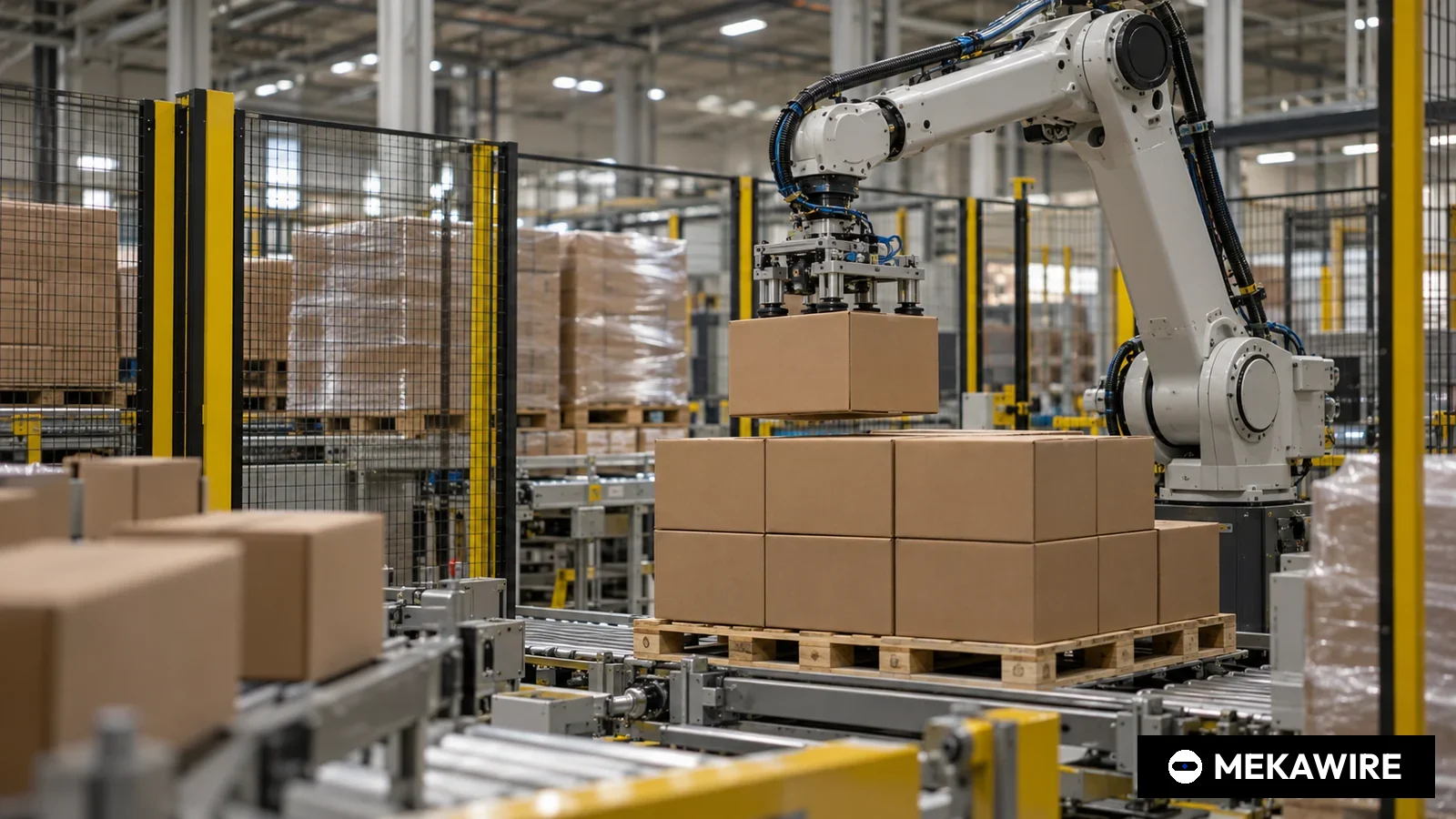
Doosan Robotics agreed on 28 July 2025 to buy 89.59% of ONExia, an Exton, Pennsylvania robot integrator, for a final KRW 37.41 billion (USD 27.19 million) in cash, closing on 17 September 2025. ONExia has since absorbed Doosan's US sales arm, won Haleon packaging contracts and swung to a loss as the merged unit, while Doosan raised its stake to 94.12%.
Doosan Robotics, the Korean collaborative robot maker controlled by Doosan Corp, agreed on 28 July 2025 to take 89.59% of ONExia, Inc., a Pennsylvania company that designs and builds robotic packaging and palletising cells. The deal gave an arm maker that had sold mostly through dealers its own US engineering shop. Doosan's board approved the purchase that day, and the company disclosed it to the Korea Exchange on the same day it reported first half results.
The filing priced the deal at KRW 35.63 billion. That figure combined USD 21,994,074.54 for 87.98% bought from ONExia's existing shareholders under a share purchase agreement and USD 3,899,144.34 of new shares Doosan would subscribe at closing, converted at 1,376 won to the dollar. On 11 September 2025 Doosan amended the disclosure after signing a closing agreement. Contractual price adjustments lifted the share purchase element to USD 23,290,972.09, about 5.9% more, and the total to KRW 37.41 billion, or USD 27.19 million. The amount equalled 9.30% of Doosan Robotics' equity at the end of 2024 and was paid in cash.
The sellers who stayed did not cash out fully. The filing says they keep a stake it puts at 12.02%, covered by options in a shareholders' agreement. Doosan may call those shares at any time after closing, and the holders may put them to Doosan between three and five years after closing. The half year report for 2026 sets the base price at USD 3,490.33 a share, rising at 8% a year for holders who stay at least three years. The July filing estimated the payout at between USD 3,005,933.76 and about USD 4.4 million, depending on how long the managers remain. The structure keeps ONExia's people tied to the business until as late as September 2030.
ONExia traces its roots to Multitech, Inc., which Greg Selke founded in 1984. The business was reincorporated as ONExia in August 2001, moved into custom machine building and robot integration, began building collaborative robot cells in 2012 and launched the ONExia Robotics brand in 2021, according to its website. It works from a 10,000 square foot site in Exton, Pennsylvania, sells the PalletizHD and PalletizHD+ palletisers along with case erectors and case packers, and lists pharmaceuticals, food and beverage, medical device assembly, aerospace, electronics and plastics among its markets. The Korean filing names Gregory Selke as its representative. Doosan said in its release that ONExia had grown sales by about 30% a year and brought 25 years of automation project data.
The unaudited statements attached to the Korean filing show a small but profitable business. Revenue rose from KRW 11.62 billion in 2022 to KRW 15.80 billion in 2023 and KRW 18.29 billion in 2024, or about USD 13.3 million at the filing's exchange rate. Net profit was KRW 2.26 billion in 2023 and KRW 1.90 billion in 2024, after a loss of KRW 34.7 million in 2022, and equity stood at KRW 4.22 billion at the end of 2024. On those figures the final price for 87.98% values the whole of ONExia's equity at about USD 26.5 million, roughly 2.0 times 2024 revenue and 19 times 2024 net profit.
- Revenue
- 11,619.12
- 15,797.32
- 18,291.86
- Net profit
- -34.72
- 2,258.2
- 1,899.39
- Total assets
- 8,040.21
- 9,214.17
- 10,455.19
- Total equity
- 1,121.02
- 3,266.73
- 4,221.47
- Net margin (%)
- -0.3
- 14.3
- 10.4
From Doosan Robotics' KRX filing of 28 July 2025 (amended 11 Sep 2025), converted by Doosan at 1,376 won per US dollar from unaudited US statements. Net margin = net profit / revenue, computed by MEKAWIRE.
As of Oct 3, 2026
The deal closed on 17 September 2025, according to Doosan's half year report for 2026. The final purchase price allocation in that report shows cash consideration of KRW 32.34 billion against identifiable net assets of KRW 12.66 billion, including KRW 11.66 billion of technology recognised as an intangible asset. Goodwill came to KRW 19.68 billion, or 60.9% of the price, and Doosan expensed KRW 1.54 billion of deal costs. Its third quarter report for 2025 put the all in cost at USD 28,697,192.08 once the share subscription, transaction costs and the options were counted.
Integration came quickly. In December 2025 ONExia absorbed Doosan Robotics Americas, LLC, the US sales company Doosan set up in May 2022, and renamed itself Doosan Robotics Americas, Inc. ONExia's website now calls the brand the automated production solutions arm of Doosan Robotics Americas. Doosan's holding in the merged company was 91.44% at the end of 2025 and 94.12% on 30 June 2026 after it bought 4,854 new shares, a capital injection MEKAWIRE covered in March. In the first half of 2026 the subsidiary booked revenue of KRW 17.64 billion and a net loss of KRW 4.62 billion.
The half year filing also names the work the unit is doing. It lists three Haleon contracts: a full end of line multipack system worth USD 3,957,839 signed on 6 October 2025 and due by 25 September 2026, 70.49% complete at the end of June; a Theraflu depalletising and opening cell worth USD 1,266,152 due by 17 September 2026; and an Advil packaging line worth USD 1,142,490 due by 27 January 2027. The subsidiary also holds an undrawn USD 1.5 million credit line from Meridian Bank secured on its assets.
Doosan Robotics was founded on 31 July 2015 and listed on the KOSPI market on 5 October 2023; Doosan Corp held 68.11% of it at 30 September 2025. The company says it reached the global top four in cobot unit sales in 2021, and its filings describe a plan to move from selling arms to selling end to end systems that combine the arm, software and AI. Korea's larger groups have bought into robotics through bigger and more varied deals: Samsung Electronics paid KRW 267.46 billion to lift its Rainbow Robotics stake to 35%, and LG Electronics took 51% of Bear Robotics. Elsewhere SoftBank agreed to buy ABB's robot division for USD 5.375 billion, and Symbotic paid USD 200 million upfront for Walmart's robotics unit.
- Doosan Robotics
- ONExia
- 2025-07-28
- 89.59
- 27.19
- USD
- SoftBank Group
- ABB Robotics
- 2025-10-08
- 100
- 5,375
- USD
- Symbotic
- Walmart Advanced Systems and Robotics
- 2025-01-16
- 100
- 200
- USD
- LG Electronics
- Bear Robotics
- 2025-01-24
- 51
- No data
- USD
- Samsung Electronics
- Rainbow Robotics
- 2024-12-31
- 35
- 267,462.55
- KRW
Prices as disclosed by the acquirer or target: Doosan final amended total incl. USD 3.90m new shares; ABB Robotics enterprise value; Symbotic upfront cash excluding up to USD 350m contingent; LG did not disclose the price of its second 30% (first 21% cost USD 60m); Samsung's 2024 purchase of 3,935,814 shares (KRW 267,462.55m) took it to 35%. Figures disclosed, not estimated.
As of Oct 3, 2026
Several questions remain open. ONExia's pre deal accounts were not audited, and the merged unit has lost money since it absorbed Doosan's loss making sales company. Three Haleon projects worth USD 6.37 million in total are the only contracts the filing breaks out, which points to concentration on one pharmaceutical customer. Owning an integrator may also unsettle the independent integrators that resell Doosan arms. Management is changing too: Kim Min-pyo, one of three representative directors, resigned on 30 September 2026, leaving Park In-won and Cho Kil-sung in the role.
The next markers are close. Doosan's third quarter report, due by mid November 2026, should show whether the two Haleon projects due in September were completed and booked. The Advil line is due by 27 January 2027, the annual report for 2026 will follow in March 2027, and the sellers' put window opens in September 2028.
MEKAWIRE analysis
Doosan bought a small, profitable packaging integrator to create US demand for its own arms, and the first year shows the unit can win pharmaceutical work but cannot yet earn money once Doosan's sales overhead is folded in.
The evidence is in the filings. ONExia made KRW 1.90 billion of net profit on KRW 18.29 billion of revenue in 2024 as a standalone integrator. After it absorbed Doosan Robotics Americas, LLC, the merged company lost KRW 4.62 billion on KRW 17.64 billion of revenue in six months. Doosan has since put in fresh capital and lifted its stake to 94.12%, which shows it is treating the unit as a platform to fund, not a bolt on to milk.
The strongest counter argument is that the loss reflects the sales company Doosan merged in, not ONExia's engineering business, and that a cell builder with Haleon as a reference customer is exactly what an arm maker needs to sell systems instead of hardware. On that reading the price, about 2.0 times revenue for a business growing at a double digit rate, was cheap.
Bull case: Haleon's projects are delivered on time, the reference opens more pharmaceutical and consumer goods packaging lines in North America, and every cell ships with Doosan arms. Solutions revenue then grows faster than arm sales shrink, and the 60.9% goodwill share is never tested.
Bear case: integration costs keep the unit loss making, the Haleon dependence shows up as lumpy revenue, and other US integrators steer customers toward rival arms. Goodwill of KRW 19.68 billion would then face an impairment review while the parent's cash pile is still funding a separate humanoid programme.
Signals to watch:
- Mid November 2026: the third quarter report and whether the Haleon multipack and Theraflu projects show as completed.
- March 2027: the 2026 annual report, with full year results for Doosan Robotics Americas, Inc. and any goodwill impairment test.
- September 2028: the start of the sellers' put window, which will show whether ONExia's managers stay or sell.
- Merged into Doosan Robotics Americas, Inc. (Dec 2025); Doosan stake 94.12% at 30 Jun 2026
- 89.59% (87.98% bought from sellers plus new shares)
- ONExia, Inc., Exton, Pennsylvania; roots to 1984; packaging and palletising cells
- 17 September 2025
- KRW 19.68 billion, 60.9% of KRW 32.34 billion consideration
- 28 July 2025 (board approval and KRX disclosure)
- KRW 37.41 billion, USD 27.19 million, cash (amended 11 Sep 2025)
- 1,376 won per US dollar
- KRW 18.29 billion (unaudited), net profit KRW 1.90 billion
- Call any time; put 3 to 5 years after closing at USD 3,490.33 a share plus up to 8% a year
Why it matters
The ONExia purchase marks a change in how Doosan Robotics wants to make money. Its arms had been sold mostly through dealers and integrators who captured the value of designing the cell around the robot. By owning ONExia, Doosan keeps that engineering margin and gets a reference base of US end of line packaging customers, starting with Haleon.
The timing matters too. Doosan disclosed the deal with first half results for 2025 that showed sharply lower arm sales, and North America is the market it most needs to grow. Buying a US based integrator puts more of the value chain inside the US market Doosan is struggling to reach with imported hardware alone.
Rival analysis
Doosan's Korean peers chose different routes. Samsung Electronics used a call option to take 35% of Rainbow Robotics for KRW 267.46 billion, and LG Electronics moved to 51% of Bear Robotics; both deals bought robot makers, not integrators. Doosan, already a robot maker, went downstream instead.
Internationally, the closest template is a hardware company owning application know how, as Symbotic did with Walmart's robotics unit for USD 200 million upfront. The difference is scale: ONExia's 2024 revenue was about USD 13.3 million, so the deal is a capability purchase, not a market share play.
Valuation context
The final share purchase price of USD 23,290,972.09 for 87.98% implies about USD 26.5 million for all of ONExia's equity. Against 2024 unaudited revenue of KRW 18.29 billion and net profit of KRW 1.90 billion at Doosan's 1,376 rate, that is about 2.0 times sales and 19 times earnings, and about 8.6 times book equity.
The purchase price allocation shows what Doosan paid for: KRW 11.66 billion of technology, KRW 12.66 billion of identifiable net assets in total and KRW 19.68 billion of goodwill, 60.9% of the KRW 32.34 billion cash consideration. A put option liability of KRW 4.19 billion at 30 June 2026 sits on top. Any sustained loss at the merged US unit will put that goodwill under review.
Supply-chain implications
ONExia's cells combine cobots with conveyors, vision, case erectors and palletiser frames that it designs and machines in Exton. Doosan's stated plan is to bring peripheral design and fabrication in house to cut cost, and ONExia's machinists and engineers give it that capability in North America.
The arms themselves are still built at Doosan's leased plant in Suwon, so finished cells remain subject to whatever US duties apply to imported robot arms. Engineering and final assembly in Pennsylvania add local content but do not remove that exposure.
Signals to watch
The third quarter report due by mid November 2026 should show whether Haleon's USD 3.96 million multipack line and USD 1.27 million Theraflu cell, both due in September 2026, were completed. The Advil packaging line is due by 27 January 2027.
The 2026 annual report in March 2027 will carry the first full year of the merged Doosan Robotics Americas, Inc. and the goodwill impairment test. From September 2028 the remaining holders can exercise their put. Management change after the resignation of representative director Kim Min-pyo on 30 September 2026 is a further signal of how the strategy is owned.
Analyst view
Thesis: the deal was cheap and strategically sound, but its value depends on Doosan turning a profitable 13 million dollar integrator into a larger systems business without drowning it in the parent's US sales overhead.
Confidence: medium. The deal terms, closing and accounting are fully disclosed in KRX filings, which supports confidence. Uncertainty comes from ONExia's unaudited pre deal accounts, the lack of a segment profit line for automation solutions, and a short track record of only three disclosed major contracts, all with one customer.
Questions you should be asking
How much of the merged unit's first half 2026 loss of KRW 4.62 billion comes from the former sales company rather than from ONExia's integration business?
What share of the cells ONExia ships use Doosan arms, and has that changed since closing? Will Doosan exercise its call on the remaining stake before the 2028 put window, and at what price?