Generalist's GEN-1.5 learns robot tasks from a single 3 to 12 second demonstration, reaching 59% without fine-tuning
Generalist AI said on August 19, 2026 that GEN-1.5 can learn a new manipulation task from one demonstration of 3 to 12 seconds placed in its context, averaging 59% success over 10 tasks with no fine-tuning and 83% after 10 gradient steps on about 5 minutes of data. The company says the ability emerged from more than eight months of pretraining, but calls the tasks simple and the skills brittle, and has named no customers.
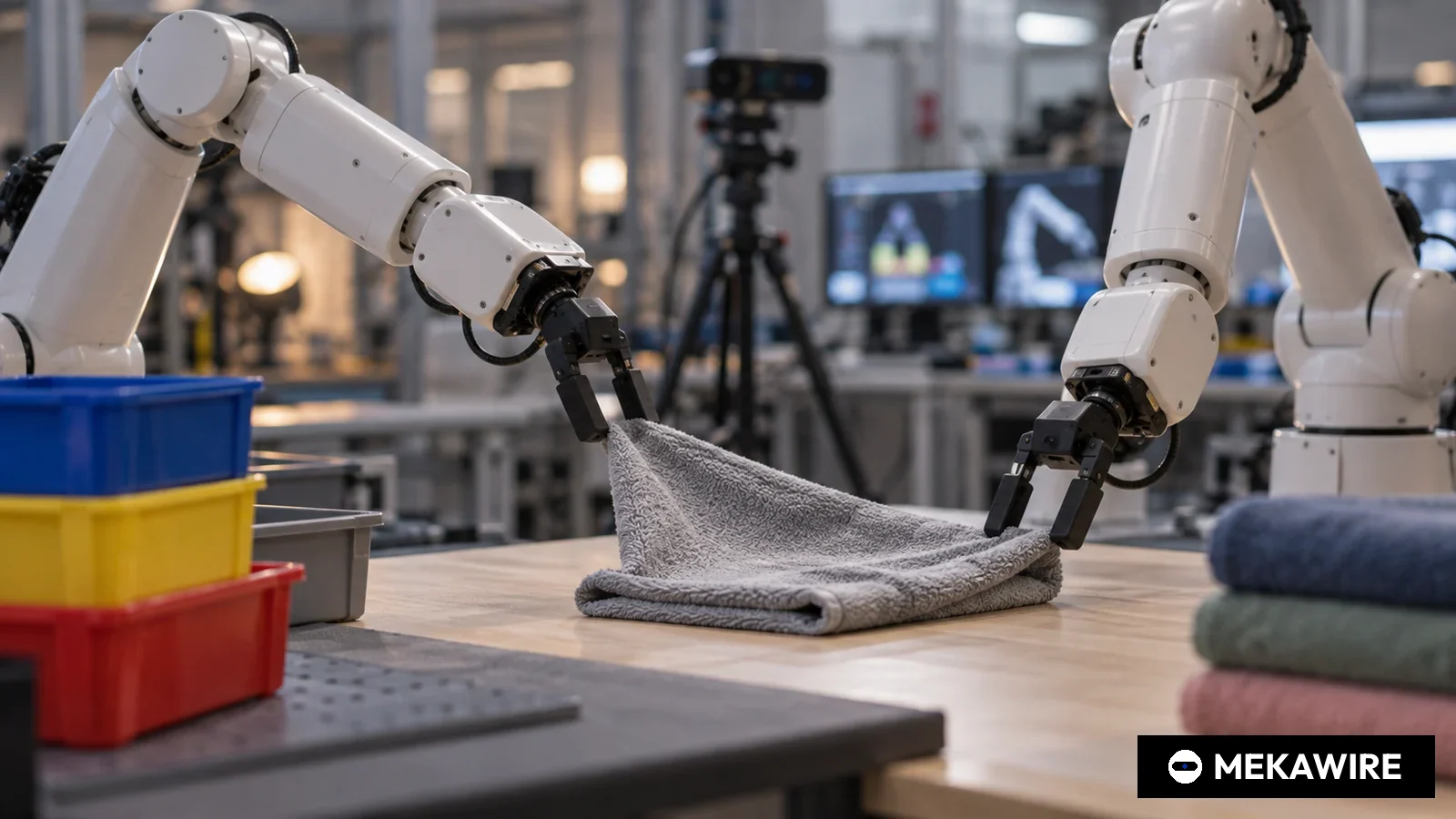
Generalist AI said on August 19, 2026 that its newest robot foundation model, GEN-1.5, can learn a new physical task from a single demonstration lasting 3 to 12 seconds, with no gradient updates and no fine-tuning. Across 10 manipulation tasks, the model reached 59% average success when prompted with one example, with a standard deviation of 10 percentage points, the company reported in a research post signed by the Generalist team.
The figures improve quickly once a small amount of training is allowed. With 10 gradient steps on about 5 minutes of data per task, or roughly 50 demonstrations, average success rose to 83%, with a standard deviation of 9 points. In what Generalist calls the extreme one-step regime, a single gradient step on data sampled from one minute of demonstrations produced 66.5% success on a held-out task. The company said 10 steps changed the model's weights on held-out tasks by less than 0.15%, which it reads as the model reconfiguring knowledge it already holds rather than building new representations. Generalist said it did not tune the adaptation procedure or sweep its hyperparameters.
GEN-1.5 is described as a large multimodal model that takes in video with 30 seconds of memory, together with other sensor, language and proprietary inputs, and outputs action trajectories at 100 Hz. Generalist calls its method physical prompting, meaning that sensorimotor examples are placed in the model's context window in the way text examples are placed in a language model's prompt. A demonstration can be recorded by a person using a pair of handheld grippers or taken from the robot's own earlier rollouts, and the company showed a drag and drop interface for choosing which demonstrations go into the context. The tasks shown include putting a marker into a cup, pouring bolts, working zippers, twisting the lid off a glass jar, unzipping a pencil pouch, brushing a cube into a bowl, removing a vacuum pad and taking money out of a wallet.
The company stresses that it did not design the model for this behaviour. According to the post, there were no architectural changes to promote in-context learning, no inner or outer meta-learning loop and no auxiliary objectives. GEN-1.5's pretraining started in parallel with earlier work and has run continuously for more than eight months, and its next-action prediction error on a held-out validation set kept falling across three training phases. "We do not yet see where that curve asymptotes," the team wrote. Generalist also showed a demonstration recorded entirely in simulation being used as a prompt for a real robot, although GEN-1.5's pretraining contained no simulation data, and gave qualitative examples of the robot using either hand after one-handed demonstrations and grasping cups and bottles it had not seen. It published no success rates for these examples.
Generalist frames the result against the history of language models. It cites GPT-3 as reaching roughly 45% average accuracy with one example and up to about 65% with around 100 examples, and positions GEN-1.5's 59% one-shot figure as a comparable early signal. The company says GEN-1.5 is the first model it knows of to show a general ability to learn a wide range of dexterous, closed-loop physical tasks from one or a few demonstrations.
The release is the third in a sequence. GEN-0, published on November 4, 2025, made the company's case for scaling laws in robot learning. GEN-1, released on April 2, 2026, was pretrained on more than 500,000 hours of human physical interaction data collected with wearable devices and no robot data, and reached 99% average success on chosen tasks after about an hour of robot data per task, according to Generalist. On June 4, 2026 the company announced $400 million in new funding led by Radical Ventures, with 8VC, Union Square Ventures, Hanabi Capital and Norwest joining existing investors including NVIDIA, Boldstart Ventures, Spark Capital, Bezos Expeditions and NFDG, taking its total raised above $500 million. It has not disclosed a valuation.
GEN-1.5 landed one day after a rival made a similar pitch. Skild AI published S1 on August 18, 2026, describing it as a foundation model built from the ground up as an in-context learner that executes a task after one video demonstration, seen or unseen and short or long, with no fine-tuning. Skild reported 96% success on in-distribution tasks and 66% on out-of-distribution tasks at 100,000 training hours, and said its long-horizon tasks run up to 10 minutes. The two companies use different tasks, metrics and demonstration formats, so the figures cannot be compared directly. Physical Intelligence, Google DeepMind and NVIDIA are pursuing general robot models through fine-tuning and large pretraining runs rather than a public one-shot benchmark.
For buyers of automation the stakes are practical. Teaching an industrial robot a new job today usually means programming or collecting task data, and GEN-1 had already cut the robot data needed to about an hour per task. If a few seconds of demonstration can replace that hour for simple tasks, the cost of adding a task to a robot cell would fall to the time it takes an operator to show it once. That would matter most for high-mix work in logistics, electronics and light assembly, where tasks change too often to justify long programming projects.
The caveats are spelled out in Generalist's own text. The company calls the tasks simple and short-horizon and the success rates modest, and says skills learned in context are currently more brittle than fine-tuned ones, though they can generalize to some perturbations. The post does not give the number of trials per task, a breakdown of the pretraining data or any independent evaluation. It names no customers, pricing or release date for GEN-1.5. A 59% success rate is far from the reliability factories accept, and the evidence for the model's sim-to-real and cross-hand behaviour is so far qualitative.
- GEN-1.5 one-shot, in context
- One demonstration of 3 to 12 seconds
- 0
- 59
- GEN-1.5 one-step adaptation (held-out task)
- Sampled from 1 minute
- 1
- 66.5
- GEN-1.5 few-shot adaptation
- About 5 minutes (about 50 demonstrations)
- 10
- 83
- GPT-3 one-shot (as cited by Generalist)
- One example
- 0
- 45
- GPT-3 few-shot (as cited by Generalist)
- About 100 examples
- 0
- 65
Company-reported figures from Generalist AI's GEN-1.5 post of August 19, 2026. GEN-1.5 one-shot and few-shot are averages over 10 tasks (standard deviations 10 and 9 points); the one-step figure refers to a held-out task. GPT-3 values are approximate figures quoted by Generalist (roughly 45% and up to about 65%). Trial counts not disclosed.
As of Oct 1, 2026
- Generalist AI
- Growth
- 400,000,000
- No data
- 2026-06-04
- Skild AI
- Series C
- 1,400,000,000
- 14,000,000,000
- 2026-01-14
- Figure AI
- Series C
- 1,000,000,000
- 39,000,000,000
- 2025-09-16
- Dyna Robotics
- Series A
- 120,000,000
- No data
- 2025-09-15
- Genesis AI
- Launch
- 105,000,000
- No data
- 2025-06-30
- Physical Intelligence
- Series B
- No data
- No data
- 2025-11-20
Latest round amounts and post-money valuations as disclosed by the companies or their investors; — means not disclosed. Generalist AI's June 2026 round was not given a series letter by the company; Genesis AI's round was described as a launch round. Figures disclosed, not estimated.
As of Oct 1, 2026
MEKAWIRE analysis
GEN-1.5 moves the robot learning debate from how much data a task needs to whether a demonstration can replace training altogether, but its one-shot numbers are a research signal, not a deployable capability.
The evidence is the shape of the curve. Generalist went from about an hour of robot data per task with GEN-1 to seconds of demonstration with GEN-1.5 in under five months, and Skild published a similar in-context claim a day earlier. Two well-funded labs arriving at in-context learning at the same time suggests that the behaviour emerges from scale rather than from one company's design choice, which is the pattern seen in language models.
The strongest counter-argument is that the measured tasks are short tabletop actions chosen by the company, with undisclosed trial counts. The jump from 59% to 83% with 10 gradient steps also shows that light fine-tuning still beats pure prompting by a wide margin, so the practical product may look more like fast fine-tuning than true one-shot learning.
Bull case. One-shot success keeps rising with pretraining, as Generalist's still-falling validation error hints, and within a model generation simple tasks clear 90% from a single demonstration. Integrators then sell robots that are taught on the floor, and Generalist's human data engine becomes the moat.
Bear case. In-context skills stay brittle, customers fall back on fine-tuning, and the advantage narrows to a faster training pipeline that Skild, Physical Intelligence and NVIDIA can match. Without disclosed customers or valuation, Generalist's lead remains a matter of company-published research.
Signals to watch:
- Whether Generalist publishes trial counts, a technical report or third-party results for GEN-1.5 before December 31, 2026.
- Whether GEN-1.5 reaches early access partners or named customers by the end of the first quarter of 2027.
- The next one-shot success figure from Generalist or Skild, and whether either reports long-horizon in-context results above the 59% and 66% marks set in August 2026.
- August 19, 2026 (Generalist AI research post)
- Continuous for more than eight months across three training phases
- No customers, pricing or release date disclosed
- $400 million led by Radical Ventures, June 4, 2026; more than $500 million in total
- 83% with 10 gradient steps on about 5 minutes of data per task (std. dev. 9 points)
- 59% average over 10 tasks (std. dev. 10 points)
- 66.5% on a held-out task from data sampled from 1 minute
- 3 to 12 seconds, no gradient updates or fine-tuning
- Video with 30 seconds of memory plus sensor, language and proprietary inputs; 100 Hz action trajectories
Why it matters
The cost of teaching a robot a new task is the single biggest brake on general-purpose robotics. Each new job has traditionally needed engineering time or a dedicated data collection campaign. Generalist's GEN-1 claimed to cut that to about an hour of robot data. GEN-1.5 claims that for simple tasks a demonstration of a few seconds, placed in the model's context, can do part of the job with no training at all.
The second reason is the claim of emergence. Generalist says in-context learning appeared without any architecture or objective built for it. If that holds, the capability should improve with more pretraining, which turns data and compute spending into a predictable lever, the argument that drove investment in language models after GPT-3.
Rival analysis
Skild AI is the closest rival on this specific claim. Its S1 post on August 18, 2026 reported 66% success on unseen tasks from a single video and 96% on seen tasks, with long-horizon tasks of up to 10 minutes. Skild's numbers cover longer tasks than Generalist's, while Generalist's post is more specific about what light fine-tuning adds. Neither disclosed trial counts in the material reviewed.
Physical Intelligence, Google DeepMind and NVIDIA have emphasised large pretraining and fine-tuning rather than a headline one-shot figure. Google DeepMind's Gemini Robotics On-Device, for example, was presented in 2025 as adaptable with as few as 50 demonstrations, roughly the data budget Generalist used to reach 83%. The competitive question is now which lab can shrink that budget to a single demonstration without losing reliability.
Valuation context
Generalist has disclosed $400 million in its June 4, 2026 round and more than $500 million in total, but no valuation. Skild AI's January 2026 Series C of $1.4 billion valued it at $14 billion, and Figure AI's September 2025 Series C put it at $39 billion. Physical Intelligence has not disclosed figures in the data MEKAWIRE holds.
GEN-1.5 does not change Generalist's disclosed financials, but research results are the main currency for a pre-revenue model company. A credible one-shot curve supports a valuation built on future licensing to robot makers, while the absence of named customers limits how far that can be pushed.
Supply-chain implications
Generalist's data comes from people using handheld grippers and wearable devices rather than from robot fleets, according to its GEN-1 and GEN-1.5 posts. That shifts the bottleneck from robot hardware and teleoperation labour to low-cost capture devices and the people who wear them in homes, warehouses and factories.
The model's 100 Hz action output and 30-second video memory imply significant onboard or nearby compute for inference, though Generalist did not specify hardware. NVIDIA is an investor, and any commercial rollout will depend on robot makers that can host the model and accept its action stream.
Signals to watch
The first signal is evidence quality: trial counts, a technical report or third-party testing of GEN-1.5. The second is commercial: whether the early access programme Generalist opened with GEN-1 in April 2026 extends to GEN-1.5, and whether any customer is named.
The third is the curve itself. Generalist says validation error is still falling after more than eight months of pretraining. A later update showing one-shot success well above 59% on the same tasks would support the scaling thesis; a flat figure would weaken it.
Analyst view
Thesis: GEN-1.5 is a meaningful research step that makes in-context learning a competitive benchmark for robot foundation models, but it is not yet evidence of a deployable product. Confidence: medium.
Reasons for medium rather than high: all figures are self-reported, trial counts are absent and the tasks are short. Reasons for medium rather than low: the company is candid about brittleness, the few-shot results are internally consistent, and a separate lab, Skild, reported similar behaviour within 24 hours, which makes a one-off artefact less likely.
Questions you should be asking
How many trials stand behind each task's success rate, and how were the 10 tasks selected? What share of GEN-1.5's pretraining data comes from human wearables, robot rollouts and other sources?
Can in-context skills be chained into long-horizon jobs, as Skild claims for S1? When will GEN-1.5 be available to partners, on what hardware, and at what price?