Google DeepMind's Gemini Robotics 1.5 makes robots think before they act, and puts its planning model in developers' hands
Google DeepMind on 25 September 2025 introduced Gemini Robotics 1.5, a vision-language-action model that reasons in natural language before moving and transfers skills across robot bodies, alongside Gemini Robotics-ER 1.5, an embodied reasoning model opened to developers as a preview in the Gemini API. In its technical report, the pairing of the two cut total subtask failures on long-horizon tasks to 22% from 44.5% when a general Gemini 2.5 Flash model did the planning.
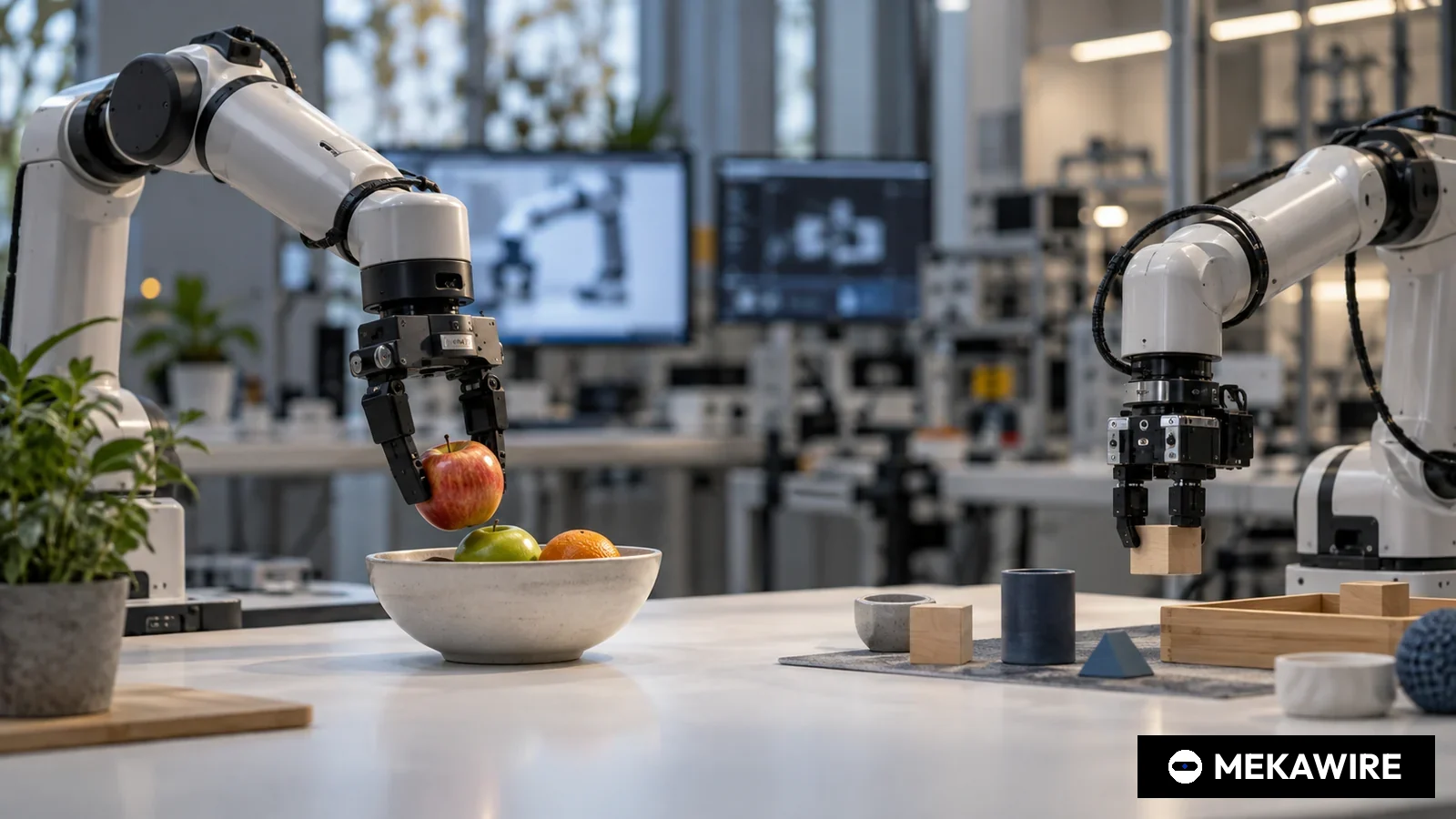
Google DeepMind on 25 September 2025 released two robot models that split the job of a general-purpose robot into a planner and a doer. Gemini Robotics 1.5 is a vision-language-action (VLA) model that turns camera images and instructions into motor commands and, according to the company, writes out its reasoning before it acts. Gemini Robotics-ER 1.5 is a vision-language model built for embodied reasoning that plans multi-step tasks, calls digital tools such as Google Search and hands steps to a VLA.
The access terms differ sharply. Gemini Robotics-ER 1.5 went live the same day as a preview in Google AI Studio and the Gemini API under the model identifier gemini-robotics-er-1.5-preview, the Google developers blog said. Gemini Robotics 1.5, the model that actually moves robot arms, is available only to select partners, DeepMind's announcement said. Neither model's weights were published.
The clearest number in the release sits in the accompanying technical report, a preprint that was not peer reviewed and was posted to arXiv on 2 October 2025 (arXiv:2510.03342). When Gemini Robotics-ER 1.5 orchestrated Gemini Robotics 1.5 on long-horizon tasks, total subtask failures were 22%, against 44.5% when Gemini 2.5 Flash acted as the orchestrator. Planning failures fell to 9% from 25.5%, action failures to 9% from 13% and success-detection failures to 4% from 6%, the report said.
- Planning
- 25.5
- 9
- Success detection
- 6
- 4
- Action
- 13
- 9
- Total
- 44.5
- 22
As reported by Google DeepMind in the Gemini Robotics 1.5 technical report (arXiv:2510.03342v1); both agents use Gemini Robotics 1.5 as the action model. Self-reported, not independently replicated.
As of Oct 2, 2025
The report also says the thinking VLA on its own reached a progress score of up to 44% on its hardest multi-step evaluations, while the full agent "frequently achieves scores near 80%". DeepMind said Gemini Robotics-ER 1.5 was evaluated on 15 academic embodied reasoning benchmarks, among them ERQA and Point-Bench, and claimed state-of-the-art results on aggregate. The report compares it with GPT-5, GPT-5-mini, Gemini 2.5 Pro and Gemini 2.5 Flash, but presents most per-benchmark results only in charts rather than in text, so MEKAWIRE does not reproduce individual scores here.
The second technical claim is motion transfer. DeepMind trained Gemini Robotics 1.5 on data from three quite different machines: the ALOHA 2 bimanual research platform, a bi-arm Franka setup and Apptronik's Apollo humanoid. The company says tasks learned on one of these bodies "also just work" on the others without specialising the model to each. The report contrasts this with its own Gemini Robotics On-Device models, which need a separate checkpoint for every embodiment.
The 1.5 generation is the third robotics release from DeepMind in 2025. The first Gemini Robotics and Gemini Robotics-ER models, built on Gemini 2.0, were announced on 12 March 2025 with Apptronik as hardware partner and Agile Robots, Agility Robotics, Boston Dynamics and Enchanted Tools as trusted testers. Gemini Robotics On-Device followed on 24 June 2025, offered to trusted testers through an SDK and adaptable to new tasks with as few as 50 to 100 demonstrations, according to DeepMind. Google also took part in Apptronik's $350 million Series A in February 2025, Apptronik said.
The competitive field has moved fast. Figure AI introduced Helix on 20 February 2025, pairing a 7-billion-parameter vision-language model running at 7 to 9 Hz with an 80-million-parameter control policy running at 200 Hz on embedded GPUs inside its robots. NVIDIA released Isaac GR00T N1 on 18 March 2025 as a downloadable 2-billion-parameter model under an NVIDIA licence that restricts commercial use. Physical Intelligence published pi0.5 on 22 April 2025 and released its base weights in its openpi repository in September 2025. Figure closed a $1 billion Series C at a $39 billion post-money valuation on 16 September 2025, nine days before DeepMind's release.
- Gemini Robotics 1.5
- Google DeepMind
- 2025-09-25
- No
- Select partners
- No data
- Gemini Robotics-ER 1.5
- Google DeepMind
- 2025-09-25
- No
- Gemini API preview
- No data
- Gemini Robotics On-Device
- Google DeepMind
- 2025-06-24
- No
- Trusted testers via SDK
- No data
- pi0.5
- Physical Intelligence
- 2025-04-22
- Yes (openpi, Sept 2025)
- Open base checkpoint
- No data
- Isaac GR00T N1
- NVIDIA
- 2025-03-18
- Yes (non-commercial NVIDIA licence)
- Hugging Face download
- 2
- Helix
- Figure AI
- 2025-02-20
- No
- Runs on Figure robots
- 7.08
From each developer's own announcement, model card or repository. Helix = 7B System 2 + 0.08B System 1 as disclosed by Figure. Null = not disclosed. No benchmark scores compared because the models were not evaluated on a common test.
As of Oct 2, 2025
The idea behind the thinking VLA is simple to state. A conventional VLA maps pixels and a command straight to joint movements. Gemini Robotics 1.5 first produces a short internal monologue in language, breaking an instruction such as sorting laundry by colour into steps, and only then emits actions. DeepMind argues this makes behaviour easier to inspect and more robust to multi-step tasks. Gemini Robotics-ER 1.5 adds a tunable thinking budget, set through the thinking_config parameter, so a developer can trade latency for accuracy on harder spatial questions.
For robot makers, the split matters commercially. A company with its own controllers can call Gemini Robotics-ER 1.5 today as a cloud reasoning layer for pointing, object localisation, progress estimation and task planning, paying for API use rather than training a large model. The action model that would replace their own control stack remains behind a partner gate, so for now DeepMind sells the brain's planning cortex, not its motor cortex.
Safety remains an open question. DeepMind released an upgraded ASIMOV benchmark for semantic safety and says Gemini Robotics-ER 1.5 improves on its predecessor, but the report gives these results in charts and the tests are DeepMind's own. Cloud latency, pricing at scale and how motion transfer performs on bodies outside the three training platforms are not addressed by public data. The signals to watch are wider partner access to Gemini Robotics 1.5, a move of the ER model from preview to general availability, and third-party benchmark replications.
MEKAWIRE analysis
DeepMind is betting that the planning layer, not the motor policy, is where a general robot model first becomes a sellable product, and Gemini Robotics-ER 1.5 is the first DeepMind robotics model any developer can call.
Evidence for the thesis is in the release terms and in the report. The ER model is public in preview while the VLA is gated, and the largest measured gain in the report, a halving of total subtask failures to 22% from 44.5%, comes from swapping the orchestrator rather than the action model. Planning failures alone fell to 9% from 25.5%.
The strongest counter-argument is that a cloud planner is easy to copy. Large general models from OpenAI and others already answer spatial questions, and the report's own comparison set includes GPT-5. If the gap on embodied reasoning benchmarks narrows, the planner becomes a commodity and value returns to whoever owns robot data and low-level control, which is the strategy of Figure, Physical Intelligence and NVIDIA.
Bull case: developers adopt the ER model as a default reasoning layer across many robot brands, giving DeepMind a distribution channel that open-weight rivals lack, and motion transfer lets the partner-only VLA scale to new bodies with little extra data. Partners such as Apptronik then ship humanoids with Gemini on board as a selling point.
Bear case: robot makers resist sending live camera feeds to a cloud model for latency, cost and data-control reasons, and prefer open checkpoints such as pi0.5 or GR00T N1 that they can run and modify locally. The VLA stays a lab result on three platforms and the benchmarks remain self-reported.
Signals to watch: the date Gemini Robotics-ER 1.5 leaves preview and its published per-token price; whether DeepMind opens Gemini Robotics 1.5 beyond select partners before mid-2026; and any independent replication of the report's long-horizon results on a fourth embodiment.
- Gemini Robotics 1.5 (VLA); Gemini Robotics-ER 1.5 (embodied reasoning VLM)
- Not released
- 25 September 2025
- 15 academic embodied reasoning benchmarks incl. ERQA and Point-Bench
- Preview in Gemini API and Google AI Studio (gemini-robotics-er-1.5-preview)
- arXiv:2510.03342, posted 2 October 2025, not peer reviewed
- Select partners only
- ALOHA 2, bi-arm Franka, Apptronik Apollo
- 22% with ER 1.5 orchestrator vs 44.5% with Gemini 2.5 Flash
Why it matters
This is the first time DeepMind has shipped a robotics model that any developer with a Gemini API key can call, which turns robot reasoning from a closed research programme into a cloud product line. The March 2025 Gemini Robotics-ER and June 2025 On-Device releases were limited to trusted testers. With the ER 1.5 preview, the barrier to trying DeepMind's spatial reasoning on a real robot drops to an API call.
The architecture also formalises a two-tier robot stack, a reasoning orchestrator above an action model, that many labs had been converging on. Figure's Helix uses a slow 7-billion-parameter system above a fast 80-million-parameter policy inside one robot. DeepMind's version separates the tiers into two products with different access rules, which lets it monetise the upper tier immediately while keeping the lower tier close.
Rival analysis
Physical Intelligence is the most direct research rival. Its pi0.5 model, published on 22 April 2025, targets generalisation to unseen homes, and its base weights are public in the openpi repository under an Apache-2.0 repository licence. That gives university labs and startups a model they can fine-tune and run offline, something DeepMind does not offer for Gemini Robotics 1.5.
NVIDIA's GR00T N1, released on 18 March 2025, is downloadable but carries an NVIDIA licence restricting commercial use; NVIDIA's strategy is to sell the GPUs, simulation and synthetic data pipeline around the model. Figure's Helix is vertically integrated into Figure's own robots and is not offered to others. DeepMind therefore occupies a distinct position: a cloud reasoning service open to all, plus a gated action model shared with partners such as Apptronik.
Valuation context
Google DeepMind is a unit of Alphabet and discloses no separate financials, so the release carries no direct valuation signal. The relevant market marks are those of independent rivals. Figure closed a $1 billion Series C at a $39 billion post-money valuation on 16 September 2025, a price that rests heavily on Helix being a proprietary advantage.
If general cloud models such as Gemini Robotics-ER 1.5 can handle the planning tier for any robot, part of the premium investors pay for in-house robot brains is at risk. Conversely, Google's participation in Apptronik's $350 million Series A in February 2025 shows Alphabet hedging through hardware partners rather than building its own humanoid.
Supply-chain implications
The release is software-only and changes no component orders directly. Its supply-chain relevance lies in compute placement. The ER model runs in Google's cloud, so robots using it need reliable connectivity and less onboard inference capacity for planning, while motor control still requires local compute. That favours modest onboard processors plus networking over the high-end embedded GPU modules NVIDIA promotes for running full models on the robot.
The three training platforms span a low-cost research arm system (ALOHA 2), an industrial-grade arm (Franka) and a full humanoid (Apptronik Apollo). If motion transfer works as described, component suppliers benefit from a model that does not tie data collection to one hardware design, lowering the switching cost between arm and hand vendors.
Signals to watch
First, the general availability date and per-token pricing of Gemini Robotics-ER 1.5; a stable release would indicate DeepMind is confident enough to support production robot workloads. Second, any expansion of Gemini Robotics 1.5 beyond select partners, and whether a version appears for on-device deployment like the June 2025 On-Device model.
Third, partner announcements naming Gemini Robotics 1.5 in commercial pilots, especially from Apptronik and the March 2025 trusted testers Agile Robots, Agility Robotics and Boston Dynamics. Fourth, independent benchmark results from labs running ERQA or Point-Bench on the public ER preview, which would test DeepMind's state-of-the-art claim outside its own report.
Analyst view
Thesis: DeepMind has the strongest public embodied reasoning model available through an API, but the commercially decisive layer, real-time action on diverse hardware, remains unproven outside DeepMind's three platforms. Confidence: medium.
Reasons for medium rather than high: the headline failure-rate improvement comes from DeepMind's own long-horizon evaluation, the report presents most benchmark comparisons in charts, and the paper is a non-peer-reviewed technical report. Reasons for not going lower: the ER model is publicly testable, so claims about spatial reasoning can be checked by anyone, and the report discloses failure-mode breakdowns rather than only success rates.
Questions you should be asking
What will Gemini Robotics-ER 1.5 cost per robot-hour at production scale, and what latency does a round trip to the Gemini API add to a pick-and-place cycle? How many demonstrations per new embodiment does motion transfer require, compared with the 50 to 100 DeepMind cited for task adaptation in its On-Device model?
Which partners hold Gemini Robotics 1.5 today, and under what terms on data sharing? Will DeepMind publish weights of any robotics model, as Physical Intelligence did with pi0.5, or keep the action tier closed?