LG enters the robot joint business with its AXIUM actuator brand as the CLOiD home robot makes its CES debut
LG Electronics unveiled the CLOiD home robot and launched LG Actuator AXIUM, a brand of motor, drive and reducer joint modules aimed at the wider robotics market, at CES 2026. The robot came with detailed joint counts but no price or date, and the actuator with no specifications or customer, leaving LG behind Hyundai Mobis, which named Boston Dynamics' Atlas as its first actuator customer three days later.
LG Electronics used CES 2026 to put two robotics bets on the table at once. On Jan. 4 the Seoul-based company presented LG CLOiD, a wheeled home robot with two seven-joint arms and five-fingered hands, and in the same announcement introduced LG Actuator AXIUM, a brand of robot joint modules that it said targets the wider robotics market. The robot drew the crowds at its Las Vegas booth. The actuator brand is the move with more commercial weight, because it puts one of the world's largest appliance makers into the component that its own peer, Hyundai Mobis, describes as the largest cost item in a humanoid.
The numbers LG disclosed were about the robot rather than the part. Each CLOiD arm has seven degrees of freedom and each hand has five independently actuated fingers, LG said. The torso tilts to change height, which lets the robot pick up objects from knee level upward, and a chipset in the head acts as its brain alongside a display, speaker, cameras and other sensors. LG said its vision language model and vision language action model were trained on tens of thousands of hours of household task data.
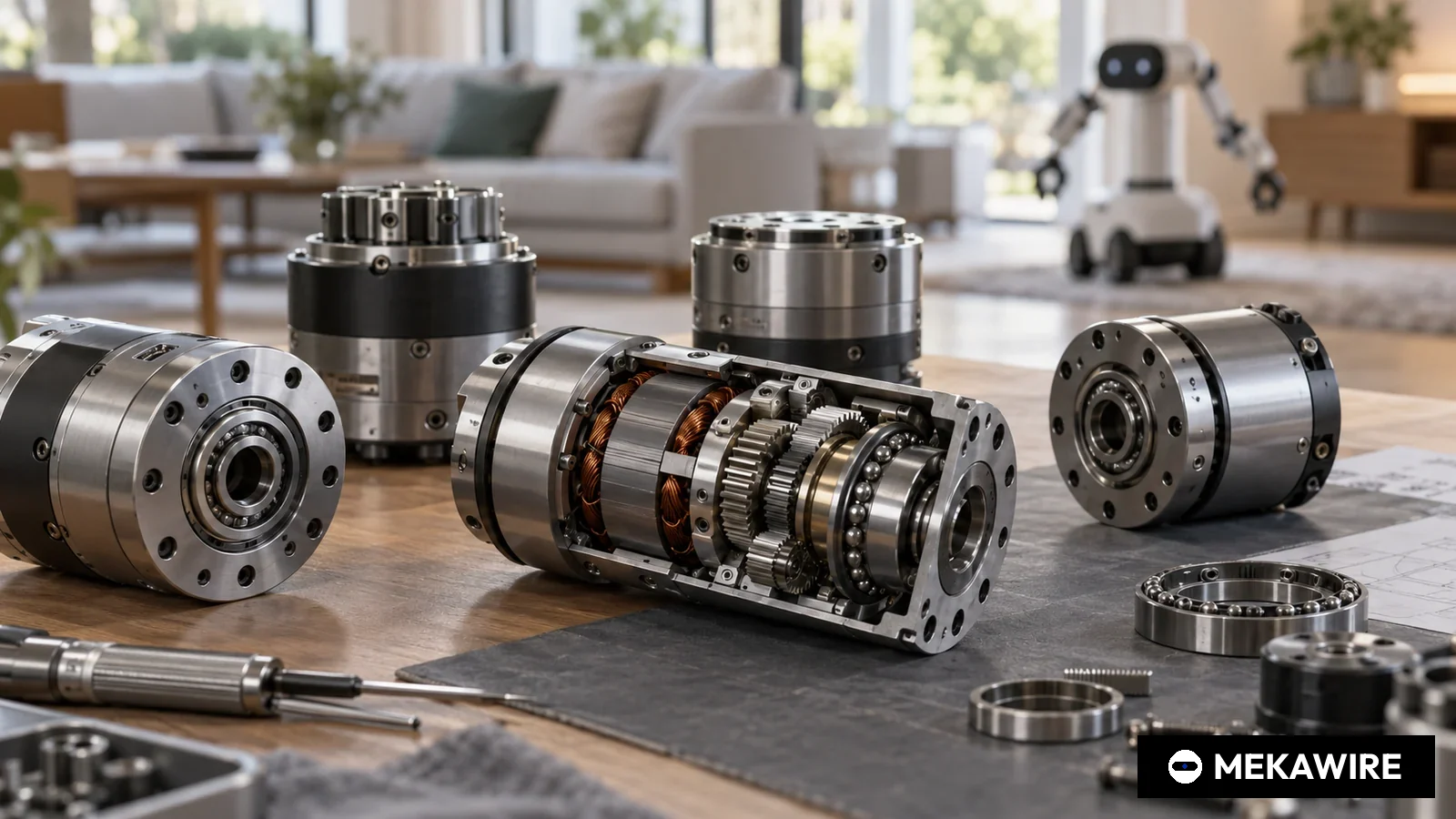
For AXIUM, LG gave a description but no specifications. The company said each actuator combines a motor that produces rotational force, a drive that controls the electrical signal and a reducer that sets speed and torque, packaged as a compact module that works as a robot joint. In its Jan. 7 CES release LG called AXIUM a cost- and performance-optimised platform built on its experience designing appliance motors, and listed light weight, compact size, high efficiency and high torque as its advantages. It did not publish torque ratings, weights, prices, a production site or a customer.
The CES demonstrations were domestic. LG said CLOiD would take milk from a refrigerator, place a croissant in an oven, start a laundry cycle and fold and stack clothes, tied into its ThinQ smart home platform. The company said it designed the robot with a low centre of gravity for safety around children and pets, and that it plans to keep developing what it calls Appliance Robots and Robotized Appliances on the way to a home where chores are automated. Steve Baek, president of LG's Home Appliance Solution company, said CLOiD was designed to engage naturally with the people it serves.
The launch builds on two years of deal making. LG bought 21% of Silicon Valley service robot maker Bear Robotics for $60 million in March 2024 and in January 2025 exercised a call option to lift its stake to 51%, moving its own CLOi commercial robot business into Bear, according to LG. Ahead of CES the company said it had set up an HS Robotics Lab inside its Home Appliance Solution company to develop robot technology and pursue partnerships.
The money for all of this comes from appliances. LG reported 2025 consolidated revenue of KRW 89.2 trillion and operating profit of KRW 2.48 trillion on Jan. 30, 2026. Its Home Appliance Solution company, which houses the robotics lab, earned KRW 1.28 trillion of operating profit on KRW 26.13 trillion of revenue, while the TV business lost KRW 750.9 billion. The company's 2026 outlook in that release focused on AI appliances, air conditioning and data centre cooling, and software-defined vehicles, without a robotics target.
- Home Appliance Solution (HS)
- 26.13
- 1.28
- Vehicle Solution (VS)
- 11.14
- 0.56
- Eco Solution (ES)
- 9.32
- 0.65
- Media Entertainment Solution (MS)
- 19.43
- -0.75
- LG Electronics consolidated
- 89.2
- 2.48
Figures as disclosed by LG Electronics on Jan. 30, 2026; consolidated total includes items not shown by business. Negative = operating loss.
As of Oct 1, 2026
LG is not alone among Korean groups. Three days after LG's CLOiD announcement, Hyundai Mobis said it would supply actuators for Boston Dynamics' next-generation Atlas, calling it the parts maker's first official robotics customer and saying actuators account for more than 60% of a humanoid's material cost. Samsung Electronics said on Dec. 31, 2024 it would raise its stake in Rainbow Robotics to 35% from 14.7% and set up a Future Robotics Office reporting to its chief executive. Hyundai has a captive buyer in Boston Dynamics and Samsung has an in-house robot maker. LG's actuator, as described at CES, has neither yet.
- LG Electronics
- 1958
- Launches AXIUM actuator brand and CLOiD home robot
- 2026-01-04
- No data
- Hyundai Mobis
- No data
- Framework to supply actuators for Boston Dynamics' next-generation Atlas
- 2026-01-07
- No data
- LG Electronics
- 1958
- Raises Bear Robotics stake by call option
- 2025-01-24
- 51
- Samsung Electronics
- 1969
- Becomes largest shareholder of Rainbow Robotics
- 2024-12-31
- 35
Dates and stakes from company releases; founding years from MEKAWIRE company data; — = not disclosed or not applicable.
As of Oct 1, 2026
The technology is familiar to anyone who builds washing machines. A humanoid joint is an electric motor, a controller and a gearbox, and the engineering problem is packing torque into a small, light housing that survives millions of cycles at a price buyers accept. Appliance makers already run high-volume motor lines and the quality systems that go with them. What they have less of is reducer know-how, the precision gearing that Japanese specialists such as Harmonic Drive Systems and Nabtesco have long dominated, and LG did not say whether AXIUM's reducers are made in house.
The risks follow from what LG left out. Without published torque density, weight or price, outsiders cannot compare AXIUM with joint modules from established suppliers, and a captive customer base is the usual way a new actuator supplier proves durability. CLOiD itself carried no price or launch date, and home robots have a long record of impressive demonstrations that never reach shops.
MEKAWIRE analysis
LG's real CES robotics launch was the joint, not the robot, because AXIUM lets an appliance motor giant sell into every humanoid maker's bill of materials while CLOiD remains a showcase.
The evidence is in where LG put its detail and where it did not. CLOiD came with joint counts and AI model descriptions but no price or date, while AXIUM came with a brand, a positioning as a cost-optimised platform for the robotics market and a direct link to LG's appliance motor heritage. Hyundai Mobis' own disclosure that actuators are more than 60% of humanoid material cost shows why a Korean parts maker would want that slice.
The strongest counter-argument is that LG is arriving with no anchor customer. Mobis has Atlas, Samsung controls Rainbow Robotics, and reducer specialists in Japan and China have years of qualification history with robot makers. A component supplier without a first buyer can spend years in qualification.
Bull case. LG's appliance motor volumes and quality systems let it undercut specialist actuator makers on cost while matching them on reliability, and CLOiD plus Bear Robotics give it in-house test beds. If one global humanoid maker signs on, AXIUM becomes a second leg for the Home Appliance Solution company.
Bear case. Reducers and torque density, not motors, decide actuator performance, and LG has disclosed nothing on either. Without a named customer AXIUM stays a brand, and CLOiD joins the list of home robots that never ship.
Signals to watch:
- LG Electronics' third-quarter 2026 results, expected in late October 2026, for any disclosed actuator revenue or external customer.
- CES 2027 in Las Vegas in January 2027, for AXIUM specifications, pricing or a CLOiD launch date.
- LG Electronics' annual general meeting in March 2027, for capital spending on a dedicated actuator line.
- Actuator modules combining motor, drive and reducer; no specs, price or customer disclosed
- CES 2026, Las Vegas, Jan. 6 to 9, booth 15004
- VLM and VLA trained on tens of thousands of hours of household task data
- Jan. 4, 2026 (CLOiD and AXIUM); Jan. 7, 2026 (corporate CES release)
- Hyundai Mobis to supply Atlas actuators (Jan. 7, 2026)
- 2 arms, 7 degrees of freedom each
- 5 independently actuated fingers per hand
- KRW 89.2 trillion; operating profit KRW 2.48 trillion
- 51% after January 2025 call option (21% bought for $60 million in March 2024)
Why it matters
Actuators are where the money in a humanoid sits. Hyundai Mobis put the share at more than 60% of material cost when it announced its Atlas supply framework. A company that can make joint modules at appliance volumes and appliance prices would capture value regardless of which robot brand wins, which is a safer bet than backing one robot.
LG chose CES, a consumer show, to launch a component aimed at business buyers. That signals AXIUM is meant to be marketed beyond LG's own products, though LG said nothing about external sales terms in its releases.
Rival analysis
Hyundai Mobis has what LG lacks, a named first customer in Boston Dynamics and a parent group that has said it will build a robot factory with capacity for 30,000 units a year in North America. Samsung controls Rainbow Robotics, giving it an in-house robot platform for any components it develops.
Outside Korea, reducer and actuator specialists in Japan and China have long qualification records with robot makers. LG's differentiation, on its own description, is cost and performance optimisation drawn from appliance motor design. That claim needs published torque density and price to be tested.
Valuation context
LG Electronics earned KRW 2.48 trillion of operating profit on KRW 89.2 trillion of revenue in 2025, a margin of about 2.8%. The Home Appliance Solution company that houses the robotics lab earned KRW 1.28 trillion on KRW 26.13 trillion, about 4.9%, and is the internal funder of CLOiD and AXIUM.
LG has disclosed no robotics revenue. Its only priced robotics transaction is Bear Robotics, where it paid $60 million for 21% in March 2024 and later took control through a call option at an undisclosed price, so investors have no market mark for the robotics unit.
Supply-chain implications
An AXIUM module has three parts by LG's description: motor, drive and reducer. LG's appliance business gives it the motor and power electronics base. The reducer is the open question, and LG did not say whether it makes or buys gearing.
If LG sources reducers externally, AXIUM's cost advantage depends on suppliers that also serve its competitors. If it builds them, it needs precision gear manufacturing that appliance plants do not normally run.
Signals to watch
First, any named external AXIUM customer or a supply agreement disclosed by LG Electronics. Second, published specifications such as rated torque, weight and price per joint. Third, any CLOiD price or launch date.
Also watch whether robotics appears as a line item in LG's quarterly results, starting with the third quarter of 2026 in late October, and whether Bear Robotics adopts AXIUM in its service robots.
Analyst view
Thesis: AXIUM is the more consequential half of LG's CES launch because it lets LG sell into other makers' humanoids, but it is unproven until a customer is named. Confidence: medium.
Reasons for medium confidence: the strategic logic rests on a disclosed cost share and on LG's verified appliance scale, but LG published no actuator specifications, prices or customers, and its Jan. 30 outlook did not set a robotics target.
Questions you should be asking
Does LG make AXIUM's reducers in house? What torque range and weight does the first AXIUM line cover, and at what price? Is AXIUM intended for humanoids or mainly for wheeled service robots like CLOiD?
Will Bear Robotics, which LG controls, be the first external user? When will CLOiD go on sale, and at what price?