Microsoft enters the robot model race with Rho-alpha, a Phi-based model that adds touch and learns from human corrections
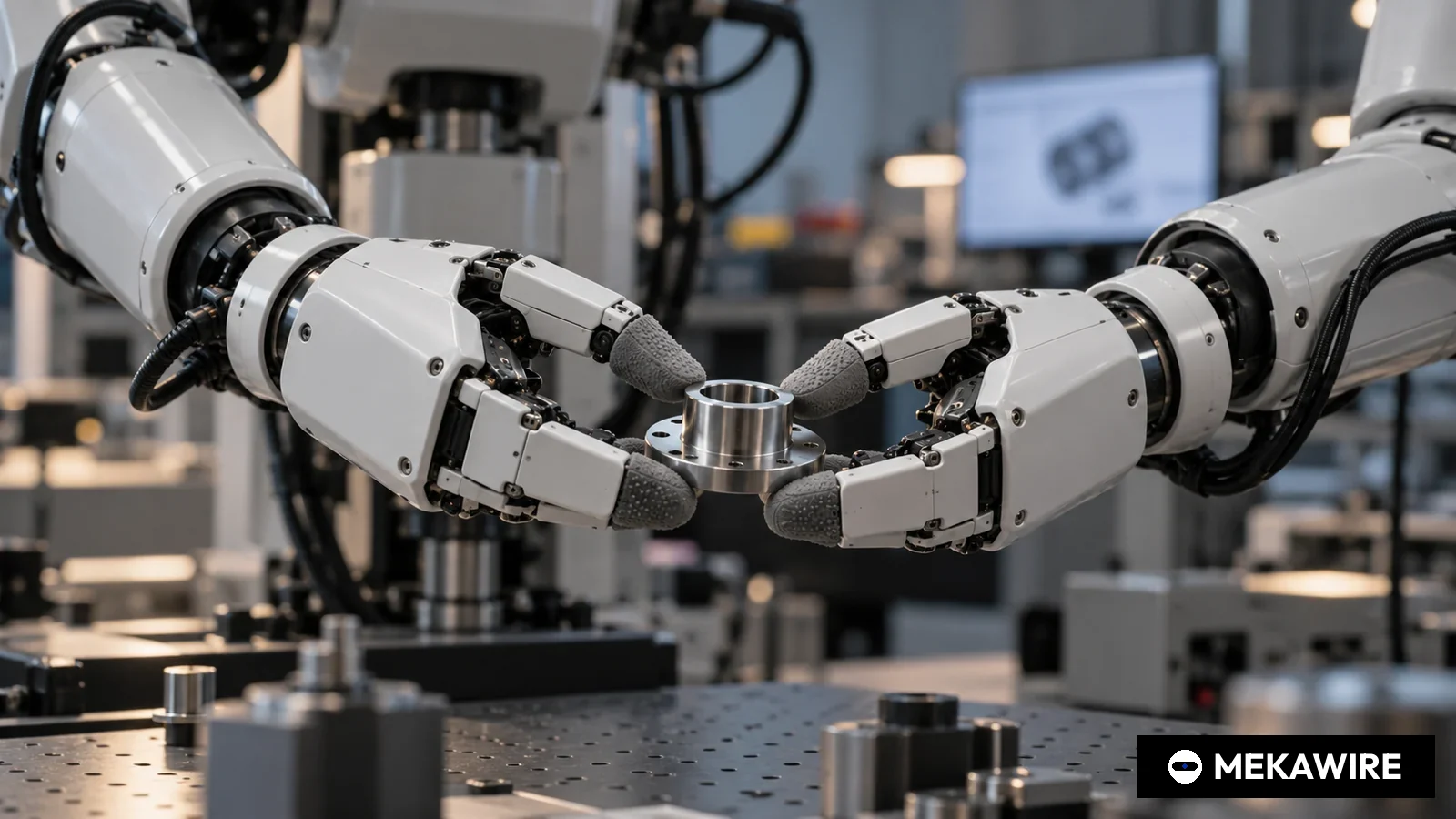
Microsoft Research on January 21, 2026 introduced Rho-alpha, its first robotics model, derived from the Phi vision-language family and trained partly on synthetic data from NVIDIA Isaac Sim on Azure. The model adds tactile sensing and learning from operator corrections to the usual vision-language-action recipe, and is offered through a research early access program ahead of a later Microsoft Foundry release.
Microsoft has put its name into the race to build general-purpose robot brains. On January 21, 2026, Microsoft Research introduced Rho-alpha, which it describes as its first robotics model, a system that turns plain-language instructions into control signals for robots handling objects with two arms.
The model is derived from Microsoft's Phi family of vision-language models, according to the company's announcement. Microsoft labels it a "VLA+" model. A conventional vision-language-action (VLA) model takes camera images and a text command and outputs robot actions; Microsoft says Rho-alpha widens both what the robot perceives and how the model learns, adding tactile sensing on the perception side and learning from human corrections on the training side. Force sensing is under development, the company said.
What Microsoft showed
Microsoft demonstrated the model on BusyBox, a physical interaction benchmark that Microsoft Research introduced, with Rho-alpha pressing buttons, pulling wires, flipping switches, turning knobs to set positions and moving sliders in response to natural-language prompts. On a dual-arm rig built from two UR5e arms fitted with tactile sensors, the model inserted a plug into a surge protector and packed and unpacked a toolbox, the company said. The UR5e is a collaborative arm made by Universal Robots, the Danish unit of Teradyne.
When the robot struggles, an operator can step in through a teleoperation device such as a 3D mouse, and Microsoft said its team is building tooling and adaptation methods so the model learns from those corrections while it is deployed. Ashley Llorens, corporate vice president and managing director of Microsoft Research Accelerator, framed the goal as robots that perceive, reason and act with more autonomy alongside people in less structured settings.
How it was trained
The scarcity of robot data, and especially data that includes touch, shaped the training recipe. Microsoft said it co-trained Rho-alpha on trajectories from physical demonstrations, on simulated tasks and on web-scale visual question answering data. Real demonstrations came from teleoperated robots and from commercial and openly available datasets. Synthetic data was generated through a multistage reinforcement learning process using NVIDIA's open Isaac Sim framework running on Azure.
That last element makes the release as much an NVIDIA story as a Microsoft one. Deepu Talla, NVIDIA's vice president of robotics and edge AI, said in the announcement that physically accurate synthetic datasets from Isaac Sim help speed the training of such foundation models. Abhishek Gupta, an assistant professor at the University of Washington, argued that teleoperation is impractical in many settings and that simulation and reinforcement learning can fill out the datasets.
Availability
Rho-alpha is not a product yet. Microsoft opened a Research Early Access Program for robot makers and integrators and said the model will later be offered through Microsoft Foundry, its platform for AI models, without giving a date. The company said it is evaluating the model on dual-arm setups and humanoid robots, plans cloud-hosted tools so partners can train and adapt it with their own data, and will publish a technical description in the coming months. It disclosed no parameter count, no success rates and no customer names.
The field it is entering
Microsoft arrives in a crowded field. A week earlier, on January 14, Skild AI announced a $1.4 billion Series C at a valuation of more than $14 billion for a model meant to run any robot. Physical Intelligence, Figure AI with its Helix model, Google DeepMind with Gemini Robotics and NVIDIA with its open GR00T models are all pursuing general robot policies, and NVIDIA opened GR00T N1.6 at CES in early January. Most of those efforts lead with vision and language. Microsoft is betting that touch and in-deployment correction are the missing ingredients for contact-heavy work like plugging, packing and assembly.
- Skild AI
- US
- 2023
- Series C
- 1,400,000,000
- 14,000,000,000
- 2026-01-14
- Figure AI
- US
- No data
- Series C
- 1,000,000,000
- 39,000,000,000
- 2025-09-16
- Dyna Robotics
- US
- 2024
- Series A
- 120,000,000
- No data
- 2025-09
- Microsoft (Rho-alpha)
- US
- No data
- Internal (no external round)
- No data
- No data
- 2026-01-21
Latest primary-sourced private round for each developer announced on or before January 21, 2026; Microsoft's row shows the Rho-alpha announcement date. Figures disclosed by the companies or lead investors, not estimated; — means not disclosed. Skild AI disclosed a valuation of more than $14 billion and Figure AI more than $1 billion in committed capital, shown at the stated floor. Dyna Robotics disclosed the month only. Developers whose amounts could not be confirmed on a primary page are omitted.
As of Oct 1, 2026
For industrial buyers the practical point is that Rho-alpha was shown on commodity hardware rather than a bespoke robot. Integrators running fleets of collaborative arms rarely have model teams of their own, and a touch-aware model they could adapt in the cloud would address insertion and packing jobs that camera-only systems handle poorly. The trade-off is dependence on a single cloud provider for training and, potentially, for serving.
MEKAWIRE analysis
Rho-alpha is less a challenge to the robot model startups than an opening bid to make Azure and Foundry the place where robot makers train and host their models.
The evidence sits in the release itself. Microsoft named no robot it will build and offered no benchmark scores against rivals, yet devoted much of its announcement to training infrastructure, citing Isaac Sim on Azure, cloud-hosted adaptation tools, training on partners' proprietary data and a future Foundry listing. That is the shape of a platform play, in which the model is the reference workload that draws customers onto the cloud.
The strongest counter-argument is that Microsoft Research ships many research artifacts that never become products, and that without disclosed results Rho-alpha may remain a demonstration. Robot makers with serious data, such as Figure or Tesla, have shown a preference for owning their full stack.
Bull case: tactile co-training proves to be a real edge in contact-rich manipulation, the technical report confirms it, and Foundry becomes a neutral home for mid-sized robot makers and integrators that cannot afford their own model teams. Microsoft's enterprise sales reach would then matter more than research leadership.
Bear case: Rho-alpha trails dedicated labs on generalisation, the early access program stays small, and the effort shrinks into an Azure reference demo for NVIDIA's tools. In that outcome the winners are the model startups and NVIDIA, with Microsoft as a landlord.
Signals to watch:
- The promised technical description, which Microsoft said would come within months of January 2026, and whether it carries comparative benchmark numbers.
- The first Microsoft Foundry listing of Rho-alpha and its terms for commercial use.
- Named hardware partners from the early access program, especially any humanoid maker, given Microsoft's stated humanoid evaluations.
- Derived from Microsoft's Phi series of vision-language models
- Rho-alpha, Microsoft's first robotics model
- Research Early Access Program now; Microsoft Foundry later (no date given)
- January 21, 2026, by Microsoft Research
- "VLA+": vision, language and tactile input; learns from human corrective feedback
- Parameter count, success rates, customers
- Real teleoperated demonstrations, commercial and open datasets, web-scale VQA data, synthetic data from NVIDIA Isaac Sim on Azure
- Force sensing; evaluation on dual-arm setups and humanoid robots
- BusyBox benchmark; dual UR5e arms with tactile sensors (plug insertion, toolbox packing)
Why it matters
Rho-alpha is the first time Microsoft has put a robot model under its own name, and it lands in the same month that Skild AI priced a general robot brain at more than $14 billion and NVIDIA opened GR00T N1.6. That timing tells robot makers that every hyperscaler now wants a seat at the robot model layer. For buyers, this means the question of which model runs their arms will soon be bundled with the question of which cloud they train on.
The VLA+ framing is the substantive bet. Most public robot models are trained from cameras and text; Microsoft is arguing that touch and in-service human correction close the gap on contact-rich tasks. If that holds, it shifts the bottleneck from data volume to sensor-equipped data, which favours whoever can generate tactile data cheaply, and Microsoft's answer is simulation on Azure.
Rival analysis
Google DeepMind is the closest structural rival, a big-tech lab with Gemini Robotics models and hardware partners. The difference is distribution: Google ties its robot models to Gemini and its own partner list, while Microsoft is pointing to Foundry, its AI model platform, as the channel. NVIDIA is both partner and competitor, supplying Isaac Sim for Rho-alpha while giving away GR00T models that robot makers can fine-tune without any cloud lock-in.
The startups compete on speed and focus. Skild AI, Physical Intelligence and Figure each have dedicated robot fleets and data pipelines, and Figure trains Helix for its own humanoid. Microsoft has none of that hardware, so Rho-alpha will be judged on how well it adapts to other people's robots with little data, the exact pitch Skild and Physical Intelligence also make.
Valuation context
Microsoft did not attach any investment figure to Rho-alpha, so there is no direct valuation read. The useful benchmark is what private capital paid for the same ambition. Skild AI's valuation of more than $14 billion in January 2026 was at least 9.3 times the $1.5 billion valuation it disclosed in July 2024, by our calculation from the company's disclosed figures, and Figure AI's September 2025 Series C was priced at $39 billion.
Those prices assume the robot model layer captures a large share of value. A credible big-tech entrant offering a model through an existing cloud marketplace is a pricing threat to that assumption, because buyers on a cloud model platform can compare options side by side. The counterweight is that Microsoft has disclosed no performance data, so investors had little reason to mark down the startups on this announcement alone.
Supply-chain implications
The demonstrations ran on Universal Robots UR5e arms, a widely used collaborative arm from Teradyne's Danish unit, fitted with tactile sensors whose supplier Microsoft did not name. That choice signals Microsoft wants Rho-alpha to work on commodity hardware already in labs and factories rather than on a bespoke robot.
The compute chain runs through NVIDIA and Azure. Synthetic data is produced in Isaac Sim on Azure, and adaptation tools are planned as cloud-hosted services. For tactile sensor makers the release is a demand signal, since a model that learns from touch needs fleets of instrumented grippers to collect real data alongside simulation.
Signals to watch
First, the technical description Microsoft promised in the coming months after January 2026; it should reveal model size, data mix and comparative results. Second, the move from early access to a Microsoft Foundry listing, including commercial terms and whether partners can fine-tune on private data as the company described.
Third, named partners. Microsoft said it is evaluating Rho-alpha on humanoid robots; a named humanoid maker would turn the research release into a commercial alliance. Fourth, whether force sensing, which Microsoft says is in development, appears in a subsequent version.
Analyst view
Thesis: Rho-alpha is a cloud platform play dressed as a research model, and its success should be measured by partner adoption on Azure and Foundry rather than by leaderboard wins. Confidence: medium. The infrastructure-heavy announcement, the Foundry roadmap and the NVIDIA Isaac Sim partnership support the reading; the absence of any disclosed performance data, partner names or timeline limits how far it can be pushed.
The tactile emphasis is the part most worth tracking technically. If the forthcoming technical description shows clear gains from touch on insertion and packing tasks, other model developers will need tactile data strategies, and Microsoft will have set an agenda rather than followed one.
Questions you should be asking
How large is Rho-alpha, and how does it perform against open models such as NVIDIA's GR00T or Physical Intelligence's released policies on the same tasks? Microsoft has not said.
Who owns the corrections operators provide during deployment, and do they flow back into Microsoft's base model? What will Foundry charge for training and serving a robot model, and will Microsoft certify specific robot and sensor combinations?