XPeng unveils a next-generation IRON humanoid with 82 degrees of freedom and sets end-2026 for mass production
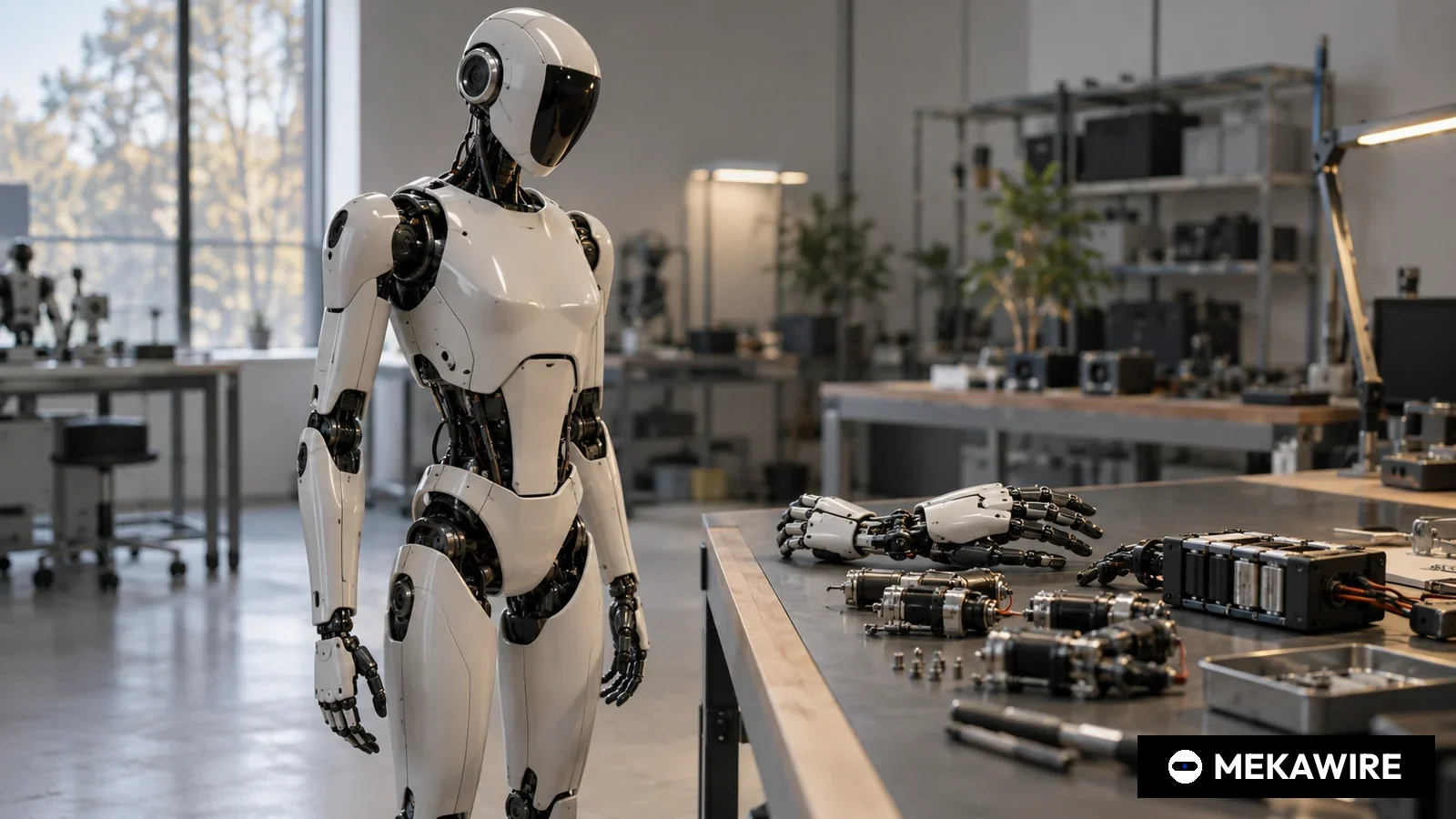
XPeng used its 2025 AI Day in Guangzhou on 5 November to show a redesigned IRON humanoid with 82 degrees of freedom, 22-degree-of-freedom hands, three in-house Turing AI chips and an all-solid-state battery.
The carmaker said it aims for large-scale mass production by the end of 2026, starting with guide and retail roles, and named Baosteel as an industrial partner.
XPeng, the Guangzhou electric-vehicle maker, presented a second-generation version of its IRON humanoid robot at its 2025 AI Day on 5 November, according to a company release. The event, held at the XPENG Science Park in Guangzhou, also covered a new driving model, a robotaxi programme and flying cars, but the humanoid carried the most aggressive timetable: XPeng said it aims to reach large-scale mass production of IRON by the end of 2026.
The company put the new robot at 82 degrees of freedom across the body. Each hand has 22 degrees of freedom and is the size of a human hand, which XPeng said it achieved with what it called the smallest harmonic joint in the industry. Onboard computing comes from three of XPeng's own Turing AI chips, rated by the company at 3,000 TOPS of effective computing power. XPeng also said IRON is the first robot to use an all-solid-state battery, a claim it did not support with capacity, runtime or supplier details.
On software, XPeng said IRON carries its first-generation physical world large model and combines three model types it labels VLT, VLA and VLM, covering vision-language-task planning, vision-language-action control and vision-language understanding. The company will open a software development kit to developers worldwide. It listed guided tours, shopping guidance and directing customer traffic as the first commercial uses, and named Baosteel as an ecosystem partner for inspection and other industrial applications. XPeng gave no price, no unit target and no height or weight.
The gap from the first IRON is wide. When XPeng introduced the robot at its AI Day on 6 November 2024, it described more than 60 joints and 200 degrees of freedom, a five-year development effort and internal use in its own factories and stores. The company did not explain whether the 2024 and 2025 degree-of-freedom counts use the same method, so the lower 2025 figure should not be read as a reduction in capability.
The robot shares its hardware base with XPeng's cars. The same release said its VLA 2.0 driving model was trained on nearly 100 million video clips, which the company equates to 65,000 years of human driving, using a 30,000-card computing cluster and a 72-billion-parameter base model that is retrained every five days. Volkswagen is the launch customer for VLA 2.0 and has been designated for the Turing chip, XPeng said. Its robotaxi, due in three models in 2026, uses four Turing chips for 3,000 TOPS, with Amap as the first ride-hailing partner.
XPeng can fund the effort from a large balance sheet. Its third-quarter results, published on 17 November, showed revenue of RMB20.38 billion, up 101.8% from a year earlier, deliveries of 116,007 vehicles, a 20.1% gross margin and a net loss of RMB0.38 billion. Cash stood at RMB48.33 billion at 30 September, and research and development spending rose 48.7% to RMB2.43 billion in the quarter. Chief executive He Xiaopeng used the event to recast XPeng as a physical AI and embodied intelligence company rather than a carmaker.
The announcement lands in a crowded field. In China, UBTech raised gross proceeds of about HK$3,109.04 million on 25 November by placing 31,468,000 new H shares at HK$98.80, and said about 75% would go to investments or acquisitions along its value chain, according to its Hong Kong exchange filing. Abroad, Figure AI closed a US$1 billion Series C at a US$39 billion post-money valuation in September, while Apptronik, Agility Robotics and 1X Technologies are funded by venture rounds of US$350 million, US$150 million and US$100 million respectively.
In plain terms, XPeng is betting that the parts it already makes at scale for cars, namely inference chips, perception models trained on fleet video and battery packs, transfer to a walking machine. Degrees of freedom count independently controlled joints; more of them, especially in the hands, allow finer grasping but add actuators, cost and failure points. TOPS measures peak inference throughput, and XPeng's use of the word effective, without a published definition, makes direct comparison with rival platforms difficult.
The main risks are commercial. Shopping guidance and guided tours are low-value tasks that wheeled or tabletop robots already handle, so IRON's early uses do not yet prove the economics of a full humanoid. The solid-state battery claim is unverified, and no external customer beyond Baosteel's partnership was named.
The next milestones are dated by XPeng itself. VLA 2.0 reaches pioneer users in December 2025 and all Ultra models in the first quarter of 2026, the robotaxi models arrive in 2026, and IRON's mass-production target falls at the end of 2026.
MEKAWIRE analysis
XPeng's IRON is the clearest test yet of whether an automaker's chip, model and factory stack can shorten the road to a production humanoid, but the November 2025 launch proved capability claims rather than demand.
The evidence for the thesis is in the shared bill of materials. The same Turing chip runs the robotaxi and the robot, the same training cluster feeds both models, and XPeng reported RMB48.33 billion of cash to carry the programme through a loss-making ramp. Few humanoid start-ups can match that combination of silicon, data and money inside one group.
The strongest counter-argument is that cars and humanoids fail in different ways. Driving models learn from millions of fleet hours, while manipulation data for hands with 22 degrees of freedom has to be collected or simulated almost from scratch, and XPeng disclosed no robot training data at all.
Bull case. If the end-2026 target holds, XPeng could price IRON aggressively by amortising chips and batteries across vehicle volumes, and partners such as Baosteel would give it industrial reference sites. An open SDK could pull developers toward its platform as Chinese demand for embodied AI grows.
Bear case. Retail guidance is a weak first market, the specification may change before production, and humanoid spending competes for cash with robotaxis and flying cars. A slip in the timetable would leave XPeng with a showcase robot and no revenue line.
Signals to watch:
- December 2025: whether VLA 2.0 reaches pioneer users on schedule, a proxy for XPeng's model delivery discipline.
- First quarter of 2026: full VLA 2.0 rollout to Ultra models and any disclosure of IRON pilot sites beyond XPeng's stores.
- End of 2026: evidence of large-scale IRON production, including a named factory, unit volumes and an external price.
- XPeng
- CN
- No data
- Group cash position (Q3 2025 results)
- RMB
- 48,330
- No data
- 2025-09-30
- UBTech Robotics
- CN
- 2012
- H-share placing, gross proceeds
- HKD
- 3,109.04
- No data
- 2025-11-25
- Figure AI
- US
- No data
- Series C
- USD
- 1,000
- 39
- 2025-09-16
- Apptronik
- US
- 2016
- Series A
- USD
- 350
- No data
- 2025-02-13
- Agility Robotics
- US
- 2015
- Series B
- USD
- 150
- No data
- 2022-04-22
- 1X Technologies
- US
- 2014
- Series B
- USD
- 100
- No data
- 2024-01-13
Figures as disclosed by the companies or in exchange filings, in original currency, not converted. XPeng row is the group cash position reported for 30 September 2025 and is not a robotics-specific raise. — means not disclosed.
As of Oct 2, 2026
- Degrees of freedom (body)
- 200
- 82
- Joints
- more than 60
- No data
- Hand degrees of freedom
- No data
- 22
- Turing AI chips onboard
- No data
- 3
- Effective compute (TOPS)
- No data
- 3000
- Battery
- No data
- all-solid-state
- Stated uses
- internal factories and stores
- guided tours, shopping guidance, customer traffic guidance, industrial inspection with Baosteel
- Mass production target
- No data
- large scale by end of 2026
All values as stated in XPeng releases of 6 November 2024 and 5 November 2025. XPeng did not say whether the 2024 and 2025 degree-of-freedom counts use the same method. — means not disclosed.
As of Oct 2, 2026
- XPENG 2025 AI Day, Guangzhou, 5 November 2025
- All-solid-state (company claim, no specs disclosed)
- 3 Turing AI chips, 3,000 TOPS effective (company figure)
- Guided tours, shopping guidance, customer traffic guidance
- Not disclosed
- Baosteel (inspection and industrial applications)
- Large scale by end of 2026
- 82
- 22 per hand, human hand size
- RMB48.33 billion
Why it matters
IRON is the most fully specified humanoid yet from a Chinese carmaker, and XPeng attached a hard date to it: large-scale mass production by the end of 2026. That turns the robot from an R&D showpiece, which is how the 2024 version was framed, into a product commitment that investors can track against XPeng's own disclosures.
The launch also reframes XPeng's equity story. He Xiaopeng presented the group as a physical AI company with four product lines (cars, robotaxis, humanoids and flying vehicles) sharing one chip and one model family. If that framing holds, the humanoid is not a side bet but a second outlet for the Turing chip and the VLA training pipeline, which spreads their fixed cost.
Rival analysis
Among Chinese rivals, UBTech is the listed pure play and is raising capital to buy into its supply chain: its 25 November placing raised about HK$3,109.04 million gross, with about 75% earmarked for upstream or downstream investments or acquisitions. Unitree and AgiBot are venture-backed start-ups whose main business is robots. XPeng differs from all three in owning its inference silicon and a vehicle factory network.
Outside China, Figure AI's US$1 billion Series C at a US$39 billion post-money valuation sets the private-market benchmark, and Tesla is the closest structural analogue as a carmaker building humanoids on its own chips and driving software. Apptronik, Agility Robotics and 1X rely on venture funding, while XPeng can finance its programme from a carmaker's balance sheet.
Valuation context
XPeng did not separate its robotics business in its financial reporting, so there is no disclosed valuation or revenue for IRON. The relevant group numbers are third-quarter 2025 revenue of RMB20.38 billion, a net loss of RMB0.38 billion, quarterly R&D of RMB2.43 billion and cash of RMB48.33 billion at 30 September.
For scale, Figure AI's disclosed US$39 billion post-money valuation compares with no stand-alone mark for XPeng's humanoid unit. Any sum-of-the-parts case for XPeng therefore rests on assumptions until the company discloses robot shipments, a price or an external capital raise for the business.
Supply-chain implications
Three components carry the bill of materials. The Turing AI chip is designed in house and shared with cars and robotaxis, which gives XPeng control of its compute roadmap. The hands rely on what XPeng calls the industry's smallest harmonic joint, a precision reducer category in which Japanese and Chinese specialists compete; XPeng did not name its supplier. The all-solid-state battery is the least transparent element, with no cell chemistry, capacity or supplier disclosed.
On the demand side, Baosteel's role as an ecosystem partner for inspection gives XPeng an industrial testbed in steel, where heat, dust and long shifts favour automation. Volkswagen's designation for the Turing chip and VLA 2.0 matters indirectly, because external chip volume lowers the unit cost of the silicon that IRON also uses.
Signals to watch
December 2025 is the first check: XPeng said VLA 2.0 would reach pioneer users that month, and its delivery record on software timetables is the best available guide to its robot timetable. The first quarter of 2026, when VLA 2.0 is due on all Ultra models, is the second.
For IRON itself, watch for a named production site, unit capacity, a price, and customers beyond XPeng's own stores and the Baosteel partnership, all before the end-2026 target. A restatement of the specification sheet before production would also be telling, because it would show where the November 2025 design met manufacturing constraints.
Analyst view
Thesis: XPeng has the technical stack and the cash to put a humanoid into volume production faster than most start-ups, but the November 2025 launch did not show the demand that would justify large-scale output by the end of 2026.
Confidence: medium. The specification and the balance sheet are documented in XPeng's own releases and quarterly results, which supports the capability side. Confidence is capped because XPeng disclosed no price, no units, no runtime and no external buyer, and the solid-state battery and 3,000 TOPS effective figures lack definitions that would allow independent comparison.
Questions you should be asking
Is the 3,000 TOPS figure for three chips in IRON measured the same way as the 3,000 TOPS XPeng quoted for four chips in its robotaxi, and what does effective mean in each case?
How does the 82 degree-of-freedom count for 2025 relate to the 200 degrees of freedom XPeng cited for the 2024 IRON? Who supplies the harmonic joints and the solid-state cells, and at what volume? What does large-scale mass production mean in units per year, and where will it happen?