1X puts a 14-billion-parameter video model in charge of its NEO home humanoid, trading robot data for internet video
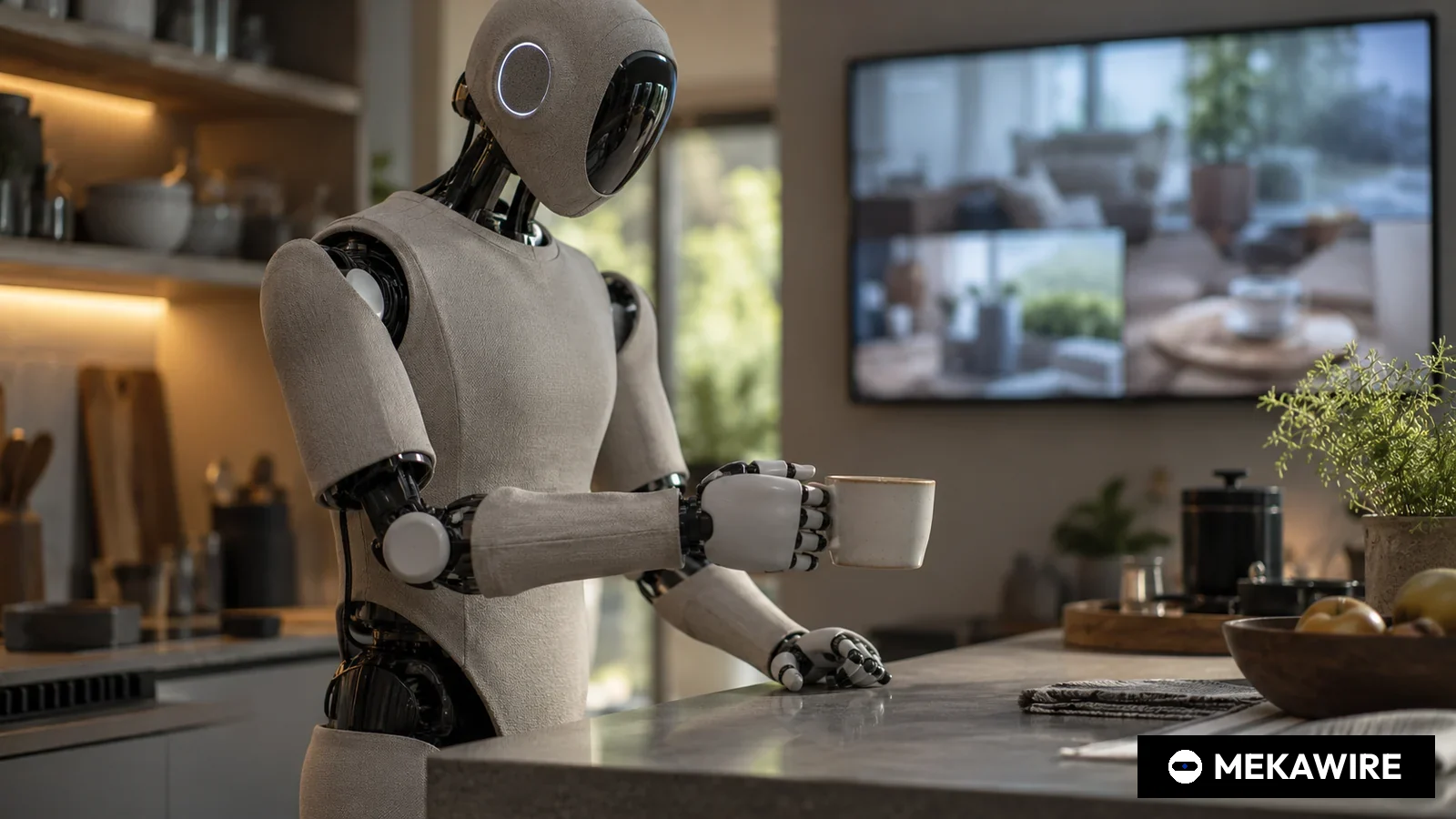
1X Technologies said on January 12, 2026 that its NEO humanoid now runs on the 1X World Model, a 14-billion-parameter video generator that imagines a task before an inverse dynamics model turns the clip into joint commands.
The system was mid-trained on 900 hours of first-person human video and fine-tuned on only 70 hours of NEO data. 1X's own trials show it working on simple household tasks and failing on fine ones such as pouring cereal, months before the first $20,000 NEOs were due in US homes.
1X Technologies said on January 12, 2026 that NEO, the home humanoid it began taking orders for in October 2025, would be driven by a new policy built on a generative video model rather than a conventional robot control network. The company calls it the 1X World Model, or 1XWM. In its announcement chief executive Bernt Børnich said NEO could now learn from internet-scale video and carry that knowledge into the physical world, and 1X researcher Daniel Ho said a user's prompt could become a fully autonomous action even for tasks the robot had never seen.
The technical write-up 1X published the same day gives the numbers behind that claim. The backbone is a 14-billion-parameter, text-conditioned diffusion model for video. It was trained in three stages, starting with web-scale video, then mid-training on 900 hours of egocentric human video of people manipulating objects, then fine-tuning on 70 hours of NEO sensorimotor logs. A separate inverse dynamics model, trained on 400 hours of unfiltered robot data that includes random play, reads the generated frames and predicts the actions needed to move from one frame to the next. It uses a Depth Anything backbone with a flow matching head and works over a sliding window of eight frames.
In practice NEO receives a text prompt, the world model renders five seconds of predicted video, and the inverse dynamics model extracts the motor commands. 1X said generation takes 11 seconds on multi-GPU inference and action extraction one second, so each five-second action chunk costs roughly 12 seconds of compute before the robot moves. The company also uses a vision-language model to expand short prompts into detailed captions, a step it calls caption upsampling, which it says improves how closely the video follows instructions.
- Grab chips
- 100
- 30
- Steam shirt
- 80
- 30
- Open sliding door
- 60
- 30
- Watering can
- 60
- 30
- Iron shirt
- 40
- 30
- Scrub dish
- 40
- 30
- Draw smiley
- 0
- 30
- Pour cereal
- 0
- 30
Approximate rates as charted by 1X Technologies in its 12 January 2026 1XWM technical post, 30 trials per task. Disclosed by the company, not independently tested.
As of Oct 1, 2026
The company was unusually open about results. In real-world tests of 30 trials per task, 1X charted success of about 100% for grabbing a bag of chips, about 80% for steaming a shirt, about 60% for opening a sliding door and for using a watering can, and about 40% for ironing a shirt and scrubbing a dish. Pouring cereal and drawing a smiley face both scored zero. On a tissue-pulling task, a single generation succeeded 30% of the time, and picking the best of eight parallel generations lifted that to 45%. 1X listed its own limits as weak three-dimensional grounding from monocular pretraining, a tendency to overshoot or undershoot positions even when the video looks right, difficulty with dexterous tasks and a five-second task horizon.
The launch sits on top of a consumer product with firm commercial terms. 1X, headquartered in Palo Alto, California, opened NEO orders on October 27, 2025 at $20,000 for early access with priority 2026 delivery, or $499 a month on subscription, with US deliveries in 2026 and other markets from 2027. Its launch release put NEO at 66 pounds with a lifting capacity of 154 pounds, a carrying capacity of 55 pounds and a noise level of 22 decibels, and offered an Expert Mode in which 1X staff can guide the robot through tasks it cannot yet do alone.
The design choice puts 1X on a different path from most of its rivals. Its write-up contrasts 1XWM with vision-language-action models such as Physical Intelligence's π0.6, Figure's Helix and NVIDIA's GR00T N1.5, arguing that models built on vision-language backbones learn semantics well but are not trained to predict physical dynamics. A video model, in 1X's framing, already knows how objects move and fall, so the robot needs far less of its own data. That is the point of the 70-hour fine-tune, which is small next to the thousands of teleoperated hours most humanoid developers describe collecting.
- 1X Technologies
- Video world model (1XWM)
- Series B
- 100,000,000
- No data
- 2024-01-13
- Figure AI
- Helix VLA
- Series C
- 1,000,000,000
- 39,000,000,000
- 2025-09-16
- Physical Intelligence
- π0.6 VLA
- Series B
- No data
- No data
- 2025-11-20
- Skild AI
- General-purpose robot foundation model
- Series C
- 1,400,000,000
- 14,000,000,000
- 2026-01-14
- Sunday
- Memo home robot
- Series B
- 165,000,000
- No data
- 2026-03-12
Latest round per MEKAWIRE company data; figures as disclosed by the companies or lead investors, — where not disclosed. Approach column for Figure and Physical Intelligence follows 1X's own comparison.
As of Oct 1, 2026
The money behind the competing approaches is large. MEKAWIRE company data show Skild AI closing a $1.4 billion Series C at a $14 billion valuation two days later, on January 14, 2026, and Figure raising $1 billion at a $39 billion post-money valuation in September 2025. The latest 1X round in the same records is a $100 million Series B from January 2024. NVIDIA moved in the same direction two months after 1X, previewing GR00T N2 at GTC in March 2026 as a model that predicts video before acting.
The open questions are speed and reliability. A 12-second wait for each five seconds of motion is slow for a robot sharing a kitchen with people, and 40% success on ironing or dishwashing is far from what a $20,000 appliance will be judged against. 1X said its next steps are faster inference for reactive and contact-rich work, closed-loop replanning with memory, depth or stereo input for better 3D grounding, and a self-improvement loop driven by the robot's own experience rather than expert demonstrations. Expert Mode remains the fallback, which means remote human operators stay in the loop for an unknown share of tasks.
Later disclosures show how the bet developed. On April 30, 2026 1X said it had opened a 58,000-square-foot factory in Hayward, California with capacity for 10,000 NEOs a year and a goal of more than 100,000 a year by the end of 2027, and on June 4, 2026 it set up a 1X World Model Lab under Sam Sinha, formerly a founding research scientist at Luma AI, to scale world model pretraining.
MEKAWIRE analysis
1X has made the clearest public bet that a home humanoid's brain should be a video model first and a robot model second, and its own scorecard shows the bet works for coarse tasks and not yet for fine ones.
The evidence is in the ratio of data. A 14-billion-parameter backbone and 900 hours of human video carry most of the load, while NEO itself contributed 70 hours, plus 400 hours for the action decoder. If that ratio holds as tasks get harder, a home robot maker can scale skills with cheap human video instead of teleoperation fleets, which is the costliest input in this industry. Publishing failures at zero percent alongside successes also makes the claim testable in a way most humanoid demos are not.
The strongest counter-argument is that the hard part of a home robot is contact, precision and reaction, exactly where 1XWM scores worst. Pouring, drawing and dish scrubbing need millimetre control and force feedback, and a five-second open-loop horizon with 12 seconds of compute leaves no room to correct mid-motion. Vision-language-action rivals that run closed-loop at control rates may simply be better suited to the tasks buyers care about.
- Bull case: inference gets fast enough for closed-loop control, depth input fixes the overshoot problem, and fleet data from NEOs in homes feeds the self-improvement loop. 1X then scales skills at video cost while rivals pay for teleoperation, and the Hayward plant's 10,000-unit capacity becomes a data engine.
- Bear case: success on fine tasks stays near 40% or below, Expert Mode carries much of the real work in early homes, and customers judge NEO as a remotely operated device. The world model then becomes a research asset while the shipped product depends on human operators.
- Signals to watch: published 1XWM success rates or inference times beyond the January 12, 2026 figures; first NEO customer deliveries during 2026 and any disclosure of how often Expert Mode is used; output from the 1X World Model Lab set up on June 4, 2026.
- 1X World Model (1XWM), policy for NEO
- 14-billion-parameter text-conditioned video diffusion model
- 12 January 2026
- 11 s to generate 5 s of video, plus 1 s action extraction
- $20,000 early access or $499 per month
- US in 2026, other markets from 2027
- Grab chips about 100%; pour cereal and draw smiley 0% (30 trials each)
- 70 hours
- 900 hours of egocentric video
- 400 hours of robot data
Why it matters
1XWM is the most detailed public case for making a video generation model the core of a humanoid policy. Most rivals bolt an action head onto a vision-language model and train it with large volumes of teleoperated demonstrations. 1X instead claims that internet video plus 900 hours of first-person human footage teaches enough physics that 70 hours of NEO data suffice for adaptation.
If that data ratio holds, the cost structure of home robotics changes. Teleoperation is slow and expensive to scale, while human video is abundant. The announcement therefore matters less as a product feature than as evidence on which data strategy will win.
Rival analysis
1X's own write-up names Physical Intelligence's π0.6, Figure's Helix and NVIDIA's GR00T N1.5 as the vision-language-action models it is arguing against. Figure has the most capital among them, with a $1 billion Series C at a $39 billion post-money valuation in September 2025, and Skild AI raised $1.4 billion at $14 billion two days after the 1XWM launch.
The contrast is narrowing. NVIDIA previewed GR00T N2 at GTC in March 2026 as a model that predicts video before acting, which moves the largest supplier of robot AI tools toward the approach 1X took in January. 1X's edge is that it has a consumer robot with a price and delivery date on which to deploy the idea.
Valuation context
The latest 1X round recorded in MEKAWIRE company data is a $100 million Series B in January 2024, with no post-money valuation disclosed. 1X did not attach any financing news to the 1XWM launch.
That leaves 1X with far less disclosed capital than Figure or Skild AI while it builds both a factory and a large-model research effort. A 14-billion-parameter backbone and multi-GPU inference are compute-heavy, so the company's next disclosed round will be a direct test of whether investors price the world model approach at the level they have priced rival robot brains.
Supply-chain implications
1XWM shifts the bottleneck from robot data collection to compute. Generation currently runs on multi-GPU inference and takes 11 seconds per five-second clip, which 1X has not said runs on the robot. If inference stays off-board, NEO depends on data centre capacity and home connectivity for each action.
On the hardware side, 1X said in April 2026 that its Hayward plant builds critical components such as motors, batteries and transmission systems in-house. A video-first policy that tolerates imprecision in the action decoder may reduce the demand for high-precision sensing, but 1X's planned move to depth or stereo input points the other way.
Signals to watch
Updated 1XWM benchmarks with success rates on the tasks that scored 0% to 40% in January 2026, and any disclosure of on-robot rather than multi-GPU inference.
First NEO customer deliveries in the US during 2026 and any figures on the share of tasks handled in Expert Mode. Research output from the 1X World Model Lab established on June 4, 2026, and the next 1X financing round.
Analyst view
Thesis: 1X has the strongest public evidence that video pretraining can cut the robot data a humanoid needs, but not yet evidence that it can deliver the precision home chores demand. Confidence medium.
The reasons for medium rather than high are that all results come from 1X itself, trials number 30 per task, fine manipulation fails outright, and inference latency rules out reactive control today. The reasons it is not low are the disclosed data budgets, the published failures, and NVIDIA's later move toward the same architecture.
Questions you should be asking
Does 1XWM run any part of its inference on NEO, and what latency does a home user see? What share of real household tasks will be handled autonomously versus by remote Experts when deliveries start?
How do success rates change as NEO fleet data replaces expert demonstrations in the self-improvement loop 1X described? Will 1X license or open the world model to other robot makers?