ABB Robotics ends its last full year under ABB with sales up 2.8% and fourth-quarter operating income halved
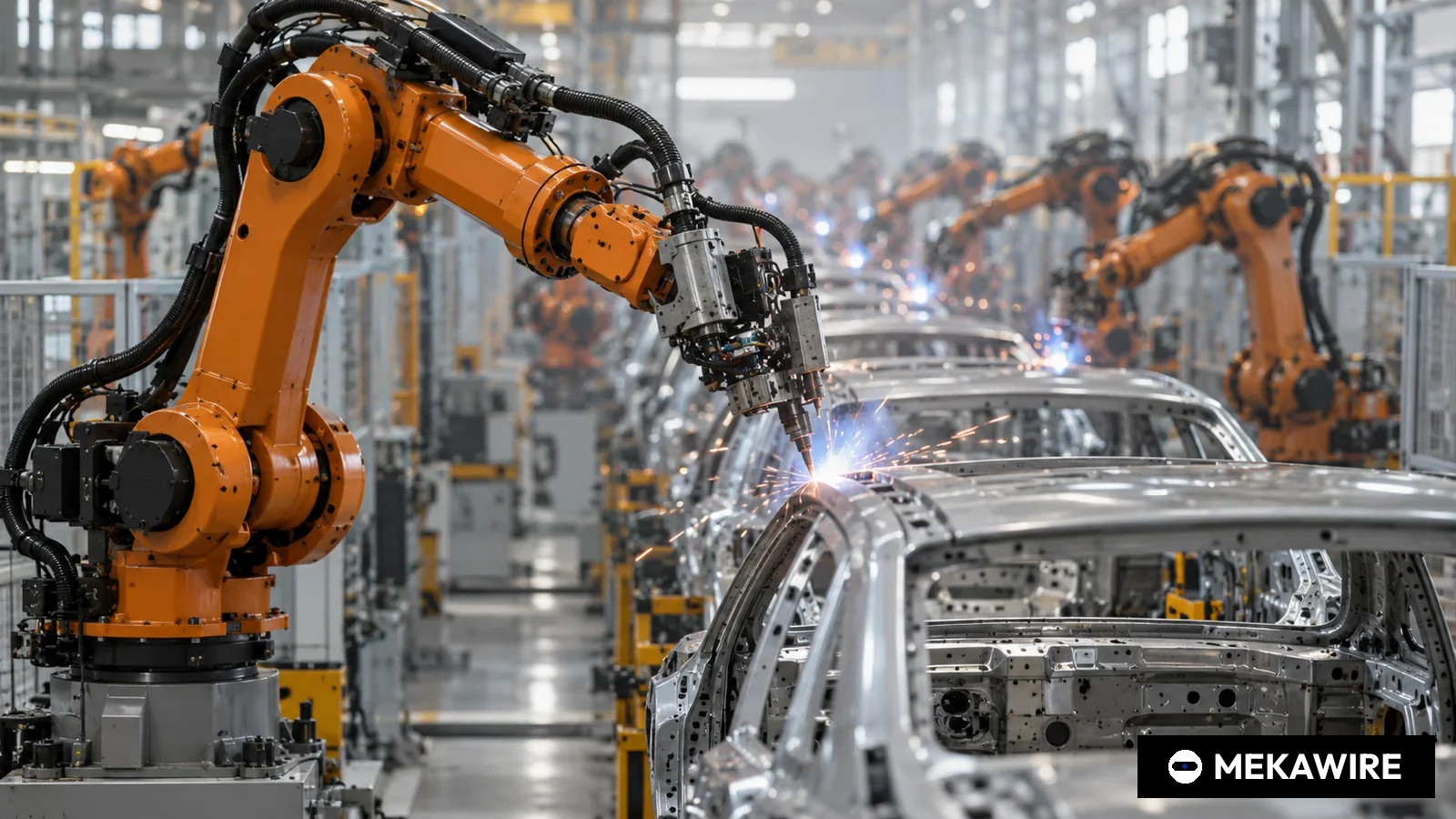
ABB's robotics division, now reported as a discontinued operation ahead of its USD 5.375 billion sale to SoftBank Group, booked 2025 revenue of USD 2,331 million and income from operations of USD 294 million, ABB disclosed with its fourth-quarter results on 29 January 2026.
Fourth-quarter operating income fell to USD 37 million from USD 71 million as expenses rose 48%, while gross margin improved.
ABB's robotics division finished its last full year inside the Swiss group with slightly higher sales and markedly lower profit. In the financial information released with ABB's fourth-quarter results on 29 January 2026, the Zurich company said the business, now carried as a discontinued operation pending its sale to SoftBank Group, generated revenue of USD 2,331 million in 2025, up from USD 2,267 million in 2024. Income from operations fell to USD 294 million from USD 331 million.
The fourth quarter was weaker. Revenue slipped to USD 581 million from USD 594 million a year earlier, and income from operations dropped to USD 37 million from USD 71 million, according to ABB's note on discontinued operations. After USD 13 million of net finance expense and USD 17 million of income tax, the division contributed USD 6 million of net income in the quarter, compared with USD 47 million in the fourth quarter of 2024. For the full year its after-tax contribution was USD 174 million, against USD 226 million.
The pressure sat below gross profit. Quarterly gross profit rose to USD 212 million from USD 189 million, which by MEKAWIRE arithmetic lifts gross margin to 36.5% from 31.8%. Expenses, however, climbed to USD 175 million from USD 118 million, an increase of 48%. ABB's filing does not itemise that increase and the company did not explain it in its release. When it agreed the sale, ABB estimated separation costs for the transaction at about USD 200 million.
- Revenue
- 594
- 581
- 2267
- 2331
- Cost of sales
- -405
- -369
- -1497
- -1527
- Gross profit
- 189
- 212
- 770
- 804
- Expenses
- -118
- -175
- -439
- -510
- Income from operations
- 71
- 37
- 331
- 294
- Income after tax
- 47
- 6
- 226
- 174
- Gross margin (%)
- 31.8
- 36.5
- 34
- 34.5
- Income from operations / revenue (%)
- 12
- 6.4
- 14.6
- 12.6
Figures from ABB's Q4 2025 financial information, note on discontinued operations (US GAAP), published 29 January 2026. MEKAWIRE arithmetic: gross margin = gross profit / revenue; operating ratio = income from operations / revenue. No depreciation or amortisation recorded after 5 October 2025; USD 30m (Q4) and USD 123m (FY 2025) of allocated overhead reported in Corporate and Other instead.
As of Oct 1, 2026
Three accounting choices matter for reading these figures. ABB classified Robotics as held for sale on 5 October 2025, the day its board authorised the sale, and says it has recorded no depreciation or amortisation on the division's property, plant and intangible assets since then. Overhead that ABB previously charged to the division, USD 30 million in the quarter and USD 123 million in 2025, now sits in the group's Corporate and Other line as stranded cost. And the income from operations shown in the note is a US GAAP measure, which differs from the 12.1% operational EBITA margin ABB quoted for Robotics in 2024 when it announced the deal.
ABB agreed on 8 October 2025 to sell the division to SoftBank Group at an enterprise value of USD 5.375 billion, abandoning an earlier plan to list it separately. At signing ABB expected a pre-tax book gain of about USD 2.4 billion, net cash proceeds of about USD 5.3 billion and transaction-related cash taxes of USD 400 million to USD 500 million. The division employs about 7,000 people. In January ABB said it expected completion in the second half of 2026, subject to regulatory approvals and customary conditions. At 31 December 2025 the business carried USD 3,562 million of assets held for sale, including USD 1,847 million of goodwill and USD 372 million of inventories, and USD 1,108 million of current liabilities.
The group that is letting Robotics go is growing faster than the unit it is selling. ABB's fourth-quarter orders rose 36% to USD 10.3 billion, or 32% on a comparable basis, and revenue rose 13% to USD 9.1 billion. For 2025 the group booked orders of USD 36.8 billion and revenue of USD 33.2 billion at an operational EBITA margin of 19.0%. It proposed a dividend of CHF 0.94 per share and guided to comparable revenue growth of 6% to 9% for 2026. Robotics accounted for about 7% of group revenue when the sale was agreed. The Machine Automation division stays with ABB and from the fourth quarter is reported within the Automation business area. Sami Atiya, who led Robotics and Discrete Automation, left the Executive Committee at the end of 2025 and will leave ABB by the end of 2026.
ABB's main Japanese rivals reported stronger robot sales over overlapping periods. FANUC said its robot division's sales rose 11.1% to JPY 269,241 million in the nine months to 31 December 2025, with sales in China up significantly on demand from EV-related and general industries while sales in Japan fell. Yaskawa Electric's robotics segment lifted revenue 7.3% to JPY 183,038 million in the nine months to 30 November 2025, helped by large projects in China and South Korea, although segment operating profit fell 3.9% to JPY 15,484 million and Yaskawa described automotive investment in Japan, the Americas and Europe as sluggish. In collaborative robots, Teradyne reported fourth-quarter Robotics revenue of USD 89 million.
- ABB Robotics (discontinued operation)
- FY 2025 (Jan to Dec)
- USD
- 2,331
- 2.8
- 294
- ABB Robotics (discontinued operation)
- Q4 2025 (Oct to Dec)
- USD
- 581
- -2.2
- 37
- FANUC (Robot division)
- 9 months to 31 Dec 2025
- JPY
- 269,241
- 11.1
- No data
- Yaskawa Electric (Robotics segment)
- 9 months to 30 Nov 2025
- JPY
- 183,038
- 7.3
- 15,484
- Teradyne (Robotics segment)
- Q4 2025 (Oct to Dec)
- USD
- 89
- No data
- No data
Disclosed figures from each company's own release: ABB Q4 2025 financial information (29 Jan 2026), FANUC consolidated results for the nine months to 31 Dec 2025 (26 Jan 2026), Yaskawa results for the first three quarters (9 Jan 2026), Teradyne Q4 2025 release (2 Feb 2026). ABB YoY = current / prior period minus 1 (MEKAWIRE arithmetic); FANUC and Yaskawa YoY as stated by the companies. Profit measures differ: ABB = income from operations (US GAAP), Yaskawa = segment operating profit. Periods and currencies are not aligned; compare growth rates, not levels. — = not disclosed in the release.
As of Oct 1, 2026
An industrial robot maker earns its money from the arm itself, from the controller and software used to program it, and from service over a working life that runs for years. Gross margin captures price and product mix on those sales, and on that measure ABB Robotics improved in the fourth quarter. Operating income also absorbs selling, administrative and other costs, which is the line that grew. A business being carved out of a larger group typically carries one-off costs in exactly that area, though ABB has not said how much of the increase was separation-related.
For buyers and rivals the figures put a fresh frame on SoftBank's price. By MEKAWIRE arithmetic the USD 5.375 billion enterprise value equals 2.31 times the division's 2025 revenue and 18.3 times its 2025 income from operations. SoftBank is acquiring a business whose top line held up in 2025 while its reported profit declined, at a time when FANUC and Yaskawa grew robot sales faster on Chinese demand.
Several questions remain open. ABB has not disclosed Robotics orders since moving the unit to discontinued operations, so the January filing gives no read on backlog. The halt to depreciation since October flatters operating income, which makes the fourth-quarter fall more notable. Regulatory approvals were still outstanding at the time of the report, and the division's leadership after closing has not been announced.
The next markers are ABB's first-quarter 2026 report in April, which will update stranded costs and the closing timetable; Yaskawa's full-year results for the year to 28 February 2026 and FANUC's for the year to 31 March 2026, which will show whether the Japanese makers kept their lead in robot sales growth; and completion of the SoftBank deal, which ABB expects in the second half of 2026.
MEKAWIRE analysis
ABB Robotics enters SoftBank ownership with stable sales and a cost base that rose sharply in its final quarter, so the buyer's first task is margin repair rather than growth.
The evidence is in ABB's own note. Revenue for 2025 rose 2.8% and quarterly gross margin improved by 4.7 percentage points, yet fourth-quarter income from operations fell 48% as expenses rose 48%. The ratio of income from operations to revenue fell to 12.6% for 2025 from 14.6% a year earlier, and to 6.4% in the fourth quarter from 12.0%.
The strongest counter-argument is that the quarter is distorted by the separation itself. ABB expects about USD 200 million of separation costs, and some of the expense increase is likely to be one-off. Once the business stands alone, the same gross margin could translate into healthier operating income, and SoftBank would be buying at a trough.
Bull case: gross margin of 36.5% in the fourth quarter shows pricing power intact, and if separation costs fade after closing the division can return to the 14.6% operating ratio it showed in 2024. SoftBank then owns a profitable arm maker at 2.31 times sales with room to add software.
Bear case: the business lost ground to FANUC and Yaskawa in 2025, and the expense jump is partly structural, because a standalone ABB Robotics must pay for functions ABB used to provide. Stranded costs of USD 123 million a year show how much overhead the unit used to share, and some of it will return as standalone cost.
Signals to watch:
- April 2026: ABB's first-quarter report, for any update on stranded costs, separation spending and approvals.
- Second half of 2026: completion of the SoftBank sale and the first disclosure of who runs ABB Robotics under new ownership.
- April to May 2026: full-year results from Yaskawa (year to 28 February) and FANUC (year to 31 March), to test whether the growth gap with ABB Robotics widened.
- 29 January 2026
- USD 581 million (Q4 2024: USD 594 million)
- 2.31x (MEKAWIRE arithmetic)
- USD 33.2 billion, operational EBITA margin 19.0%
- USD 5.375 billion enterprise value, completion expected in H2 2026
- USD 2,331 million (2024: USD 2,267 million)
- USD 37 million (Q4 2024: USD 71 million)
- USD 30 million in Q4, USD 123 million in 2025
- USD 294 million (2024: USD 331 million)
- USD 6 million (Q4 2024: USD 47 million)
Why it matters
These are the last full-year figures ABB Robotics will publish as part of ABB, and the only detailed profit and loss for the business that will exist before SoftBank takes control. They set the baseline against which SoftBank's ownership will be judged, and they arrive in a format, a US GAAP discontinued-operations note, that most robotics investors do not routinely read.
The numbers also show a division whose sales held up while its profit fell, in the same year that FANUC and Yaskawa grew robot revenue on the back of China. That divergence matters for the European share of the industrial robot market, because ABB Robotics is one of only two large European arm makers, alongside KUKA.
For ABB itself, the report confirms how small Robotics had become relative to a group booking USD 36.8 billion of orders, and how little the sale should alter ABB's growth profile.
Rival analysis
FANUC's robot division grew sales 11.1% in its nine months to December 2025 and cited significant growth in China. Yaskawa's robotics segment grew 7.3% in its nine months to November 2025, with large projects in China and South Korea. ABB Robotics grew 2.8% for calendar 2025 and shrank 2.2% in the fourth quarter. On those disclosed rates the Swiss unit lost relative ground to both Japanese leaders.
Profitability comparisons need care because the measures differ. Yaskawa's robotics segment operating profit of JPY 15,484 million on revenue of JPY 183,038 million implies an 8.5% margin, below ABB Robotics' 12.6% ratio of income from operations to revenue for 2025. ABB's figure benefits from the depreciation halt after 5 October and excludes USD 123 million of overhead now booked as stranded cost, so the true standalone gap is narrower than the headline suggests.
Teradyne's Robotics segment reported USD 89 million of fourth-quarter revenue, a fraction of ABB Robotics' USD 581 million. Collaborative robots remain a niche in revenue terms next to the traditional arm makers.
Valuation context
SoftBank's USD 5.375 billion enterprise value equals 2.31 times 2025 revenue of USD 2,331 million and 18.3 times 2025 income from operations of USD 294 million. On 2024 figures from the same note the multiple of income from operations would have been 16.2 times, so the profit decline in 2025 has made the agreed price look fuller.
The balance sheet gives a second reference. Goodwill of USD 1,847 million accounts for 51.9% of the USD 3,562 million in assets held for sale, and current liabilities held for sale total USD 1,108 million. ABB's expected pre-tax book gain of about USD 2.4 billion is the gap between the price and what ABB carries the business at.
MEKAWIRE does not estimate a standalone value. All multiples above are computed from figures ABB disclosed.
Supply-chain implications
ABB's filing gives inventories held for sale of USD 372 million and receivables of USD 489 million at the end of 2025, alongside USD 290 million of property, plant and equipment. Those are the physical and working-capital assets SoftBank inherits, and they are modest next to goodwill, which reflects how much of the value sits in brands, customer relationships and software rather than plants.
The division relies on the same component chain as its rivals: precision reducers, servo motors, drives and controllers. Neither ABB nor SoftBank has disclosed any change to sourcing or manufacturing footprint linked to the sale.
The separation itself is a supply-chain task. Shared services, IT systems and purchasing contracts that ABB ran centrally must be split, which is consistent with the rise in expenses and with the USD 123 million of overhead that ABB now reports as stranded.
Signals to watch
ABB's first-quarter 2026 report in April should show whether stranded costs fall and whether separation spending continues to weigh on the discontinued result. Any update to the second-half closing guidance would signal progress or delay on approvals.
Yaskawa's results for the year to 28 February 2026 and FANUC's for the year to 31 March 2026 will show whether Japanese makers extended their growth lead through the winter quarter.
After closing, the first standalone disclosure from SoftBank on ABB Robotics, whether through SoftBank Group's own reporting or a separate announcement, will reveal the cost base without ABB's shared services.
Analyst view
Thesis: ABB Robotics reaches SoftBank with intact gross margins and a cost base swollen by separation, which makes the first year under new ownership a test of cost control more than of growth.
Confidence: medium. The revenue, gross profit and expense figures are fully disclosed in ABB's statements. The confidence is capped because ABB does not split the expense increase into one-off and recurring parts, does not publish Robotics orders, and changed the depreciation basis mid-quarter.
What would change our view: a disclosure that most of the fourth-quarter expense increase was one-off separation cost would support the bull case of a quick margin recovery. Evidence that orders weakened in the second half of 2025 would point the other way.
Questions you should be asking
For ABB: How much of the USD 57 million increase in fourth-quarter Robotics expenses was separation cost, and how much of the USD 123 million in stranded costs will disappear after closing?
For ABB: What were Robotics orders in the fourth quarter and full year 2025, given that the division is no longer reported as a segment?
For SoftBank: Will ABB Robotics publish standalone results after closing, and which management team will run it?