ABB IRB 1700 robots cut cycle times by up to 20% and power use by 15%
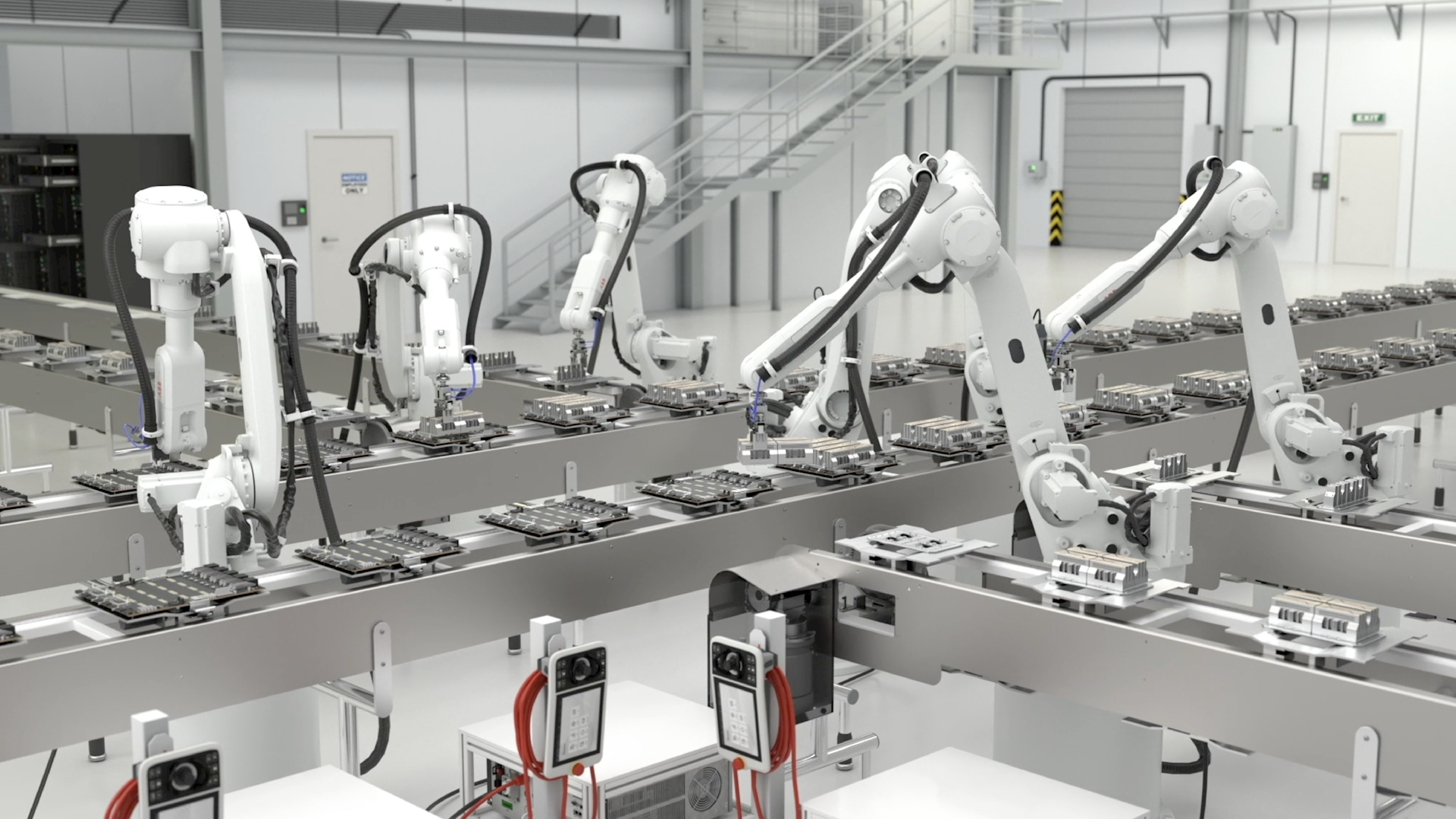
ABB Robotics said in a press release on Oct 12 that its new IRB 1700 and IRB 1700ID arms, five variants carrying 6 to 12 kg on OmniCore controllers, run up to 20% shorter cycle times than comparable robots and use up to 15% less power than the IRB 1600 they follow.
The pair debuted at CIIF in Shanghai on Oct 12 to 16, aimed at electronics work such as AI server rack assembly as well as welding and sanding.
ABB Robotics has replaced one of its most common mid-size arms. The new IRB 1700 and its integrated-dressing sibling, the IRB 1700ID, come in five variants with payloads from 6 kg to 12 kg and run on ABB's OmniCore controllers, the company said in a press release dated Oct 12. ABB claims cycle times up to 20% shorter than comparable robots on the market and power consumption up to 15% lower than its predecessor, the IRB 1600, measured at the same payload on OmniCore.
The robots made their public debut at the China International Industry Fair (CIIF) in Shanghai, held Oct 12 to 16, in a working arc-welding and sanding cell on ABB's stand, the company said.
The specification sheet behind the 20% claim
ABB lists path repeatability down to 0.03 mm and joint speeds of up to 700 degrees per second. The footprint is 50% smaller than the predecessor's, and the interval between oil changes stretches to up to 20,000 hours. On the IRB 1700ID, cables and hoses run inside the arm, which ABB says simplifies installation and avoids snagging in tight cells.
The target jobs are material handling, arc welding, deburring, sanding and machine tending, plus a newer electronics task the company singles out: assembling racks for AI servers. Craig McDonnell, managing director of ABB Robotics' Industries business line, said in the release that precision manufacturers must raise output while holding quality and cutting operating costs.
- Variants
- 5
- ABB release
- Payload
- 6 to 12 kg
- ABB release
- Cycle time
- Up to 20% shorter
- vs comparable robots on the market
- Power use
- Up to 15% lower
- vs IRB 1600, same payload, OmniCore
- Repeatability
- Down to 0.03 mm
- ABB release
- Joint speed
- Up to 700 deg/s
- ABB release
- Oil-change interval
- Up to 20,000 h
- ABB release
- Footprint
- 50% smaller
- vs predecessor
Company-stated figures from ABB's Oct 12, 2026 press release; no independent tests yet.
As of Oct 12, 2026
Why the software list matters as much as the arm
The release ties the IRB 1700 to ABB's software stack: RobotStudio for simulation and offline programming, AI Robot Trainer, OmniCore EyeMotion vision and automatic collision-free path planning. MEKAWIRE reported on Oct 15 that ABB had put AI Robot Trainer into an apparel-sorting cell, where the company claimed up to 75% less commissioning time. Pairing a new mid-size arm with that toolchain is how ABB tries to sell shorter set-up, not only faster joints.
MEKAWIRE analysis
The IRB 1700 is a cost-of-ownership product launched into China's busiest robot fair: ABB is competing on uptime and energy against cheaper local arms rather than on headline speed alone.
MEKAWIRE arithmetic on ABB's own figure: an oil-change interval of 20,000 hours equals about 2.3 years of round-the-clock running (20,000 / 8,760 hours a year), or about 3.4 years on two 8-hour shifts every day (20,000 / 5,840). For an electronics plant that is the difference between a maintenance stop every year and one every two to three years.
The counter-argument is that "up to 20% shorter" is measured against unnamed comparable robots, and the 15% energy figure is against ABB's own older model, so neither is an independent benchmark. ABB has not published prices or delivery dates in the release. Chinese makers that sell 6 kg to 12 kg arms at lower prices will judge the launch by cost, not by repeatability on a datasheet.
What to watch
Whether ABB names first electronics customers for AI server rack lines, whether independent cycle-time tests appear from integrators, and how ABB Robotics prices the IRB 1700 in China against domestic arms in the same payload class.
- CIIF Shanghai, Oct 12 to 16, 2026
- Up to 20% shorter cycle times than comparable robots (ABB claim)
- Up to 15% lower power use than the IRB 1600 at the same payload
- IRB 1700 and IRB 1700ID, five variants
- ABB Robotics (about 7,000 employees, per the release)
- 6 kg to 12 kg
- Press release, Oct 12, 2026
- Path repeatability down to 0.03 mm, joints up to 700 degrees per second
- Up to 20,000 hours between oil changes; footprint 50% smaller
Why it matters
Mid-size six-axis arms in the 6 kg to 12 kg class are the volume segment of industrial robotics, used across electronics and automotive suppliers. A refresh there affects pricing pressure on every rival in that class, especially in China where the arm debuted.
ABB frames the arm around total cost of ownership: power, service intervals and footprint. That is the argument a premium Western maker needs when Chinese arms undercut it on purchase price.
Rival analysis
The direct comparison is with FANUC, Yaskawa and KUKA arms of similar reach and payload and with fast-growing Chinese makers such as Estun and Inovance. ABB has not published a head-to-head comparison or named the 'comparable robots' behind its 20% claim, so rivals' datasheets remain the only basis for comparison.
Integrated dressing, as on the IRB 1700ID, is now common across premium makers; ABB's differentiation sits in the software bundle and OmniCore controller rather than in the mechanics alone.
Valuation context
ABB does not break out the revenue contribution of single models. The launch matters for the robotics division's margin story because energy and service claims support price premiums. No financial figures were given in the release.
Supply-chain implications
Reducers, servo motors and controllers are the main cost blocks of an arm in this class. ABB did not disclose where the IRB 1700 is built or which component suppliers it uses. A Shanghai debut suggests the Chinese market is the first focus, but production location is not confirmed.
Signals to watch
Named customers for AI server rack assembly; integrator tests of cycle time; IRB 1700 pricing in China; any follow-up variants with longer reach.
Analyst view
A solid product refresh, not a strategic shift. Confidence medium that it helps ABB defend share in electronics, low on how much it changes price competition with Chinese arms, because prices are not public.
Questions you should be asking
Which robots are the comparison base for the 20% cycle-time claim? Where is the IRB 1700 manufactured? What is the price gap to the IRB 1600 and to Chinese arms in the same payload class?