What is Teradyne Robotics? Universal Robots and MiR nearly broke even on $100 million in Q2 2026, but gross margin is six points below 2023
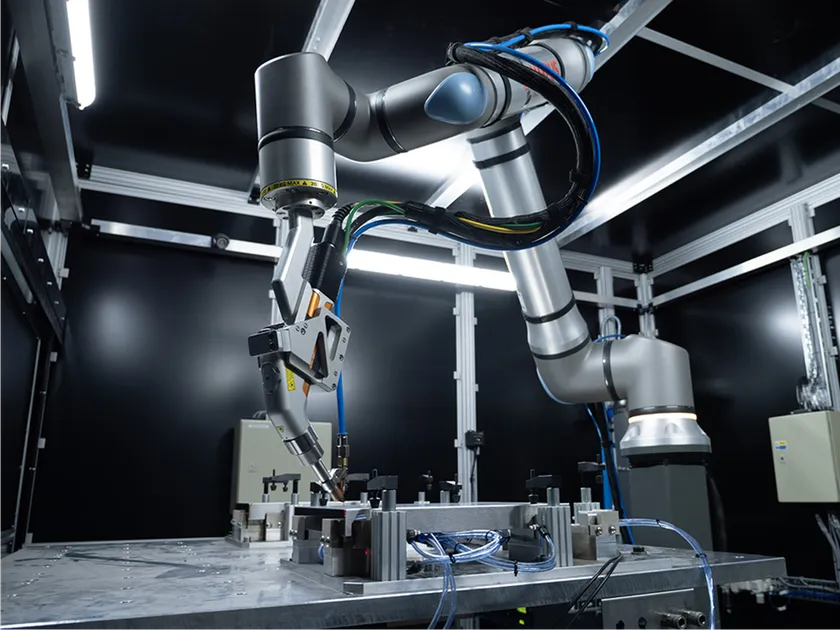
Teradyne Robotics is the segment of US test-equipment maker Teradyne that sells Universal Robots cobot arms and MiR autonomous mobile robots. Its second-quarter 2026 10-Q shows revenue of $99.9 million, up 33% from a year earlier, and a pre-tax loss of only $2.6 million against $18.5 million, while gross margin slipped to 53.5% from 59.5% in 2023 and the unit shrank to 7.5% of group sales.
Teradyne Robotics, the owner of Universal Robots and MiR, lost $2.6 million before tax in the second quarter of 2026 on revenue of $99.9 million, its best result in years and a far cry from the $99.4 million it lost in 2025. The numbers sit in the segment note of the 10-Q that Teradyne filed on July 31. The same filing shows something the headline growth hides: the robots are being sold at lower gross margins than three years ago, and the unit now makes up only 7.5% of a company whose AI chip-test business more than doubled.
That combination raises the question this explainer answers. Is Teradyne Robotics turning into a profitable cobot leader, or a smaller, cheaper business that cost cuts and one strong end-market have flattered?
Two brands inside a chip-test company
Teradyne reports three segments: Semiconductor Test, Product Test and Robotics. Its 2025 10-K says Robotics is made of two product lines, cobot arms under the Universal Robots brand and autonomous mobile robots under the Mobile Industrial Robots brand. Teradyne bought Universal Robots in 2015 and MiR in 2018, and added Energid in 2018 and AutoGuide in 2019, the filing says. The 10-K credits UR with the first commercially viable cobot in 2008 and says the unit has sold more than 110,000 cobots and more than 11,000 AMRs. The current arm range runs from the UR3e to the UR30 and the UR8 Long, programmed through UR's PolyScope software and a partner ecosystem it calls UR+. The MiR line includes the MiR250, MiR600 and MiR1350 and the MiR1200 Pallet Jack. The 10-K says cobots pay back in 12 to 18 months on average and its AMRs in 12 to 24 months.
In September UR launched its seventh-generation platform with a new CB7 controller and native ROS 2 support, MEKAWIRE reported, and Teradyne Robotics has spent 2026 pursuing Chinese rivals in European courts: a Hamburg injunction against Elite Robots in April, settled on confidential terms on Oct 1, and a Unified Patent Court suit against JAKA's German arm in late August.
The question is what all of that earns.
The loss nearly disappeared, mostly through costs
Robotics revenue fell 15.5% in 2025 to $308.3 million, after $364.8 million in 2024 and $375.2 million in 2023. The segment lost $99.4 million before tax in 2025, its third straight year of deeper losses. Then the trend broke. First-half 2026 revenue rose 32.9% to $191.2 million and the pre-tax loss shrank to $3.5 million from $55.7 million.
- Revenue
- 375.2
- 364.8
- 308.3
- 143.9
- 191.2
- Gross margin
- 59.5%
- 57.5%
- 51.0%
- 53.8%
- 52.0%
- Engineering, selling and G&A
- 232.3
- 235.0
- 194.0
- 98.4
- 87.1
- Pre-tax income (loss)
- (54.3)
- (77.6)
- (99.4)
- (55.7)
- (3.5)
- Pre-tax margin
- -14.5%
- -21.3%
- -32.2%
- -38.7%
- -1.9%
Segment figures from Teradyne's 2025 Form 10-K and Q2 2026 Form 10-Q. Gross margin = (revenue minus segment cost of revenues) / revenue; pre-tax margin = segment income before taxes / revenue. Segment pre-tax results exclude severance and other items booked under Corporate and Eliminations. As of 2026-10-18.
As of Oct 18, 2026
The table shows where the swing came from. Engineering, selling and administrative spending fell from $235.0 million in 2024 to $194.0 million in 2025 and to $87.1 million in the first half of 2026, against $98.4 million a year earlier. The 10-Q records a restructuring started in the first quarter of 2025 that affected about 150 employees, and MEKAWIRE reported in February that restructuring in the unit affected about 400 people. Between the second quarters of 2025 and 2026, revenue rose $25.1 million and pre-tax results improved $16.0 million, so about 64 cents of each extra sales dollar reached the bottom line.
Gross margin did not help. Computed from segment cost of revenues, it was 59.5% in 2023, 57.5% in 2024, 51.0% in 2025 and 53.5% in the second quarter of 2026. The unit is selling more robots at roughly six points less margin than three years ago. The filings do not split margin by product or region, so mix, pricing and costs cannot be separated from the outside.
Where are the extra units going?
America and electronics are doing the lifting
- Americas
- 27.2
- 41.8
- +53.7%
- 41.8%
- Europe, Middle East and Africa
- 31.8
- 36.6
- +15.2%
- 36.6%
- Asia Pacific
- 15.9
- 21.6
- +35.4%
- 21.6%
- Total
- 74.9
- 99.9
- +33.5%
- 100%
From the disaggregated revenue table in the Q2 2026 Form 10-Q (figures in thousands, rounded). Change = Q2 2026 / Q2 2025 minus 1, computed on unrounded figures; the 10-Q itself states +33.4% on figures in millions. As of 2026-10-18.
As of Oct 18, 2026
Americas revenue rose 53.7% to $41.8 million and overtook Europe, Middle East and Africa, which grew 15.2% to $36.6 million. Asia Pacific rose 35.4% to $21.6 million. In the management discussion, Teradyne says Q2 was the fifth consecutive quarter of sequential growth for Robotics and that electronics manufacturing and semiconductor customers have become the segment's largest end-market. That is a notable shift for a business whose 10-K still lists e-commerce, logistics, semiconductor and electronics as its target verticals. It also ties Robotics to the same electronics capex cycle that is driving Teradyne's test sales.
Smaller inside Teradyne, larger than its listed cobot peers
Robotics was 7.5% of Teradyne's $1,329 million second-quarter revenue, down from 11.5% a year earlier, because Semiconductor Test revenue rose 128% to $1,121.8 million on AI compute and memory demand. In 2025 the segment was 10% of group sales, against 13% in 2024. Robotics also carries $405.3 million of goodwill, 57.8% of its $701.0 million of segment assets.
Against listed cobot makers, the unit is still large. The 10-K names traditional robot makers KUKA, ABB, FANUC, Staubli and Yaskawa, cobot makers Techman, Doosan, JAKA and AUBO, and AMR makers including Omron, Rockwell Automation, HikRobot and KION as competitors.
- Teradyne Robotics (UR, MiR)
- US
- USD 308.3m
- -15.5%
- 32.2%
- Segment pre-tax loss / revenue
- Doosan Robotics
- KR
- KRW 32.98bn
- -29.6%
- 180.3%
- Operating loss / revenue
- Neuromeka
- KR
- KRW 18.95bn
- -25.0%
- 78.4%
- Operating loss / revenue
- Dobot
- CN
- RMB 492.2m
- +31.7%
- n/a
- Not in MEKAWIRE records
Disclosed figures only, currencies not converted, from Teradyne's 10-K, Doosan Robotics IR material, Neuromeka's IR Book and Dobot's HKEX results as stored in MEKAWIRE. Loss measures differ by company as labelled. As of 2026-10-18.
As of Oct 18, 2026
Its 2025 revenue of $308.3 million compares with KRW 32.98bn at Doosan Robotics and KRW 18.95bn at Neuromeka. Of the four listed cobot makers in the table, only China's Dobot grew in 2025, by 31.7%.
MEKAWIRE analysis
Teradyne Robotics has bought its way to break-even with cost cuts and an electronics upswing, not with pricing power, which makes it a cheaper option for Teradyne rather than a second growth engine.
The evidence is the gap between margin and cost lines. Operating spending fell 17.4% in 2025 from 2024 while gross margin is still below its 2024 level, and the newest customers come from electronics and semiconductors, a cyclical market Teradyne already serves through test. The 2025 pre-tax losses alone, $99.4 million, equal roughly a third of the year's revenue, and the segment has lost $234.7 million before tax from 2023 through June 2026. The strongest counter-argument is operating leverage: at a Q2 run-rate near $400 million a year, sales are already above 2024, and if Gen 7 and the Americas push revenue higher, the 64% incremental margin would turn the unit solidly profitable.
In the bull case, revenue keeps rising sequentially through 2026, gross margin recovers toward 57% as the new platform ships, and the patent actions slow Chinese price competition in Europe. In the bear case, electronics demand cools, Chinese cobot makers keep growing faster than UR, and Teradyne, with Robotics under a tenth of sales, treats the unit as a candidate for partnership or sale.
Three dated signals will tell which way it goes. Teradyne filed its third-quarter 2025 results on Oct 29 last year, so third-quarter 2026 results are due in late October and will show whether a sixth sequential gain arrives. The third-quarter 10-Q, due by early November, will give the margin and regional split again. The JAKA case at the Unified Patent Court is the third.
- Teradyne's Robotics segment designs, makes and sells collaborative robot arms under the Universal Robots brand and autonomous mobile robots under the Mobile Industrial Robots (MiR) brand, according to its 2025 Form 10-K.
- The 10-K says Teradyne Robotics has sold more than 110,000 cobots since introducing what it calls the first commercially viable cobot in 2008, and more than 11,000 AMRs.
- Robotics revenue was $99.9 million in the quarter to June 28, 2026, against $74.9 million a year earlier, a 33.4% increase the 10-Q attributes to higher sales of cobot arms and AMRs.
- The segment's pre-tax loss narrowed to $2.6 million from $18.5 million; for the first half it was $3.5 million against $55.7 million.
- Segment gross margin, computed from the filings, was 53.5% in Q2 2026, 51.0% in 2025, 57.5% in 2024 and 59.5% in 2023.
- Robotics revenue fell 15.5% to $308.3 million in 2025 from $364.8 million in 2024, with a pre-tax loss of $99.4 million.
- Americas sales were $41.8 million in Q2 2026, up 53.7% and now 41.8% of segment revenue; the 10-Q says electronics and semiconductor customers have become the segment's largest end-market.
- Robotics was 7.5% of Teradyne's $1.33 billion Q2 2026 revenue, down from 11.5% a year earlier, as AI-driven semiconductor test sales more than doubled.
Why it matters
Universal Robots is the reference product of the cobot category, and its parent's filings are the only audited, segment-level look at what a mature Western cobot and AMR business earns. When UR's margins move, they say something about the whole category, including Korean and Chinese makers whose numbers are smaller and noisier.
The Q2 2026 swing to near break-even matters because it came after three years of deepening losses. It shows that a cobot business at about $400 million of annual sales can cover its costs, but only after cutting operating spending by 17.4% in 2025.
Rival analysis
Against traditional industrial robot makers named in the 10-K (FANUC, KUKA, ABB, Yaskawa, Staubli), UR competes on ease of programming and short payback, the selling points its 10-K lists. Against cobot specialists, the 10-K names Techman, Doosan, JAKA and AUBO. MEKAWIRE records show Doosan Robotics revenue down 29.6% in 2025 with an operating loss 1.8 times revenue, and Neuromeka down 25.0% with a loss of 78% of revenue; on those numbers UR is both much larger and much closer to profit.
The Chinese challengers are the real pressure. Dobot grew 31.7% in 2025 while UR shrank 15.5%, and Teradyne's legal campaign against Elite Robots and JAKA in Germany suggests it sees price-led competition from China as a threat to its European base.
Valuation context
Teradyne does not disclose a separate valuation for Robotics, and MEKAWIRE does not estimate one. What the filings do show is book value: $405.3 million of goodwill on $701.0 million of segment assets at June 28, 2026, against $191.2 million of first-half revenue. The goodwill reflects the 2015 and 2018 acquisitions.
As a share of Teradyne, Robotics fell from 13% of revenue in 2024 to 10% in 2025 and 7.5% in Q2 2026. With semiconductor test now generating $427.3 million of pre-tax income in a single quarter, Robotics' result barely moves group earnings, which shapes how much capital management is likely to commit to it.
Supply-chain implications
The filings do not list Robotics suppliers. They do show that the unit's revenue now comes 41.8% from the Americas, 36.6% from Europe, Middle East and Africa and 21.6% from Asia Pacific, and that electronics and semiconductor manufacturers are its largest end-market. The 10-K lists Denmark as one of Teradyne's largest employee bases outside the US, at 10% of staff.
For component suppliers, the relevant point is volume: a business that has shipped more than 110,000 cobots is a steady buyer of strain-wave reducers, servo motors, encoders and safety-rated controllers, and the Gen 7 CB7 controller launched in September will set component demand for its next cycle.
Signals to watch
Q3 2026 results in late October (the Q3 2025 results 8-K was filed Oct 29, 2025): a sixth consecutive sequential revenue gain and segment pre-tax result above zero would confirm the turnaround.
The Q3 2026 Form 10-Q, expected by early November: segment gross margin above 55% would suggest pricing or mix is recovering rather than only costs. Regional data will show whether the Americas surge continues.
The Unified Patent Court case against JAKA's German subsidiary and any further actions against Chinese cobot makers in Europe.
Analyst view
Thesis: the turnaround is real but cost-led, and the margin trend argues against calling UR a structurally stronger business yet. Confidence: medium. The segment data are audited and consistent, but the filings do not separate UR from MiR or price from mix, so the margin decline can only be described, not fully explained.
What would change our view: two quarters of gross margin at or above 2024's 57.5% with revenue still rising, or disclosure that the Gen 7 platform is carrying higher prices. What would make us more negative: a sequential revenue decline while semiconductor test keeps growing, which would expose how much of the recovery depends on the electronics cycle.
Questions you should be asking
How much of the Q2 2026 revenue came from Universal Robots versus MiR, and how do their gross margins compare?
What drove the fall in segment gross margin from 59.5% in 2023 to 51.0% in 2025: price cuts in response to Chinese competitors, product mix, or fixed costs on lower volume?
Which electronics and semiconductor applications are driving the new demand, and how dependent is it on a few large customers?
Is Teradyne committed to owning Robotics long term now that the segment is under a tenth of group sales?