Hitachi and Agile Robots agree to build a shared physical AI brain for factories, sold through HMAX Industry
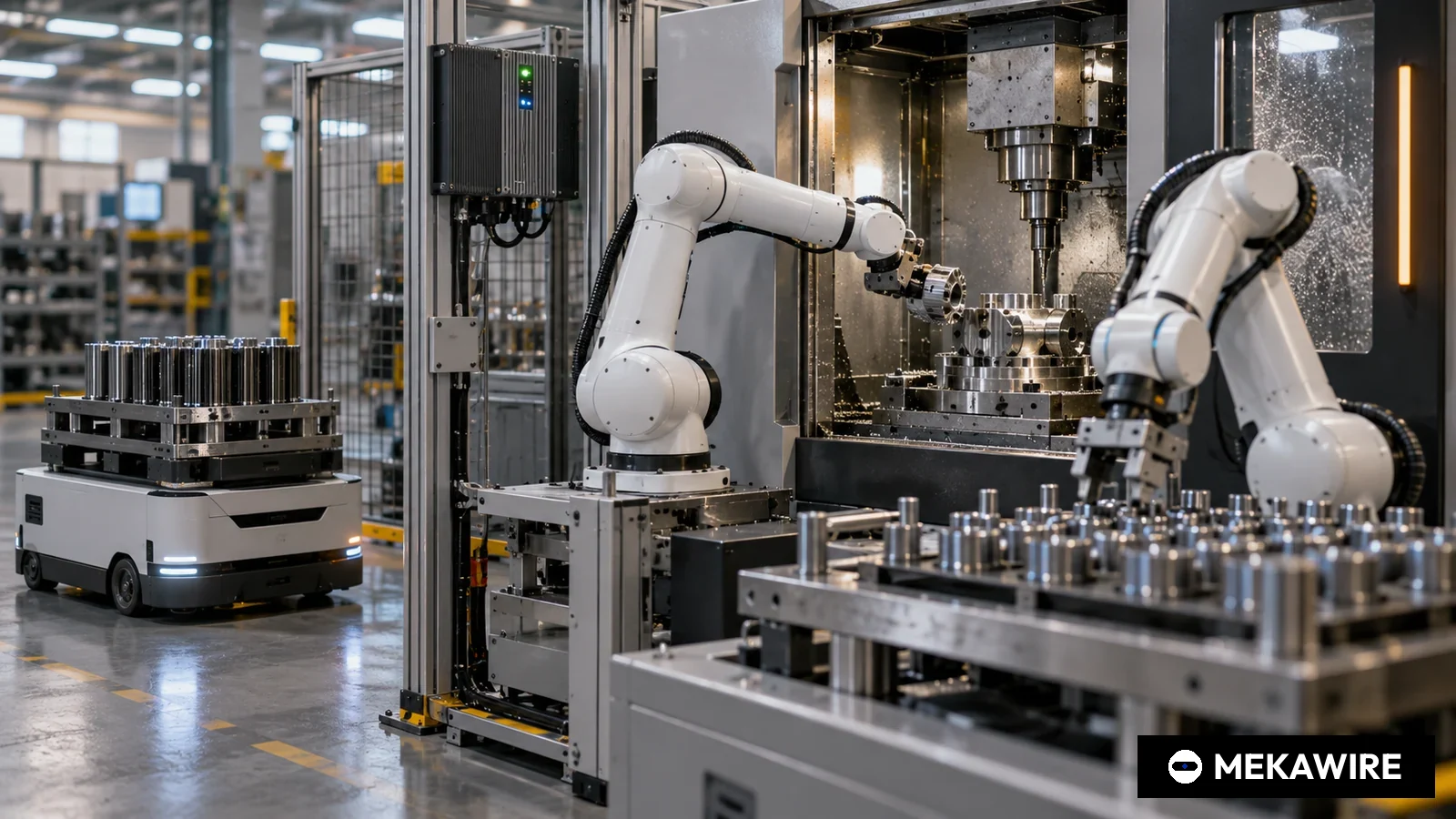
Hitachi has reached a basic agreement with Munich's Agile Robots to fuse their AI models into a robot "brain" for factory work and pair it with Hitachi's edge AI chips, then sell the results globally through HMAX Industry.
No financial terms or launch dates were disclosed, and the deal came a day before Hitachi's separate physical AI partnership with FANUC.
Hitachi has agreed to build what it calls the "brain" for AI robotics with Munich-based Agile Robots, the company said on 29 September 2026, a day before it announced a separate physical AI alliance with FANUC. Under the strategic co-creation partnership, Hitachi will fuse its own AI model for factory work with Agile Robots' general-purpose robot model and sell the resulting physical AI solutions worldwide through its HMAX Industry offering.
Neither company disclosed financial terms, an equity stake, revenue targets or a launch date. The Japanese version of Hitachi's release describes the deal as a basic agreement (kihon gōi), a step short of a definitive contract, while the English release and Agile Robots' own announcement call it a strategic co-creation partnership.
According to Hitachi, its AI model is built to absorb the tacit knowledge of skilled workers in a short time, and Agile Robots' model has a track record in production processes across automotive manufacturing, healthcare and data centres. The two companies say the combined model should let robots take over varied, complex tasks that until now depended on human skill and judgment, earlier than either could manage alone.
The second strand is hardware. Hitachi said it will pair its edge AI semiconductors, which process the equivalent of a robot's vision and touch at high speed and low power, with Agile Robots' robotics technology so that machines can recognise changing surroundings in real time and act safely. Agile Robots listed four joint work areas on its site: advancing physical AI for complex real-world tasks, integrating Hitachi's edge AI chips into Agile Robots systems, commercialising products through HMAX Industry and direct customer channels, and coordinating multi-robot operations.
Hitachi frames the target as the work fixed automation never reached. Its release names parts handling, machine loading, machining and assembly, line changeovers and transfer between processes, and singles out picking and line setup changes as still heavily manual. The stated aim is autonomy, in which machines perceive, decide and control their own motion, as an answer to labour shortages.
"This co-creation partnership with Agile Robots marks an important step forward in accelerating Hitachi's Physical AI business," said Yoshimitsu Takagi, Vice President and Executive Officer and CEO of the Industrial Solutions Business Unit in Hitachi's Connective Industries sector. In the Japanese release he added that Hitachi aims to automate whole factories rather than make single robots smarter. Agile Robots founder and CEO Zhaopeng Chen said physical AI "will only transform industry if it works reliably on the factory floor, and at scale", and pointed to Hitachi's century of manufacturing experience, operational technology knowledge, customer base and edge AI chips.
Agile Robots was founded in Munich in 2018 by robotics researchers from the German Aerospace Center (DLR). Its boilerplate in the Hitachi release cites more than 3,500 employees from nearly 60 countries, more than 20,000 robot solutions installed worldwide, more than 650 patent filings and over 20,000 square metres of R&D space. Its group includes BÄR Automation, Franka Robotics, idealworks and Krause Automation, the former thyssenkrupp Automation Engineering business whose purchase it closed on 1 April 2026. It unveiled the Agile ONE industrial humanoid on 19 November 2025, with production in Bavaria from early 2026, and its last disclosed equity round was a US$220 million Series C led by SoftBank Vision Fund 2 in September 2021, which the company said valued it above US$1 billion.
Hitachi brings scale and distribution. The group reported revenue of ¥10.5867 trillion for the year to March 2026, with 606 consolidated subsidiaries and about 290,000 employees, according to the Japanese release. HMAX Industry is the Connective Industries sector's suite that combines data from Hitachi's installed base of products with domain knowledge and AI. On 3 September 2026 Hitachi widened the HMAX family with HMAX Data Center, HMAX Cyber, HMAX Data Fabric and HMAX AI Operations.
The Agile Robots deal sits beside Hitachi's partnership with FANUC, announced on 30 September 2026. In that tie-up the two companies will validate Hitachi's edge AI semiconductor on FANUC industrial robots, use Hitachi's Ibaraki factories as "customer zero" for picking and changeovers, and begin joint deployment to customers in fiscal 2027. Agile Robots, for its part, signed a research partnership with Google DeepMind on 24 March 2026 to run Gemini Robotics models on its industrial robots. Hitachi is therefore taking a second robot supplier with its own AI ties, which leaves open how models from the two camps will coexist.
- Agile Robots
- DE
- 2018
- Series C
- 220,000,000
- No data
- 2021-09-10
- Neura Robotics
- DE
- 2019
- Series C
- No data
- No data
- 2026-06-10
- RobCo
- DE
- No data
- Series C
- 100,000,000
- No data
- 2026-01-29
- Sereact
- DE
- 2021
- Series B
- 110,000,000
- No data
- 2026-04-27
- Humanoid
- GB
- No data
- Series A
- 152,000,000
- 1,350,000,000
- 2026-07-21
Figures as disclosed by the companies on primary pages; — where not disclosed. Agile Robots said in 2021 its valuation exceeded US$1 billion but gave no exact figure. No estimates.
As of Oct 1, 2026
Competition for factory physical AI is crowded. In Europe, NEURA Robotics closed a Series C on 10 June 2026, RobCo raised US$100 million in January and Sereact US$110 million in April. In Japan, FANUC announced physical AI collaborations with Google on 13 May 2026 and with NVIDIA on 15 May 2026 before signing with Hitachi, so Hitachi's robot partners each keep ties to the large US AI platforms.
The open questions are commercial. Hitachi has not said which robots or which Agile Robots products will carry HMAX Industry branding first, how revenue will be split, or whether Agile ONE will be part of the first offers. The fiscal 2027 date attached to the FANUC deal is the nearest benchmark for when Hitachi expects physical AI revenue at scale.
MEKAWIRE analysis
Hitachi is assembling a hardware-neutral physical AI layer, with HMAX Industry as the storefront and robot makers as interchangeable bodies.
The evidence is in the sequence. In four weeks Hitachi expanded HMAX on 3 September, signed Agile Robots on 29 September and FANUC on 30 September, and in both robot deals its edge AI semiconductor is the common component. Agile Robots supplies what FANUC does not, a humanoid, mobile robots, force-sensitive arms through Franka, and system integrators in BÄR and Krause.
The strongest counter-argument is that this is a basic agreement with no money, dates or volumes attached. Agile Robots already works with Google DeepMind and NVIDIA, so Hitachi may end up as one of several channels rather than the owner of the brain.
Bull case. Hitachi's own plants and installed base give the fused model a stream of real production data no start-up can buy, and two robot suppliers let it offer HMAX Industry across arms, mobile robots and humanoids. If the fiscal 2027 rollout with FANUC lands, the Agile Robots line can follow through the same channel.
Bear case. Two robot partners with different controllers and AI allegiances could fragment Hitachi's effort and slow integration. Without disclosed terms, there is no guarantee either partner prioritises Hitachi over larger platforms such as Google or NVIDIA.
Signals to watch:
- Whether Hitachi converts the basic agreement into a definitive contract, before the end of Hitachi's fiscal year on 31 March 2027.
- Any HMAX Industry offer naming Agile Robots hardware or Agile ONE, and whether it shares the fiscal 2027 timetable of the FANUC programme.
- Agile Robots' next financing or ownership news, given its last disclosed round dates from September 2021.
- 29 September 2026 (Tokyo and Munich)
- Strategic co-creation partnership; basic agreement per Hitachi's Japanese release
- Fusion of Hitachi's skill-learning AI model with Agile Robots' general-purpose robot model; Hitachi edge AI chips for vision and touch
- Hitachi and FANUC partnership, 30 September 2026, customer rollout from fiscal 2027
- Hitachi HMAX Industry plus direct customer channels
- Not disclosed
- 3,500+ employees, 20,000+ robot solutions installed, 650+ patent filings
- ¥10.5867 trillion (year to March 2026)
- Robot arms, mobile robots, Agile ONE humanoid, AgileCore software
Why it matters
Hitachi is one of the few industrial groups that is simultaneously a large manufacturer, an operational technology supplier and an IT services company. The Agile Robots agreement shows it trying to turn that position into a physical AI business in which Hitachi owns the model and the customer relationship while robot makers supply bodies. Together with the FANUC deal a day later, it is the clearest statement yet that HMAX Industry is meant to carry robots, not only software and data services.
For Agile Robots, the agreement adds a Japanese distribution route and a semiconductor partner at a time when its last disclosed equity round is five years old and its group has grown through acquisitions such as Franka Robotics and Krause Automation. Access to Hitachi's customer base could matter more to it than any single technology element.
Rival analysis
FANUC, Hitachi's other new partner, is the incumbent in industrial arms and has its own links to Google and NVIDIA. Agile Robots overlaps with FANUC only partly. Its Franka arms target research and sensitive assembly, idealworks builds mobile robots, and Agile ONE is a humanoid. Hitachi can therefore position the two partners as complementary rather than competing, at least at the hardware layer.
In Europe, Agile Robots competes for capital and customers with NEURA Robotics, which raised a Series C in June 2026, and with RobCo and Sereact. Each of these has its own AI story and in several cases its own large-platform partner, so the Hitachi tie gives Agile Robots a differentiator in channel access rather than in model capability.
Valuation context
Agile Robots' last disclosed round was a US$220 million Series C led by SoftBank Vision Fund 2 in September 2021, which the company said took its valuation above US$1 billion. No newer valuation has been published on a primary page that MEKAWIRE has verified. By comparison, London's Humanoid disclosed a US$1.35 billion post-money valuation in July 2026.
Hitachi disclosed no investment in Agile Robots. If a stake or a commercial minimum emerges when the basic agreement becomes a contract, it would be the first market signal on how Hitachi values the Agile Robots stack.
Supply-chain implications
The hardware link that matters is Hitachi's edge AI semiconductor, which Hitachi says handles vision and tactile processing at high speed and low power. The same chip is being validated on FANUC robots, which makes it the common silicon across Hitachi's robot partnerships and a potential alternative to GPU-based modules in factory robots.
Agile Robots builds hardware in Germany, China and India, including Munich and Kaufbeuren, Beijing, Shanghai and Shenzhen, and Bangalore and Chennai, according to its company page. That footprint gives Hitachi optional production capacity in three regions, although neither side has said where jointly developed products will be made.
Signals to watch
First, conversion of the basic agreement into a definitive contract, and any disclosure of terms. Second, the first HMAX Industry product or reference customer that names Agile Robots hardware. Third, whether Hitachi's Ibaraki "customer zero" sites, used for the FANUC programme, also host Agile Robots equipment.
Also watch whether Agile Robots' Google DeepMind collaboration and the Hitachi model fusion are presented as complementary, or whether customers will have to choose between model stacks.
Analyst view
Thesis. Hitachi is building a robot-agnostic physical AI layer and is using two hardware partners with different strengths to cover most factory use cases. Confidence is medium. The direction is clear from the September 2026 announcements, but the basic agreement has no disclosed money, volumes or dates, and Agile Robots retains other AI partners.
The deal is more meaningful for Hitachi's strategy than for near-term revenue. Investors should look for the first priced offer and named customer before treating it as a growth driver.
Questions you should be asking
Will Hitachi take an equity stake in Agile Robots, and will the basic agreement include exclusivity in Japan or for any product line?
How will Hitachi's model, Agile Robots' model and Google DeepMind's Gemini Robotics models relate inside one deployed robot?
Is Agile ONE part of the first HMAX Industry offers, and on what timetable relative to the FANUC programme's fiscal 2027 start?