What is Symbotic? Walmart brings 85% of revenue and most of a $22.5 billion backlog, and half of the first profitable quarter came from interest
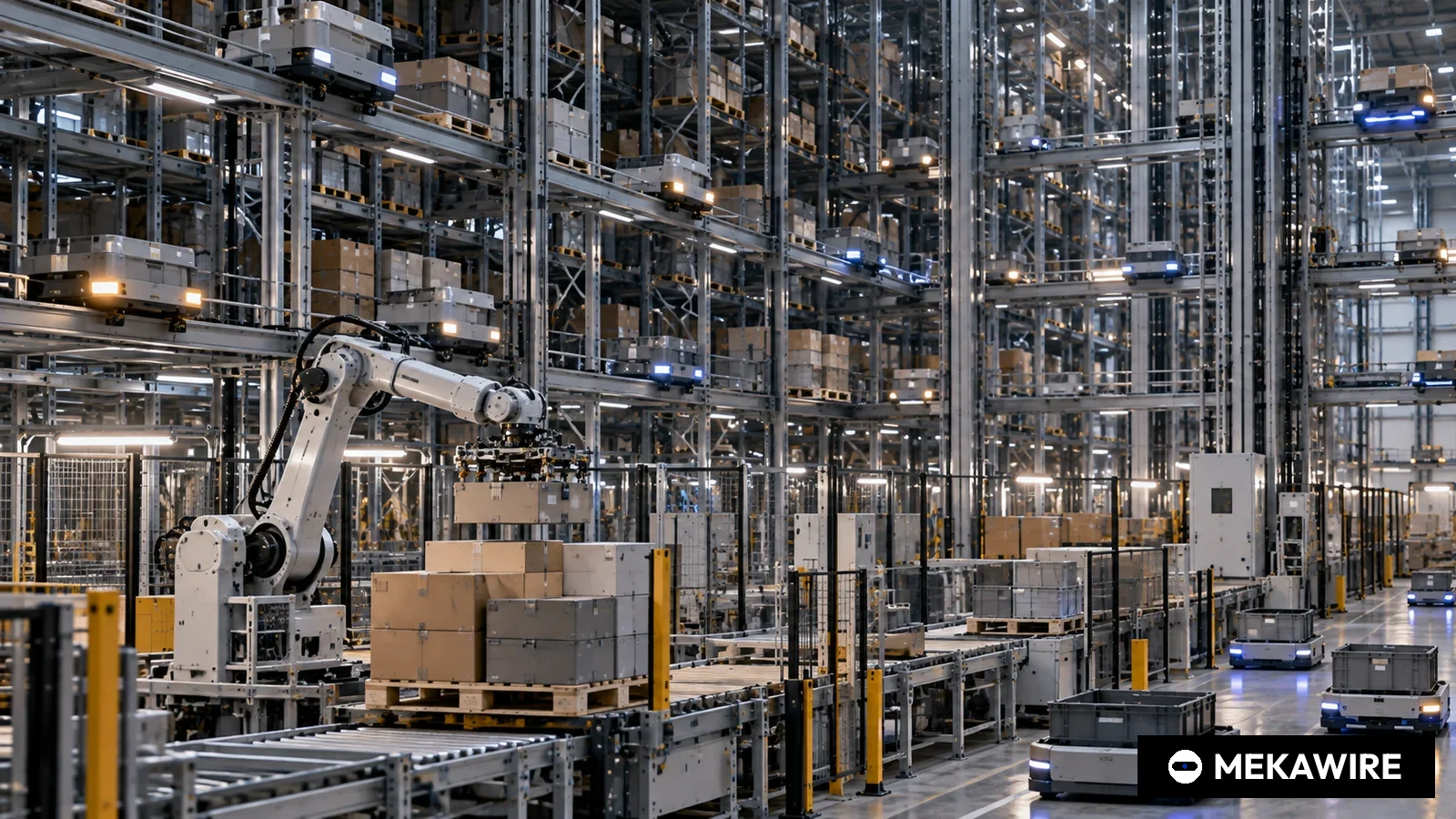
Symbotic builds robotic case-handling systems for warehouse distribution centres, and Walmart supplied about 85% of its $2.25 billion revenue in fiscal 2025, according to its 10-K. The backlog of about $22.5 billion is ten times annual revenue.
Its fiscal Q3 2026 10-Q shows the first operating profit, $32.9 million on $720.8 million of revenue, while other income added another $30.6 million to pre-tax profit.
Symbotic, the Massachusetts maker of robotic warehouse systems, earned an operating profit for the first time in the quarter to June 27, 2026: $32.9 million on revenue of $720.8 million, according to its 10-Q. The same filing shows that another $30.6 million of pre-tax profit came from other income, so almost half of the $63.5 million the company made before tax in its breakout quarter did not come from selling robots.
That detail matters because Symbotic is unusual among robotics companies. It has the revenue scale of an industrial group, $2.25 billion in fiscal 2025, and a backlog of about $22.5 billion, yet one customer, Walmart, supplied about 85% of that revenue. This explainer uses the 10-K and the latest 10-Q to answer what Symbotic actually sells, how dependent it is on Walmart and whether the move into profit is durable.
A cost-plus robot builder inside Walmart's network
Symbotic designs, installs and maintains automated systems for distribution centres. Fleets of autonomous robots move cases into high-density storage racks and retrieve them in the order a store needs, and robotic arms build mixed pallets for outbound trucks. Systems revenue, the installation work, was 94% of fiscal 2025 revenue; software maintenance and operation services made up the rest.
The relationship with Walmart is written into the contracts. The two companies have worked together since 2015. A 2021 amendment covered 25 of Walmart's 42 regional distribution centres and the May 2022 restated agreement extended it to all 42, adding about $6.1 billion of backlog, with every system due to begin implementation by the end of 2029. Walmart pays the cost of each implementation plus a specified profit, has board observation rights, and the agreement restricts Symbotic from selling to a specified company. In January 2025 Symbotic bought Walmart's Advanced Systems and Robotics unit and signed a second agreement for up to 400 store micro-fulfilment systems, conditional on performance metrics.
- Revenue
- 1,788.2
- 2,246.9
- 1,628.5
- 2,027.3
- 720.8
- Gross profit
- 245.7
- 422.6
- 303.7
- 444.3
- 160.9
- Gross margin
- 13.7%
- 18.8%
- 18.6%
- 21.9%
- 22.3%
- Operating income (loss)
- (116.7)
- (115.0)
- (69.2)
- 45.5
- 32.9
- Net income (loss)
- (84.7)
- (91.0)
- (47.9)
- 77.8
- 55.0
From Symbotic's fiscal 2025 Form 10-K and fiscal Q3 2026 Form 10-Q. Fiscal years end on the last Saturday of September. Gross margin = gross profit / revenue. Net income includes the part attributable to noncontrolling interests.
As of Oct 18, 2026
The cost-plus model explains the margin profile. Gross margin rose from 13.7% in fiscal 2024 to 18.8% in fiscal 2025 and 22.3% in the June quarter, but it is a contractor's margin, far from the 72.7% AutoStore reported for the first quarter of 2026. The next question is how much of the future is already contracted.
Ten years of revenue already signed
Backlog stood at about $22.5 billion at the end of fiscal 2025 and was unchanged at the end of June 2026; the filings say agreements with Walmart and the GreenBox joint venture make up the vast majority. On fiscal 2025 revenue that is 10.0 years of work, against 1.03 years for AutoStore. The 10-K expected only about 12% of the backlog, roughly $2.7 billion, to become revenue in fiscal 2026. The company's own guidance fits that: nine-month revenue of $2,027.3 million plus the fourth-quarter range of $760 million to $780 million gives $2.79 billion to $2.81 billion for the year, 24.1% to 24.9% growth.
- Walmart share of FY2025 revenue
- about 85% (about $1.91 billion)
- 10-K
- UNFI, GreenBox, Southern Glazer's, Albertsons
- about 13% of FY2025 revenue
- 10-K
- Backlog, Sep 27, 2025 and June 27, 2026
- about $22.5 billion each
- 10-K, 10-Q
- Backlog / FY2025 revenue
- 10.0x
- MEKAWIRE calculation
- Share of backlog expected in FY2026
- about 12% (about $2.7 billion)
- 10-K
- Revenue outside the US, Q3 FY2026
- 11.6% (Q3 FY2025: 1.2%)
- 10-Q
- Systems in deployment, Q3 FY2026
- 77 (Q3 FY2025: 46)
- 10-Q
Walmart dollar figure = 85% x $2,246.9 million. Backlog multiple = $22.5 billion / $2,246.9 million. Disclosed figures, not estimates.
As of Oct 18, 2026
GreenBox, set up in July 2023 with SoftBank Group, which owns 65%, is the second pillar. It committed to buy at least $7.5 billion of Symbotic systems over six years and now trades as Exol. Symbotic carries its 35% stake under the equity method, and the losses it books from it grew to $22.4 million in the first nine months of fiscal 2026 from $7.8 million. Exol is therefore a customer and a drag on earnings at the same time.
What the profit is made of
The improvement at the operating line is real. Nine-month operating income was $45.5 million against a $69.2 million loss, research and development spending fell 8.5% to $138.1 million while selling and administrative costs rose 25.5%, and systems in deployment climbed to 77 from 46. Operating cash flow over nine months was $305.6 million.
But the quarter's operating margin was 4.6%, and other income nearly matched operating income. Of the $55.0 million net income, $43.3 million was attributable to noncontrolling interests, the holders of units in Symbotic Holdings, leaving $11.7 million, or $0.09 a share, for Class A shareholders. Cash fell to $1.7 billion from $2.0 billion in the prior quarter.
MEKAWIRE analysis
Symbotic is best understood as Walmart's outsourced warehouse automation arm with a stock listing: the backlog buys visibility no other robot maker has, but the cost-plus contracts that create it also cap the margin, so the profit story depends on volume and on customers beyond Walmart.
The evidence is in the tables. Revenue has grown about 25% a year with almost no change in customer mix, and margins have improved through execution, not pricing. The strongest counter-argument is that diversification has started: revenue outside the US rose to 11.6% of the quarter from 1.2%, Walmart Mexico signed for two sites near Mexico City, and on Oct 13 Symbotic bought cellumation, a Bremen maker of sortation systems, for cash. Those are early signs; none yet changes the 85% figure.
- Symbotic (US)
- to Sep 2025
- $2,246.9m
- 18.8%
- net loss $91.0m
- backlog about $22.5bn
- AutoStore (Norway)
- 2025
- $538.6m
- 72.7% (Q1 2026)
- net income $81.8m
- backlog $557.0m
- Geek+ (China)
- 2025
- RMB3,171.0m
- 35.5%
- IFRS loss RMB10.4m
- new orders RMB4,137m
- Ocado Technology Solutions (UK)
- to Nov 2025
- £561.2m
- not disclosed
- adj. EBITDA margin 25.0%
- not disclosed
From each company's results as recorded in verified MEKAWIRE stories. Currencies as reported; no conversion. AutoStore backlog / revenue = 1.03x against Symbotic's 10.0x.
As of Oct 18, 2026
In the bull case, the Walmart roll-out runs to 2029 on schedule, Exol adds sites and store micro-fulfilment works, carrying gross margin toward the mid-20s and turning the operating line into the main profit source. In the bear case, a Walmart slowdown or a dispute over the micro-fulfilment performance metrics would hit a company with no second customer of similar size, while Exol's losses keep growing.
Three dated signals will test the thesis. The fiscal 2026 10-K, due around late November if Symbotic follows last year's Nov 24 filing, will give the new Walmart revenue share. The end of Exol's initial commercial term on July 23, 2027 will show whether the joint venture keeps buying. And the first quarterly report that breaks out international systems after cellumation will show whether Europe becomes a business or stays a bolt-on.
- Symbotic designs, installs and maintains AI-driven robotic systems that store, sort and palletise cases in warehouse distribution centres, according to its fiscal 2025 Form 10-K.
- Walmart accounted for about 85% of Symbotic's $2,246.9 million revenue in the year to Sep 27, 2025; UNFI, GreenBox, Southern Glazer's and Albertsons together for about 13%.
- Backlog was about $22.5 billion on Sep 27, 2025 and again on June 27, 2026; the 10-K expected about 12% of it to turn into revenue in fiscal 2026.
- Fiscal 2025 revenue rose 25.7% and gross margin improved to 18.8% from 13.7%, but the company still posted a net loss of $91.0 million.
- In the quarter to June 27, 2026, revenue was $720.8 million (up 21.7%), gross margin 22.3% and operating income $32.9 million against a $25.8 million loss a year earlier.
- Other income of $30.6 million made up 48.2% of the quarter's $63.5 million pre-tax income; $43.3 million of the $55.0 million net income was attributable to noncontrolling interests.
- Systems in deployment rose to 77 from 46 a year earlier, and revenue from outside the US reached 11.6% of the quarter's total from 1.2%.
- GreenBox, a joint venture 65% owned by SoftBank Group and 35% by Symbotic, now trades as Exol and committed to buy at least $7.5 billion of systems over six years.
Why it matters
Symbotic has the largest revenue of the warehouse automation makers compared here, more than four times AutoStore's 2025 revenue. How it moves into profit shows what a robotics business looks like when a single anchor customer funds the scale-up.
The structure is also a template: venture-backed humanoid makers chasing anchor customers in auto and logistics are effectively trying to sign a Walmart-style contract. Symbotic's filings show both the visibility and the margin ceiling that such contracts bring.
Rival analysis
The 10-K names Witron, Honeywell, Dematic, Vanderlande, Knapp, SSI Schaefer and Swisslog as rivals in full-system automation, and Knapp, Exotec, Ocado, Geek+, Hai Robotics and AutoStore in each-picking and micro-fulfilment. AutoStore sells a licensed cube-storage product through integrators at a 72.7% gross margin, while Symbotic installs and runs whole systems at about 22%.
Geek+ is the closest in growth profile, with 2025 revenue up 31.6% and the US now its largest market, at a 35.5% gross margin. Ocado's technology unit shows the downside of customer concentration: Kroger closed three of its US fulfilment centres in January 2026.
Valuation context
MEKAWIRE does not estimate a valuation for Symbotic. The filings give scale markers: total equity of $1.13 billion on June 27, 2026, of which $425.2 million is noncontrolling interest, cash of $1.7 billion and a backlog of about $22.5 billion.
Because most of the net income belongs to noncontrolling interests, earnings per Class A share are small ($0.09 in Q3). Any valuation built on the headline $55.0 million figure overstates what reaches Class A shareholders.
Supply-chain implications
The 10-K says about half of Symbotic's roughly 2,000 employees work at customer sites installing and maintaining systems, and about 1,950 of them are in the US. Installation labour, not robot hardware, is the scaling constraint visible in the filings.
Property and equipment are almost entirely in the US ($158.4 million of $158.6 million on June 27, 2026). The cellumation purchase adds a German engineering team and a product that can be sold to other integrators.
Signals to watch
Fiscal 2026 10-K, expected around late November 2026: the Walmart share of revenue and any change to the $22.5 billion backlog.
Q4 fiscal 2026 results: whether revenue lands in the $760 million to $780 million range and whether operating income again exceeds other income.
July 23, 2027: end of the initial term of the Exol commercial agreement, subject to a conditional two-year extension by Exol.
Analyst view
Thesis: Symbotic is Walmart's automation arm with a listing, and its profit depends on volume rather than pricing power. Confidence: medium. The filings are audited and detailed, but they do not split margins by customer or show the micro-fulfilment economics.
What would change our view: two consecutive quarters in which operating income clearly exceeds other income, and a fiscal 2026 Walmart share below 80%.
Questions you should be asking
What gross margin does Symbotic earn on non-Walmart systems compared with the Walmart cost-plus contracts?
How many store micro-fulfilment systems have met the performance metrics in the 2025 Walmart agreement?
How much of Exol's $7.5 billion commitment has been placed as firm orders, and why are equity-method losses rising?