Agility unveils Digit 5 humanoid for barrier-free work, with $300 million in orders tied to contractual milestones
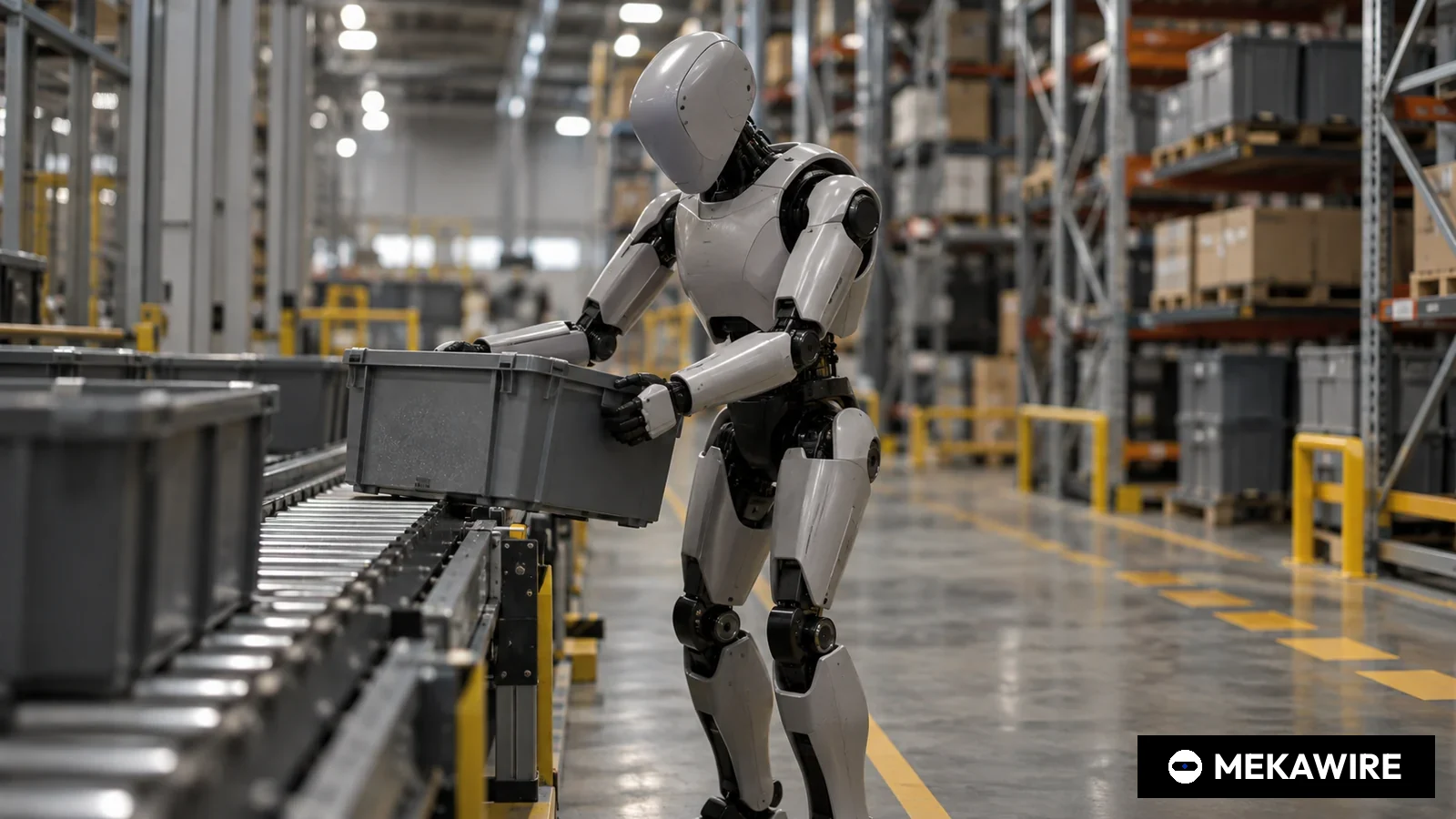
Agility Robotics unveiled Digit 5 on September 15, 2026, a humanoid it says can work beside people without safety fences. The company reported more than $300 million in multi-year Digit 5 orders as of May 2026, subject to contractual milestones, while general availability is set for the end of 2027 as its Churchill Capital Corp XI listing heads for a fourth-quarter close.
Agility Robotics unveiled Digit 5 on September 15, 2026, a redesigned version of its warehouse humanoid that the Salem, Oregon company says can work near people without fences or cages. The launch came with the number that now anchors Agility's pitch to public-market investors: more than $300 million in multi-year customer orders for Digit 5, a figure the company said was counted as of May 2026 and is "subject to satisfaction of certain contractual milestones."
The qualifier matters. The $300 million figure first appeared on June 24, when Agility and Churchill Capital Corp XI announced their planned merger and described "more than $300 million of multi-year contracted Digit v5 orders secured to date" in investor materials filed with the US Securities and Exchange Commission. The September release repeats the total but ties it explicitly to milestones, and the robot those orders cover is not yet on sale. Agility expects early access in the first half of 2027 and general availability by the end of 2027.
What Digit 5 is
Digit 5 stands 1.81 metres tall, weighs 129 kilograms (284 pounds) and can reach up to 2.2 metres, according to Agility. It is rated to lift up to 50 pounds repeatedly, which the company says is 40% more than the previous model. The battery runs for 90 minutes and recharges in 9 minutes, giving what Agility calls a 10:1 run-to-charge ratio. On MEKAWIRE arithmetic, that ratio allows at most about 21.8 hours of work in a 24-hour day before any maintenance or task gaps (24 x 90 / 99).
The headline feature is what Agility calls cooperative safety. The company describes three layers: safe human detection, which uses proprietary AI algorithms and several sensor types to spot people and respond by steering around them, stopping or lowering itself into a seated position; safety cues, which use lights and sounds to signal where the robot is about to move; and safe motion control, in which an independent safety controller supervises Digit's reactions. Agility says it contributes to two standards efforts, the ANSI/A3 technical report R15.108 for dynamically stable industrial mobile robots in the US and Canada, and ISO 25785-1, which it describes as the first international safety standard for the humanoid category.
The robot's computing and safety stack runs on NVIDIA IGX Thor with NVIDIA's Halos Core infrastructure, and Agility says Digit 5 is the first launch partner for NVIDIA's Halos for Robotics platform. Deepu Talla, NVIDIA's vice president of robotics and edge AI, pointed in the release to Digit's more than 65,000 hours of real-world operation. The hands are swappable grippers on ISO-standard mounting flanges, so a customer can change tools between tote handling and machine tending.
Customers and the field record
Agility named GXO, Schaeffler, Amazon and Toyota Motor Manufacturing Canada as customers in the launch release. The June merger materials listed Schaeffler, GXO, Toyota Motor Manufacturing Canada and Mercado Libre, and said Digit was working in nine customer facilities. The most specific performance figure comes from GXO's Flowery Branch site near Atlanta, where Digit 4 passed a cumulative 100,000 totes at about 98% accuracy while on task, Agility said. The company also says it has nearly three years of continuous commercial deployment behind it.
Production is planned at RoboFab, Agility's 70,000-square-foot plant in Salem, which the company says is designed for up to 10,000 units a year at full capacity and would employ more than 500 people at that rate. Agility also plans to take Digit 5 to the European Union and the United Kingdom, and says it expects the robot to carry a CE mark for access to the EU, Great Britain and Northern Ireland.
The listing behind the launch
The product news sits inside a capital-markets process. Under the June 24 agreement, Churchill XI values Agility at $2.5 billion before new money, with about $200 million of common stock PIPE financing committed at $10 a share and led by Foxconn, plus about $420 million held in the SPAC's trust if no shareholders redeem. Agility put total gross proceeds at more than $620 million. A July 14 update gave the trust as $421 million and the PIPE as about $201 million, and confirmed the planned Nasdaq ticker AGLT. On September 17 Agility said it expects the deal to close in the fourth quarter of 2026 and will hold an analyst and investor day in New York on October 6. It named three new directors for the planned public-company board on September 29, and on October 1 announced a deeper partnership with FORT Robotics covering a safety pendant with an emergency stop and an "Offboard Safety Bridge" linking Digit to plant safety systems.
How it compares
Agility's capital base is modest beside the best-funded US humanoid rivals. Figure AI raised more than $1 billion in its Series C at a $39 billion post-money valuation in September 2025, and Apptronik added $520 million in a Series A extension in February 2026. 1X Technologies' last round in MEKAWIRE data is a $100 million Series B from January 2024. Where Agility differs is its record of paid work in logistics and its decision to compete on certified safety rather than on dexterity or home use.
- Agility Robotics
- US
- 2015
- 200
- PIPE alongside Churchill XI merger
- 2026-06-24
- 2,500
- pre-money equity value
- 8
- Figure AI
- US
- No data
- 1000
- Series C
- 2025-09-16
- 39,000
- post-money
- 2.6
- Apptronik
- US
- 2016
- 520
- Series A extension
- 2026-02-11
- No data
- not disclosed
- No data
- 1X Technologies
- US
- 2014
- 100
- Series B
- 2024-01-13
- No data
- not disclosed
- No data
Agility figures from the Churchill Capital Corp XI 8-K exhibit 99.1 (June 24, 2026): PIPE about $200M, $2.5B pre-money equity value. Peer figures from MEKAWIRE verified company data. Figure founding year not in verified data. Raise as % of valuation is a MEKAWIRE calculation = latest raise / disclosed valuation x 100. Pre-money and post-money bases differ. Figures disclosed, not estimated.
As of Oct 3, 2026
Several questions remain open. Agility has not said how many robots the $300 million covers, how the total splits among customers, what a Digit 5 costs or rents for, or which milestones must be met before orders turn into revenue. The orders were counted in May, four months before the robot was shown publicly, and deliveries at volume are more than a year away.
- Height
- 1.81
- m
- Agility
- Weight
- 129
- kg
- Agility
- Reach
- 2.2
- m
- Agility
- Repeated payload
- 50
- lb
- Agility
- Repeated payload (metric)
- 22.7
- kg
- MEKAWIRE calc
- Implied prior-model payload
- 35.7
- lb
- MEKAWIRE calc
- Battery runtime
- 90
- min
- Agility
- Charge time
- 9
- min
- Agility
- Theoretical working hours per 24 h
- 21.8
- h
- MEKAWIRE calc
- Payload as share of body weight
- 17.6
- %
- MEKAWIRE calc
Company figures from Agility's September 15, 2026 release. MEKAWIRE calculations: metric payload = 50 lb x 0.4536; implied prior payload = 50 / 1.40 (Agility says 40% increase); working hours = 24 x 90 / (90 + 9); payload share = 22.7 / 129 x 100. Theoretical maximum, ignores maintenance and task gaps.
As of Oct 3, 2026
MEKAWIRE analysis
Digit 5 moves Agility's argument from whether humanoids can do warehouse work to whether they can do it beside people, but the $300 million order book is a conditional promise on a robot that will not be generally available until late 2027, and it should be valued that way.
The evidence for the first half is real. Agility can point to multi-year paid deployments with named logistics and automotive customers, a six-figure tote count at one site and 65,000 operating hours. Building the new model around barrier-free operation targets the cost that most limits fleet size: a robot that needs its own fenced cell cannot share aisles with workers, so every extra unit adds floor space and integration work. On MEKAWIRE arithmetic, the orders equal 12% of the $2.5 billion pre-money value (300 / 2,500), and the PIPE is 8.0% of it (200 / 2,500).
The strongest counter-argument is timing. Digit 5 is a 2027 product sold in 2026 on a figure counted in May 2026, and the release itself calls the orders subject to milestones. Investors in a SPAC have no audited backlog line to test it against, and Agility has not disclosed unit counts or pricing.
Bull case: Digit 5 reaches early access on schedule, the CE mark opens Europe, home market of customer Schaeffler, and RoboFab's 10,000-unit design capacity lets Agility convert the order book into recurring robot-as-a-service revenue faster than better-funded rivals can prove safety in mixed traffic.
Bear case: milestones slip, customers renegotiate or defer orders tied to a robot they have not yet run, and a heavily redeemed trust leaves Agility with far less than $620 million while Figure and Apptronik spend from much larger balance sheets.
Signals to watch:
- October 6, 2026: the New York investor day, where any unit count, pricing or milestone schedule behind the $300 million would be the most useful disclosure.
- Fourth quarter of 2026: the Churchill XI shareholder vote and redemption level against the roughly $420 million trust.
- First half of 2027: Digit 5 early access sites and the first CE-marked units in Europe.
- More than $300M multi-year Digit 5 orders as of May 2026, subject to contractual milestones
- 90 min runtime, 9 min charge, 10:1 run-to-charge
- RoboFab, Salem, 70,000 sq ft, designed for up to 10,000 units a year
- Churchill Capital Corp XI merger at $2.5B pre-money; Nasdaq AGLT; close expected Q4 2026
- Up to 50 lb (22.7 kg) repeatedly, 40% more than prior model
- Digit 5 humanoid, 1.81 m tall, 129 kg
- September 15, 2026, Salem, Oregon
- Early access H1 2027, general availability end of 2027
- 65,000+ operating hours; 100,000 totes at GXO Flowery Branch at about 98% accuracy
- GXO, Schaeffler, Amazon, Toyota Motor Manufacturing Canada
Why it matters
Digit 5 is the first humanoid launch from a company in the middle of a US public listing, so its specifications and order claims double as offering material. Agility's choice to lead with cooperative safety, rather than dexterity or a home use case, tells investors where it thinks the bottleneck in humanoid adoption sits: on the factory and warehouse floor, a robot that must be fenced off cannot scale beyond a few cells.
The $300 million figure is the second reason the launch matters. It was first presented in June as contracted Digit v5 orders and is now described as multi-year orders, counted as of May 2026, subject to contractual milestones. That language is more cautious, and it arrives with a public timetable that puts general availability at the end of 2027. For a company that, on its own description, has spent nearly three years in commercial deployment, the gap between orders and revenue is now the central diligence item.
Rival analysis
Figure AI, the best-funded US rival, raised more than $1 billion at a $39 billion post-money valuation in September 2025 and has focused on its Helix model and automotive work at BMW. Apptronik raised a $520 million Series A extension in February 2026 and works with Google DeepMind. 1X targets homes first with NEO. None of them has made third-party safety standards the core of a product launch in the way Agility did on September 15.
Chinese makers compete on volume and price rather than on mixed-traffic safety claims, selling many units into research, education and exhibition. Agility's bet is that industrial buyers in North America and Europe will pay a premium for a robot whose safety case fits their existing compliance processes. The risk is that rivals close the safety gap with software while keeping larger balance sheets.
Valuation context
Churchill XI values Agility at $2.5 billion before new money. On MEKAWIRE arithmetic, the $300 million in orders equals 12% of that figure (300 / 2,500), the roughly $200 million PIPE equals 8.0% (200 / 2,500), and the more than $620 million in expected gross proceeds equals 24.8% (620 / 2,500), assuming no redemptions. Figure's $39 billion post-money valuation is about 15.6 times Agility's pre-money value (39,000 / 2,500), though the two are measured on different bases.
The gross proceeds figure depends on the roughly $420 million in trust staying put. SPAC redemptions can be heavy, and the Foxconn-led PIPE is the only money Agility has described as committed. Investors will therefore weigh the order book less as a revenue forecast and more as evidence of customer intent.
Supply-chain implications
Digit 5's computing and safety stack runs on NVIDIA IGX Thor with Halos Core, and Agility is the first launch partner for NVIDIA's Halos for Robotics platform. That ties the robot's safety certification path to an NVIDIA industrial-grade module. On October 1 Agility also widened its relationship with FORT Robotics, previously a component supplier, to joint hardware development, regulatory compliance and deployment support around a safety pendant and an offboard safety bridge.
Assembly is planned at RoboFab in Salem, a 70,000-square-foot plant designed for up to 10,000 units a year. Foxconn's role as PIPE lead gives Agility a large electronics manufacturer as a shareholder, though the companies have not described a manufacturing agreement. Swappable grippers on ISO-standard flanges open a path for third-party end-of-arm tooling suppliers.
Signals to watch
The October 6 investor day in New York is the first chance for Agility to put numbers behind the order book: units, average contract value, milestone schedule and customer concentration. The amended S-4 filed on September 30 and later amendments are the documents where any such figures must appear in audited or reviewed form.
The Churchill XI shareholder vote, expected with a fourth-quarter close, will show how much of the roughly $420 million trust survives redemptions. In 2027, watch for named Digit 5 early-access sites in the first half, the CE mark, and progress on ISO 25785-1 and ANSI/A3 R15.108, the two standards documents Agility says it helps write.
Analyst view
Thesis: Agility has the most credible industrial deployment record among US humanoid makers that have disclosed customer sites, and Digit 5 addresses the right constraint, but the order book is a soft asset until the company discloses units, pricing and milestones. Confidence: medium. The specifications, customers and deployment metrics come from Agility's own releases and SEC filings; the conversion of orders into revenue and the redemption outcome are unknown.
We would treat the $300 million as an indicator of demand from named customers rather than as backlog. The most useful upgrade to confidence would be disclosure of the share of orders that are firm and non-cancellable, and the revenue Agility has recognised from Digit 4 deployments in 2026.
Questions you should be asking
How many Digit 5 units does the more than $300 million in orders represent, and over how many years?
Which contractual milestones must be met before orders become revenue, and can customers cancel if early access slips past the first half of 2027?
Is Digit 5 sold outright, leased, or offered as a robot-as-a-service subscription, and at what price?
How much of the roughly $420 million trust does Agility expect to retain after redemptions, and does the plan for RoboFab depend on it?