Amazon unveils Blue Jay, a multi-arm robot that merges three workstations, and Project Eluna, an agentic AI for warehouse managers
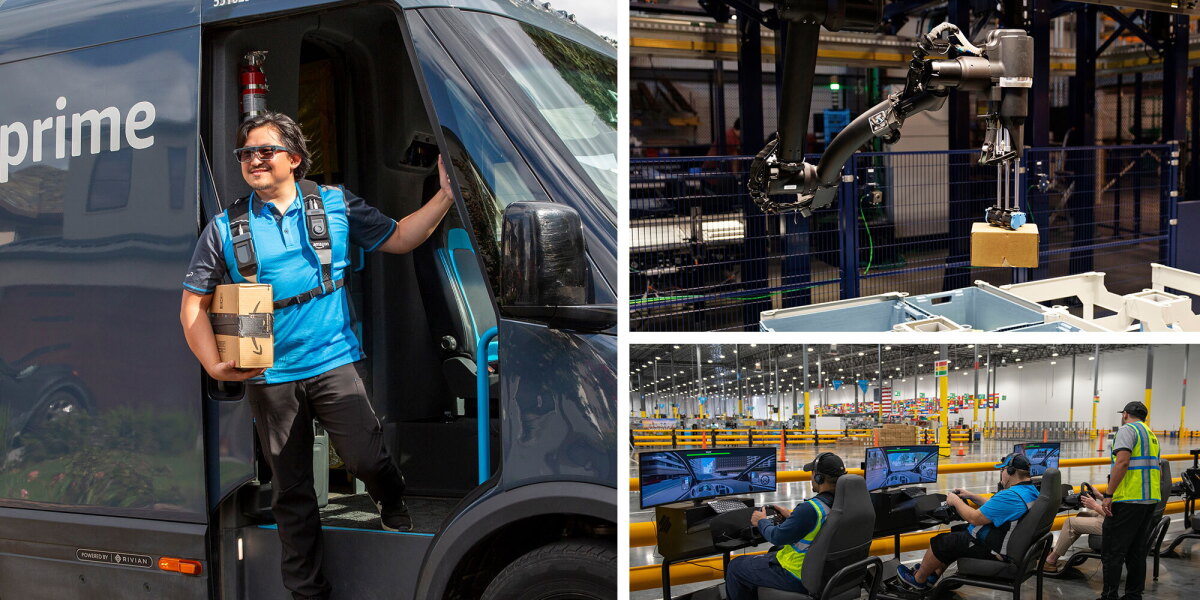
At its Delivering the Future event on October 22, 2025, Amazon showed Blue Jay, a multi-arm system it said could pick, stow and consolidate about 75% of the item types at a South Carolina test site, and Project Eluna, an agentic AI piloted at a Tennessee fulfillment center.
Amazon said Blue Jay went from concept to production in just over a year, but an update dated February 25, 2026 states the company no longer uses it in operations.
Amazon introduced two new tools for its fulfillment network on October 22, 2025, at its annual Delivering the Future event. The first, Blue Jay, is a robotic cell in which several arms work together on picking, stowing and consolidating orders. The second, Project Eluna, is an agentic AI system that reads live and historical facility data and tells operations managers in plain language where trouble is building. Amazon presented both as ways to take repetitive and physically demanding work off employees and to speed up deliveries.
According to Amazon's own account, Blue Jay folds what had been three separate robotic stations into a single workspace. At the South Carolina fulfillment site where it was being tested, the company said the system could already handle roughly 75% of the different item types Amazon stores. Amazon described it as a core technology for its Same-Day sites, the smaller buildings that serve the fastest delivery promises, where floor space is the binding constraint.
The development timeline was the figure Amazon stressed most. The company said Blue Jay moved from concept to production in just over a year, against three years or more for earlier systems such as Robin, Cardinal and Sparrow. It credited digital twins, simulations that model real physics so engineers can test designs virtually, together with the data and experience gathered from its existing robot fleet. Tye Brady, chief technologist for Amazon Robotics, framed the goal as making technology a practical tool that leaves work safer and more rewarding.
Project Eluna addresses a different bottleneck: the time managers spend reading dashboards. Amazon said the system analyses historical and real-time data, anticipates congestion and recommends actions, and that operators can query it in natural language, for example by asking where to move staff to avoid a bottleneck. The pilot ran at one fulfillment center in Tennessee during the 2025 holiday season, with sortation as the first use case. Amazon's event summary added that Eluna can help plan ergonomic job rotations and maintenance schedules.
The announcements sat inside a wider package. Amazon also showed smart glasses for delivery drivers, built with input from hundreds of delivery associates, said more than 300,000 drivers had completed its virtual reality training since 2022, and repeated a $4 billion plan to triple its rural delivery network by 2026. On the workforce side it pointed to Career Choice, mechatronics and robotics apprenticeships and new AI training, and said it was hiring 250,000 people for the holiday period.
Blue Jay arrived as the latest step in a fast run of robotics disclosures. In May 2025 Amazon introduced Vulcan, a robot with force feedback sensing that it said could pick and stow about 75% of item types, deployed in Spokane, Washington and Hamburg, Germany. On July 1, 2025 it said it had deployed its one millionth robot, at a site in Japan, across more than 300 facilities, and launched DeepFleet, a generative AI foundation model it said cut fleet travel time by 10%.
- Vulcan
- 2025-05-07
- Pick and stow robot with force feedback sensing
- 75
- Deployed in Spokane, Washington and Hamburg, Germany
- Amazon planned wider rollout in Europe and the US
- DeepFleet
- 2025-07-01
- Generative AI foundation model for robot fleet routing
- No data
- Fleet travel time cut by 10%
- Launched
- Blue Jay
- 2025-10-22
- Multi-arm pick, stow and consolidate cell
- 75
- Concept to production in just over 1 year
- Withdrawn from operations (Amazon update 2026-02-25)
- Project Eluna
- 2025-10-22
- Agentic AI assistant for operations managers
- No data
- Piloted at 1 Tennessee fulfillment center
- Pilot disclosed, no results published
All metrics as stated by Amazon on aboutamazon.com; none independently measured. Item share refers to item types, not volume.
As of Oct 1, 2026
The competitive frame is crowded. Specialist suppliers such as Symbotic, AutoStore, Ocado, Exotec, Locus Robotics, Geek+, Dexterity and Mujin sell storage, mobile robot and picking systems to retailers and logistics groups that cannot build their own. Amazon, with its own engineering teams and network data, is the benchmark they are measured against. Blue Jay signalled that Amazon wants to own the integrated pick, stow and consolidate cell in house, the part of the warehouse where specialist vendors still compete hardest on manipulation.
- Dexterity
- US
- 2017
- Series B (equity and debt)
- 140,000,000
- No data
- 2021-10-13
- Exotec
- FR
- 2015
- Series D
- 335,000,000
- 2,000,000,000
- 2022-01-17
- Locus Robotics
- US
- 2015
- Series F
- 117,000,000
- No data
- 2022-11-29
- Mujin
- JP
- 2011
- Series D (first close)
- No data
- No data
- 2025-12-02
Figures disclosed by the companies or their investors; — means not disclosed in the MEKAWIRE verified dataset. Amazon builds its systems in house and does not disclose Blue Jay or Eluna development spending.
As of Oct 1, 2026
The technical bet behind Blue Jay was coordination. A single robot arm at a station handles one task at a time; several arms sharing a workspace must plan around each other, share perception of the same totes and avoid collisions while keeping throughput high. Simulation lets engineers rehearse those interactions before hardware exists, which is how Amazon explained the compressed schedule. Eluna is a software layer above the floor, a language model interface over operational data that suggests decisions rather than executing them.
The programme did not last in its announced form. An update on Amazon's Blue Jay page, dated February 25, 2026, says the company is no longer using Blue Jay in operations and that the underlying technology will continue to support employees across its network. Amazon gave no reason on that page and did not say whether the South Carolina cell had been expanded before it was withdrawn.
The main open questions follow from that reversal. Amazon disclosed no throughput, cost or reliability numbers for Blue Jay, so the 75% item coverage figure was never tied to a rate. For Eluna, Amazon disclosed a single pilot site and no measured outcome. Both disclosures were made at a media event, and neither came with independent data.
MEKAWIRE analysis
Blue Jay's withdrawal within four months shows that Amazon now treats warehouse robots as fast, disposable experiments built on shared simulation and fleet data, and the durable asset is that development pipeline rather than any one machine.
The evidence is in Amazon's own words. It cut concept to production from three or more years to just over one, credited digital twins and fleet data for the gain, and, when it retired Blue Jay, said the underlying technology would keep supporting its network. A company that can build a multi-arm cell in a year can afford to stop one.
The strongest counter-argument is simpler. A system pulled from operations four months after launch may have failed on cost, speed or reliability, and a faster pipeline that produces systems that do not survive contact with peak volumes is not yet an advantage. Amazon's silence on the reason leaves that reading open.
Bull case: Blue Jay's perception, motion planning and simulation assets flow into Vulcan, Proteus and later cells, and Eluna scales from one Tennessee site across the network, lowering the cost of each new automation project. Amazon's in-house cycle time then becomes a moat that specialist vendors cannot match.
Bear case: multi-arm manipulation at warehouse speed remains harder than demonstrations suggest, and Amazon keeps relying on specialist suppliers for storage and picking. Eluna stays a dashboard assistant with unproven gains, and the October 2025 event is remembered for its announcements rather than its deployments.
Signals to watch:
- Amazon's third quarter 2026 results in late October 2026, for any capital spending or robotics deployment figures.
- The November to December 2026 holiday peak, the first full season after the Tennessee Eluna pilot, for any Amazon disclosure of wider rollout.
- Amazon's 2026 annual report on Form 10-K in early 2027, for robot counts and automation language.
- Amazon update dated February 25, 2026: Blue Jay no longer used in operations
- Multi-arm system that picks, stows and consolidates in one workspace, replacing three separate stations
- October 22, 2025, at Amazon's Delivering the Future event
- About 75% of item types at the South Carolina test site (Amazon figure)
- Agentic AI piloted at a Tennessee fulfillment center, starting with sortation
- 250,000 positions for the 2025 holiday season
- Just over one year from concept to production, versus three or more years for Robin, Cardinal and Sparrow
Why it matters
Blue Jay and Eluna mark two directions in Amazon's automation strategy. Blue Jay attacks the physical constraint of small Same-Day buildings by stacking three tasks in one cell; Eluna attacks the managerial constraint of reading data fast enough to move people before queues form. Together they show Amazon automating both the hands and the shift supervisor.
The more lasting signal is the development claim. Amazon said a multi-arm system reached production in just over a year, against three or more years for Robin, Cardinal and Sparrow. If that cycle time holds, the economics of in-house automation shift: more projects can be tried, and failures such as Blue Jay's withdrawal in February 2026 cost less.
Rival analysis
Third-party automation vendors such as Symbotic, AutoStore, Ocado, Exotec, Locus Robotics, Geek+, Dexterity and Mujin sell to retailers that lack Amazon's engineering bench. Each must spread development cost across many customers; Amazon spreads it across one very large network and its own data.
Blue Jay's retirement narrows the immediate threat to picking specialists such as Dexterity and Mujin, whose products target the same pick and place step. But Amazon's statement that the underlying technology will keep supporting its network means the capability stays inside the company and can return in another form.
Valuation context
Amazon does not report robotics spending or returns separately, and it gave no cost or productivity figure for either system. Any valuation effect sits inside Amazon's broader operating margin in North America and international retail, where automation is one of several levers.
For private peers the reference points are older. Exotec's last disclosed round in January 2022 valued it at $2 billion after a $335 million Series D; Locus raised $117 million in November 2022; Dexterity raised $140 million in October 2021. Amazon's ability to build comparable functions in house is a standing discount factor for any vendor that counts Amazon as a target customer.
Supply-chain implications
Multi-arm cells depend on industrial arms, vacuum and gripper end effectors, 3D vision and edge computers. Amazon did not name suppliers for Blue Jay. Its claim of a one year build relied on simulation and on data from an existing fleet that Amazon said passed one million robots in July 2025.
Eluna depends on data infrastructure rather than hardware: facility sensors, sortation logs and labour scheduling systems. Its value rises with the number of sites connected, which makes the Tennessee pilot the first point of a network rollout rather than a product in itself.
Signals to watch
First, Amazon's quarterly results and 10-K filings for robot counts, capital spending and any mention of Same-Day site automation. Second, any new aboutamazon.com disclosure of systems that inherit Blue Jay's multi-arm design, which would confirm the company's claim that the technology lives on.
Third, an expansion of Eluna beyond its Tennessee pilot, ideally with a measured outcome such as reduced sortation backlog or overtime. Fourth, Amazon's next Delivering the Future event, where the company has introduced its main robotics news in 2025.
Analyst view
Thesis: Amazon's real product is its robotics development pipeline, and Blue Jay was one output of it. Confidence: medium. The cycle time claim and the February 2026 statement both point this way, but Amazon has published no cost, throughput or reliability data, and the reason for Blue Jay's withdrawal is undisclosed.
We would raise confidence if Amazon names a successor system that reuses Blue Jay's components within the next year, or if Eluna is rolled out to multiple sites with measured results. We would lower it if Amazon's next disclosures return to single function robots and longer development cycles.
Questions you should be asking
Why exactly did Amazon stop using Blue Jay: throughput, cost, reliability, a change in Same-Day site design, or replacement by another system? How many Blue Jay cells were built before February 2026?
What measurable effect did Eluna have on the Tennessee site's sortation performance during the 2025 holiday peak, and which model and data stack does it run on? Will Amazon offer Eluna style tools to sellers or logistics customers outside its own network?