Boston Dynamics and Toyota Research Institute put one 450-million-parameter behaviour model in charge of Atlas's hands and feet
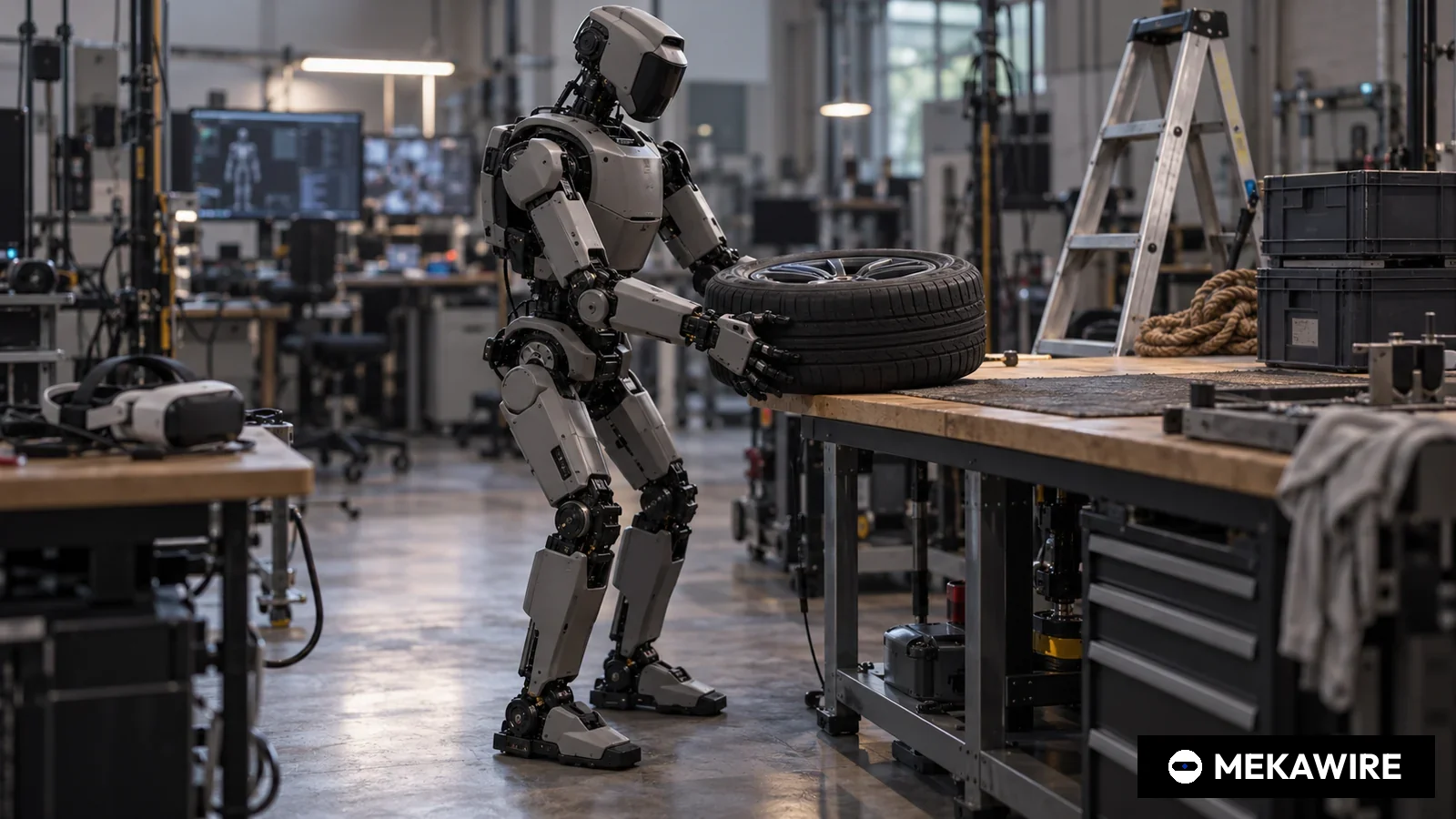
Boston Dynamics and TRI showed Atlas completing a long workshop task under a single Large Behavior Model that commands walking and manipulation together. The 450M-parameter Diffusion Transformer runs at 30 Hz on camera, body-state and language inputs and learns new behaviours from VR teleoperation data without new code. No success rates or data volumes were disclosed.
Boston Dynamics and the Toyota Research Institute (TRI) on Wednesday released a video of the electric Atlas humanoid working through a long, multi-step workshop job under the control of a single Large Behavior Model (LBM), the first public result of a research partnership the two signed in October 2024.
The model has 450 million parameters and is built on a Diffusion Transformer trained with a flow-matching objective, according to a technical post on the Boston Dynamics blog dated August 20, 2025. It runs at 30 Hz, reads images from a pair of HDR stereo cameras in Atlas's head along with the robot's own joint state and a natural-language instruction, and outputs a chunk of 48 future actions, or 1.6 seconds of motion, of which 24 are executed before the next inference step.
The headline claim is architectural. Humanoids that have shown similar behaviour usually split low-level walking and balance control from arm control, Toyota's US newsroom said in the joint release. In this project one LBM directly commands the whole robot and treats the hands and feet almost identically, the companies said. On Atlas the action space covers both grippers, neck yaw, torso pose and the pose of each hand and foot.
In the demonstration, which Boston Dynamics calls the Spot Workshop task, a single language-conditioned policy folds the legs of a Spot quadruped taken from a cart and shelves them, moves Spot face plates into a bin it pulls from a low shelf, and empties a blue bin of parts into a tilt truck. Researchers interrupted the sequence by closing a box lid and sliding the box across the floor, and Atlas adjusted without a change of program, the release said.
Boston Dynamics said the team has studied dozens of tasks on Atlas and on the Atlas Manipulation Test Stand (MTS), an upper-body rig that shares Atlas's hardware and software. Examples in the post include tying rope, flipping a barstool, unfurling a tablecloth, stacking rigid blocks, folding a T-shirt and handling a 22-pound (about 10 kg) car tire. Atlas has 50 degrees of freedom, the MTS has 29, and each gripper has seven.
The training data come from human operators who drive the robot in virtual reality through a teleoperation system built on Boston Dynamics' model predictive controller, later extended with foot trackers so operators can step and squat. The model was trained on demonstrations from Atlas and the MTS, on TRI's Ramen dataset and on simulation data used for co-training, the blog said. Behaviours such as recovering from a dropped part were added by collecting examples and retraining, with no algorithmic or engineering changes, according to the post.
The team also found it could run trained policies 1.5 to 2 times faster at inference without significantly affecting performance, by changing the timing inside predicted trajectories rather than retraining. Boston Dynamics did not disclose how many hours of teleoperation went into the model or task success rates.
Scott Kuindersma, vice president of robotics research at Boston Dynamics, said training one network on many long-horizon tasks would lead to better generalisation. Russ Tedrake, TRI's senior vice president for Large Behavior Models, said previous approaches to programming humanoid tasks "simply could not scale" and that as LBMs get stronger they need fewer demonstrations.
Boston Dynamics has been majority owned by Hyundai Motor Group since June 2021, when the group took an 80% stake at a US$1.1 billion valuation and SoftBank kept 20%, according to the 2021 closing announcement. Its company description still lists Atlas as a platform in development alongside the Spot and Stretch robots. TRI, founded in 2016 and led by Gill Pratt, has offices in Los Altos, California and Cambridge, Massachusetts.
The result lands in a crowded race to build a general robot model. Figure AI's Helix, shown in February 2025, pairs a 7 billion-parameter vision-language model with an 80 million-parameter controller running at 200 Hz over a 35-degree-of-freedom upper body. NVIDIA's open GR00T N1 has 2.2 billion parameters, and Physical Intelligence's pi0 has 3.3 billion. Atlas's LBM is far smaller than those, and its developers say it commands the legs and the hands from the same output.
MEKAWIRE analysis
By letting one learned policy emit foot poses next to hand poses, Boston Dynamics has moved Atlas's bottleneck from control code to demonstration data.
- Atlas LBM
- Boston Dynamics and Toyota Research Institute
- 2025-08-20
- 450
- 30
- 48
- Helix (S2 + S1)
- Figure AI
- 2025-02-20
- 7080
- 200
- No data
- GR00T N1 (2B)
- NVIDIA
- 2025-03-18
- 2200
- 120
- 16
- π0
- Physical Intelligence
- 2024-10-31
- 3300
- 50
- 50
Figures as disclosed by each developer on its own page or paper: Boston Dynamics blog (20 Aug 2025); Figure Helix post (20 Feb 2025, 7B-parameter S2 plus 80M-parameter S1, rate is S1's 200 Hz loop); NVIDIA GR00T N1 paper arXiv 2503.14734 (2.2B total, 120 Hz action module, 16-step chunks; launch date from NVIDIA newsroom); Physical Intelligence pi0 paper arXiv 2410.24164 (3.3B total, up to 50 Hz, 50-step chunks). Helix total = 7,000 + 80. Not estimated; — = not disclosed. Rates measure different things across architectures and are not a direct performance ranking.
As of Oct 1, 2026
The evidence is in the action space. Feet poses sit next to hand poses in a single 30 Hz output, and the same pipeline that taught rope tying taught stepping and squatting. That removes the hand-tuned seam between a balance controller and a manipulation stack that most humanoid programmes still keep.
The strongest counter-argument is that the policy outputs pose targets for the feet, torso and hands rather than joint torques, so Boston Dynamics' model-based control layer, the same one its teleoperation system is built on, still has to turn those targets into balanced motion. The learned model decides where limbs go at 30 Hz, and classical control keeps the robot upright. Without published success rates, the video shows feasibility rather than reliability.
Bull case. If demonstration data, not code, is the bottleneck, Boston Dynamics' VR teleoperation tooling and TRI's datasets give the pair a fast loop for adding tasks, and a 450 million-parameter policy is small by current standards, which keeps training and inference costs down. Hyundai's factories offer a ready supply of real tasks to collect.
Bear case. Rivals with larger vision-language backbones may generalise better to new objects and instructions, and teleoperated data is slow and costly to collect at humanoid scale. A research partnership with Toyota's lab also leaves open who owns the resulting models when Atlas goes commercial.
Signals to watch.
- Whether Boston Dynamics or TRI publishes quantitative success rates and data hours for whole-body LBM tasks before the end of 2025.
- Whether a production Atlas design is shown during 2026 and runs this policy family on board.
- Whether egocentric human video or reinforcement learning, both listed as next steps in the August 2025 post, appear in TRI or Boston Dynamics releases by mid-2026.
- Large Behavior Model, 450M-parameter Diffusion Transformer, flow-matching loss
- Head-mounted HDR stereo cameras, proprioception, language prompt
- Atlas (50 DoF, 7-DoF grippers) and Atlas MTS (29 DoF)
- 20 Aug 2025, Boston
- Joint research agreement since 16 Oct 2024
- 30 Hz, 48-action chunks (1.6 s), 24 executed per step
- Atlas and MTS teleoperation, TRI Ramen data, simulation co-training
- 1.5x to 2x without significant performance loss
Why it matters
Boston Dynamics built its reputation on hand-engineered dynamic control, from the hydraulic Atlas parkour videos to Spot's locomotion stack. The August 2025 result signals that, for manipulation and for the walking that supports it, the company is now willing to let a learned policy decide where the feet go. Toyota's newsroom framed it as new capabilities added without writing a single new line of code.
For buyers, the practical change is the cost of a new task. If a task can be taught through VR demonstrations and a retraining run, the marginal engineering cost of each new factory job falls, and the limiting resource becomes operator time and data quality. Boston Dynamics said recovery behaviours were added exactly this way, with no algorithmic or engineering changes.
Rival analysis
Figure AI's Helix, disclosed in February 2025, splits the problem into a 7 billion-parameter vision-language model at 7 to 9 Hz and an 80 million-parameter controller at 200 Hz over a 35-degree-of-freedom upper body. NVIDIA's GR00T N1 uses a similar dual-system design with 2.2 billion parameters and a 120 Hz action module. Physical Intelligence's pi0 combines a 3 billion-parameter vision-language backbone with a 300 million-parameter action expert, producing chunks at up to 50 Hz.
The Atlas LBM is the smallest of these at 450 million parameters and runs slower, at 30 Hz with 48-step chunks. Its differentiator is scope of control, with feet, torso and hands in one output, and the depth of its hardware partner. The trade-off is semantic breadth, since the post does not describe a large internet-pretrained language backbone, and the companies list VLM and VLA deployment as future work.
Valuation context
Neither organisation disclosed financial terms for the partnership, and Boston Dynamics does not raise outside rounds. The last public price point is Hyundai Motor Group's June 2021 acquisition of an 80% stake at a US$1.1 billion valuation, with SoftBank retaining 20%.
That figure predates the electric Atlas and the humanoid funding boom, in which Figure AI alone raised a US$675 million Series B in February 2024. Any future external marking of Boston Dynamics will lean heavily on whether results like this one translate into a production programme, which the company's own description still called in development in August 2025.
Supply-chain implications
The LBM relies on data infrastructure more than on new components. The inputs named in the post are a pair of HDR stereo cameras in Atlas's head, proprioceptive state from 50 degrees of freedom, and grippers with seven degrees of freedom each. Teleoperation uses a VR headset, base stations, hand controllers and chest and foot trackers mapped onto Boston Dynamics' own controller.
For suppliers, the implication is that camera quality, gripper dexterity and actuator repeatability become training-data inputs as much as hardware specs. A policy that treats feet and hands alike also puts more weight on leg actuators that can follow learned pose targets precisely, an area where Hyundai's parts affiliates are natural candidates, though no supply arrangement was disclosed in August 2025.
Signals to watch
First, quantitative disclosure. The blog gives architecture details but no success rates or data volumes; a TRI paper with numbers would let outsiders compare the LBM with Helix, GR00T and pi0 on equal terms.
Second, data sources. The post names cross-embodiment data and egocentric human video as next steps. If those enter training during 2026, the cost per task argument strengthens. Third, the production Atlas design and whether the same policy family ships on it.
Analyst view
Thesis. Boston Dynamics and TRI have shown that whole-body humanoid behaviour can be taught through demonstration with a modest model, which moves the competitive axis to data throughput and hardware reliability, where Hyundai's industrial base is an advantage.
Confidence: medium. The architectural facts are disclosed in detail on the company's own blog, which supports the thesis. Confidence is not higher because there are no published success rates, no data volumes, and the demonstration is a single curated workshop sequence. The pose-target action space also means classical control still carries balance.
Questions you should be asking
How many hours of teleoperated data did the Spot Workshop policy require, and how does that number scale with each added task?
What share of training came from TRI's Ramen dataset and from simulation, and does simulation co-training measurably improve whole-body tasks? Who will own and license the models once Atlas is sold to customers, Boston Dynamics, TRI or both?