Hyundai pledges US$21 billion for America and puts Boston Dynamics in a US$6.3 billion future-industries bucket
Hyundai Motor Group said on March 24, 2025 it will invest US$21 billion in the United States from 2025 to 2028, lifting US vehicle capacity to 1.2 million units and building a 2.7 million-ton steel mill in Louisiana.
US$6.3 billion goes to future industries and energy, including faster commercialisation at Boston Dynamics and reinforcement-learning robot work with the RAI Institute, though the group did not say how much is earmarked for robots.
Hyundai Motor Group will spend US$21 billion in the United States between 2025 and 2028, the Korean carmaker said on March 24, 2025, US time, and it filed robotics in the same bucket as autonomous driving, artificial intelligence and air taxis. The group said US$6.3 billion of the total would go to future industries and energy, where it pledged to speed up commercialisation at its US subsidiaries Boston Dynamics, Supernal and Motional.
Most of the money is conventional industrial spending. According to the group's Korean-language release, US$8.6 billion goes to vehicle production and US$6.1 billion to parts, logistics and steel; the English release rounds the three buckets to US$9 billion, US$6 billion and US$6 billion. The goal is US capacity of 1.2 million vehicles a year for Hyundai, Kia and Genesis. The group listed current capacity of 360,000 units at Hyundai's Alabama plant, 340,000 at Kia's Georgia plant and 300,000 at the new Hyundai Motor Group Metaplant America (HMGMA), which is to be expanded to 500,000.
- Vehicle production
- 8.6
- 9
- 41
- Parts, logistics and steel
- 6.1
- 6
- 29
- Future industries and energy (incl. robotics)
- 6.3
- 6
- 30
- Total
- 21
- 21
- 100
Amounts as disclosed by Hyundai Motor Group on March 24 to 25, 2025. Share = area amount / 21.0, from the Korean release figures. No robotics-only figure was disclosed.
As of Mar 25, 2025
The steel item is the most tangible. Hyundai Steel will build an electric arc furnace mill in Louisiana with annual capacity of 2.7 million tons, specialised in low-carbon automotive sheet made from recycled scrap. The group said local steel supply would make it more resilient to tariffs and other external risks. Affiliates that followed Hyundai and Kia into the US will add equipment to lift parts localisation and source electric vehicle components such as battery packs locally.
On robotics the release is clear about direction and silent on dollars. Hyundai said Boston Dynamics and the Robotics and AI Institute (RAI) would strengthen their capabilities to develop intelligent robots based on reinforcement learning. It said it runs projects with NVIDIA to make software-defined vehicles and robotics more intelligent and to apply AI across its operations. It did not say how much of the US$6.3 billion goes to robots rather than to Supernal, which targets commercial service for its advanced air mobility aircraft in 2028, to Motional's Level 4 driving software, or to small modular reactor cooperation and the IONNA charging network.
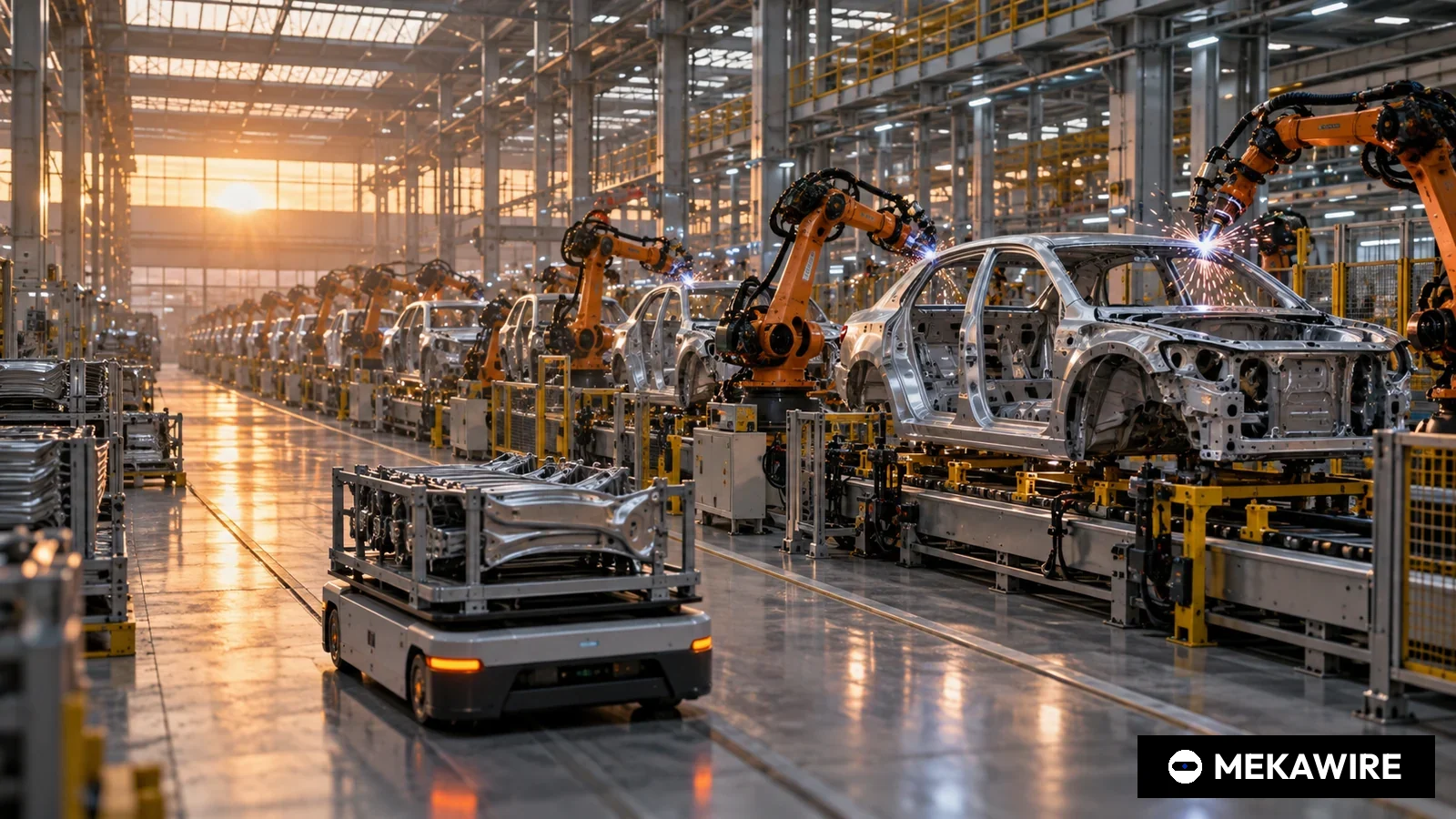
Two days later, on March 26, Hyundai held the grand opening of HMGMA in Ellabell, Georgia, with Governor Brian Kemp in attendance, and the plant shows what the robotics label buys in practice. The group says the factory runs order collection, procurement, logistics and production on AI and real-time data, uses Boston Dynamics' Spot quadruped for exterior quality inspection in the weld shop, moves parts with automated guided vehicles and parks finished cars with robots. It says automation in the assembly shop is nearly double the level of its existing plants.
- Hyundai Motor Manufacturing Alabama
- AL
- 360,000
- No data
- Kia Georgia
- GA
- 340,000
- No data
- Hyundai Motor Group Metaplant America
- GA
- 300,000
- 500,000
- Total
- No data
- 1,000,000
- 1,200,000
Plant figures from Hyundai Motor Group's March 2025 releases. Totals are sums of disclosed plant figures; planned total assumes Alabama and Kia Georgia unchanged, which matches the group's 1.2 million target. — = not disclosed.
As of Mar 26, 2025
HMGMA is part of a US$12.6 billion Georgia commitment that includes battery joint ventures with LG Energy Solution and SK On. The plant built its first vehicle on October 3, 2024, makes the IONIQ 5 and IONIQ 9 and is due to add a Kia model in 2026, according to the company. Hyundai said the wider plan would create 14,000 direct full-time jobs by 2028 and more than 100,000 direct and indirect job opportunities, on top of roughly US$20.5 billion it says it has invested in the US since 1986. In Korea it is spending a record 24.3 trillion won this year, the group said.
Reinforcement learning, the technique Hyundai named, trains a robot by letting it try actions, mostly in simulation, and rewarding the ones that succeed, instead of hand-coding each motion. It is how legged robots learn to walk on uneven floors and recover from slips. Spot's role at HMGMA is narrower and already in daily use: it walks a fixed route and checks welds and body panels so defects are caught before paint.
The competitive context explains why a carmaker owning a robot company matters. Humanoid developers without an industrial parent are raising money to reach factories: Apptronik announced a US$350 million Series A on February 13, 2025 and a further US$53 million on March 18, and Figure AI raised US$675 million in a Series B in February 2024, according to the companies. Hyundai can instead hand Boston Dynamics a set of plants, a supplier base and a production engineering team. NVIDIA, which supplies AI computing to many of those rivals, is a Hyundai partner as well, so the edge Hyundai holds lies in deployment rather than in compute.
The open questions are budget and timing. Hyundai gave no robot count, no dollar figure for Boston Dynamics and no schedule for putting humanoids into its US lines. The plan is also weighted toward steel and cars, which respond directly to tariff risk; future-industry spending is the line most easily trimmed if margins tighten. Watch for HMGMA's expansion toward 500,000 units, the Kia model due in 2026, Supernal's 2028 target and any disclosure of how many robots Hyundai intends to buy for its American factories.
MEKAWIRE analysis
Hyundai is using a tariff-driven factory pledge to give Boston Dynamics something most robot makers lack, a captive industrial customer, but until it puts a number on the robotics share the pledge is a direction rather than a budget.
The evidence for the first half is HMGMA itself. A plant that already uses Spot for weld inspection, AGVs for logistics and nearly twice the assembly automation of older sites is a test bed where Boston Dynamics can move from demonstration to repeat use, and the planned 200,000-unit expansion at HMGMA gives it new lines to automate from the start.
The strongest counter-argument is that nothing in the release obliges Hyundai to buy robots at scale. The US$6.3 billion is spread across robotics, AI, air mobility, autonomous driving and energy, and the release attaches no amount to any of them.
Bull case: the Georgia expansion becomes the reference factory for Boston Dynamics, with Spot and later humanoids specified into new lines, giving the unit revenue and field data that venture-funded rivals must win customer by customer. Reinforcement learning work at RAI then shortens the gap between lab and plant.
Bear case: tariffs and EV demand absorb management attention, the future-industries bucket is spent mostly on autonomous driving and energy, and Boston Dynamics remains a showcase rather than a supplier. Rivals with outside customers scale faster.
- Signal 1, during 2025: any Hyundai disclosure of robot purchase volumes or Boston Dynamics funding inside the US$21 billion.
- Signal 2, 2026: the Kia model launch at HMGMA and progress from 300,000 toward 500,000 units of capacity.
- Signal 3, 2028: Supernal's commercial target and the end of the investment window, when Hyundai should show how the US$6.3 billion was split.
- 14,000 direct full-time by 2028; 100,000+ direct and indirect
- 300,000 units, to rise to 500,000
- Boston Dynamics Spot for weld-shop inspection, AGVs, parking robots
- US$21 billion, 2025 to 2028
- US$8.6 billion; US capacity target 1.2 million units a year
- US$6.1 billion; 2.7 million-ton EAF steel mill in Louisiana
- US$6.3 billion (robotics, AI, AAM, autonomous driving, energy)
- about US$20.5 billion
Why it matters
The US$21 billion is mainly a tariff answer: steel, cars and parts made in America. Robotics matters because it sits inside the one bucket, US$6.3 billion for future industries and energy, that Hyundai described in terms of capability building rather than capacity, and because Hyundai owns a legged-robot developer outright, which few carmakers do.
The practical link is HMGMA. The release and the grand-opening statement two days later together show a group that intends to use its own plants as the first market for Boston Dynamics products, starting with Spot inspection and AGV logistics. That turns robotics from a research cost into a manufacturing input with an internal buyer.
Rival analysis
Independent humanoid developers such as Apptronik (US$350 million Series A in February 2025, plus US$53 million in March) and Figure AI (US$675 million Series B in February 2024) must sign outside automakers to get factory time. Hyundai can allocate lines internally, which lowers the commercial barrier for Boston Dynamics but also removes market discipline on price and reliability.
Tesla is another carmaker developing robots in-house. Unlike Tesla, Hyundai has disclosed no robot production target in this plan, and it relies on a subsidiary with a separate research institute (RAI) rather than an internal team. NVIDIA works with Hyundai and with most independent rivals, so compute is not a differentiator.
Valuation context
Hyundai did not disclose a robotics allocation, so no valuation or return analysis is possible from this announcement. The only defensible statement is the ceiling: robotics spending in the US over 2025 to 2028 is some fraction of US$6.3 billion, which also funds Supernal, Motional, AI projects, SMR cooperation and IONNA charging.
For scale, the whole future-industries bucket equals about 30% of the plan, against 41% for vehicle production and 29% for parts, logistics and steel.
Supply-chain implications
The parts commitment matters for robots more than it seems. Group affiliates that moved to the US with Hyundai and Kia are adding equipment to raise localisation, including battery packs. Those same suppliers are candidates for actuator, battery and structural parts if Boston Dynamics scales hardware output in the US.
The Louisiana EAF mill, with 2.7 million tons of capacity for low-carbon auto sheet, is a vehicle-supply decision and has no stated robotics role.
Signals to watch
First, any number: robot units, Boston Dynamics capital or RAI budget inside the US$21 billion. Second, HMGMA's expansion from 300,000 to 500,000 units and whether new lines are specified with more Boston Dynamics equipment. Third, the Kia model scheduled for HMGMA in 2026, which will show whether the automation level claimed for Hyundai lines carries over.
Longer term, Supernal's 2028 target marks the end of the investment window and competes with robotics for the same budget line.
Analyst view
Thesis: Hyundai has given Boston Dynamics a guaranteed proving ground in Georgia, but the plan is a statement of intent for robotics, not an allocation. Confidence: medium. Reasons: the HMGMA automation facts are disclosed and concrete, but the absence of any robotics figure, robot count or deployment date means the size of the commitment cannot be checked.
We would raise confidence if Hyundai discloses purchase volumes or a Boston Dynamics capital plan, and lower it if future-industry spending is cut back in favour of tariff-related capacity.
Questions you should be asking
How much of the US$6.3 billion is assigned to Boston Dynamics and RAI, and over what years? Will Hyundai specify humanoids or only Spot and AGVs for the 200,000-unit expansion at HMGMA? Will Boston Dynamics hardware be built by group suppliers in the US?
Will the plan include robots bought from outside vendors, or only from Boston Dynamics? And what is the timeline for reinforcement-learning research at RAI to reach production lines?