NVIDIA upgrades its humanoid model to GR00T N1.5 at Computex and says world-model video cut a three-month data job to 36 hours
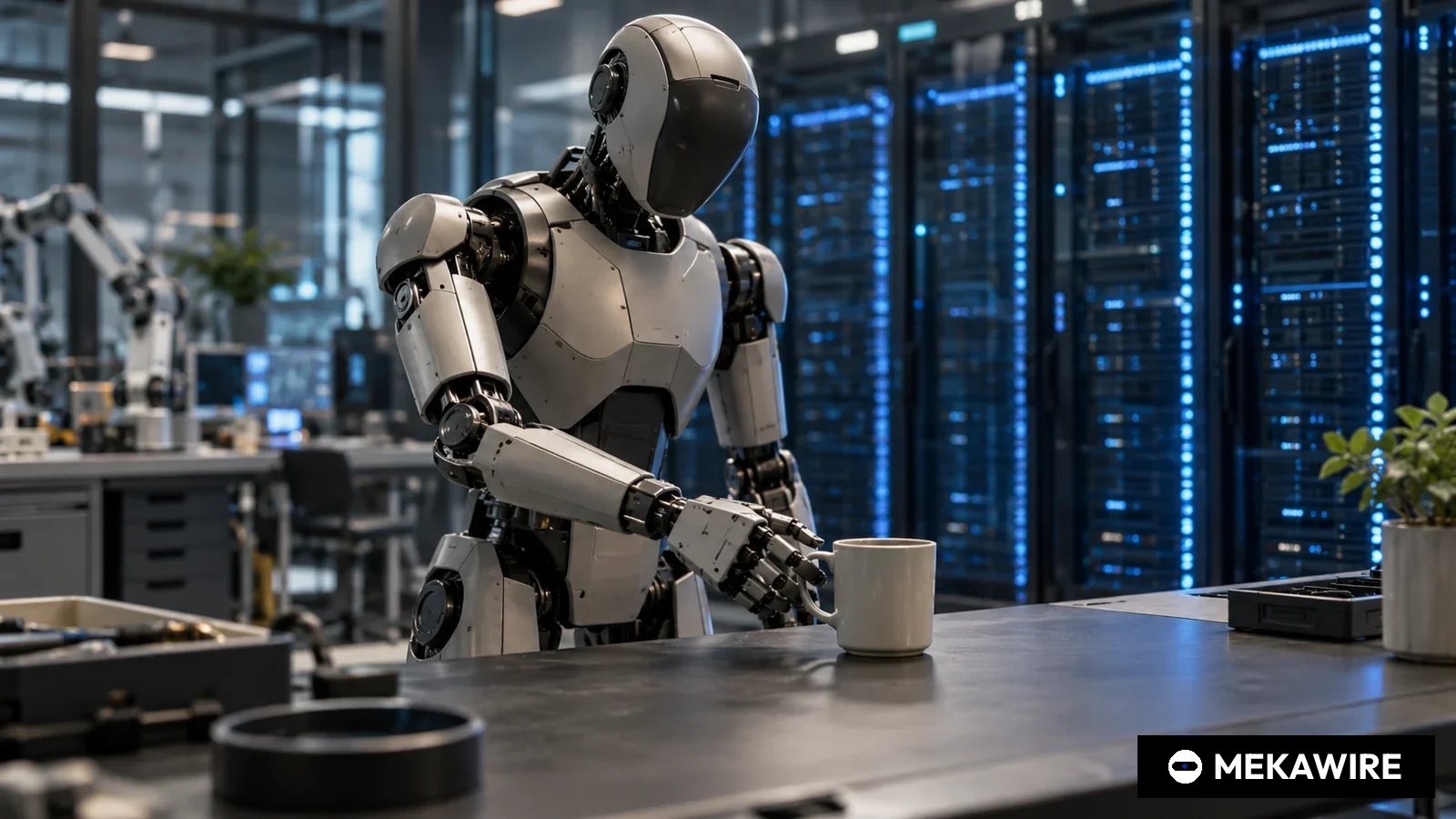
NVIDIA introduced Isaac GR00T N1.5 and the Isaac GR00T-Dreams blueprint at Computex 2025 in Taipei, saying its researchers used Cosmos-generated video to build the model's training data in 36 hours instead of nearly three months of human data collection.
The 3-billion-parameter model, opened on June 11, 2025 for non-commercial use, doubled language-following accuracy on Fourier's GR-1 humanoid in NVIDIA's own tests, while AeiROBOT, Foxlink, Foxconn and NEURA Robotics signed on to parts of the stack.
NVIDIA used Computex 2025 in Taipei to argue that the scarcest input in humanoid robotics, demonstration data, can be manufactured on its GPUs. In a release dated May 18, 2025, the company introduced Isaac GR00T N1.5, an update to the GR00T N1 humanoid foundation model it opened at GTC in March 2025, together with Isaac GR00T-Dreams, a blueprint that turns video from its Cosmos world foundation models into robot training data.
The headline number came from NVIDIA Research. The company said its researchers used GR00T-Dreams to generate the synthetic training data for GR00T N1.5 in 36 hours, work it said would have taken nearly three months of manual human data collection. NVIDIA's research page dates the open release of the model to June 11, 2025, on GitHub and Hugging Face. The Hugging Face model card lists 3 billion parameters, against 2 billion for GR00T N1, and states that the model is ready for non-commercial use under an NVIDIA licence.
GR00T-Dreams works in three steps, according to the release. Developers first post-train a Cosmos Predict world model for their own robot. From a single image, the blueprint then generates videos of that robot carrying out new tasks in new environments. Finally it extracts action tokens from those videos, compact chunks of motion data that are used to teach the robot the new task. The method is laid out in a preprint, DreamGen, posted to arXiv on May 19, 2025 by NVIDIA researchers led by Joel Jang, Seonghyeon Ye and Zongyu Lin. The authors report that a humanoid performed 22 new behaviours in seen and unseen environments after starting from teleoperation data for a single pick-and-place task in one environment, and they published a video benchmark called DreamGen Bench along with the code.
The rest of the package filled in the pipeline around the model. Cosmos Reason, a world model that uses chain-of-thought reasoning to curate higher-quality synthetic data, went live on Hugging Face, and Cosmos Predict 2, the model used inside GR00T-Dreams, was listed as coming soon with what NVIDIA called reduced hallucination. NVIDIA said Isaac Sim 5.0 would soon be openly available on GitHub, that Isaac Lab 2.2 would add evaluation environments for testing GR00T N models, and that its open Physical AI dataset now held 24,000 humanoid motion trajectories used to develop the GR00T N models. The GR00T-Mimic blueprint, which augments existing manipulation data using Omniverse and Cosmos, completed the set.
The research page explains what changed inside the model. The vision-language model is now frozen during both pretraining and fine-tuning, and NVIDIA moved to an Eagle 2.5 model tuned for grounding, which scored 40.4 on a GR-1 grounding IoU test against 35.5 for Qwen2.5-VL 3B. A new objective called FLARE, short for future latent representation alignment, lets the model learn from human videos without generating future frames. NVIDIA trained N1.5 for 250,000 steps on 1,000 H100 GPUs with a global batch size of 16,384, on a data mix that included its own GR-1 recordings, Open X-Embodiment, simulated GR-1 data, DreamGen neural trajectories and AgiBot-Beta.
The reported gains are large but self-measured. On a real Fourier GR-1 humanoid asked to pick one of two fruits and place it on a plate, the language-following rate rose from 46.6% for N1 to 93.3% for N1.5, and overall success from 43.3% to 83.0%. On 12 new verbs taught through DreamGen data, success went from 13.1% to 38.3%. After post-training on 1,000 teleoperation episodes on a Unitree G1, N1.5 succeeded 98.8% of the time with four seen fruits and 84.2% with five unseen objects, against 44.0% for N1 on the same task, according to NVIDIA.
- Language following, real Fourier GR-1
- 46.6
- 93.3
- 46.7
- Overall success, real GR-1 fruit task
- 43.3
- 83
- 39.7
- Language Table (simulation)
- 52.8
- 93.2
- 40.4
- Sim GR-1 Language
- 36.4
- 54.4
- 18
- RoboCasa, 30 demonstrations
- 17.4
- 47.5
- 30.1
- 12 new verbs via DreamGen data
- 13.1
- 38.3
- 25.2
Rates as reported by NVIDIA Research on its GR00T N1.5 page. Change = N1.5 minus N1, in percentage points. Figures disclosed, not estimated, and not independently reproduced.
As of Oct 3, 2026
NVIDIA named four early users of the GR00T N models. Korea's AeiROBOT is using them so its ALICE4 robot can follow natural-language instructions in industrial pick-and-place work, Foxlink Group to make industrial manipulators more flexible and efficient, Lightwheel to validate synthetic data for faster humanoid deployment in factories, and Germany's NEURA Robotics is evaluating them for household automation. Agility Robotics, Boston Dynamics, Fourier, Mentee Robotics, NEURA Robotics and XPENG Robotics were described as simulating and training humanoids in Isaac Sim and Isaac Lab, Skild AI as using the frameworks to develop general robot intelligence, and General Robotics as integrating them into its platform. Foxconn and Foxlink are using GR00T-Mimic to speed up their robot training pipelines.
- AeiROBOT
- KR
- 2018
- GR00T N models for ALICE4
- No data
- No data
- No data
- No data
- Agility Robotics
- US
- 2015
- Isaac Sim and Isaac Lab
- Series B
- 150,000,000
- No data
- 2022-04-22
- Boston Dynamics
- US
- 1992
- Isaac Sim and Isaac Lab
- No data
- No data
- No data
- No data
- Fourier
- CN
- 2015
- Isaac Sim and Isaac Lab; GR-1 used in NVIDIA tests
- No data
- No data
- No data
- No data
- Mentee Robotics
- IL
- No data
- Isaac Sim and Isaac Lab
- No data
- No data
- No data
- No data
- NEURA Robotics
- DE
- 2019
- Evaluating GR00T N models; Isaac Sim and Isaac Lab
- Series C
- No data
- No data
- 2026-06-10
- Skild AI
- US
- 2023
- Isaac frameworks for general robot intelligence
- Series C
- 1,400,000,000
- 14,000,000,000
- 2026-01-14
- XPENG (XPENG Robotics)
- CN
- No data
- Isaac Sim and Isaac Lab
- Listed
- No data
- No data
- No data
Roles from NVIDIA's May 18, 2025 release. Funding is the latest round in the MEKAWIRE verified company database; figures disclosed, not estimated; — means not disclosed or not on record. Boston Dynamics and Mentee Robotics are subsidiaries, XPENG is listed.
As of Oct 3, 2026
The Taiwan angle ran through the keynote. NVIDIA's keynote summary said TSMC, Foxconn, Wistron, Pegatron, Delta Electronics, Quanta and GIGABYTE are using NVIDIA Omniverse to build digital twins, and that NVIDIA and Foxconn Hon Hai Technology Group plan to work with Taiwan's government on an AI factory supercomputer built on Blackwell infrastructure. On hardware, Cisco, Dell Technologies, Hewlett Packard Enterprise, Lenovo and Supermicro announced RTX PRO 6000 Blackwell servers, and NVIDIA pointed developers to GB200 NVL72 systems on DGX Cloud for up to 18 times greater data processing performance. Jetson Thor, the on-robot computer, was still listed as coming soon at the time; it reached developers in August 2025.
The release positions NVIDIA as a supplier to companies that are also building their own robot brains. Figure unveiled its in-house Helix vision-language-action model in February 2025, and Skild AI, named in the release as an Isaac user, describes its own goal as general robot intelligence. Because the GR00T weights are open but restricted to non-commercial use, N1.5 works for most humanoid makers as a research baseline and reference design rather than a model they can ship in a product without separate terms.
In plain terms, GR00T N1.5 is a vision-language-action model. A frozen vision-language model reads camera images and a spoken or written instruction, and a diffusion-style action module turns that understanding into joint commands. GR00T-Dreams works on the training data instead. Rather than recording people steering a robot through each new task, a world model imagines the robot doing it on video, and a separate model infers the motor actions that would have produced that video.
Several questions remain open. All benchmark figures come from NVIDIA's own tests on a small set of tasks and robots, chiefly Fourier's GR-1 and Unitree's G1. The 36-hour figure measures data generation for one model update, not the time needed to put a robot to work in a factory. Generated video can contain physically impossible motion, which is why NVIDIA paired Cosmos Predict 2 with a separate reasoning model to filter data. And a non-commercial licence leaves partners to experiment, or to negotiate other terms, before anything reaches a customer.
MEKAWIRE analysis
GR00T-Dreams mattered more than GR00T N1.5 itself, because it tried to move the binding constraint in humanoid learning from teleoperation hours to GPU hours, which is the input NVIDIA sells.
The evidence sits in NVIDIA's own disclosures. The company put the data work for N1.5 at 36 hours against nearly three months of human collection, the DreamGen preprint reports 22 new behaviours starting from one pick-and-place dataset, and DreamGen trajectories were written into the N1.5 training mix. Every step of that loop, from post-training Cosmos Predict to filtering with Cosmos Reason to training on H100 or GB200 clusters, runs on NVIDIA hardware.
The strongest counter-argument is that synthetic video has not yet proved it can replace real robot data at the reliability a factory needs. Success on the 12 DreamGen verbs reached 38.3%, which is a large relative gain but still fails most of the time, and the near-perfect Unitree G1 result relied on 1,000 real teleoperation episodes.
Bull case. If world-model data keeps closing the gap, every humanoid maker becomes a buyer of simulation and training compute regardless of whose model it runs, and NVIDIA earns from Figure and Skild AI as readily as from GR00T users. Taiwan's contract manufacturers, already building Omniverse twins, give NVIDIA a ready route from synthetic training to production lines.
Bear case. If generated trajectories plateau at lab-grade success rates, real teleoperation and fleet data remain the moat, and that data belongs to the robot makers. A non-commercial licence then leaves GR00T as an academic baseline while commercial humanoid brains are trained in-house.
Signals to watch
- Each new GR00T model card on Hugging Face: whether the licence moves from non-commercial to commercial use.
- Computex 2027 in Taipei: whether Foxconn or Foxlink describe GR00T-Mimic or GR00T-Dreams data running on production lines rather than in training pipelines.
- Revisions to the DreamGen preprint (first revised June 17, 2025): whether success on unseen tasks generated purely from video moves above the 38.3% NVIDIA reported for N1.5.
- Isaac GR00T N1.5, 3 billion parameters (GR00T N1: 2 billion)
- May 18, 2025, at Computex in Taipei
- 24,000 humanoid motion trajectories
- June 11, 2025, GitHub and Hugging Face, non-commercial use
- 250,000 steps on 1,000 H100 GPUs
- arXiv 2505.12705, May 19, 2025, 22 new behaviours
- Foxconn, Foxlink
- 36 hours vs nearly three months of manual collection (NVIDIA)
- AeiROBOT, Foxlink, Lightwheel, NEURA Robotics
- 46.6% (N1) to 93.3% (N1.5)
Why it matters
The Computex package was the first time NVIDIA put a number on the cost of robot data in its own pipeline. Saying that 36 hours of world-model generation replaced nearly three months of human collection reframes the humanoid data problem as a compute problem, and compute is what NVIDIA sells. The GR00T N1.5 model is the proof point; the GR00T-Dreams blueprint is the product strategy.
It also showed how NVIDIA intends to keep humanoid makers inside its stack even when they build their own models. Isaac Sim, Isaac Lab, Cosmos and GR00T-Mimic are useful to a company that never ships GR00T, and the release lists exactly that kind of user, from Boston Dynamics to Skild AI. The open model is the visible piece; the tools around it are where adoption accumulates.
Rival analysis
The most direct comparison is with companies that train their own humanoid brains. Figure introduced Helix in February 2025 and keeps it in-house, and Skild AI, though listed by NVIDIA as an Isaac user, is building a general robot model of its own and later raised a Series C of US$1.4 billion at a US$14 billion post-money value, according to the MEKAWIRE company database. For both, NVIDIA is a supplier of simulation and compute, not a model vendor.
Among partners using GR00T N models directly, the profile is different. AeiROBOT, Foxlink, Lightwheel and NEURA Robotics are either smaller humanoid developers or industrial players that benefit from a strong pretrained baseline. That split suggests GR00T's commercial impact depends less on beating Helix in benchmarks and more on lowering the entry cost for second-tier and industrial robot makers, provided licensing allows them to deploy.
Valuation context
NVIDIA does not disclose robotics revenue separately in the release, and no price was attached to GR00T N1.5, which is free for non-commercial use. The economic logic runs through hardware: the release pairs the software with RTX PRO 6000 Blackwell servers from Cisco, Dell Technologies, Hewlett Packard Enterprise, Lenovo and Supermicro, and with GB200 NVL72 capacity on DGX Cloud.
For the humanoid partners, disclosed valuations show where capital was flowing. Skild AI's Series C in January 2026 carried a US$14 billion post-money value, and NEURA Robotics closed a Series C in June 2026, according to the MEKAWIRE database. Companies of that scale can afford their own data operations, which is why NVIDIA's pitch emphasises tools rather than the model alone.
Supply-chain implications
Taiwan sits at both ends of the pipeline NVIDIA described. NVIDIA's keynote summary said TSMC, Foxconn, Wistron, Pegatron, Delta Electronics, Quanta and GIGABYTE use Omniverse for digital twins, and Foxconn and Foxlink are using GR00T-Mimic for robot training. The same manufacturers assemble the servers that run the training.
On the robot side, NVIDIA's tests ran on Fourier's GR-1 and Unitree's G1, both Chinese humanoids, and the training mix included the AgiBot-Beta dataset. That makes Chinese hardware and data a practical part of NVIDIA's humanoid research even as the commercial partner list leans toward US, German, Korean and Taiwanese firms.
Signals to watch
The licence is the first signal. The GR00T N1 and N1.5 model cards both restrict use to non-commercial purposes, so any move to commercial terms in a later GR00T release would change the model from research baseline to deployable component.
The second is evidence of GR00T-Dreams or GR00T-Mimic data in production work, especially at Foxconn and Foxlink, rather than in training pipelines. The third is independent replication of the DreamGen results, since every figure in this package so far comes from NVIDIA's own evaluations.
Analyst view
Thesis: GR00T-Dreams is a credible step toward making robot data a compute product, but in May 2025 it had shown lab-scale rather than factory-scale results. Confidence: medium.
Reasons for confidence: NVIDIA published the method as a preprint with code, documented training compute and data sources for N1.5, and reported consistent gains across simulated and real benchmarks. Reasons for caution: the gains are self-reported, the 12-verb DreamGen task still failed more often than it succeeded at 38.3%, and the strongest real-world result depended on 1,000 human teleoperation episodes. The licence also limits how quickly partners can turn N1.5 into products.
Questions you should be asking
How much of the 36-hour figure is generation versus the post-training of Cosmos Predict for a new robot, and would a partner with a different humanoid see the same speed?
Will NVIDIA offer commercial licensing for GR00T N models, and on what terms?
How do success rates from DreamGen data compare with an equal GPU budget spent on conventional simulation in Isaac Lab?
Which of the named partners, if any, will disclose a deployed task trained mainly on world-model data?