NVIDIA opens Isaac GR00T N1, a 2.2-billion-parameter humanoid robot model, at GTC 2025 and teams with Google DeepMind and Disney Research on the Newton physics engine
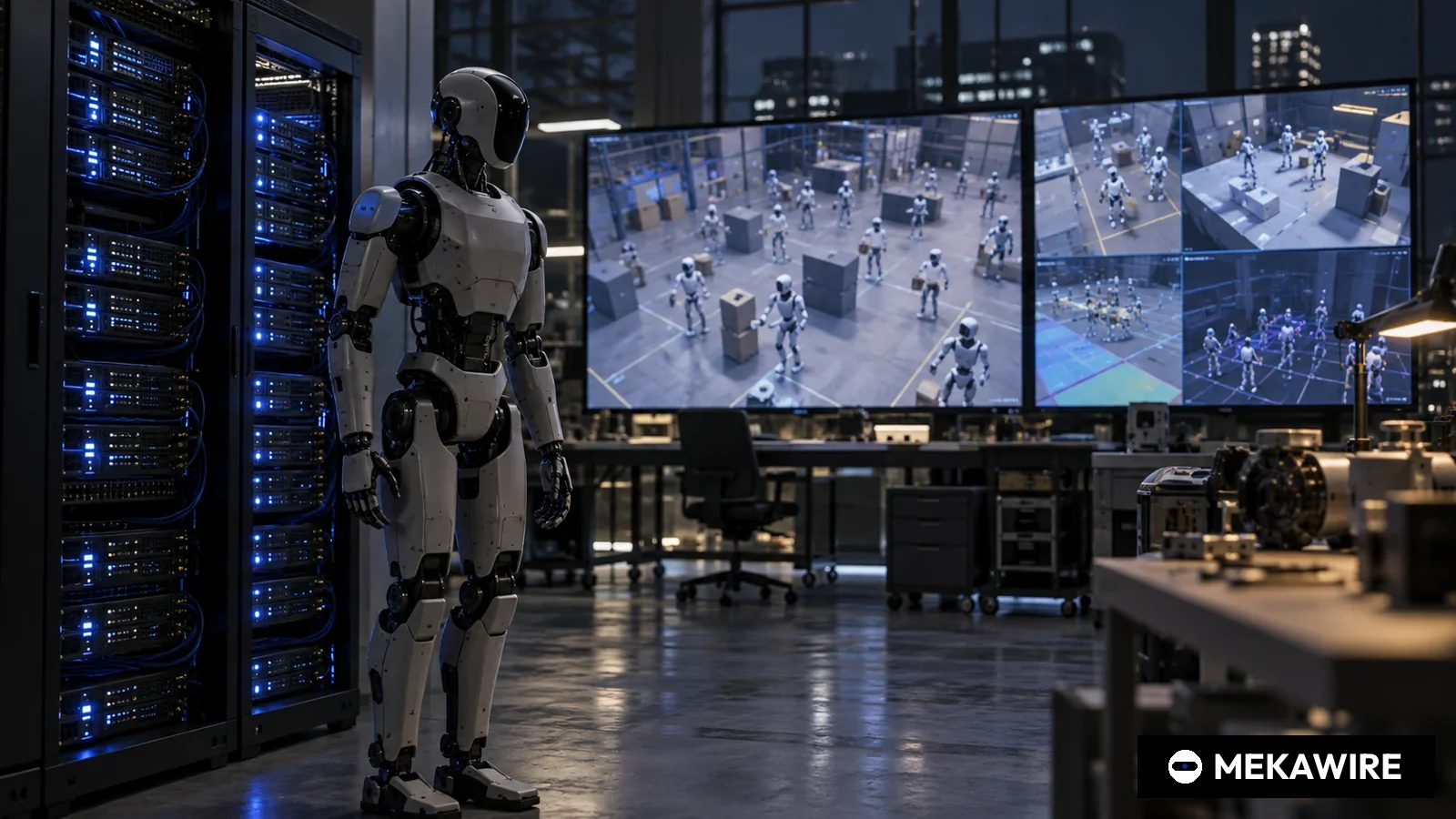
NVIDIA on 18 March 2025 released Isaac GR00T N1, a dual-system vision-language-action model for humanoid robots, as downloadable weights on Hugging Face and GitHub, with 1X, Agility Robotics, Boston Dynamics, Mentee Robotics and NEURA Robotics named as early-access partners.
It also announced Newton, an open-source physics engine under development with Google DeepMind and Disney Research, a synthetic manipulation-data blueprint and a 15-terabyte open physical AI dataset.
NVIDIA released Isaac GR00T N1 on 18 March 2025, an open foundation model for humanoid robots that developers can download from Hugging Face and GitHub and post-train for their own machines. Chief executive Jensen Huang unveiled it in his GTC keynote at the SAP Center in San Jose, which began at 10:00 a.m. Pacific time, and NVIDIA called it the world's first open, fully customizable foundation model for generalized humanoid reasoning and skills. In the same release the company announced Newton, an open-source physics engine it is developing with Google DeepMind and Disney Research, a blueprint for generating synthetic manipulation data and an open physical AI dataset.
The model is small by language-model standards. NVIDIA's technical report, a preprint posted to arXiv as paper 2503.14734 on 18 March and revised on 27 March, puts it at 2.2 billion parameters, of which 1.34 billion sit in the vision-language component. The Hugging Face listing, dated 17 March 2025, carries the checkpoint as GR00T-N1-2B. Pretraining used about 50,000 H100 GPU hours on up to 1,024 GPUs, according to the preprint. On an NVIDIA L40 GPU the reasoning module runs at 10 Hz, and the action module samples a chunk of 16 actions in 63.9 milliseconds, for motor commands at 120 Hz.
NVIDIA describes the design in terms borrowed from human cognition. System 2, a vision-language model built on NVIDIA's Eagle-2 with a SmolLM2 language model and a SigLIP-2 image encoder, reads camera images and a spoken or typed instruction and plans what to do. System 1, a diffusion transformer trained with flow matching, turns that plan into continuous joint commands. The two are trained together end to end. NVIDIA said the model generalises across common tasks such as grasping, moving objects with one or both arms and handing items from one arm to the other, and can handle multistep tasks that need long context. Its developer blog said post-training needs a single RTX A6000 or GeForce RTX 4090, and that the result can run on an RTX A6000 or a Jetson AGX Orin module.
The early-access list named 1X Technologies, Agility Robotics, Boston Dynamics, Mentee Robotics and NEURA Robotics. On stage, Huang showed a 1X humanoid tidying a home autonomously with a policy post-trained on GR00T N1, which NVIDIA said came out of joint work between the two companies. Bernt Børnich, 1X's chief executive, said in the release that 1X develops its own models but that GR00T N1 gave a significant boost to robot reasoning and skills with little post-training data.
The training recipe is what NVIDIA calls a data pyramid. At the base sit human videos from public collections such as Ego4D and EPIC-KITCHENS. In the middle are synthetic data, including 827 hours of generated video trajectories and 780,000 simulated trajectories produced with DexMimicGen. At the top are real robot recordings, including 88 hours of NVIDIA's own teleoperation on Fourier's GR-1 humanoid, Open X-Embodiment datasets and 140,000 trajectories from AgiBot's AgiBot-Alpha set. In the preprint's tests GR00T N1 beat Diffusion Policy, a widely used imitation-learning baseline, on three simulation benchmarks, and on a real GR-1 it reached a 76.8% average success rate against 46.4%. With only a tenth of the data, the gap widened to 42.6% against 10.2%.
- RoboCasa, simulation
- 32.1
- 25.6
- 6.5
- DexMimicGen, simulation
- 66.5
- 56.1
- 10.4
- GR-1 humanoid, simulation
- 50
- 32.7
- 17.3
- Fourier GR-1, real robot, full data
- 76.8
- 46.4
- 30.4
- Fourier GR-1, real robot, 10% of data
- 42.6
- 10.2
- 32.4
Average success rates reported by NVIDIA in arXiv preprint 2503.14734 (v2); simulation results use 100 demonstrations per task; gap = GR00T N1 minus Diffusion Policy; not independently replicated; figures disclosed, not estimated.
As of Oct 2, 2026
The synthetic-data pieces were released alongside. The Isaac GR00T Blueprint for synthetic manipulation motion generation uses Omniverse and Cosmos Transfer world models to expand a few human demonstrations into large motion datasets. NVIDIA said it generated 780,000 trajectories, equivalent to 6,500 hours or nine continuous months of human demonstration, in 11 hours, and that mixing that data with real data lifted GR00T N1's performance by 40% over real data alone. The blueprint is offered on build.nvidia.com and GitHub. A separate open dataset on Hugging Face started at 15 terabytes with more than 320,000 robot training trajectories and up to 1,000 OpenUSD assets, and NVIDIA named UC Berkeley's DeepDrive Center, Carnegie Mellon's Safe AI Lab and UC San Diego's Contextual Robotics Institute as early users.
Newton is the longer-term bet. NVIDIA said the engine is built on its Warp framework and tuned for robot learning, and that it expected the engine to be available later in 2025. Separately, Google DeepMind and NVIDIA are developing MuJoCo-Warp, which NVIDIA expects to speed up robotics machine-learning workloads by more than 70 times. Disney Research plans to use Newton for its robotic character platforms, starting with the Star Wars-inspired BDX droids, one of which joined Huang on stage. Kyle Laughlin of Walt Disney Imagineering said the collaboration would let Disney build robotic characters that are more expressive and engaging.
Huang framed the launch as a labour question. He told the keynote audience that the world will be at least 50 million workers short by the end of the decade, and said in the release that the age of generalist robotics is here. The same keynote announced that General Motors is adopting NVIDIA AI, simulation and accelerated computing for vehicles, factories and robotics. GR00T N1 sits on top of a stack NVIDIA has built for years, from Omniverse and Isaac Lab for simulation to Jetson for on-robot compute, and it follows the first Isaac GR00T Blueprint shown at CES on 6 January 2025, which MEKAWIRE covered at the time.
Rivals moved in the same weeks. Figure AI unveiled Helix on 20 February 2025, a two-part model with a 7-billion-parameter vision-language module running at 7 to 9 Hz and an 80-million-parameter control policy at 200 Hz, trained on about 500 hours of teleoperation, with weights kept in-house. Google DeepMind announced Gemini Robotics on 12 March 2025, built on Gemini 2.0 and offered to Apptronik and a group of trusted testers. Physical Intelligence described its 3.3-billion-parameter π0 model, which controls robots at up to 50 Hz after training on about 10,000 hours of robot data, in a preprint first posted on 31 October 2024.
- Isaac GR00T N1
- NVIDIA
- 2025-03-18
- 2.2
- 120
- Yes
- Helix
- Figure AI
- 2025-02-20
- 7.08
- 200
- No
- π0
- Physical Intelligence
- 2024-10-31
- 3.3
- 50
- No data
- Gemini Robotics
- Google DeepMind
- 2025-03-12
- No data
- No data
- No, trusted testers
From each developer's own page or preprint. Helix parameters = 7 billion (System 2) + 80 million (System 1). π0 = 3 billion PaliGemma + 300 million action expert, up to 50 Hz. GR00T N1 rate is action output at 120 Hz. — = unknown or not disclosed.
As of Oct 2, 2026
The open questions are real. The benchmark wins in the preprint are against Diffusion Policy and a BC-Transformer, not against π0, Helix or Gemini Robotics, and the paper has not been peer reviewed. The Hugging Face card states the model is not tested or intended for mission-critical uses that require functional safety. The weights come under NVIDIA's own licence rather than a standard open-source one, and Newton existed only as a plan with a 2025 target. NVIDIA later said, on 18 May 2025 at Computex, that it had built an update, GR00T N1.5, in 36 hours using synthetic data, against nearly three months of manual collection.
MEKAWIRE analysis
GR00T N1 is NVIDIA's attempt to become the default starting point for humanoid robot brains, so that every company that fine-tunes it also trains, simulates and deploys on NVIDIA hardware.
The evidence is in what shipped together on 18 March 2025. The model, the blueprint, the dataset and the physics engine cover pretraining, data generation, simulation and evaluation, and every performance claim is tied to NVIDIA silicon, from 50,000 H100 hours of pretraining to 63.9 milliseconds on an L40 and deployment on Jetson AGX Orin. Making the model small enough to post-train on one RTX 4090 lowers the entry price for start-ups and labs, which are the customers most likely to buy NVIDIA compute rather than build their own stacks.
The strongest counter-argument is that the companies with the most money and data do not need it. Figure kept Helix proprietary, Google DeepMind gave Gemini Robotics only to selected partners, and 1X's own chief executive said in NVIDIA's release that his company builds its own models. A generalist model trained largely on one humanoid, Fourier's GR-1, may also need far more post-training than the preprint suggests before it handles a new body.
Bull case. GR00T N1 and its successors become the Llama of humanoid robots, a free base that most second-tier robot makers post-train, while Newton becomes the shared simulator. NVIDIA then earns on training clusters, simulation and the chip inside each robot.
Bear case. Leaders keep closed models that outperform it, open rivals such as π0 offer a standard open-source licence, and GR00T N1 settles as a research baseline. NVIDIA still sells GPUs, but the model itself sets no standard.
- May 2025, Computex Taipei: whether NVIDIA ships an updated GR00T model and names more humanoid makers using it in production pilots.
- Second half of 2025: whether Newton and MuJoCo-Warp are released as promised and confirm the 70-fold speed-up claim.
- Through 2025: whether 1X, Agility, Boston Dynamics, Mentee or NEURA publish results from robots running GR00T-based policies outside demos.
- Isaac GR00T N1 (GR00T-N1-2B), open weights on Hugging Face and GitHub
- Open-source physics engine with Google DeepMind and Disney Research, expected later in 2025
- 18 March 2025, GTC keynote, San Jose
- System 2 vision-language model plus System 1 diffusion transformer, trained end to end
- 15 TB, more than 320,000 robot trajectories
- About 50,000 H100 GPU hours
- 16 actions in 63.9 ms; actions at 120 Hz, reasoning at 10 Hz
- 780,000 trajectories (6,500 hours equivalent) in 11 hours; 40% gain over real data alone
- 1X, Agility Robotics, Boston Dynamics, Mentee Robotics, NEURA Robotics
- 2.2 billion, of which 1.34 billion in the vision-language module
Why it matters
GR00T N1 moved NVIDIA from selling tools around robot learning to shipping the robot brain itself. Until March 2025 its humanoid offer was simulation in Isaac Sim and Isaac Lab, data workflows in the January GR00T Blueprint and Jetson chips on the robot. With N1, a small robot maker can download a pretrained policy, post-train it on one workstation GPU and deploy it on Jetson, without building a model team.
The release also set a reference point for openness in humanoid AI. In the four weeks before GTC, Figure kept Helix closed and Google DeepMind limited Gemini Robotics to partners. NVIDIA chose to publish weights, a training recipe in a preprint and data, which gives universities and start-ups a common baseline and gives NVIDIA a say in how humanoid models are built and benchmarked.
Rival analysis
Figure's Helix, disclosed on 20 February 2025, uses the same two-speed idea with a 7-billion-parameter planner and an 80-million-parameter controller at 200 Hz, and it runs entirely on Figure's own robots. Google DeepMind's Gemini Robotics, announced on 12 March 2025, inherits the scale of Gemini 2.0 and has Apptronik as a hardware partner, with Agility Robotics and Boston Dynamics among trusted testers. That overlap matters, because Agility and Boston Dynamics also sit on NVIDIA's early-access list, so humanoid makers were testing more than one brain at once.
Physical Intelligence's π0 is the closest open rival in spirit, with 3.3 billion parameters and about 10,000 hours of robot data across seven robot configurations. NVIDIA's edge is distribution through its developer base and hardware, while its weakness is that the preprint did not benchmark N1 against any of these models.
Valuation context
NVIDIA did not attach revenue to GR00T N1 and gives the weights away, so the value accrues through GPU sales for pretraining, simulation and post-training and through Jetson modules in robots. Huang's framing of a shortfall of at least 50 million workers by the end of the decade is the addressable-market argument behind that spending.
The early-access partners were mostly venture-backed. According to MEKAWIRE verified company data, 1X's last disclosed round before GTC was a $100 million Series B in January 2024, Agility's a $150 million Series B in April 2022 and NEURA's a Series B in January 2025, while Boston Dynamics is a subsidiary. A free, capable base model reduces the capital such firms must spend on AI teams, which shifts competition toward hardware cost and deployment.
Supply-chain implications
The compute chain runs through NVIDIA end to end in the published numbers: H100 clusters for pretraining, L40 for benchmark inference, RTX A6000 or GeForce RTX 4090 for post-training and Jetson AGX Orin on the robot. The release also pointed developers to DGX Spark as a desktop system to extend GR00T N1.
On the data side, the recipe depends on Fourier's GR-1 humanoid for in-house teleoperation, AgiBot's open dataset for 140,000 trajectories, public human-video sets and simulation in Omniverse with Cosmos Transfer. That means Chinese hardware and data sit inside an American open model, a dependency worth watching as trade policy tightens.
Signals to watch
The first test comes at Computex in Taipei in May 2025, where NVIDIA could show an updated model and new partners. The second is the promised release of Newton and MuJoCo-Warp later in 2025, and whether outside users confirm the claimed speed-up of more than 70 times.
Also watch for results from the five early-access partners running GR00T-based policies in pilots, and for independent benchmarks that compare N1 with π0 and other open models on the same robots.
Analyst view
Thesis: GR00T N1 is strategically strong for NVIDIA and useful to smaller robot makers, but it is unlikely to become the brain of the best-funded humanoids. Confidence: medium.
Reasons. The model, data and simulation pieces are verified on NVIDIA's primary pages and form a coherent platform, and the efficiency results on a real GR-1 with 10% of the data are notable. Against that, the preprint compares N1 only with older baselines, the licence is NVIDIA's own, Newton is not yet available, and leading developers including 1X said they build their own models.
Questions you should be asking
How well does GR00T N1 transfer to humanoids other than Fourier's GR-1 and 1X's robot, and how many hours of post-training data does a new embodiment need? NVIDIA did not publish results for the other early-access partners.
What are the precise commercial terms of the NVIDIA licence for derivative models, and will NVIDIA keep them stable as GR00T versions follow? How much of the 40% gain from synthetic data holds outside the tasks NVIDIA chose?