Physical Intelligence's π0.5 cleans kitchens and bedrooms in homes it never saw in training, with 97.6% of its data from other sources
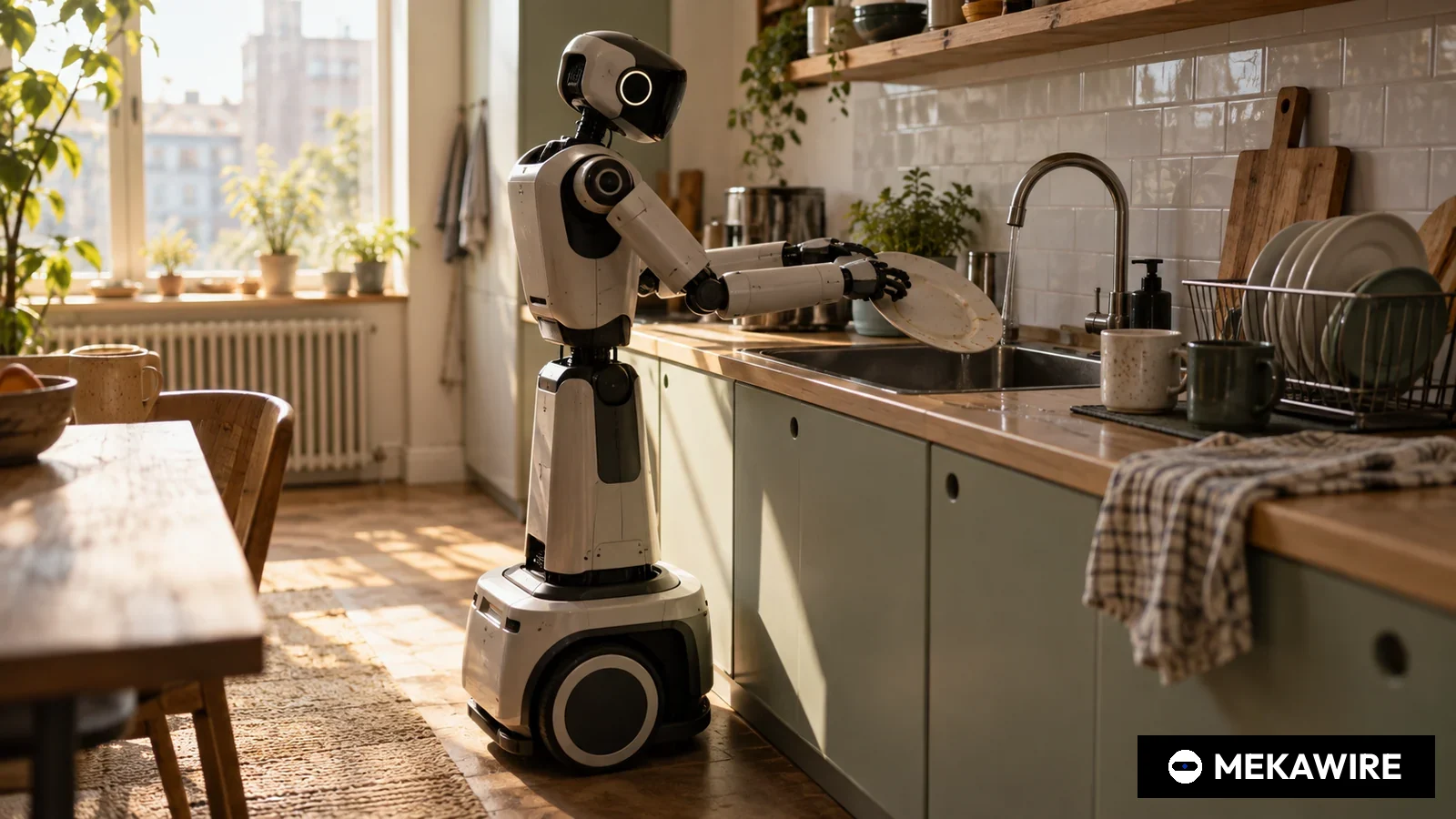
Physical Intelligence on 22 April 2025 published π0.5, a vision-language-action model that drove mobile manipulators through 10- to 15-minute cleaning jobs in three homes absent from its training set.
The San Francisco start-up says co-training on data from other robots, web tasks and spoken coaching, rather than more home-robot data alone, is what lets the model generalise, and its own ablations show which ingredients matter most.
Physical Intelligence, the San Francisco robot-software start-up, on 22 April 2025 published π0.5, a vision-language-action (VLA) model that it says can clean kitchens and bedrooms in homes it has never seen. In a blog post and an accompanying preprint on arXiv, the company showed two-armed mobile robots putting dishes in a sink, making beds, wiping spills and clearing bedroom floors in three real homes that were excluded from training.
The figures in the paper are specific. The mobile robots learned from about 400 hours of household data collected in about 100 homes, yet the paper states that 97.6% of training examples in the first training phase did not come from mobile manipulators doing household work. The rest of the mix came from static robot arms in homes, laboratory robots including the public Open X-Embodiment collection, web data for captioning, question answering and object localisation, hand-labelled subtasks, and a small set of spoken coaching sessions. Single tasks took about 2 to 5 minutes, and full room clean-ups ran 10 to 15 minutes, according to the authors.
The architecture builds directly on π0, the company's first generalist policy published on 31 October 2024. π0.5 starts from a 2-billion-parameter vision-language model initialised from Google's PaliGemma weights and adds a 300-million-parameter "action expert". At each step the model first writes out, in text, the next subtask it should perform, such as picking up a pillow, and then generates motor commands for it. Those commands come out as 50-step action chunks covering one second of motion, produced by flow matching with 10 denoising steps. Training ran in two stages, 280,000 gradient steps on discrete tokens followed by 80,000 steps that add the continuous flow-matching head, the paper says.
The robots themselves are modest. The paper describes two mobile platforms, each with two 6-degree-of-freedom arms fitted with parallel-jaw grippers, a wheeled holonomic base, a torso lift and four cameras, two of them on the wrists. The state and action space has 18 or 19 dimensions depending on the platform. The company said its goal was not new skills or high dexterity but generalisation to new settings.
The most useful result for anyone building such systems is the company's ablation study. In a language-following test in held-out homes, the full π0.5 followed instructions 86% of the time and succeeded 83% of the time on familiar object types, and 94% on both measures for novel object types, according to the blog post. Removing web data barely moved the familiar-object score but cut success on novel objects to 74%. Removing laboratory cross-embodiment data cut novel-object success to 49%, and removing data from static robots in many homes cut it to 31%.
- π0.5 (full mix)
- 86
- 83
- 94
- 94
- no WD (web data removed)
- 86
- 82
- 80
- 74
- no CE (cross-embodiment lab data removed)
- 74
- 67
- 67
- 49
- no ME (multi-environment static-robot data removed)
- 66
- 57
- 33
- 31
Figures as published by Physical Intelligence in its 22 April 2025 π0.5 blog post; paper arXiv 2504.16054. Company-run evaluation, not independently verified.
As of Oct 3, 2026
Scale of environments mattered too. The authors trained versions on mobile-robot data from 3, 12, 22, 53, 82 and 104 locations and found performance generally rose with more locations. The 104-location model performed about as well as a control model trained directly on data from the test homes, a result the blog post summarised as approaching that baseline after only about 100 training environments. The paper also reports that π0.5 significantly outperformed π0 and an enhanced π0 variant, even when π0 was trained for up to 300,000 steps, and that the full model beat a version in which a human supplied the high-level subtasks, while a zero-shot GPT-4 planner did worst.
Physical Intelligence is not alone. Figure AI published its Helix VLA on 20 February 2025, pairing a 7-billion-parameter model at 7 to 9 Hz with an 80-million-parameter controller at 200 Hz trained on about 500 hours of teleoperation. Google DeepMind followed on 12 March 2025 with Gemini Robotics, built on Gemini 2.0, and NVIDIA released its open GR00T N1 humanoid model on 18 March 2025. Where those efforts lean on a single body or a single owner's hardware, π0.5 is a test of whether data from many robots can be pooled into one model that works in someone else's house.
- Physical Intelligence
- Series B (CapitalG lead)
- No data
- No data
- 2025-11-20
- Skild AI
- Series C
- 1400
- 14
- 2026-01-14
- Figure AI
- Series C
- 1000
- 39
- 2025-09-16
- FieldAI
- Two consecutive rounds (combined)
- 405
- No data
- 2025-08-20
- Generalist AI
- Growth (unnamed)
- 400
- No data
- 2026-06-04
- Dyna Robotics
- Series A
- 120
- No data
- 2025-09-15
- Genesis AI
- Launch round (unnamed)
- 105
- No data
- 2025-06-30
Rounds as disclosed by the companies or lead investors. Physical Intelligence's Series B was announced by lead investor CapitalG, whose page gives no amount or valuation. — = not disclosed. Figures disclosed, not estimated.
As of Oct 3, 2026
The company was candid about the limits. Its paper lists unfamiliar drawer handles, cabinets that are physically hard to open, an arm hiding the spill it was meant to wipe, and a high-level planner that sometimes opened and closed the same drawer repeatedly. The evaluation used three homes and averaged scores over 10 trials per task, which is a small sample, and all results are the company's own. Physical Intelligence later released π0.5 checkpoints in its Apache-2.0 openpi repository in September 2025, including a base model and versions fine-tuned on the LIBERO benchmark and the DROID dataset, which lets outside labs check the claims.
MEKAWIRE analysis
π0.5 shifted the robot-model race from collecting more data on the target robot to mixing many cheaper data sources well, and that is a bet on breadth that rivals with their own robots have to answer.
The evidence sits in the company's own numbers. With 97.6% of first-phase examples coming from somewhere other than home mobile robots, and with removing static-robot or lab data cutting novel-object success from 94% to 31% and 49%, the paper argues that diversity of sources outweighs volume on the target platform. The 104-location result matching a model trained on the test homes is the strongest single data point for that view.
The strongest counter-argument is sample size. Three homes, 10 trials per task and two in-house robot designs cannot establish that the model works in an arbitrary home, and the tasks were chosen by the developer. Success rates averaged over subtasks can also hide whole-task failures that a paying customer would notice.
Bull case. If co-training holds up, every new robot deployment adds data that improves all the others, giving the first company with a large multi-robot fleet a compounding advantage. The openpi release then turns outside labs into contributors to Physical Intelligence's ecosystem.
Bear case. Household cleaning remains slow, with room clean-ups taking 10 to 15 minutes, and failures on handles and occlusion are exactly the long tail that sinks consumer products. Rivals with their own hardware and capital, such as Figure, can gather target-robot data at scale and may not need the pooled approach.
Signals to watch:
- Independent replications of π0.5 results on the openpi checkpoints released in September 2025, especially outside the LIBERO and DROID settings.
- Whether later Physical Intelligence models report evaluations in more than three homes and with whole-task, not subtask-averaged, success rates.
- The first paid deployments of Physical Intelligence models on third-party hardware, which would test the cross-embodiment thesis commercially.
- π0.5, vision-language-action model built on π0
- 2B-parameter VLM initialised from PaliGemma, plus 300M-parameter action expert
- 22 April 2025 (blog post and arXiv preprint 2504.16054)
- 3 unseen homes, 10 trials per task, room clean-ups of 10 to 15 minutes
- pi05_base, pi05_libero, pi05_droid in openpi (Apache-2.0), September 2025
- 50-step chunks covering 1 second, flow matching with 10 denoising steps
- about 400 hours from about 100 homes
- 97.6% of first-phase training examples not from home mobile manipulators
- 94% full model; 74% without web data; 31% without multi-environment data
Why it matters
π0.5 is the clearest public evidence so far that a robot policy can be made to work in an unfamiliar home without collecting data in that home. For a company selling a software brain rather than a robot, that is the commercial premise, and the paper gives it numbers rather than demos.
It also moved the debate about robot data. The finding that 97.6% of first-phase examples came from outside the target task, and that static-robot and lab data mattered more than web data for in-home success, tells buyers and investors that the value of a dataset depends on its diversity across bodies and places, not only its hours.
Rival analysis
Figure's Helix, published on 20 February 2025, takes the opposite route: about 500 hours of teleoperation on Figure's own humanoid and a two-speed architecture with a 7-billion-parameter planner and an 80-million-parameter controller at 200 Hz. Figure controls hardware, data collection and deployment, which suits a vertically integrated factory customer.
Google DeepMind's Gemini Robotics (12 March 2025) and NVIDIA's GR00T N1 (18 March 2025) bring large model families and, in NVIDIA's case, an open release. Physical Intelligence differentiates on cross-embodiment training and, after September 2025, on open π0.5 weights, which puts it closest to NVIDIA in distribution strategy while competing with DeepMind on research depth.
Valuation context
CapitalG said on 20 November 2025 that it was leading Physical Intelligence's Series B; the CapitalG page does not state the amount or valuation, so MEKAWIRE leaves both blank in its peer table. Disclosed peer rounds show the scale of capital chasing robot foundation models, from Skild AI's $1.4 billion Series C at a $14 billion post-money valuation in January 2026 to Figure's $1 billion Series C at $39 billion in September 2025.
For a software-only company, π0.5 is the asset behind the valuation. Its open release lowers the barrier for users but also exposes the model to direct comparison, so future funding will likely hinge on whether newer models keep a measurable lead over open alternatives.
Supply-chain implications
π0.5 runs on modest hardware: two 6-degree-of-freedom arms with parallel-jaw grippers, a holonomic wheeled base, a torso lift and four cameras. That favours makers of low-cost arms, grippers and mobile bases over high-end humanoid component suppliers, at least for household tasks.
On compute, the openpi repository lists more than 8 GB of GPU memory for inference and more than 70 GB for full fine-tuning on an A100 or H100 class card. Those requirements put inference within reach of consumer GPUs such as the RTX 4090, but training remains a data-centre workload, which concentrates value with GPU suppliers and cloud providers.
Signals to watch
The first signal is outside replication. The openpi release of September 2025 includes a base checkpoint and LIBERO and DROID fine-tunes, so academic results on those benchmarks will show whether π0.5's generalisation transfers beyond the company's own robots.
The second is evaluation scale. A later paper or release reporting results in dozens of homes, with whole-task success rates, would materially strengthen the case. The third is commercial: named customers running Physical Intelligence models on their own hardware.
Analyst view
Thesis: π0.5 establishes heterogeneous co-training as the practical route to generalisable robot policies, and Physical Intelligence's lead rests on data diversity rather than model size. Confidence: medium.
Reasons for medium rather than high: the ablations are internally consistent and the scaling study is careful, but the evaluation covers three homes and the robots are the company's own. Reasons it is not low: the effect sizes are large, with novel-object success falling from 94% to 31% when multi-environment data is removed, and the open checkpoints allow outsiders to test the claims.
Questions you should be asking
How does π0.5 perform on whole tasks, rather than subtask averages, in homes chosen by a third party?
How much of the 400 hours of home data, and of the static-robot data, would a new customer need to collect on a different robot design to reach the reported performance? And how will Physical Intelligence monetise a model whose weights are openly available?