Standard Bots raises US$200 million at a US$1 billion valuation to build AI-taught factory robots in New York
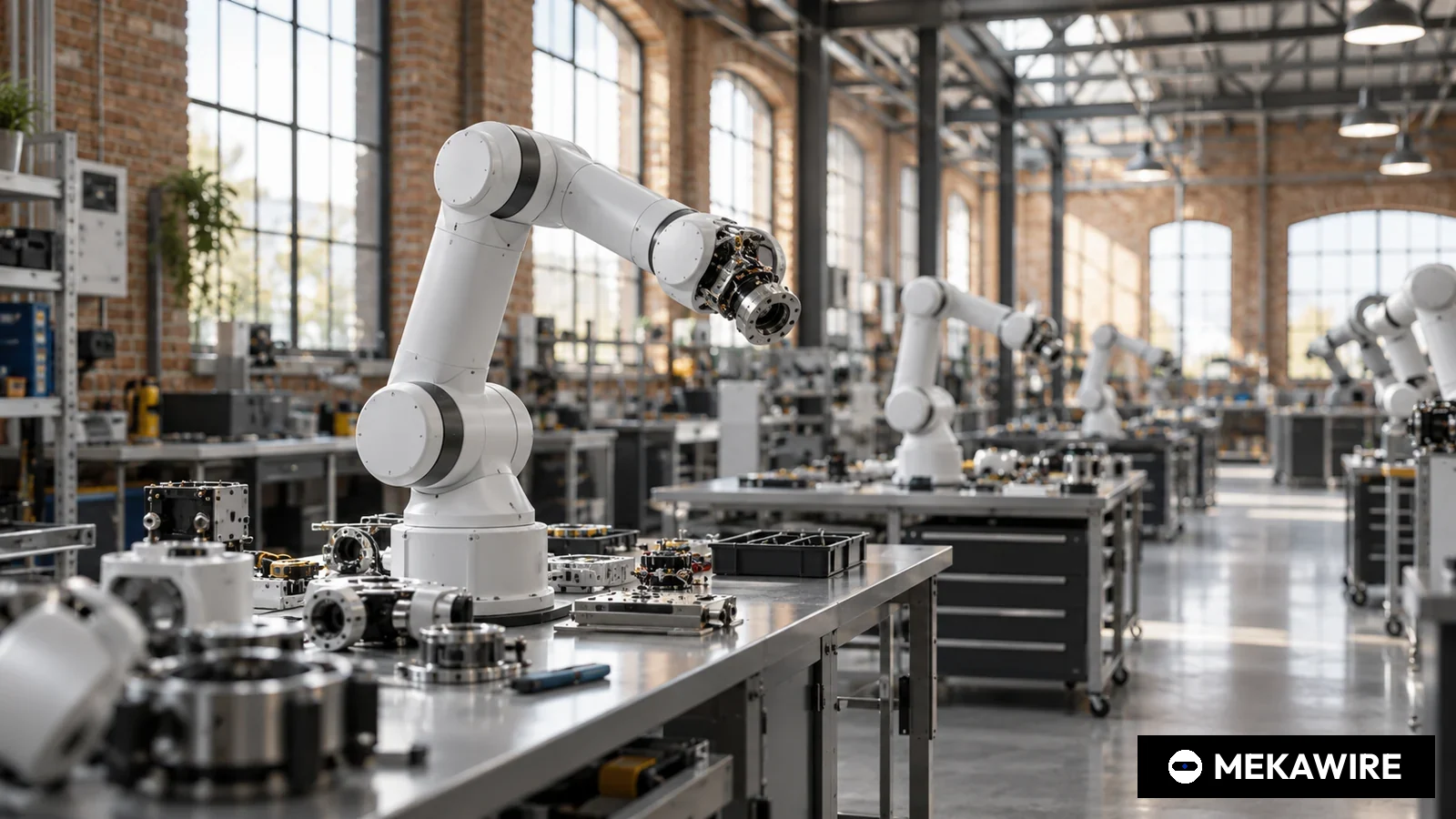
Standard Bots said on 9 June 2026 that it had raised a US$200 million Series C led by RoboStrategy, with existing investors including General Catalyst, at a valuation of US$1 billion. The Glen Cove, New York, robot maker is expanding its plant to 70,000 square feet and says it is on pace to supply 10% of new US industrial robot deployments by 2027.
Standard Bots builds its own actuators, assembles every robot it sells in Glen Cove, New York, and says that by next year one in ten new industrial robots deployed in the United States will be its own. On 9 June 2026 the company put a price on that claim, announcing a US$200 million Series C led by RoboStrategy, with existing investors including General Catalyst, at a valuation of US$1 billion.
The round more than triples the company's previous raise and places a young American arm maker in a valuation bracket that few private industrial robot companies have disclosed. What investors are paying for is a bet that a vertically integrated domestic producer, selling at what it calls a 30% discount to established manufacturers, can take share from incumbents that have dominated factory automation for decades. The terms, the plant and the share claim each need to be read closely.
A round three times the last one, 23 months later
The company said the Series C was led by RoboStrategy and that existing investors, General Catalyst among them, took part. Its release lists General Catalyst, RoboStrategy, Amazon, Samsung Next, Box Group and GiantLeap Capital as backers. It states the US$1 billion valuation without saying whether the figure is pre-money or post-money, and it gives no individual commitments. Needham & Company, Bal Strategic Partners and Optimal PCA acted as strategic advisors; a corrected release issued on 11 June amended only the sentence naming them. The previous round, a US$63 million Series B announced in July 2024, was led by General Catalyst with the Amazon Industrial Innovation Fund and Samsung Next participating, according to the company. That puts disclosed equity across the two rounds at US$263 million.
What the money buys is a factory, not a sales force
Standard Bots said it is expanding its Glen Cove manufacturing site to 70,000 square feet. The company said it designs almost all of its own parts, including its actuators, assembles every finished product in-house, and plans by 2027 to make everything in the United States, from incoming metal to finished robots. It describes its products as AI-native robot arms and industrial humanoids that need no code to program, aimed at machining, welding, palletising, grinding, fastening, dispensing, assembly and inspection. It gave no specifications, prices or delivery dates for the humanoid.
The arm line is better documented. The company's website lists Spark with a 7 kg payload and 900 mm reach from US$29,500, Core with 18 kg and 1,300 mm from US$37,000, and Thor with 30 kg and 2,000 mm from US$49,500, plus a 14 kg, 900 mm model called Bolt offered as a beta. Standard Bots says its robots cost 30% less than those of legacy manufacturers, without naming which rivals or models it compared. It names Amazon, Lockheed Martin, NASA and the US Army as customers alongside hundreds of small and mid-sized manufacturers in nearly every state. It did not disclose revenue, units shipped or headcount.
Founders who chose to own the hardware
The company was co-founded by Evan Beard, its chief executive and chief engineer, with David Golden and James Cordle. In the release Beard described AI-native robots as the essential power tool of this century for American manufacturing. Andrew Kang, chief executive of RoboStrategy, said the company had solved the problem of making powerful robots usable without specialist programming. Max Rimpel, a partner at General Catalyst, said robotics was being democratised on factory floors, and Samir Parikh, managing partner at GiantLeap Capital, called Standard Bots an enabler of US industrial capacity. None of them addressed how the company will defend its price once incumbents respond.
The incumbents are cutting prices and adding AI of their own
The competition Standard Bots names only as legacy manufacturers is moving. Teradyne's robotics segment, which includes Universal Robots, saw revenue fall 16% to US$308 million in 2025 before growing 33% to US$100 million in the second quarter of 2026, and Universal Robots launched its Gen 7 cobot platform in September, according to Teradyne and Universal Robots disclosures covered by MEKAWIRE. FANUC said its CRX cobot drew more than 1,000 physical AI orders after iREX 2025. Doosan Robotics reported a wider 2025 loss of 59.5 billion won as its cobot arm sales halved. Among private challengers, RobCo raised US$100 million in January 2026, Vention US$110 million the same month and Machina Labs US$124 million in February.
Teaching by demonstration moves the cost from engineers to software
Most industrial arms are programmed line by line by integrators, and that engineering can cost more than the robot. Standard Bots says its machines are taught through demonstration instead, so an operator shows the task and the software turns it into a motion program. Owning the actuator matters here because the joint's motor, gearing and sensing set both the unit cost and how precisely the arm can feel and repeat what it was shown.
For US manufacturers the pitch is a domestic supplier at a lower price with a shorter setup. The investor list adds a second-order point. Amazon backs both Standard Bots and Germany's NEURA Robotics, which announced its own Series C a day later, on 10 June, so one of the largest robot buyers in the world now holds stakes in two competing arm makers on two continents.
The 10% claim has no published denominator
The risks start with the headline number. Standard Bots did not define what counts as a US industrial robot deployment or publish its own volumes, so the 10% figure cannot be checked from the outside. Full domestic manufacturing by 2027 means sourcing or making motors, bearings, gearing and electronics in the United States. Chinese cobot makers are competing hard on price, which is one reason Universal Robots has taken Elite Robots and JAKA to court in Europe.
MEKAWIRE analysis
Investors are valuing Standard Bots as a domestic manufacturing champion rather than a cobot vendor, and the US$1 billion price stands or falls on whether its unverified 10% share claim shows up in delivered robots by 2027.
- Standard Bots
- US
- No data
- Series C
- 200
- 1000
- 2026-06-09
- Agile Robots
- DE
- 2018
- Series C
- 220
- No data
- 2021-09-10
- Machina Labs
- US
- 2019
- Series C
- 124
- No data
- 2026-02-04
- Vention
- CA
- 2016
- Venture round (unnamed)
- 110
- No data
- 2026-01-27
- RobCo
- DE
- No data
- Series C
- 100
- No data
- 2026-01-29
- Path Robotics
- US
- 2018
- Series D
- 100
- No data
- 2024-10-14
Latest disclosed round per company or investor releases in the MEKAWIRE database. Standard Bots states a US$1 billion valuation without specifying pre-money or post-money; no peer disclosed a valuation. Figures are disclosed, not estimated.
As of Oct 3, 2026
The evidence is in how the money is to be spent and how fast it arrived. The Series C is 3.2 times the size of the Series B and came 23 months later. Its stated use is a factory and in-house parts, not market entry. If the US$1 billion is a post-money figure, the new money would buy about 20% of the company; the release does not settle that. The round alone equals about 65% of the US$308 million that Teradyne's whole robotics segment booked in 2025.
- Series B
- 2024-07-12
- 63
- General Catalyst
- No data
- Series C
- 2026-06-09
- 200
- RoboStrategy
- 1000
Round size step-up = 200 / 63 = 3.2x. Months between rounds = 23 (12 July 2024 to 9 June 2026). Disclosed total across the two rounds = 263. Implied new-money share if the valuation is post-money = 200 / 1000 = 20%. Figures are disclosed, not estimated.
As of Oct 3, 2026
The strongest counter-argument is that the arm market rewards installed base, distribution and integrator networks, all of which Universal Robots and FANUC already have. A 30% price cut is also a margin decision a larger rival can match, and the company has published no revenue that would show its cost structure can absorb it.
Bull case: domestic content and defence customers such as Lockheed Martin and the US Army give Standard Bots a procurement advantage foreign rivals cannot copy quickly, the Glen Cove expansion lowers unit cost, and the company becomes the default US source for small and mid-sized factories.
Bear case: the 10% target slips, incumbents and Chinese makers match the price, and the humanoid programme absorbs cash before it has a product. The next round would then be priced on revenue rather than ambition.
Signals to watch:
- Teradyne's third-quarter 2026 results in late October, which will show whether Universal Robots is still growing.
- Any disclosure of units shipped, revenue or a completion date for the 70,000 square foot Glen Cove site before the end of 2026.
- Evidence during 2027 that Standard Bots has met its own target to manufacture everything in the United States, and first specifications for its industrial humanoid.
- Series C, US$200 million, announced 9 June 2026
- Evan Beard (CEO and chief engineer), David Golden, James Cordle
- US$1 billion (release does not specify pre-money or post-money)
- 30% below legacy manufacturers (company)
- Series B, US$63 million, July 2024, led by General Catalyst
- On pace for 10% of new US industrial robot deployments by 2027 (company)
- Expand Glen Cove, New York, plant to 70,000 square feet
- RoboStrategy, with existing investors including General Catalyst
- Make everything in the US, from metal to finished robots, by 2027
- Amazon, Samsung Next, Box Group, GiantLeap Capital
Why it matters
This is the first time a US-built industrial arm maker founded in the cobot era has disclosed a US$1 billion valuation, and it did so on a manufacturing thesis rather than a software one. The stated use of funds is a 70,000 square foot plant and in-house components, which means investors are underwriting capital intensity that most robot start-ups try to avoid by outsourcing hardware.
The round also tests whether US industrial policy priorities, domestic content and defence supply chain resilience, translate into a valuation premium for robot hardware. Standard Bots leans hard on that framing with customers such as Lockheed Martin, NASA and the US Army, and the lead investor's comments focus on usability for non-specialists, which is the market Universal Robots built.
Rival analysis
Universal Robots is the reference point. Its parent Teradyne reported robotics revenue of US$308 million for 2025, down 16%, then a 33% rise to US$100 million in the second quarter of 2026, and UR launched its Gen 7 platform in September. UR has the integrator network and installed base Standard Bots lacks, and it is fighting Chinese rivals in European courts, which shows how price pressure is reshaping the segment.
FANUC's CRX cobot and its physical AI tie-ups with Google's Intrinsic and NVIDIA bring a Japanese incumbent into the same no-code pitch. Among venture-backed peers, RobCo (US$100 million, January 2026) sells robots as a service to small factories and is entering the US, Vention (US$110 million, January 2026) sells a design-to-deploy platform, and Machina Labs (US$124 million, February 2026) uses arms for metal forming rather than selling them. Standard Bots is the only one of these betting on owning actuator production at scale in the US.
Valuation context
The release states a US$1 billion valuation without specifying pre-money or post-money. If it is post-money, US$200 million of new money implies roughly a 20% stake for Series C investors. No prior valuation is disclosed, so a step-up cannot be computed; the round size step-up from the US$63 million Series B is 3.2 times.
None of the private peers in our table disclosed a valuation with their latest round, so there is no direct multiple to compare. The only public anchor is Teradyne's robotics segment, whose 2025 revenue of US$308 million is about 1.5 times the size of Standard Bots' single round. Without revenue from Standard Bots, any revenue multiple would be an estimate and we do not publish one.
Supply-chain implications
Standard Bots says it designs almost all of its own parts, including actuators, and assembles every product in Glen Cove. Its 2027 goal of making everything from incoming metal to finished robots in the US implies domestic sources for castings and machined housings, motors, reducers or gearing, bearings, encoders and drive electronics. Several of those components are today dominated by Japanese, German and Chinese suppliers.
The company has not named suppliers, so the size of its remaining import exposure is unknown. The 70,000 square foot expansion is the first physical test: if more machining and motor work moves in-house, unit cost and lead times should become visible in pricing and delivery claims during 2027.
Signals to watch
Near term, Teradyne's third-quarter 2026 results in late October will show whether UR's recovery continues, and whether incumbents are cutting prices in the US. Any SEC Form D filed by Standard Bots itself for this round would give the amount actually sold and the investor count.
Over 2027, watch for the first independent measure of Standard Bots' volume, for example a units-shipped figure, a large fleet order from Amazon or a defence prime, and the first specification sheet for its industrial humanoid. A missed 2027 domestic-manufacturing target would weaken the thesis that underpins the price.
Analyst view
Thesis: Standard Bots has been priced as a domestic manufacturing champion; the valuation is defensible only if its claimed path to 10% of US deployments is borne out in disclosed volumes by 2027.
Confidence: medium. The round terms, plant expansion and product prices are documented on company pages, and the investor base includes a strategic buyer in Amazon. Confidence is not higher because the company has published no revenue or units, the 10% claim has no stated denominator, and incumbents have the margin to match a 30% price gap.
Questions you should be asking
How does Standard Bots define a US industrial robot deployment, and how many robots did it ship in 2025 and the first half of 2026?
Is the US$1 billion valuation pre-money or post-money, and does the Series C carry structured terms such as liquidation preferences above 1x? Which components still come from outside the US today, and what does the industrial humanoid look like, with what payload and target price?