Bedrock Robotics raises $270 million at a $1.75 billion valuation to take excavators operator-less in 2026
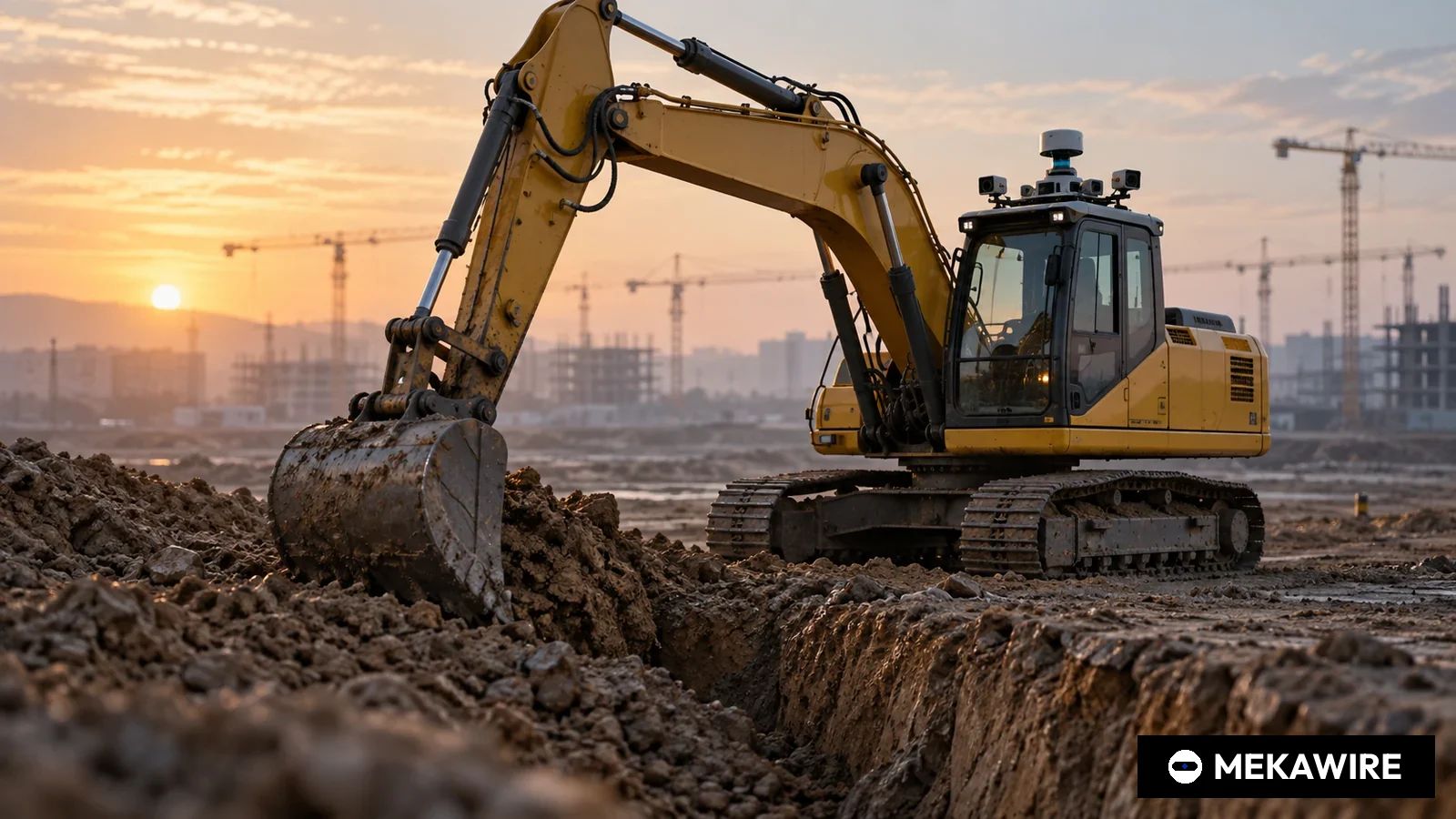
Bedrock Robotics, founded in 2024 by former Waymo engineers, raised a $270 million Series B co-led by CapitalG and Valor Atreides AI Fund, taking total funding past $350 million. The San Francisco company retrofits existing excavators with autonomy and is targeting its first operator-less deployments this year, a month after Caterpillar unveiled its own construction autonomy line.
Bedrock Robotics, a San Francisco start-up that fits autonomy kits to excavators already working on American job sites, said on 4 February 2026 that it had raised $270 million in a Series B round at a $1.75 billion valuation, about two years after the company was founded.
CapitalG and Valor Atreides AI Fund co-led the round, according to the company's release. Xora, 8VC, Eclipse, Emergence Capital, Perry Creek Capital, NVentures (the venture arm of NVIDIA), Tishman Speyer, MIT, Georgian, Incharge Capital and C4 Ventures also took part. Bedrock said the round takes its total funding to more than $350 million, less than seven months after it came out of stealth on 16 July 2025 with $80 million in combined seed and Series A money led by Eclipse and 8VC.
What Bedrock sells
The company's product, which it calls the Bedrock Operator, is a retrofit. Instead of selling new machines, Bedrock bolts reversible hardware and software onto equipment contractors already own, starting with excavators. CapitalG describes the platform in three layers, covering plug-in hardware, machine-learning models that adapt as a site changes, and operations software that coordinates several machines on one job.
On 18 November 2025 Bedrock said it had begun supervised autonomous work on live sites. On a 130-acre manufacturing site in the southern United States, prepared with Sundt Construction, autonomous excavators ranging from 20 to 80 tonnes moved more than 65,000 cubic yards of material, loading articulated dump trucks driven by people. The company also listed Zachry Construction, Champion Site Prep, Capitol Aggregates, Austin Bridge & Road, Maverick Constructors and Haydon Companies as partners. Its stated target is the first fully operator-less excavator deployments during 2026.
Bedrock said the new money will go into development and deployments, into maturing its autonomy and into tools that let contractors run connected autonomous fleets. Alongside the round it named Vincent Gonguet, who led AI safety and alignment work on Meta's Llama models, as head of evaluation, and John Chu, a former Waymo people executive, as head of people.
Who is behind it
Bedrock was founded in 2024. Chief executive Boris Sofman and chief technology officer Kevin Peterson both helped lead Waymo's autonomous trucking effort, and chief operating officer Laurent Hautefeuille helped build Uber Freight, according to CapitalG. "This funding helps us scale our development and deployments," Sofman said in the release. Derek Zanutto of CapitalG tied the bet to hyperscalers and developers trying to shorten project schedules that labour shortages keep stretching.
The labour case
The company leans on figures from Associated Builders and Contractors, which estimates that the US industry needs more than 800,000 additional workers over two years and that contractor backlogs exceeded eight months as of December 2025. CapitalG adds that more than 40% of the construction workforce is nearing retirement and that off-highway vehicle incidents cause more than 100,000 injuries a year at a cost of $11 billion. Its investment note also points to a forecast $1.7 trillion of data-centre construction by 2030, the kind of large, repetitive earthmoving job where Bedrock has started.
The rivals
An incumbent has moved first. On 7 January 2026 Caterpillar said it would bring autonomy to excavators, loaders, haul trucks, dozers and compactors for construction, building on mining fleets that it says have moved more than 11 billion tonnes and travelled over 380 million kilometres autonomously. Caterpillar sells autonomy with its own iron and its MineStar and VisionLink fleet software. Bedrock is betting the other way, on the view that contractors run mixed fleets and replace machines slowly, so a kit that fits existing equipment can reach more hours of operation sooner.
The round also sits in a busy month for physical AI. Skild AI raised $1.4 billion at a $14 billion valuation on 14 January, Munich's RobCo $100 million on 29 January, and Machina Labs $124 million on the same day as Bedrock. Bedrock's valuation is 6.5 times the size of its round; Skild AI's latest is 10 times.
MEKAWIRE analysis
Bedrock's valuation rests less on its software than on the claim that a retrofit can reach operator-less excavation in 2026, before Caterpillar's factory-built autonomy reaches mixed construction fleets.
So far the evidence comes from supervised work, with 65,000 cubic yards moved alongside human-driven trucks and safety oversight. The jump from supervised to operator-less is where autonomous trucking, Sofman's former field, spent years. The hire of a head of evaluation from a large language model programme suggests Bedrock knows that proof of safety, rather than model capability, will gate revenue.
The strongest counter-argument is distribution. Caterpillar controls dealers, financing, service and warranty. A contractor fitting a third-party kit to a leased 50-tonne machine has to settle who carries liability when it fails.
Bull case. Data-centre and factory site work gives Bedrock large, fenced, repetitive jobs where a few autonomous excavators replace scarce operators on long shifts. If the first operator-less sites run in 2026 as promised, the $1.75 billion price looks modest against the $1.7 trillion data-centre build-out CapitalG cites.
Bear case. Caterpillar's January launch narrows the window, and original equipment makers can restrict machine interfaces. If operator-less work slips to 2027 or needs a person on site anyway, Bedrock becomes a costly driver-assist supplier and the valuation multiple compresses.
Signals to watch:
- Caterpillar's construction autonomy line-up at CONEXPO-CON/AGG 2026, and whether it opens interfaces to third parties.
- Bedrock's first announced operator-less excavator site, promised for 2026.
- Any equipment-maker or rental-company partnership disclosed by Bedrock before the end of 2026.
- Bedrock Robotics
- US
- Series B
- 2026-02-04
- 270
- 1.75
- 6.5
- 2024
- Skild AI
- US
- Series C
- 2026-01-14
- 1400
- 14
- 10
- 2023
- Skild AI
- US
- Series A
- 2024-07-09
- 300
- 1.5
- 5
- 2023
- FieldAI
- US
- Two rounds combined
- 2025-08-20
- 405
- No data
- No data
- No data
- Dyna Robotics
- US
- Series A
- 2025-09-15
- 120
- No data
- No data
- 2024
- Machina Labs
- US
- Series C
- 2026-02-04
- 124
- No data
- No data
- 2019
- RobCo
- DE
- Series C
- 2026-01-29
- 100
- No data
- No data
- No data
Amounts and valuations as disclosed by the companies or lead investors; none estimated. Valuation / round size = disclosed valuation divided by the amount of that round, shown only where both are disclosed. Bedrock's valuation is from its 4 February 2026 release; Skild AI figures are post-money as disclosed. — = not disclosed.
As of Oct 1, 2026
- Series B, $270 million
- 2024, San Francisco
- CapitalG; Valor Atreides AI Fund
- 4 February 2026
- $1.75 billion
- Over 65,000 cubic yards moved on a 130-acre site with 20 to 80 tonne excavators (November 2025)
- More than $350 million
- First fully operator-less excavator deployments in 2026
- $80 million seed and Series A, 16 July 2025
Why it matters
Construction is one of the largest outdoor markets where autonomy is being sold to customers who did not ask for robots but cannot find operators. Bedrock's round prices that labour gap at $1.75 billion for a company with no disclosed revenue and supervised deployments only, which tells us investors now value heavy-equipment autonomy on the same physical-AI curve as humanoid and robot foundation model companies.
The second signal is investor composition. CapitalG, NVentures and Tishman Speyer, a large property developer, sit on the same cap table. That mix links compute, software and the owners of the buildings being built, the parties who feel schedule delays first.
Rival analysis
Caterpillar is the reference rival. Its 7 January 2026 announcement covers excavators, loaders, haul trucks, dozers and compactors and is backed by mining autonomy that it says has moved more than 11 billion tonnes. Caterpillar's advantage is integration with its own machines, dealers and MineStar and VisionLink fleet software. Its weakness, on Bedrock's bet, is that contractors run mixed fleets and keep machines for many years.
Bedrock's retrofit model attacks that gap. The risk is that original equipment makers control machine interfaces, warranty terms and parts, and can make third-party control harder. Bedrock has not disclosed any equipment-maker partnership, and that is the clearest open flank.
Valuation context
At $1.75 billion on a $270 million round, the valuation is 6.5 times the round size, between Skild AI's Series A in July 2024 (5 times, $300 million at $1.5 billion) and its January 2026 Series C (10 times, $1.4 billion at $14 billion). Bedrock reached a billion-dollar valuation roughly two years after its 2024 founding.
The company has disclosed no revenue, no fleet size and no unit pricing. The valuation therefore prices an option on the 2026 operator-less milestone rather than current cash flow, and it would be vulnerable to a delay.
Supply-chain implications
A retrofit kit depends on sensors, compute and actuation interfaces rather than on a new machine. Caterpillar lists LiDAR, radar, GPS and high-resolution cameras for 360-degree awareness on its own systems, a reasonable guide to what any construction autonomy stack must carry. NVIDIA's venture arm is an investor in Bedrock, which points to NVIDIA edge compute, although Bedrock has not named its compute supplier.
The harder dependency is mechanical. Excavators from different makers use different hydraulic and electronic control systems, so each new model family requires integration work. How quickly Bedrock can add models will decide how fast it can grow.
Signals to watch
First, CONEXPO-CON/AGG 2026, where Caterpillar said it would highlight its construction autonomy; any pricing or third-party interface policy will matter for Bedrock. Second, Bedrock's first operator-less site announcement, promised for 2026. Third, new customers beyond the Texas and southern US contractors named so far, especially data-centre developers.
Also watch for safety evaluation outputs. Bedrock hired a head of evaluation from Meta's Llama programme; a published safety case or third-party audit would be a meaningful step toward insurers and owners accepting operator-less machines.
Analyst view
Thesis: Bedrock has the most credible autonomy team in construction and investors with direct exposure to the job sites it needs, but the valuation runs ahead of evidence because no operator-less work has been shown publicly.
Confidence: medium. The team and investor facts are verified on primary pages, and the supervised field data is specific. Confidence is not high because revenue, fleet size and unit economics are undisclosed, and Caterpillar's January entry changes the competitive timeline in ways that cannot yet be measured.
Questions you should be asking
How many machines does Bedrock have in the field, and which equipment brands are supported? Who carries liability on an operator-less site, the contractor, Bedrock or the machine owner?
Will Caterpillar or other makers open machine interfaces to third-party autonomy, or restrict them? And will the first operator-less deployments run on fenced sites only, or on mixed sites with crews nearby?