Doosan Robotics names ex-Hyundai self-driving chief CTO, plans robot OS products for 2027
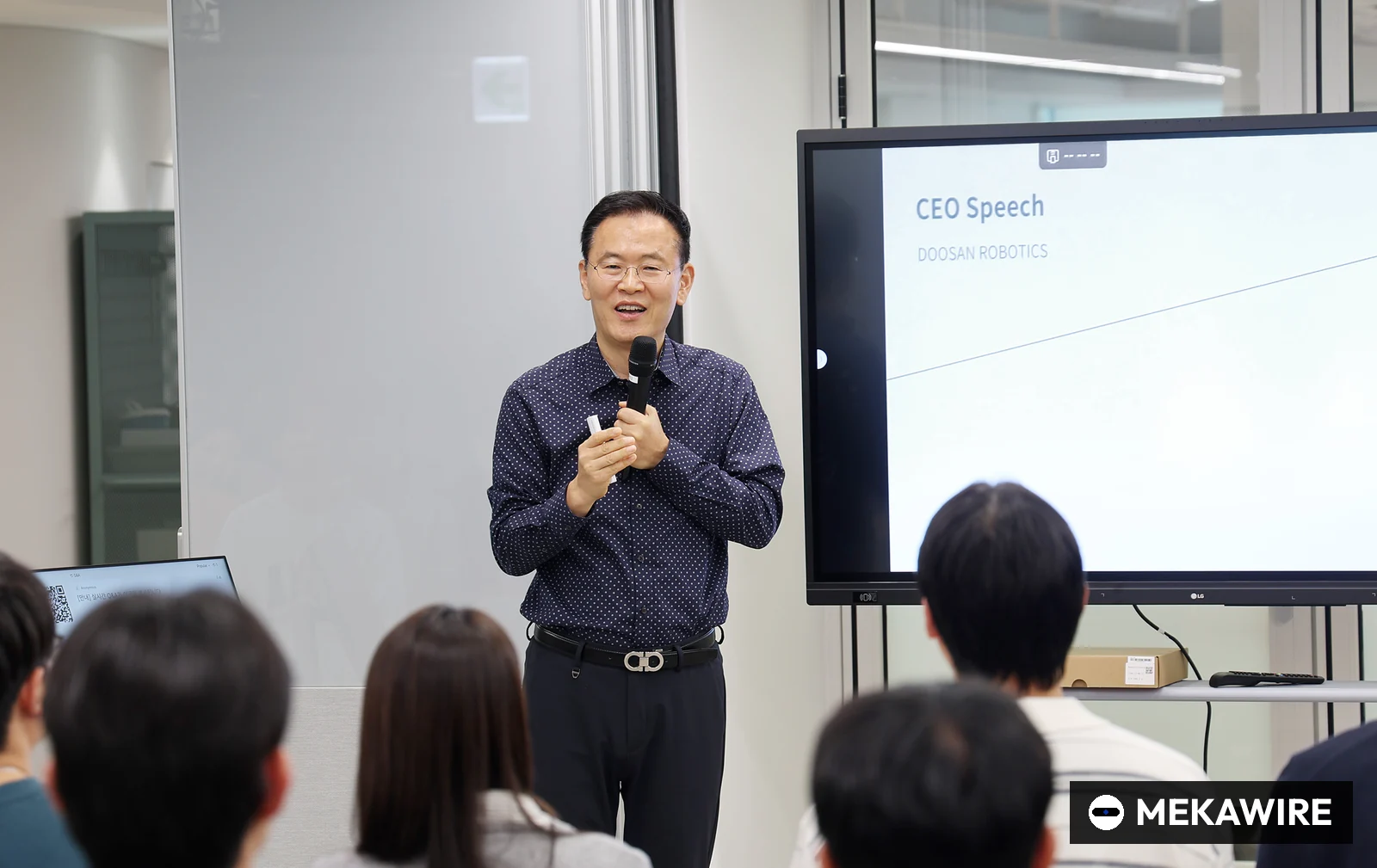
Doosan Robotics named Jang Woong-jun, former head of Hyundai Motor's autonomous driving centre and ex-CSO of Motional, as chief technology officer to lead its Agentic Robot OS software, with products planned for 2027, and made sales head Kim Hyun-soo chief strategy officer, the company said on Oct 19.
The new team takes over a cobot maker whose first-half operating loss equalled 80% of revenue, with net cash covering about 3.8 years at that rate.
Doosan Robotics has put a former head of Hyundai Motor's autonomous driving centre in charge of its technology, and says the first products from his new robot software will reach the market in 2027. The Seoul-listed cobot maker said in a press release on Oct 19 that Jang Woong-jun is its new chief technology officer and Kim Hyun-soo its chief strategy officer, introduced at a town hall at its Bundang innovation centre on Oct 15. [Company profile](/companies/doosan-robotics). MEKAWIRE explainer: [What is Doosan Robotics?](/news/what-is-doosan-robotics-cobot-maker-us-onexia-packaging-cells-53-percent-of-sales-industrial-humanoid-2028-explained-20261018).
The appointment completes a reshuffle that started on Oct 1, when Kwon Young-min moved over from Doosan Mottrol to become chief executive. The question it raises is whether a team built around self-driving software can turn a company whose operating loss still equals 80% of its revenue into a profitable one before its cash runs down.
A self-driving engineer now runs the robot software
Jang studied electrical engineering at Seoul National University and took his master's and doctorate at Stanford, according to the release. He worked as a McKinsey consultant, headed Hyundai Motor's autonomous driving centre, and was chief strategy officer of Motional, the self-driving joint venture of Hyundai Motor Group and Aptiv. He then served as CSO and head of the physical security division at SK Shieldus, and since March 2026 has run AI and digital strategy for the Doosan group.
His brief, the company said, is to deepen the existing partnership with NVIDIA and to lead development of Agentic Robot OS, software meant to let a robot perceive its work area, optimise its paths and carry out tasks safely and precisely without step-by-step programming. Products using it are planned for 2027. Doosan Robotics also said Jang will carry perception, decision and control methods from autonomous driving into robot intelligence and its industrial humanoid.
The strategy chief is the company's top salesman
Kim spent close to 20 years in Doosan group businesses, running Asia operations and strategy at Doosan Infracore and heading Doosan Bobcat's Indian subsidiary, the release said. He joined Doosan Robotics as head of sales in 2025 and, according to the company, won large domestic and overseas orders and built a key-account approach. As CSO he now runs both strategy and sales, with a mandate to concentrate on higher-margin business and expand abroad.
Kwon told staff the company would speed up intelligent robot solutions and industrial humanoids and grow mainly in the United States and Europe. That matches where growth already is: North American solutions supplied 53% of first-half 2026 revenue, MEKAWIRE's review of company filings found.
- Revenue
- KRW 53.04bn
- KRW 32.98bn
- KRW 32.97bn
- Operating loss
- n/a
- KRW 59.47bn
- KRW 26.49bn
- Operating loss as share of revenue (MEKAWIRE)
- n/a
- 180%
- 80.3%
- Net cash at period end
- n/a
- n/a
- KRW 202.4bn
- Years of net cash at H1 loss rate (MEKAWIRE)
- n/a
- n/a
- about 3.8
Share = operating loss / revenue. Years of cash = net cash / (H1 2026 operating loss x 2). Disclosed figures from DART filings and company IR as compiled by MEKAWIRE on Oct 18; H1 2026 revenue is a preliminary company figure. Not estimates.
As of Oct 19, 2026
Why the clock matters more than the org chart
Revenue fell 37.8% between 2023 and 2025 (MEKAWIRE calculation from audited figures), and the 2025 operating loss was 1.8 times revenue. First-half 2026 revenue of KRW 32.97bn already matched all of 2025, but the loss of KRW 26.49bn means the company spends roughly 80 won for every 100 won it sells. Net cash of KRW 202.4bn at the end of June covers about 3.8 years at that rate. The 2027 product date therefore sits inside the cash window, with a margin of about two years.
- Oct 1, 2026
- Kwon Young-min, head of Doosan Mottrol since 2021, named chief executive
- Company release
- Oct 6, 2026
- Two national physical-AI projects, KRW 98.9bn R&D budget, KRW 68.1bn government-funded (68.9%, MEKAWIRE)
- Company release
- Oct 15, 2026
- Town hall introduces CTO Jang Woong-jun and CSO Kim Hyun-soo
- Company release, Oct 19
- 2027
- New products built on Agentic Robot OS planned
- Company release, Oct 19
- 2028
- Industrial humanoid product planned
- Company IR
- From 2031
- On-device-AI cobots and humanoid as standard products (project target)
- Company release, Oct 6
Dates and plans as stated by the company.
As of Oct 19, 2026
MEKAWIRE analysis
Doosan Robotics is betting that cobot value is moving from the arm to the autonomy software, and it has hired a car-autonomy executive to build that layer before its cash window closes.
The evidence is in the sequence. A new chief executive on Oct 1, two state projects on Oct 6 that put a Korean AI chip with an NPU inside 5, 10 and 20 kg cobots and a humanoid ([our report](/news/doosan-robotics-krw-98-9bn-national-physical-ai-cobot-projects-20261006)), and now a CTO whose career is perception and planning software rather than mechanical design. Rivals in the same segment, from Universal Robots to China's Dobot, already compete on price for the arm itself ([MEKAWIRE comparison](/news/korean-cobot-makers-vs-china-doosan-robotics-neuromeka-hd-hyundai-robotics-fair-dobot-universal-robots-compared-2026-20261017)). Software that cuts integration time is one of the few places a Korean maker can still charge more.
The strongest counter-argument: self-driving software has repeatedly arrived years later than its planners promised, and Motional, where Jang worked, is one example. Agentic Robot OS has no published specification, no customer and no price yet.
Bull case: 2027 products ship on time, US packaging cells adopt them, and the loss ratio falls below 50% while net cash stays above KRW 100bn. Bear case: the software slips, cobot prices keep falling, and the company has to raise capital before the 2028 humanoid.
Signals to watch: the Q3 2026 results and operating-loss ratio (November 2026), the first technical disclosure or NVIDIA-linked demo of Agentic Robot OS, and any order announcement naming a US or European customer for the new software.
What would change our view: a disclosed external customer for Agentic Robot OS before launch would make the software bet look like demand-led rather than reorganisation-led.
- Kwon Young-min, named Oct 1, 2026; growth focus on the US and Europe
- Net cash KRW 202.4bn at June 30, about 3.8 years at the H1 loss rate (MEKAWIRE)
- Revenue KRW 32.97bn, operating loss KRW 26.49bn (80.3% of revenue, MEKAWIRE)
- Kim Hyun-soo: head of sales since 2025, ex-head of Doosan Bobcat India
- Jang Woong-jun: ex-head of Hyundai Motor's autonomous driving centre, ex-CSO of Motional, Doosan group AI and digital strategy since March 2026
- Agentic Robot OS, with deeper NVIDIA collaboration; products planned for 2027
- Press release, Oct 19, 2026; town hall at the Bundang Innovation Center on Oct 15
Why it matters
Doosan Robotics is Korea's best-known listed cobot maker and the group's main physical-AI vehicle. Putting an autonomous-driving software executive in charge of technology signals that management sees the next source of margin in perception and planning software, not in the arm. With operating losses at 80% of revenue in the first half, the order of execution matters more than the strategy itself.
The announcement also ties together three October moves: a new CEO, two state-funded projects worth KRW 98.9bn and the new CTO and CSO. Investors can now hold one team accountable for a dated plan: new products in 2027, an industrial humanoid in 2028.
Rival analysis
In cobots, Doosan competes with Universal Robots, Korean peers such as Rainbow Robotics and Neuromeka, and Chinese makers including Dobot, which compete hard on arm price. MEKAWIRE's Oct 17 comparison sets out the field. A software layer that shortens integration is the obvious differentiator, but every major rival is building one, and NVIDIA's tools are available to all of them.
Doosan's specific advantage is distribution in US packaging through Doosan Robotics Americas, the former ONExia, which supplied 53% of first-half revenue. If Agentic Robot OS ships into those cells first, Doosan can test it with its own integrator rather than relying on third parties.
Valuation context
No valuation figure is used here. On disclosed numbers, the company had KRW 202.4bn of net cash at June 30 against a first-half operating loss of KRW 26.49bn, about 3.8 years at that rate. The 2027 product date leaves roughly two years of buffer before cash would fall to zero at the current loss rate, ignoring growth or new funding.
Supply-chain implications
The Oct 6 projects put a Korean AI system-on-chip with an NPU, from a consortium including Mobilint, and DEEPX's edge NPU in the welding project, into cobots and a humanoid. Agentic Robot OS will also lean on NVIDIA, according to the release. The company is therefore running two compute paths, domestic NPUs for on-device control in state projects and NVIDIA for development, which raises integration cost but hedges supply risk.
Signals to watch
Q3 2026 results in November, with the operating-loss ratio against the first half's 80.3%. A first technical disclosure, developer release or NVIDIA-linked demonstration of Agentic Robot OS. An order or pilot announcement naming a US or European customer for the new software before the 2027 launch.
Analyst view
Thesis: Doosan Robotics is shifting its bet from cobot hardware to autonomy software and has hired a car-autonomy executive to build it before its cash window closes. Confidence: medium. The hire fits a consistent October sequence, and the cash runway is sufficient for a 2027 launch, but there is no specification, customer or price for the software yet, and autonomous-driving timelines have a record of slipping.
Questions you should be asking
What exactly will Agentic Robot OS do that Doosan's existing Dart-Suite software does not? Which first products in 2027 will carry it, and at what price premium? How will NVIDIA-based development reconcile with the Korean NPU chips in the state projects? What operating-loss ratio does management target for 2027?