Google DeepMind moves Gemini Robotics onto the robot itself and opens it to fine-tuning with as few as 50 demonstrations
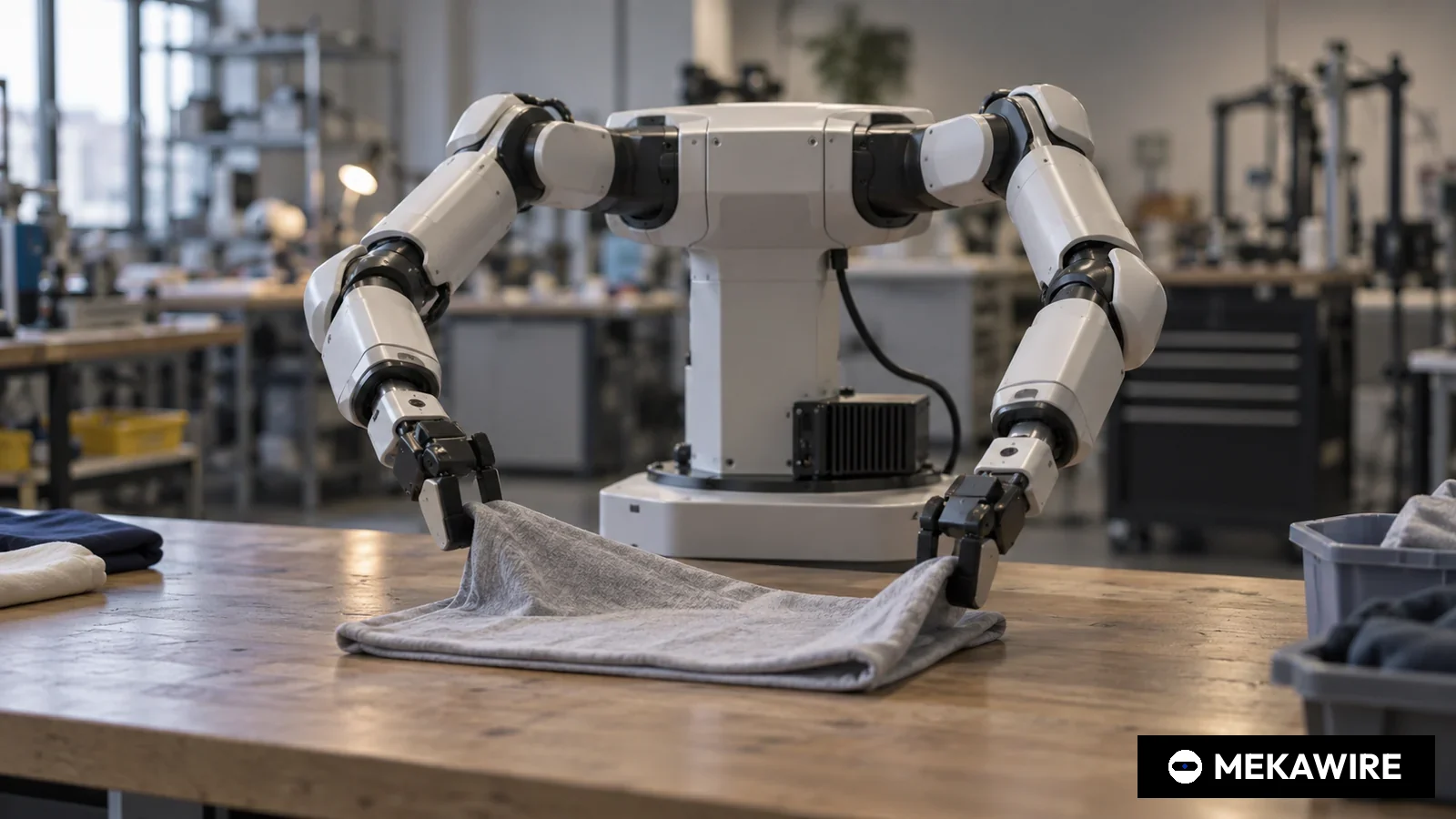
Google DeepMind on June 24, 2025 released Gemini Robotics On-Device, a vision-language-action model built to run locally on a robot with no network link. It is the first VLA the lab is letting outside developers fine-tune, through a new Gemini Robotics SDK offered to trusted testers, and DeepMind says it adapted the model from its ALOHA training rig to a bi-arm Franka FR3 and Apptronik's Apollo humanoid.
Google DeepMind on June 24, 2025 released Gemini Robotics On-Device, a version of its robot control model that runs entirely on the machine it drives, in a bid to take its Gemini models out of the data centre and onto factory floors, warehouses and homes where connectivity is patchy and every millisecond of latency counts.
The lab said in a post written by Carolina Parada that the model is a foundation model for robots with two arms, engineered to need little compute and tuned for low-latency inference without a network connection. It is also the first vision-language-action (VLA) model that DeepMind is making available for fine-tuning by outside developers, a step the company had not taken when it unveiled the cloud-scale Gemini Robotics family three months earlier.
DeepMind said the model can pick up a new task with as few as 50 to 100 demonstrations. It tested that claim on seven dexterous manipulation tasks of varying difficulty, among them zipping a lunch box, drawing a card and pouring salad dressing. On generalisation tests that varied what the robot saw, how instructions were phrased and how it had to act, DeepMind said On-Device outperformed the best earlier on-device VLA models. The company presented those results in charts and did not state the figures in its text.
The model was trained only on ALOHA, the low-cost bi-arm research platform. DeepMind said it then adapted the same model to two very different machines: a bi-arm Franka FR3, where it folded a dress and carried out an industrial belt assembly task that demands precision, and Apptronik's Apollo humanoid, where it followed natural-language instructions and handled objects it had not seen before. Cross-embodiment transfer of this kind is the property robot makers care most about, because it decides whether a model trained once can be reused across many robot bodies.
Alongside the model, DeepMind launched a Gemini Robotics SDK. Developers can use it to evaluate the model on their own tasks, run it in the MuJoCo physics simulator, and adapt it to new domains. Access is gated: developers have to sign up to DeepMind's trusted tester programme. The SDK code sits in a public GitHub repository under an Apache 2.0 licence, while the model weights themselves are not published.
The release extends a programme that began on March 12, 2025, when DeepMind introduced Gemini Robotics and Gemini Robotics-ER on top of Gemini 2.0, named Apptronik as its humanoid partner and listed Agile Robots, Agility Robotics, Boston Dynamics and Enchanted Tools as trusted testers. Apptronik had raised a US$350 million Series A in February 2025 with Google among its backers and added US$53 million in March, according to the company.
The move lands in a crowded field. Figure AI said in February 2025 that its Helix VLA runs entirely on two embedded low-power GPUs inside each humanoid, pairing a 7-billion-parameter vision-language model with an 80-million-parameter controller that outputs actions at 200 Hz across 35 degrees of freedom. NVIDIA opened Isaac GR00T N1, listed on its Hugging Face card as a 2-billion-parameter model, in March. On June 3, three weeks before DeepMind's release, Hugging Face published SmolVLA, a 450-million-parameter open model it says can run on a CPU and train on a single consumer GPU. Physical Intelligence offers open π0 weights through its openpi repository.
What separates DeepMind's offer is the combination of a frontier model lineage with local execution and supervised fine-tuning, but without open weights. Figure keeps Helix in-house for its own robots. NVIDIA and Hugging Face publish weights that anyone can download. DeepMind sits between them: developers get a capable model that runs on their hardware, but only through Google's programme and tooling.
Safety remains framed as a layered problem. DeepMind said it handles semantic safety through the Gemini Live API and pairs the model with low-level safety controllers on the robot, and it advised developers to test with semantic safety benchmarks and red-teaming before deployment. It did not publish the model's parameter count, the hardware it needs, latency figures, or commercial terms.
MEKAWIRE analysis
Gemini Robotics On-Device is Google's first serious attempt to turn its robot models into a platform that third-party hardware makers build on, and its gated, closed-weight design is a deliberate bet that model quality will matter more than openness.
The evidence is in what DeepMind chose to show. It demonstrated the model on three bodies from three different makers, ALOHA, Franka and Apptronik, rather than on a Google robot, and it shipped an SDK with simulation and fine-tuning hooks. Those are the moves of a supplier courting integrators, and they follow the March trusted tester list that already included Agile Robots, Agility Robotics and Boston Dynamics.
The strongest counter-argument is that open models are moving faster on cost and reach. SmolVLA and GR00T N1 can be downloaded today, inspected and deployed without a waiting list, and Physical Intelligence publishes weights as well. A robot maker that needs predictable licensing may prefer an open model it can control over a Google model it can only reach through a programme.
Bull case: the 50 to 100 demonstration figure holds up in customers' hands, trusted testers convert into paying integrators, and Gemini Robotics becomes the default brain for humanoid makers that cannot afford Figure's in-house AI team. Google then captures software margin across many robot brands, much as Android did across phone makers.
Bear case: without disclosed hardware requirements, latency or pricing, integrators cannot plan products around the model. Open alternatives close the quality gap, and the trusted tester gate becomes a bottleneck that pushes developers toward NVIDIA and Hugging Face stacks.
Signals to watch:
- Whether DeepMind publishes hardware requirements, latency and licensing terms for On-Device, and whether the trusted tester programme opens more broadly in the second half of 2025.
- New embodiments beyond ALOHA, Franka FR3 and Apollo announced by DeepMind or its testers, especially from the four companies named in March.
- Results presented at CoRL 2025 and Humanoids 2025, co-located in Seoul from September 27 to October 2, 2025, where rival VLA groups will report comparable benchmarks.
- Gemini Robotics On-Device
- Google DeepMind
- 2025-06-24
- No data
- No (trusted testers)
- Yes
- Helix
- Figure AI
- 2025-02-20
- 7.08
- No
- Yes, two embedded GPUs
- Isaac GR00T N1
- NVIDIA
- 2025-03-17
- 2
- Yes, noncommercial licence
- Yes, Jetson listed as compatible
- SmolVLA
- Hugging Face
- 2025-06-03
- 0.45
- Yes
- Yes, CPU or consumer GPU
- π0 (openpi)
- Physical Intelligence
- No data
- No data
- Yes
- Yes, GPU with more than 8 GB
Figures as disclosed by each developer on its own pages; — means not disclosed or not verified. Helix parameters = 7B vision-language model + 0.08B (80M) controller. GR00T N1 size and date from NVIDIA's Hugging Face model card.
As of Jun 24, 2025
- Locally on the robot, no network required
- Gemini Robotics On-Device (VLA)
- Gemini Robotics SDK via trusted tester programme
- June 24, 2025
- MuJoCo
- 7 dexterous manipulation tasks
- First DeepMind VLA opened to developer fine-tuning
- Parameter count, hardware needs, latency, pricing
- 50 to 100 demonstrations per new task
- ALOHA (training), bi-arm Franka FR3, Apptronik Apollo
Why it matters
Until June 2025 Google DeepMind's robot models were research artefacts shown in videos and offered to a handful of partners. On-Device changes the unit of sale. A model that runs on the robot and can be tuned with 50 to 100 demonstrations is something an integrator can put into a product, and the SDK gives DeepMind a channel to collect evaluation results from many embodiments it does not own.
Local execution also removes the biggest practical objection to cloud-hosted robot brains: a robot on a factory floor or in a hospital ward cannot stall when the network drops. By meeting that requirement, DeepMind moves into direct competition with Figure's onboard Helix and NVIDIA's Jetson-oriented GR00T stack.
Rival analysis
Figure AI controls the full stack and has no reason to license Helix to others, which makes it a competitor for end customers rather than for developers. NVIDIA is the more direct rival: GR00T N1 is downloadable, carries a noncommercial licence on its Hugging Face card, and pulls developers toward NVIDIA silicon. Hugging Face's SmolVLA, at 450 million parameters, competes at the low end, where university labs and hobbyists build on cheap arms.
Physical Intelligence publishes π0 weights and positions itself as a general robot brain company, the closest strategic analogue to DeepMind. The difference is distribution: DeepMind can bundle robotics with Gemini, Google Cloud and Android-era developer relations, while Physical Intelligence must win on model quality alone.
Valuation context
DeepMind is a unit of Alphabet and no valuation attaches to the robotics programme. The closest market signals are its partners' rounds. Apptronik, the humanoid maker Google backed, disclosed a US$350 million Series A in February 2025 and a further US$53 million in March 2025, without a stated valuation.
For investors in robot hardware, the more important point is margin allocation. If capable brains become available as tuned modules from Google or NVIDIA, hardware makers lose a source of differentiation, and value shifts toward whoever owns the model and the training data loop.
Supply-chain implications
DeepMind did not disclose what processor On-Device needs, which leaves robot makers unable to size compute. The demonstrations ran on ALOHA, Franka FR3 arms from Munich-based Franka Robotics and Apptronik's Apollo, which suggests the model targets embedded GPU-class compute already common in research robots rather than custom silicon.
The SDK's reliance on MuJoCo, the physics engine DeepMind open-sourced, keeps simulation inside Google's orbit, in contrast to NVIDIA's Isaac Sim and Omniverse pipeline. That choice matters for integrators who have already standardised on one simulation stack.
Signals to watch
First, disclosure of runtime requirements and commercial terms, which would show whether On-Device is meant to ship in products or stay a research preview. Second, the list of embodiments added through the SDK; any industrial arm maker or humanoid company outside the March tester list would indicate commercial pull.
Third, conference results at CoRL 2025 in Seoul from September 27 to 30, 2025, followed by Humanoids 2025 at the same venue, where VLA groups typically publish comparative benchmarks.
Analyst view
Thesis: On-Device is a credible first step toward a licensable robot brain, but the closed weights and missing runtime details mean it is not yet a product decision for most integrators. Confidence: medium. DeepMind's model lineage and the three-embodiment demonstration support the thesis; the absence of parameter count, latency and pricing, and the reliance on DeepMind's own charts for benchmarks, limit confidence.
We would raise confidence if independent trusted testers publish task success rates on their own robots, or if DeepMind discloses hardware targets that match commonly available embedded GPUs.
Questions you should be asking
What compute platform does On-Device require, and how fast does it run on it? Will DeepMind charge per robot, per deployment or through Google Cloud?
How do the 50 to 100 demonstration results hold up outside DeepMind's labs, and on tasks longer than a single manipulation skill? Will DeepMind ever publish weights, as NVIDIA and Hugging Face do?