Hexagon unveils AEON, a measurement-led industrial humanoid, with Schaeffler and Pilatus lined up as first pilot sites
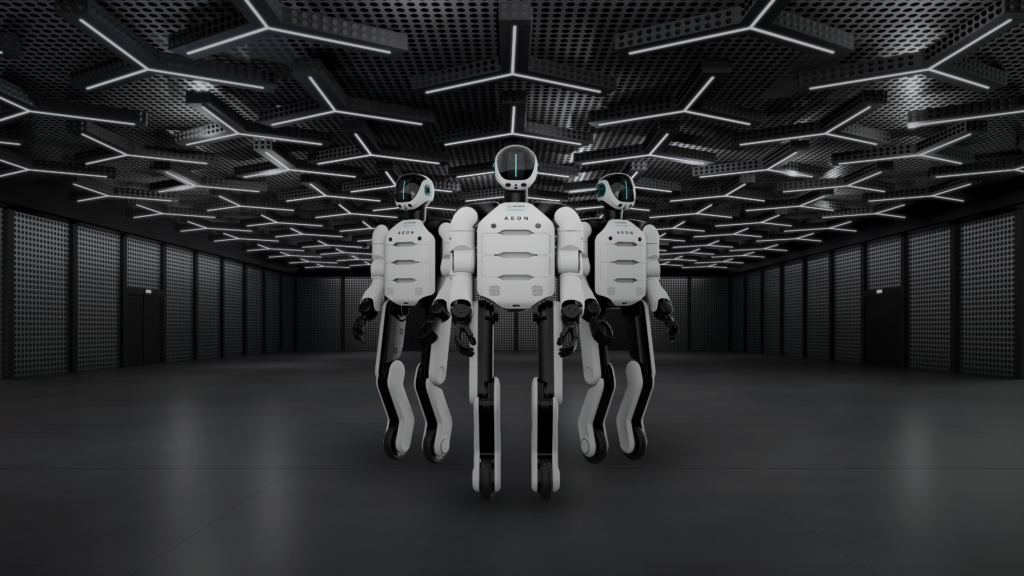
Swedish measurement group Hexagon launched AEON, a humanoid robot for inspection, machine tending, manipulation and reality capture, at its Hexagon LIVE Global conference on 17 June 2025. Schaeffler and Pilatus will pilot the robot, which runs on NVIDIA Jetson Orin computers and swaps its own batteries, and Hexagon plans six months of production deployments before a wider commercial rollout.
Hexagon, the Stockholm-based maker of measurement and reality-capture technology, unveiled its first humanoid robot on 17 June 2025, entering a field crowded with venture-funded start-ups by betting that precise sensing matters more on a factory floor than human likeness. The robot, called AEON, was presented by the group's Robotics division at Hexagon LIVE Global, the company's annual conference held from 16 to 19 June at the Fontainebleau in Las Vegas.
Hexagon said German automotive and industrial supplier Schaeffler and Swiss aircraft maker Pilatus have agreed to pilot AEON across manipulation, machine tending, part inspection and reality capture tasks. Arnaud Robert, president of Hexagon's Robotics division, said the company would deploy AEON in production environments over the next six months before expanding its commercial rollout. Hexagon did not disclose a price, a production volume or the size of either pilot.
The technical case rests on three suppliers. According to Hexagon, AEON is powered by NVIDIA accelerated computing, NVIDIA Omniverse and NVIDIA Jetson; Microsoft Azure provides scalable development and on-demand training; and Swiss motor maker maxon supplies the next-generation actuators that drive its locomotion. NVIDIA said in a blog post the same day that AEON uses Jetson Orin onboard computers to move, navigate and work in real time, and that Hexagon plans to upgrade the robot to NVIDIA IGX Thor to enable functional safety for collaborative operation.
- Height
- 165
- cm
- Weight
- 60
- kg
- Degrees of freedom
- 34
- count
- Top speed
- 2.4
- m/s
- Payload, short-term
- 15
- kg
- Payload, constant carry
- 8
- kg
- Runtime per battery charge, up to
- 4
- hours
- Planned production deployment phase
- 6
- months
Physical and battery figures as listed on Hexagon's AEON product page (robotics.hexagon.com/product); the 17 June 2025 launch release did not include a spec sheet. Deployment phase from the launch release.
As of Jun 17, 2025
Hexagon's AEON product page lists a height of 165 cm, a weight of 60 kg, 34 degrees of freedom and a top speed of 2.4 metres per second. The robot can carry 15 kg for short periods and 8 kg continuously, and each battery charge lasts up to four hours. Hexagon's launch release highlighted a battery-swapping mechanism that lets AEON keep working without stopping to recharge, which addresses one of the most common objections plant managers raise about humanoids on multi-shift lines.
The pitch is that AEON is a mobile measuring instrument as much as a worker. Hexagon said the robot fuses data from multimodal sensors with what it calls spatial intelligence to understand its surroundings and plan a task. Captured scans flow into Hexagon's Reality Cloud Studio, which NVIDIA said lets users visualise and share reality-capture data through Hexagon's HxDR platform and Omniverse running in the cloud. Chairman Ola Rollén said Hexagon had worked on robotics across its divisions for the past ten years and framed AEON as an extension of the group's legacy in precision measurement and sensors.
Simulation is central to how Hexagon says it built the robot quickly. NVIDIA said Hexagon used Isaac Sim and the open-source Isaac Lab reinforcement learning framework to train AEON, which allowed the robot to master core locomotion skills in two to three weeks rather than five to six months. Hexagon is also using Isaac GR00T-Mimic to generate synthetic motion data from a small number of human demonstrations and is exploring post-training NVIDIA's open Isaac GR00T N1.5 foundation model to improve the robot's reasoning and policies, NVIDIA said.
Hexagon brings a balance sheet that few humanoid start-ups can match. The group reported about 24,800 employees in 50 countries and net sales of roughly 5.4 billion euros in its launch release. Its pilot partners are substantial industrial customers in their own right: Schaeffler has around 120,000 employees at more than 250 locations in 55 countries, and Pilatus, founded in 1939, employs more than 3,000 people, according to the release.
The competitive field is led by privately funded American groups. Figure raised a 675 million dollar Series B in February 2024 and unveiled its own Helix vision-language-action model in February 2025, while Apptronik raised a 350 million dollar Series A in February 2025 with Google joining. Agility Robotics, 1X Technologies and Germany's Neura Robotics are also building general-purpose machines. Hexagon's difference is that its humanoid sits inside a listed industrial group with an existing base of factory customers for its metrology and scanning tools.
- Hexagon (AEON)
- SE
- No data
- Listed group; division funded internally
- No data
- No data
- Figure AI
- US
- No data
- Series B
- 675,000,000
- 2024-02-29
- Apptronik
- US
- 2016
- Series A incl. additional close
- 403,000,000
- 2025-03-18
- Agility Robotics
- US
- 2015
- Series B
- 150,000,000
- 2022-04-22
- 1X Technologies
- US
- 2014
- Series B
- 100,000,000
- 2024-01-13
- Neura Robotics
- DE
- 2019
- Series B
- No data
- 2025-01-15
Figures disclosed by the companies, not estimated. Apptronik amount = 350,000,000 Series A (2025-02-13) + 53,000,000 additional close (2025-03-18). Neura's Series B amount is not shown because it was not verified in USD. Hexagon does not report robotics investment separately.
As of Jun 17, 2025
The risks are familiar. Hexagon has not published reliability data, unit cost or a target price, and a six-month pilot at two customers is a small sample. Safety certification for humanoids working near people remains unsettled, which is why the planned move to IGX Thor for functional safety matters. And by relying on NVIDIA for compute and models and on maxon for actuators, Hexagon's own value add will have to come from sensing, software and integration.
The next checkpoints are concrete. Hexagon's own six-month window points to results from production deployments around December 2025, and investors will watch whether Schaeffler or Pilatus move beyond pilots to paid fleets. The timing of the IGX Thor upgrade and any GR00T-based skills will show how fast AEON can work alongside people rather than in fenced cells.
MEKAWIRE analysis
Hexagon is selling AEON as a walking sensor platform for its existing metrology customers, and that distribution advantage is worth more than any single hardware specification.
The evidence starts with the use cases. Two of the four tasks Hexagon named, part inspection and reality capture, are jobs its scanners and measurement software already do, and the data lands in Hexagon's own Reality Cloud Studio. Both pilot partners are manufacturers in automotive supply and aerospace, sectors where Hexagon has sold metrology for decades.
The strongest counter-argument is that Hexagon is assembling rather than inventing. Compute, simulation and foundation models come from NVIDIA, cloud training from Microsoft and actuators from maxon. If those stacks are available to every rival, differentiation narrows to integration and sales channels, and well-funded start-ups can buy their way into the same factories.
Bull case: the Schaeffler and Pilatus pilots convert into multi-site orders within a year, AEON becomes an add-on to Hexagon's metrology contracts, and the battery-swap design makes it one of the few humanoids that can run across shifts. The robotics division then becomes a growth engine inside a group with recurring software revenue.
Bear case: pilots stall on reliability or safety approval, and Hexagon ends up with an expensive demonstrator while specialist start-ups with larger budgets reach volume first. Shareholders could then question spending on a business with no disclosed revenue.
Signals to watch:
- December 2025: the end of Hexagon's stated six-month production deployment window and any disclosed results from Schaeffler or Pilatus.
- Hexagon LIVE Global 2026: whether Hexagon announces paying customers, pricing or a fleet size for AEON.
- The IGX Thor upgrade: a date for functional-safety certification would signal readiness for collaborative work beside people.
- Battery swapping; up to 4 hours per charge
- AEON industrial humanoid
- Six months of production deployments, then wider commercial rollout
- Core locomotion learned in 2 to 3 weeks in simulation instead of 5 to 6 months (NVIDIA)
- 17 June 2025, Hexagon LIVE Global, Las Vegas
- Hexagon Robotics division
- Manipulation, machine tending, part inspection, reality capture
- 165 cm, 60 kg, 34 degrees of freedom, 2.4 m/s top speed
- Schaeffler, Pilatus
- NVIDIA (compute, Omniverse, Jetson), Microsoft Azure (training), maxon (actuators)
Why it matters
AEON is the first humanoid launched by a large, listed industrial technology group whose core business is measurement rather than robotics. That changes the commercial argument. Most humanoid developers have to persuade a plant manager to buy a new category of machine from a young supplier. Hexagon can attach AEON to an existing relationship built on coordinate measuring machines, laser scanners and quality software, and it chose launch tasks, inspection and reality capture, that map directly onto that installed base.
The launch also shows how far the NVIDIA toolchain has compressed development. NVIDIA's claim that Isaac Sim and Isaac Lab cut core locomotion training from five to six months to two to three weeks matters for every incumbent that has considered building a humanoid but lacked a robotics research bench. If an industrial group can reach a credible pilot in this way, the barrier to entry for other diversified manufacturers falls as well.
Rival analysis
Figure, Apptronik, Agility Robotics and 1X Technologies are venture-backed and have raised far larger sums for their robots alone: Figure's Series B was 675 million dollars and Apptronik's Series A reached 403 million dollars with an additional close in March 2025. They control more of their own stack, Figure with its Helix model, for example. Hexagon instead buys compute, models and actuators and concentrates on sensing and integration.
In Europe, Neura Robotics raised a Series B in January 2025 and Schaeffler is a natural actuator supplier to several humanoid makers. Schaeffler's role as Hexagon's pilot customer rather than supplier is therefore notable: it gives Hexagon a reference site at one of the continent's largest automotive suppliers. Pilatus offers an aerospace reference, where low-volume, high-precision assembly suits a robot sold on measurement accuracy.
Valuation context
Hexagon does not report AEON or its Robotics division separately, and the launch release gave no revenue, investment or headcount figures for the unit. The only scale markers are group-level: about 24,800 employees and roughly 5.4 billion euros in net sales. Against that base, AEON is a small option rather than a driver of near-term earnings.
Private peers are priced on expectations instead. Figure raised 675 million dollars in its last disclosed round before the launch, and Apptronik's 2025 Series A was its largest raise. Investors in Hexagon get exposure to the humanoid theme at a fraction of the valuation risk, but also with little disclosure on how much the group is spending.
Supply-chain implications
Three outside suppliers are named. NVIDIA supplies Jetson Orin onboard computers today, with IGX Thor planned for functional safety, as well as Omniverse, Isaac Sim, Isaac Lab, GR00T-Mimic and potentially GR00T N1.5. Microsoft supplies Azure for scalable development and on-demand training. maxon, the Swiss drive specialist, supplies the actuators for AEON's locomotion.
That concentration creates both speed and dependency. The NVIDIA stack is shared by most Western humanoid developers, so Hexagon gains maturity but no exclusivity. maxon's involvement is a European sourcing choice that could ease supply for European customers, though Hexagon gave no detail on hand actuators, reducers or the battery pack.
Signals to watch
The first signal is the end of the six-month deployment window around December 2025. Hexagon has promised production environment deployments before a broader rollout, so any statement on uptime, tasks performed or additional sites will indicate whether the pilots worked. The second is whether Schaeffler or Pilatus disclose their own results or orders.
The third is the functional safety path. Hexagon's stated intention to move to NVIDIA IGX Thor ties the commercial ceiling of AEON to certification for collaborative work. A fourth is whether Hexagon begins to report robotics revenue or capital spending in its quarterly accounts, which would show management's confidence.
Analyst view
Thesis: AEON is a credible distribution play rather than a technology breakthrough, and its success depends on converting Hexagon's metrology customers into humanoid buyers. Confidence: medium.
Reasons for medium rather than high confidence: the pilot partners are real and well chosen, the toolchain is mature, and the battery-swap design addresses multi-shift work. But Hexagon disclosed no price, unit volume or reliability data, and both pilots are at an early stage. The reliance on third-party compute and actuators means rivals can match much of the hardware. We would raise confidence if Hexagon names paying customers or a fleet size after the six-month window.
Questions you should be asking
What will AEON cost to buy or lease, and will Hexagon bundle it with metrology software contracts?
How many units are deployed at Schaeffler and Pilatus, and which of the four named tasks does each partner run?
When will the IGX Thor upgrade and functional safety certification arrive, and under which standards?
Who supplies AEON's hands, reducers and battery packs, and where will the robot be assembled at volume?