NVIDIA pitches factory digital twins and Thor robot computers as the toolkit for US reindustrialization, enlisting Foxconn, Siemens, FANUC and four robot developers
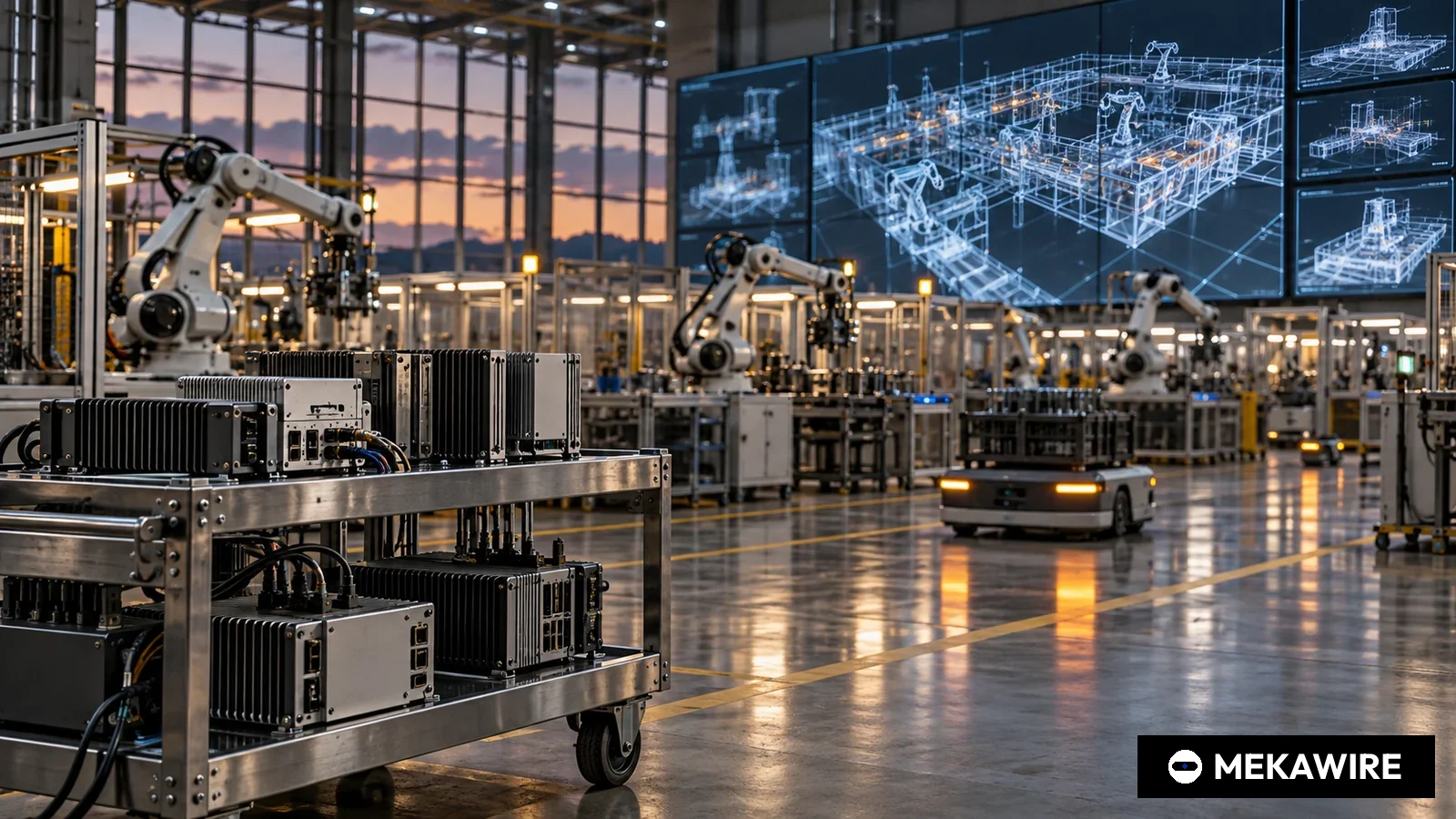
At GTC Washington on October 28, 2025, NVIDIA expanded its Mega Omniverse Blueprint for factory-scale digital twins, with Siemens, FANUC and Foxconn among the first partners, and named Figure, Agility Robotics, Amazon Robotics and Skild AI as robot developers on its stack.
It also unveiled IGX Thor, a 5,581 FP4 teraflop industrial and medical edge computer due in December 2025.
NVIDIA used its GTC conference in Washington, D.C. on October 28, 2025 to pitch factory digital twins and robot brains as the toolkit for rebuilding US manufacturing, naming Foxconn, Caterpillar, Toyota, TSMC, Lucid Motors, Belden and Wistron as users of its Omniverse simulation software and Figure, Agility Robotics, Amazon Robotics and Skild AI as builders of what it called a collaborative robot workforce.
The company framed the push around one number. In 2025, NVIDIA said, announced investments to build out US production capacity reached $1.2 trillion, led by electronics makers, drugmakers and chip manufacturers. Founder and chief executive Jensen Huang said AI is turning the world's factories into "intelligent thinking machines". The same day NVIDIA introduced IGX Thor, an industrial and medical edge computer rated at 5,581 FP4 teraflops, with production systems and developer kits expected in December 2025.
The software centrepiece is an expanded version of the "Mega" NVIDIA Omniverse Blueprint, a reference design that now carries libraries for designing and simulating whole factories before steel is cut. NVIDIA said Siemens is the first to build digital twin software supporting it, currently in beta as part of Siemens Xcelerator. FANUC and Foxconn's industrial arm Fii are among the first robot makers to publish 3D digital twins of their robots in the OpenUSD format, so planners can drop machines into a virtual plant. Huang showed Foxconn using the tools to design its 242,287 square foot Houston facility, which will build NVIDIA AI infrastructure systems.
Other manufacturers described narrower uses. Caterpillar is building twins of its factories and supply chains and using NVIDIA NIM microservices to predict maintenance needs and cuOpt to tune its supply chain. Toyota is modelling automation scenarios for its Georgetown, Kentucky plant with idealworks' iw.sim tool. TSMC is using Omniverse for fab design at its Phoenix, Arizona site and the Isaac platform for robotics. Lucid Motors is twinning its factories for planning and robot training, Wistron is validating systems assembled in Fort Worth, Texas, and Belden has deployed Accenture's Physical AI Orchestrator for virtual safety fences and quality inspection.
On the robot side, NVIDIA said Figure and NVIDIA had agreed to collaborate on next-generation humanoids, with Figure using NVIDIA computing to build its Helix vision language action model and the Isaac platform for simulation and training. Agility Robotics refines whole-body control for its Digit humanoid through millions of reinforcement learning scenarios in Isaac Lab, and Digit runs on the Jetson AGX Thor module. Skild AI uses Isaac Lab and NVIDIA's Cosmos world models to train one foundation model across legged, wheeled and humanoid robots. NVIDIA also credited simulation training for helping Amazon's Blue Jay multi-arm manipulator move from concept to production in just over a year.
IGX Thor extends the Blackwell-based Thor family from robots into regulated settings such as hospitals and rail. According to NVIDIA's announcement blog, it combines an integrated and a discrete Blackwell GPU, offers 400 GbE connectivity, delivers eight times the integrated-GPU AI compute of IGX Orin and 2.5 times on the discrete GPU, and comes with 10 years of lifecycle support and NVIDIA's Halos safety stack. It ships as the IGX T5000 module and the IGX T7000 board kit. Early adopters named include Diligent Robotics, EndoQuest Robotics, Hitachi Rail, Joby Aviation and Maven Robotics, with CMR Surgical evaluating it. No price was disclosed.
- IGX Thor
- 5581
- 8
- No data
- No data
- No data
- December 2025 (expected)
- 10
- Jetson AGX Thor
- 2070
- 7.5
- 128
- 130
- 3499
- 2025-08-25
- No data
Figures as disclosed by NVIDIA. IGX Thor gain is integrated GPU AI compute vs IGX Orin (2.5x on discrete GPU); Jetson AGX Thor gain is AI compute vs Jetson Orin. — = not disclosed. No estimates.
As of Oct 1, 2026
The launch builds on Jetson AGX Thor, which NVIDIA made generally available on August 25, 2025 with a $3,499 developer kit, 2,070 FP4 teraflops within 130 watts and 128 GB of memory. At that launch NVIDIA listed Figure, Amazon Robotics, Boston Dynamics, Caterpillar and Agility among early adopters and said more than 2 million developers use its robotics stack.
- Figure
- Isaac platform; accelerated computing for Helix VLA
- Series C
- 1,000,000,000
- 39,000,000,000
- 2025-09-16
- Agility Robotics
- Isaac Lab; Jetson AGX Thor
- Series B
- 150,000,000
- No data
- 2022-04-22
- Skild AI
- Isaac Lab; Cosmos
- Series A
- 300,000,000
- 1,500,000,000
- 2024-07-09
- Amazon Robotics
- Simulation training (Blue Jay)
- Public parent (Amazon)
- No data
- No data
- No data
Rounds are those verified in the MEKAWIRE company database dated before 2025-10-28 and may not be each company's latest. Amounts and valuations as disclosed by the companies; — = not disclosed.
As of Oct 1, 2026
NVIDIA's pitch rests on what it calls a three-computer architecture, one system to train models, one to simulate and test them, and one inside the robot. The approach puts it in competition on several fronts at once. Siemens, Dassault Systemes and PTC sell factory simulation, while robot makers from FANUC to ABB run their own controllers. NVIDIA's answer in Washington was to make partners such as Siemens and FANUC the doorway into its stack rather than rivals to it.
The technology is easier to describe than to deploy. A digital twin is a physics-accurate model of a plant, built in the OpenUSD scene format, where engineers test layouts, conveyor speeds and robot cells before building them. Robot policies are then trained in simulation, where Isaac Lab can run reinforcement learning across millions of scenarios, and transferred to real hardware. NVIDIA argues this shortens development cycles, the claim it attached to Amazon's Blue Jay.
The risks are plain in the release itself. The Siemens integration was still in beta, IGX Thor had no published price, and the collaboration with Figure carried no financial terms. Most manufacturers described pilots and planning tools rather than plants that now run on NVIDIA software. Editor's note. In an update dated February 25, 2026, Amazon said it no longer uses Blue Jay in operations, while the underlying technology continues to support employees across its network.
MEKAWIRE analysis
NVIDIA turned the US reshoring story into a sales channel for its robot stack, but the Washington announcements were mostly design tools and pilots, not robots at work.
The evidence for the thesis is in who was on stage. NVIDIA put a $1.2 trillion investment figure next to named factories in Texas, Kentucky and Arizona, and paired them with four robot developers already training on Isaac. The common thread is that every new US plant is a candidate for an Omniverse twin, and every robot that trains in that twin is a candidate for a Thor computer.
The strongest counter-argument is that simulation does not equal deployment. The Blue Jay case, cited by NVIDIA as proof of faster development, ended in Amazon dropping the system from operations about four months later. Fast design cycles do not guarantee that a robot earns its place on a live floor.
Bull case. If Siemens ships the Mega integration and FANUC's OpenUSD robot models become standard, NVIDIA's software becomes the default format for planning factories, and Thor hardware follows into the robots that are designed there. IGX Thor's 10-year support could also open hospitals and rail to NVIDIA robot compute.
Bear case. Manufacturers may treat twins as a planning aid and keep proven controllers from FANUC, ABB or Siemens on the floor, limiting NVIDIA to the engineering office. Humanoid partners such as Figure and Agility remain small in shipped units, so Thor demand from robots could lag the rhetoric for years.
- December 2025. Whether IGX Thor production systems and developer kits ship on schedule, and at what price.
- January 2026. CES in Las Vegas, where NVIDIA and partners typically update Jetson, Cosmos and GR00T releases.
- March 2026. GTC San Jose, the test of whether Siemens' Mega integration leaves beta and which factories report production use.
- NVIDIA GTC Washington, D.C., October 28, 2025
- 2,070 FP4 teraflops, $3,499 developer kit, available Aug 25, 2025
- Mega Omniverse Blueprint; Siemens integration in beta
- 5,581 FP4 teraflops, 10-year lifecycle support
- 242,287 sq ft, builds NVIDIA AI infrastructure systems
- December 2025 (expected)
- Figure, Agility Robotics, Amazon Robotics, Skild AI
- $1.2 trillion announced in 2025 (NVIDIA)
Why it matters
In Washington NVIDIA presented its robotics stack as part of a policy narrative rather than as a chip launch. By tying Omniverse twins and Thor computers to the $1.2 trillion of US production investment it cited, NVIDIA positioned itself as infrastructure for reshoring, which matters for procurement conversations at manufacturers that do not think of themselves as robotics buyers.
The practical significance is format control. If plant layouts, robot models and training environments all live in OpenUSD inside Omniverse, switching costs rise for every later decision, including which edge computer goes into the robot. FANUC and Foxconn Fii publishing OpenUSD robot models is the early sign of that lock-in.
Rival analysis
In factory simulation NVIDIA chose to partner with the incumbent rather than fight it. Siemens supplies the plant-engineering software that most large manufacturers already own, and NVIDIA made it the first Mega integration. Dassault Systemes and PTC, which sell competing industrial software, were not named, which leaves an opening for them to court manufacturers wary of a single vendor.
In robot compute the relevant comparison is with chipmakers selling edge processors to robot companies and with robot makers that keep proprietary controllers. NVIDIA's advantage is the training and simulation software that sits upstream of the chip. Its weakness is that humanoid customers such as Figure and Agility ship small volumes, so hardware revenue from robots remains modest next to data centre sales.
Valuation context
The robot developers NVIDIA named span a wide valuation range. Figure disclosed a $1 billion Series C at a $39 billion post-money valuation on September 16, 2025, while Skild AI's verified Series A in July 2024 was $300 million at $1.5 billion and Agility's last verified round in our database is a $150 million Series B from April 2022.
None of the Washington announcements carried disclosed contract values. The value to NVIDIA is indirect, through Thor module and IGX system sales, Omniverse enterprise licences and GPU demand for training. Investors should treat the partner list as pipeline, not booked revenue.
Supply-chain implications
Foxconn's 242,287 square foot Houston facility, designed in Omniverse, is meant to build NVIDIA AI infrastructure systems, which closes a loop in which NVIDIA's own supply chain becomes a reference customer for its factory software. Wistron's Fort Worth site plays a similar role for validation of assembled systems.
For robot hardware, Thor modules sit at the centre of a partner ecosystem. NVIDIA named 13 equipment makers for IGX Thor, including Advantech, ADLINK and Curtiss-Wright, which will package the module for industrial and medical buyers. Robot makers depend on those integrators for certified, ruggedised systems, so their readiness in December 2025 will shape adoption.
Signals to watch
The first signal is IGX Thor shipping in December 2025 with a disclosed price. The second is Siemens moving its Mega integration out of beta, which would mark the point at which manufacturers can buy the capability through an existing vendor relationship.
The third is evidence of robots trained in these twins working in production at the named plants. Amazon's later decision to stop using Blue Jay in operations, disclosed in a February 25, 2026 update, shows why claims of faster development need to be checked against what stays deployed.
Analyst view
Thesis. NVIDIA is building the default design and training environment for automated factories, and the robot computer sale follows from that position. Confidence medium. The partner list is broad and includes Siemens, FANUC, TSMC and Toyota, which supports the thesis, but most uses described were planning and pilots, and no contract values were disclosed.
The confidence would rise if Siemens ships the integration and at least one named manufacturer reports a production line running robots trained in Omniverse. It would fall if partners such as FANUC keep OpenUSD models as a marketing feature while controllers and programming stay proprietary.
Questions you should be asking
What will IGX Thor cost, and how does pricing compare with Jetson AGX Thor's $3,499 developer kit? Which of the named manufacturers will move from twins to robots trained in simulation on production lines, and on what timeline?
What are the terms of the Figure collaboration, and does it include hardware supply? How did Amazon's Blue Jay experience, which NVIDIA cited as a simulation success, inform Amazon's later decision to stop using it in operations?