Rokae lists in Hong Kong at HK$38 and raises about HK$1.01 billion including the over-allotment after retail investors cover its offer 156 times
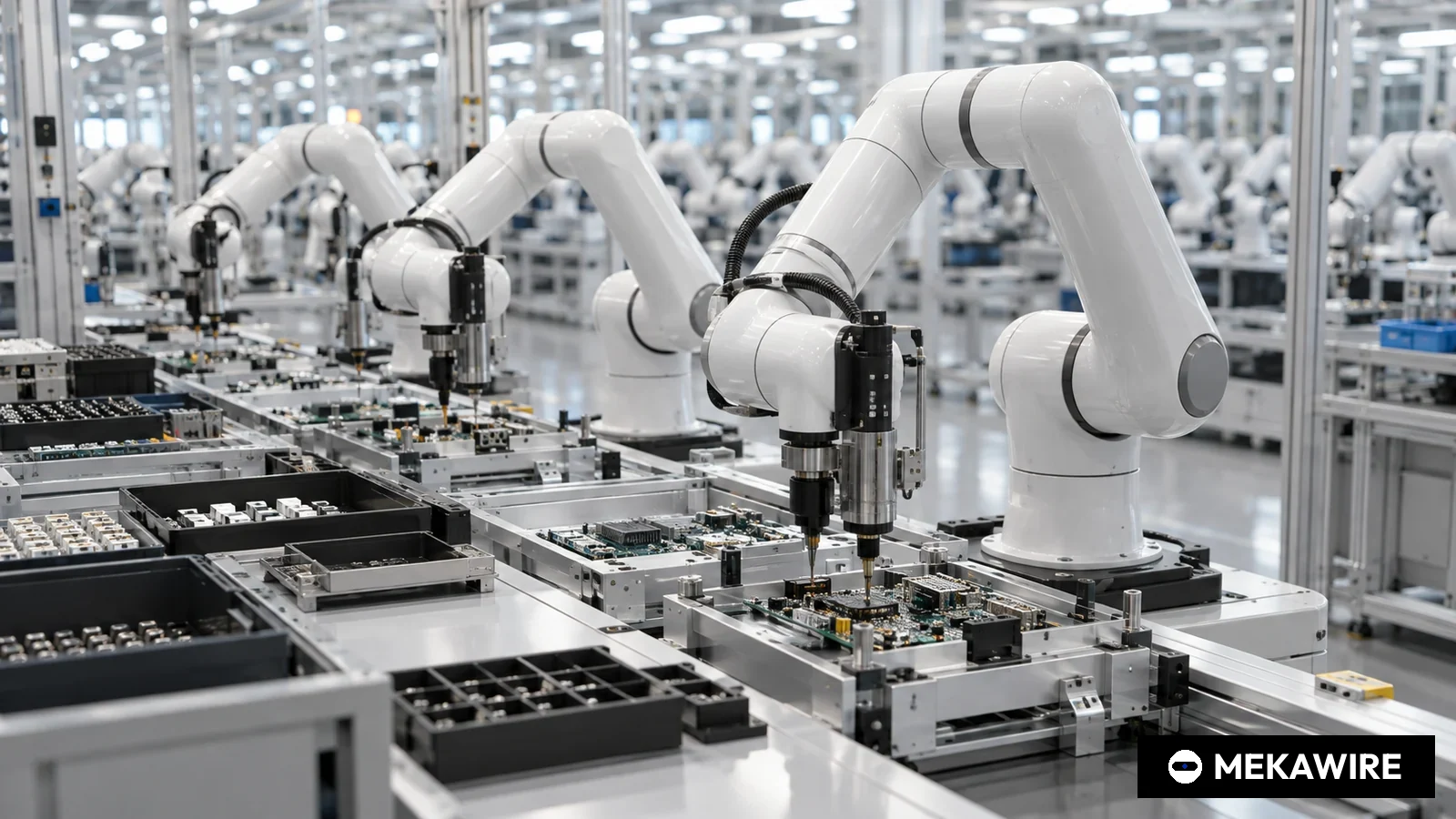
Rokae (Shandong) Robotics Group began trading on the Hong Kong Stock Exchange Main Board under code 3752 on 9 July 2026 after selling 23,031,900 H shares at a fixed HK$38.00, for gross proceeds of HK$875.2 million.
The Hong Kong public tranche was subscribed 156.58 times and the international tranche 11.96 times, and a full over-allotment exercise on 5 August took the total raised to about HK$1,006.5 million.
Rokae (Shandong) Robotics Group, the Chinese maker of industrial arms, force-controlled collaborative robots and humanoid arms for embodied AI developers, began trading on the Main Board of the Hong Kong Stock Exchange on 9 July 2026 under stock code 3752. The company sold 23,031,900 new H shares at HK$38.00 each, according to the allotment results announcement it filed with HKEX on 8 July, raising gross proceeds of HK$875.2 million and net proceeds of HK$810.5 million after estimated listing expenses of HK$64.7 million.
Demand was concentrated among Hong Kong retail investors. The public tranche of 2,303,200 shares drew 63,360 valid applications and was subscribed 156.58 times, with 11,937 applicants receiving stock. The international tranche of 20,728,700 shares was placed with 72 investors and covered 11.96 times. The announcement listed no reallocation between the two tranches, so the split stayed at 10% retail and 90% institutional. At the offer price the company was valued at about HK$9,945.6 million on 261,726,190 shares in issue, the prospectus dated 30 June shows.
Five cornerstone investors took 7,233,100 shares, or 31.40% of the base offering, worth about HK$274.9 million. Beijing Financial Street Capital Operation Group was the largest with 3,026,600 shares, followed by All View Focus Fund with 1,629,000, Huatai Capital Investment with 1,237,200, GF Fund Management and its international arm with 1,031,000, and Yishao Capital Management (HK) with 309,300. China International Capital Corporation Hong Kong Securities and Guotai Junan Capital were joint sponsors.
The deal grew after the debut. In an HKEX announcement dated 5 August 2026, Rokae said the overall coordinators had exercised the over-allotment option in full for 3,454,700 additional H shares at HK$38.00, adding net proceeds of about HK$126.7 million. The stabilising manager, CICC, made no market purchases during the stabilisation period, which means the over-allocated shares were delivered to placees who had agreed to deferred settlement. Shares in issue rose to 265,180,890, and the total offering reached 26,486,600 shares, or about HK$1,006.5 million gross on a simple multiplication of shares by price.
- Rokae Robotics
- 3752
- 2026-07-09
- 38
- 23,031,900
- 875.2
- 156.58
- 11.96
- Huayan Robotics
- 1021
- 2026-03-30
- 17
- 92,902,600
- 1579.34
- 5059.38
- 16.65
- Estun Automation
- 2715
- 2026-03-09
- 15.36
- 96,780,000
- 1486.54
- 19.67
- 3.34
- Dobot
- 2432
- 2024-12-23
- 18.8
- 40,000,000
- 752
- 9.25
- 2.64
From each company's HKEX allotment results announcement; disclosed, not estimated. Rokae, Estun and Dobot figures are before any over-allotment; Huayan includes full exercise of its Offer Size Adjustment Option. Rokae's over-allotment option of 3,454,700 H shares was exercised in full on 5 August 2026, lifting gross proceeds to HK$1,006.5 million (26,486,600 shares x HK$38.00).
As of Oct 3, 2026
The prospectus earmarks 35% of net proceeds, about HK$283.7 million, for research and development across 2026 to 2029, 25% or HK$202.6 million for an overseas sales network, 22% or HK$178.3 million for production, 8% or HK$64.8 million for minority strategic investments upstream and downstream, and 10% for working capital. Within the production budget, Rokae plans automated assembly stations at its Zoucheng plant in Shandong that it expects to add about 7,000 to 10,000 units of annual capacity, and a new manufacturing base of more than 20,000 square metres in a region such as the Yangtze River Delta, scheduled for completion in 2027 with about 5,000 units of additional capacity.
Rokae was incorporated in 2014, set up its headquarters and research centre in Beijing in 2015 and opened its Shandong manufacturing site in 2017. Its registered office and principal place of business are now in Zoucheng, Jining. Chairman and general manager Tuo Hua controls 92,572,610 shares, or 35.37% of the enlarged share capital before the over-allotment, through direct holdings, two employee partnerships and voting proxies, and is locked up until 8 July 2027. Pre-IPO holders include the National Manufacturing Transformation and Upgrade Fund with 8.82%, South Hope Industry, Golden Growth III, Xiang He Fund II and Shenzhen Capital Group, all subject to the same 12-month lock-up.
The company sells three product families. Its industrial arms span light, medium and heavy payloads; its xMate flexible collaborative robots put a high-precision torque sensor in every joint rather than relying on motor current to estimate contact forces; and its embodied intelligent line includes seven-axis AR humanoid arms, wheeled dual-arm robots, composite mobile manipulators and integrated force-controlled joint modules. All run on Rokae's own xCore control system. In 2025 it sold 11,156 robots, up from 3,761 in 2023, including 3,633 collaborative robots and 1,190 embodied intelligent units, the prospectus shows.
- Industrial robots
- 224.7
- 6333
- 35
- 21.6
- Flexible collaborative robots
- 138.2
- 3633
- 38
- 34.8
- Embodied intelligent robots
- 47
- 1190
- 40
- 10.7
From the business section of the HKEX prospectus dated 30 June 2026.
As of Oct 3, 2026
Losses remain large on a reported basis. Revenue rose from RMB267.0 million in 2023 to RMB521.7 million in 2025, while the net loss was RMB179.3 million in 2025 after RMB191.8 million in 2024. Most of the gap came from interest accrued on pre-IPO investors' redemption rights, which ended at listing; stripping that out with share-based pay and listing costs, the adjusted net loss narrowed to RMB41.7 million in 2025 from RMB101.3 million in 2023. Prices are falling. The average selling price of a Rokae collaborative robot dropped from RMB47,000 in 2023 to RMB38,000 in 2025, and the company attributes part of the decline to intensified competition.
- 2023
- 267
- 11.4
- -157.5
- -101.3
- 3,761
- 2024
- 325.3
- 21.9
- -191.8
- -72.5
- 6,178
- 2025
- 521.7
- 21.9
- -179.3
- -41.7
- 11,156
- H1 2025
- 175.9
- 22.3
- -90.3
- -35.2
- No data
- H1 2026
- 414.7
- 29.8
- -79
- 18.4
- No data
Full years from the HKEX prospectus dated 30 June 2026 (Accountants' Report); half years from the interim results announcement of 28 August 2026. Negative = loss. H1 2026 robot shipments were disclosed only as over 13,000 units and are left blank.
As of Oct 3, 2026
Rokae is a mid-sized player in a crowded home market. Citing consultancy CIC, the prospectus ranks it sixth among collaborative robot suppliers in China by 2025 revenue with a 4.8% share, fourth by volume with 8.1%, sixth among domestic brands in industrial robots with 0.9%, and among the top five in embodied AI robotic arms with 6.3%. It names Universal Robots, JAKA and AUBO among the main cobot competitors, and the top six suppliers together held 47.3% of a RMB2.9 billion market. Since listing, Dobot, Estun and Huayan have been its closest Hong Kong comparables, while Universal Robots, owned by Teradyne, FANUC and Doosan Robotics set the pace outside China.
The first post-listing numbers improved on the prospectus trend. Rokae's interim results of 28 August show revenue of RMB414.7 million for the six months to June 2026, up 135.8%, a gross margin of 29.8% against 22.3% a year earlier, a net loss of RMB79.0 million and an adjusted net profit of RMB18.4 million. Embodied intelligence revenue was RMB139 million, or 34% of the total. On 29 September the company said its 10,000th force-controlled humanoid arm had come off the line in Zoucheng and that it shipped more than 13,000 robots in the first half, 5,600 of them embodied intelligent units.
MEKAWIRE analysis
Rokae's listing is a bet that force-controlled arms sold to humanoid and embodied AI developers can carry a cobot maker whose core business is still losing money and cutting prices.
The evidence for that reading is in its own filings. Embodied intelligent robots went from 2.2% of revenue in 2024 to 9.0% in 2025 and 34% in the first half of 2026, and the prospectus describes one customer that took more than 1,200 force-controlled humanoid arms in the fourth quarter of 2025 and then placed orders for over 5,000 more. Rokae also says nearly half of China's ten most valuable embodied AI companies use or have switched to its humanoid arms. That is a supplier position, closer to a component business than to a robot brand, and it is the part of the story the 156-times retail book paid for.
The strongest counter-argument is concentration and margin. The embodied line earned a 10.7% gross margin in 2025, far below the 34.8% on collaborative robots, and its average selling price fell from RMB208,000 in 2024 to RMB40,000 as Rokae moved from complete systems to bare arms. If a handful of humanoid developers account for much of that demand, Rokae is exposed to their funding cycles and to their decision to build arms in house.
Bull case. Humanoid makers keep buying arms rather than designing them, Rokae's joint-level torque sensing becomes a de facto standard, and the new Yangtze River Delta base and Zoucheng automation let it scale volume while margins climb toward the cobot line. The first-half swing to an adjusted profit then marks a turning point rather than a one-off.
Bear case. Chinese cobot prices keep falling, the embodied AI funding wave cools, and large customers internalise arm production. Rokae is left as the sixth-ranked cobot supplier with 8.9% of revenue from overseas, a reported net loss and a valuation that assumed the humanoid supply story would last.
Signals to watch:
- The 2026 annual results, due by March 2027, and whether the adjusted profit in the first half holds across the full year.
- 8 July 2027, when the 12-month lock-up on Tuo Hua and the pre-IPO investors expires.
- Progress on the Yangtze River Delta manufacturing base, which the prospectus schedules for completion in 2027.
- 3752 (HKEX Main Board)
- HK$38.00 per H share (fixed)
- Revenue RMB521.7 million; net loss RMB179.3 million; 11,156 robots sold
- Five investors, 7,233,100 shares (31.40% of base deal), about HK$274.9 million
- 9 July 2026
- 23,031,900 H shares; gross HK$875.2 million, net HK$810.5 million
- 3,454,700 shares, fully exercised 5 August 2026; extra net HK$126.7 million
- Revenue RMB414.7 million (+135.8%); adjusted net profit RMB18.4 million
- 11.96 times subscribed; 72 placees
- 156.58 times subscribed; 63,360 valid applications
- about HK$9,945.6 million
Why it matters
Rokae follows Dobot, which listed in Hong Kong in December 2024, and Estun and Huayan, which listed in March 2026, and it is the first of that group whose prospectus rests heavily on sales into humanoid and embodied AI programmes. Its 156.58 times retail cover sits well below Huayan's 5,059.38 times but above Estun and Dobot, which suggests Hong Kong investors are still paying for robotics exposure but are starting to discriminate between stories.
The more important signal is structural. Rokae's force-controlled humanoid arms are bought by other robot companies, which makes it a picks-and-shovels supplier to China's embodied AI boom. If that model works, it shows that a component-style business can be built on top of a cobot platform, and it gives investors a listed proxy for demand from humanoid start-ups that are still private.
Rival analysis
In collaborative robots Rokae is outsized by its domestic rivals. The prospectus shows the top two Chinese cobot suppliers each with about 11% of 2025 revenue against Rokae's 4.8%, and it names JAKA and AUBO alongside Universal Robots as the main competitors. Dobot and Huayan are already listed in Hong Kong; Elite Robots and JAKA remain private. Rokae's differentiator is that its entire cobot line uses torque sensors in every joint, which it says makes it the only flexible cobot maker above 1,000 units a year among the top six.
In embodied AI arms the field is less defined. Humanoid developers can buy from Rokae, from cobot makers repurposing small arms, or design their own. Rokae's claim of a 6.3% share and a top-five rank in China's embodied AI robotic arm market, per CIC, shows a fragmented segment where scale and delivery reliability, both of which the 10,000-unit milestone is meant to demonstrate, may matter as much as specifications.
Valuation context
At HK$38.00 Rokae was valued at about HK$9.95 billion on its base share count. Huayan, by comparison, was valued at HK$9,241 million at its offer price in March, so the two cobot makers came to market at similar headline valuations despite very different product mixes. The valuation only makes sense if the first-half 2026 growth rate of 135.8% persists for several years.
Two adjustments matter for investors reading the reported losses. Interest on redemption liabilities, RMB122.3 million in 2025, disappears after listing because the pre-IPO investors' redemption rights terminated. That alone explains most of the difference between the RMB179.3 million reported loss and the RMB41.7 million adjusted loss, and it is why the first half of 2026 already shows an adjusted profit. The prospectus also showed negative pro forma net tangible assets per share of HK$5.00 before the redemption liabilities were reclassified, a technical figure that will not recur but that some screens will pick up.
Supply-chain implications
Rokae buys castings, machined parts, speed reducers and servo motors mainly from Chinese suppliers, and raw materials made up 85.2% of its 2025 cost of revenue. Purchases from its top five suppliers rose to 31.0% of the total in 2025, and it says unit costs of key materials fell as its bargaining power grew. That pattern mirrors the wider Chinese robotics supply chain, where domestic reducers and motors have driven down the bill of materials for arms.
The company is also moving upstream. Part of the production budget, about RMB30.0 million, will buy three automated lines for its HSA force-controlled joint modules, and the September announcement describes those joints as integrating torque sensing and delivering a 1 kHz force-control loop. Owning the joint makes Rokae less dependent on third-party torque sensors and lets it sell joints to other robot builders, which puts it in competition with component makers as well as arm makers.
Signals to watch
The first test is the full-year 2026 report, expected by the end of March 2027. The company says it will accelerate the commercial roll-out of embodied intelligence; investors will look at whether gross margin holds near the first-half 29.8% as low-margin humanoid arms grow as a share of sales.
The second is the expiry of the 12-month lock-up on 8 July 2027, covering Tuo Hua, the two employee partnerships and more than 25 other existing shareholders that together hold the large majority of shares. Free float is thin; the allotment announcement warned that the share price could move substantially on small volumes.
The third is overseas expansion. With only RMB46.6 million, or 8.9% of 2025 revenue, from outside China and a quarter of IPO proceeds earmarked for an international sales network, any distributor or customer announcements in Europe, Japan or the United States will show whether the plan is gaining traction.
Analyst view
Thesis: Rokae has used its listing to reposition from a sub-scale cobot maker into a supplier of force-controlled arms to the humanoid industry, and its first half as a public company supports that pivot. Confidence: medium.
The reasons for medium rather than high are specific. The adjusted profit rests on removing the redemption interest and share-based pay, which is legitimate but flattering; the embodied line carries thin margins; and the company has not disclosed customer concentration within the embodied segment. The reasons it is not low are the audited growth, the positive operating cash flow in the first half of 2026 and a manufacturing record that shows utilisation above 90% in 2025.
Questions you should be asking
How many customers account for the 5,600 embodied intelligent units shipped in the first half of 2026, and what share comes from the single customer described in the prospectus?
Will Rokae keep selling bare humanoid arms at about RMB40,000 each, or push customers toward higher-value joints, control platforms and its ROKAE Brain model stack?
How will the company use the 8% of proceeds set aside for minority strategic investments, and will those stakes be in humanoid developers that are also its customers?