Stuttgart's Sereact raises US$110 million led by Headline to sell one robot brain for any machine, starting with the US
Sereact, the Stuttgart developer of the Cortex robot model, raised US$110 million in a Series B led by Headline on 27 April 2026, citing more than 1 billion production picks and one remote intervention in about 53,000. The money funds Cortex 2.0, which adds a world model to a vision-language-action model, and a first US office in Boston; Zalando later joined, lifting the round to US$116 million.
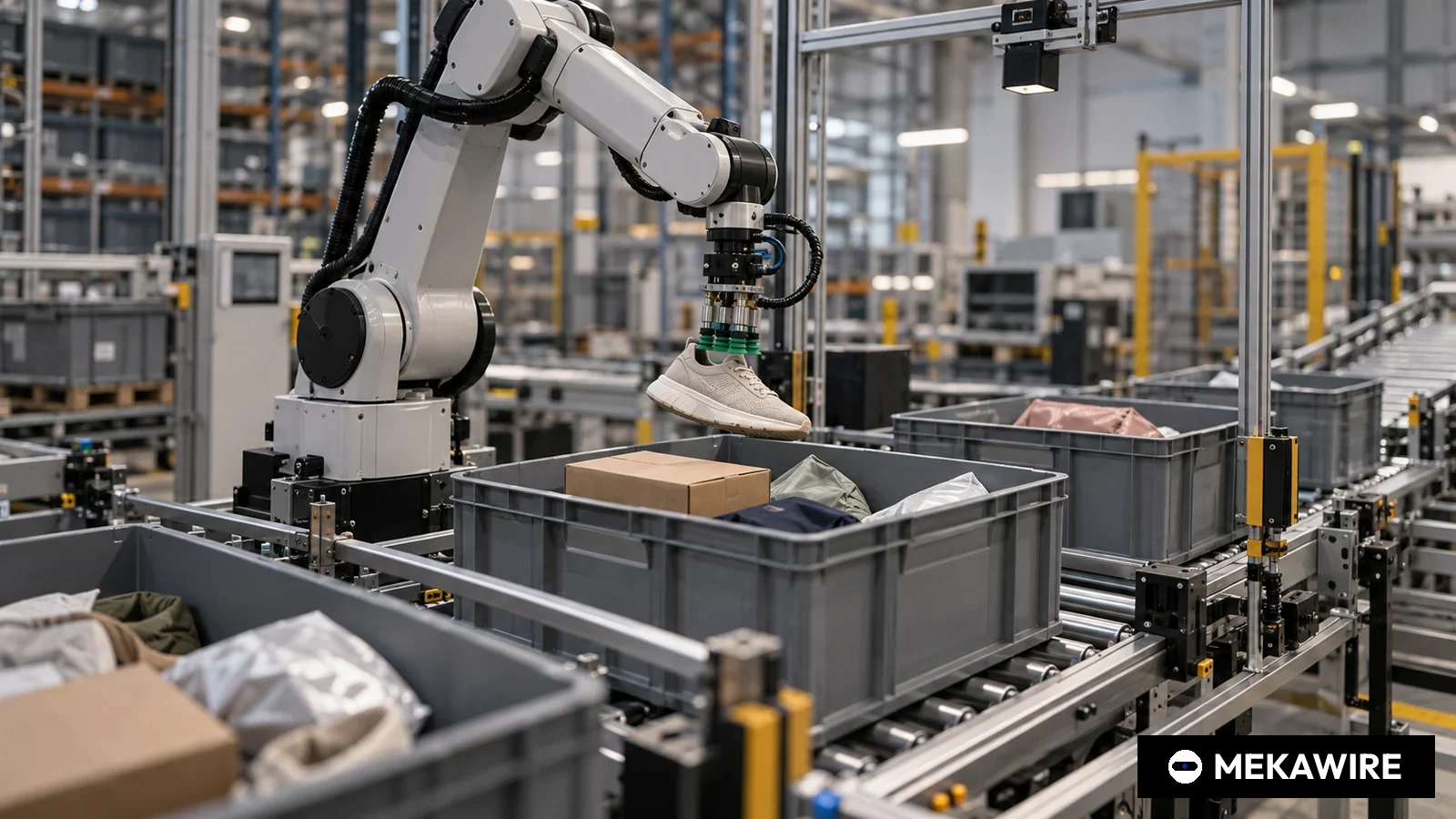
Sereact, a Stuttgart company that sells robot intelligence rather than robots, said on 27 April 2026 that it had raised US$110 million in a Series B round led by Headline. Its chief technology officer put the strategy in one line in the announcement: the company does not build robots and does not sell services, it ships a model meant to run on any robot. The number behind that claim is what made investors pay. Sereact said its systems have completed more than 1 billion real production picks, and that only about one pick in 53,000 needs a remote human to step in.
New investors Bullhound Capital, Daphni and Felix Capital joined the round alongside returning backers Air Street Capital, Creandum and Point Nine. Sereact said the round brought its total funding to more than US$140 million. It did not disclose a valuation, and none appears here. On 20 July the company said Zalando had joined the Series B as a strategic investor, lifting the round to US$116 million and total funding to US$145 million. Zalando's cheque was not disclosed; by subtraction of the two round totals it is roughly US$6 million. The question the money has to answer is whether a European software company can win the brain of the robot when hardware makers and US model labs want the same seat.
What the money buys: Cortex 2.0 and a Boston office
Sereact said the capital would scale Cortex 2.0, the new version of its robot model, and fund its entry into the United States, starting with a first US office in Boston staffed with local commercial, application and engineering hires. The company later said that office had opened at Hood Park in Charlestown. In the same announcement it said more than 200 Sereact systems were live across Europe, and it described itself as the most deployed AI picking robot company in the world, a claim it did not benchmark against named rivals.
The customer list explains why the round was priced as a scale-up rather than a science project. Sereact lists Active Ants, Austrian Post, BMW, bol., Daimler Truck, DeltiLog, Mercedes-Benz, Monta, MS Direct, PepsiCo and Rohlik Group among the companies it works with. That mix of e-commerce fulfilment, parcel, grocery and automotive plants matters, because each site produces different objects, packaging and failure cases that feed the same model.
A picking specialist that has raised 22 times its seed in under three years
Sereact was founded in 2021 by Ralf Gulde, its chief executive, and Marc Tuscher, its chief technology officer. In August 2023 it raised US$5 million in a seed round led by Point Nine and Air Street Capital, when it was marketing a pick-and-pack product it called PickGPT and quoting speeds of 1,500 picks per hour. In January 2025 it raised EUR 25 million in a Series A led by Creandum, with angels including former Formula 1 world champion Nico Rosberg. The Series B is 22 times the seed in dollar terms and came about 15 months after the Series A,.
How a world model changes the pick
Cortex 2.0 pairs a vision-language-action model, which turns camera images and an instruction into robot motions, with a world model, a learned simulator of how objects behave. Sereact said the system generates several candidate future trajectories, runs each against its learned model of physics and object behaviour, and scores them for stability, risk and efficiency before the arm moves. Tuscher described this as the robot dreaming in latent space. Because the planning happens in a visual latent space rather than in one robot's joint coordinates, the company said the same model runs single-arm picking cells, dual-arm returns stations and humanoid robots.
The company kept shipping after the round. On 15 July it described Cortex 2.5, which learns a new short task from two or three video demonstrations shown at run time, without retraining. Sereact reported a 92.6% success rate for that in-context approach against 97.6% for a fully retrained model, and said the result covers only short, single pick-and-place tasks close to its training domain. On 1 June it announced a global partnership with Veloq, the Prague-based grocery fulfilment platform that grew out of Rohlik Group and is an AutoStore Global Partner, with joint expansion into the US named as a priority.
Competing for the robot's brain
Sereact's pitch puts it against two groups at once. The first is the general robot-brain labs. Skild AI raised US$1.4 billion in January 2026 at a valuation above US$14 billion, about 12.7 times Sereact's round, and Physical Intelligence is building similar cross-robot models in the US. The second is warehouse picking specialists such as Poland's Nomagic, which raised US$44 million in a Series B in February 2025, Covariant in the US and Mujin in Japan. In Germany the money has gone mostly to hardware: RobCo raised US$100 million in January 2026 for modular factory robots it rents out, and NEURA Robotics closed a Series C in June. Bullhound's Per Roman framed Sereact's edge as software that retrofits into the large fleet of industrial robots already in service.
The open questions are commercial. Sereact has not published revenue, unit prices, headcount or the share of its 1 billion picks that come from any one customer. Its intervention figure is self-reported and depends on how a pick and an intervention are counted. And in the US it will meet Amazon's in-house robotics and well-funded local rivals on their home ground.
MEKAWIRE analysis
Sereact's Series B is a bet that, in warehouse robotics, deployment data is the scarce asset, and that a European company holding 1 billion production picks can sell the robot brain to hardware makers rather than compete with them.
- Sereact
- DE
- 2021
- Series B
- 110
- No data
- 2026-04-27
- RobCo
- DE
- No data
- Series C
- 100
- No data
- 2026-01-29
- Agile Robots
- DE
- 2018
- Series C
- 220
- No data
- 2021-09-10
- NEURA Robotics
- DE
- 2019
- Series C
- No data
- No data
- 2026-06-10
- Nomagic
- PL
- 2017
- Series B
- 44
- No data
- 2025-02-26
- Exotec
- FR
- 2015
- Series D
- 335
- 2
- 2022-01-17
- Skild AI
- US
- 2023
- Series C
- 1400
- 14
- 2026-01-14
Latest disclosed round per company or investor announcements in the MEKAWIRE database. NEURA Robotics disclosed only a ceiling for its Series C, shown as null. Sereact's Series B grew to US$116 million with Zalando on 20 July 2026. Figures are disclosed, not estimated.
As of Oct 3, 2026
The evidence is in the numbers the company chose to lead with. Dividing its two floors, 1 billion picks over 200 systems, gives roughly 5 million picks per deployed system, and an intervention rate of one in 53,000 implies about 19,000 remote assists per billion picks. That is the kind of operating record the large model labs are buying through acquisitions and pilot fleets. Sereact also has the breadth of objects that comes with grocery, fashion, parcel and automotive parts in one dataset.
- Seed
- 2023-08-08
- 5
- No data
- Point Nine, Air Street Capital
- Series A
- 2025-01-20
- No data
- 25
- Creandum
- Series B
- 2026-04-27
- 110
- No data
- Headline
- Series B with Zalando (cumulative B)
- 2026-07-20
- 116
- No data
- Zalando (strategic)
Company announcements. Series B multiple over seed = 110 / 5 = 22x. Zalando's implied cheque = 116 minus 110 = about US$6 million by subtraction. Seed to Series B = 993 days; Series A to Series B = 462 days. Figures are disclosed, not estimated.
As of Oct 3, 2026
The strongest counter-argument is scale of capital. Skild AI's single round is almost ten times Sereact's total funding of US$145 million, and a general model trained on far more compute could make a picking specialist's data advantage irrelevant within a few model generations. Sereact's own Cortex 2.5 numbers show the gap that remains, five percentage points between in-context learning and a retrained model.
Bull case: the US office converts the Veloq partnership and German automotive references into US fulfilment contracts during 2027, Cortex becomes the default software layer on third-party arms, and Sereact raises a larger round on disclosed revenue. A strategic buyer among European automation groups would then pay for the data flywheel.
Bear case: hardware makers license general models from the US labs at low cost, warehouse integrators bundle their own picking AI, and Sereact is left as a regional systems vendor with slower growth than its model ambitions require.
Signals to watch:
- The first named US customer site run from Boston, which would show the Europe playbook travels; we would expect it before mid-2027.
- The next Cortex release after 2.5, on the April to July cadence seen in 2026, and whether it extends in-context learning to longer tasks.
- Any disclosed revenue, deployment count above 200 systems or humanoid deployment, for instance at LogiMAT in Stuttgart in March 2027.
- Series B, US$110 million, announced 27 April 2026
- 2021, Stuttgart; CEO Ralf Gulde, CTO Marc Tuscher
- Zalando joined as strategic investor on 20 July 2026; Series B now US$116 million
- Not disclosed
- 200+ systems live across Europe; more than 1 billion production picks
- US$145 million (company, July 2026)
- Scale Cortex 2.0; US entry with first office in Boston
- Headline
- New: Bullhound Capital, Daphni, Felix Capital. Returning: Air Street Capital, Creandum, Point Nine
- About 1 remote human assist per 53,000 picks (company figure)
Why it matters
The round is the clearest European test of the robot-brain business model, in which a software company owns the model and leaves the metal to others. Most large physical AI rounds in Germany over the past year went to companies that build hardware, such as RobCo and NEURA Robotics. Sereact raised more than RobCo's Series C while owning no robot design, which tells us investors now price deployment data as an asset in its own right.
It also shifts the argument about where value sits in warehouse automation. If one model can run picking cells, returns stations and humanoids, as Sereact claims, then integrators and arm makers become distribution channels and the model owner captures the learning from every site. That is the same logic Skild AI and Physical Intelligence sell in the US, applied by a company that started from paying customers instead of research demos.
Rival analysis
Against the general model labs, Sereact's advantage is production data and its disadvantage is capital. Skild AI's US$1.4 billion Series C at more than US$14 billion and Physical Intelligence's funding let them train on far more compute and buy hardware fleets, as Skild did when it bought Zebra's former Fetch Robotics unit in April 2026. Sereact's answer is narrower and deeper data from logistics and automotive sites.
Against picking specialists, the comparison is more favourable. Nomagic's latest disclosed round was US$44 million in February 2025, and Covariant's last disclosed round was a US$75 million Series C extension in April 2023. Mujin in Japan raised a Series D first close in December 2025 and sells its own controller platform. Sereact's round is the largest disclosed among European AI picking software companies in our database.
Valuation context
No valuation was disclosed, so no step-up can be computed. What can be measured is pace and size. The Series B of US$110 million is 22 times the US$5 million seed of August 2023 and arrived about 15 months after the EUR 25 million Series A. The company reported total funding of US$145 million after Zalando joined, so the Series B is about 80% of all capital raised.
Among peers with disclosed post-money values, Exotec was valued at US$2 billion in its US$335 million Series D in 2022 and Skild AI at more than US$14 billion in January 2026. Neither is a clean comparable. Exotec sells hardware systems with revenue, and Skild sells a general model with a far larger capital base. We do not infer a Sereact valuation from either.
Supply-chain implications
Sereact is hardware-agnostic, so its exposure is to compute and to the arm makers whose robots run Cortex rather than to reducers or actuators. Its retrofit pitch depends on access to controllers from established industrial robot suppliers, and on partners such as Veloq, whose grocery platform is built around AutoStore storage systems.
The bigger dependency is data. A world model that predicts how objects behave improves with the variety of items it sees, which ties Sereact's progress to keeping large fulfilment and automotive customers live and sharing data. Losing one large customer would hurt the model as well as revenue.
Signals to watch
First, US traction. Sereact has named Veloq and DeltiLog in connection with its Boston opening, but no US site has been publicly announced as live. A named US deployment would confirm the thesis that the European playbook travels.
Second, model cadence and scope. Cortex 2.0 arrived in April and Cortex 2.5 in July 2026. A release that extends in-context learning beyond short pick-and-place tasks, or a paying humanoid deployment, would support the one-brain claim. Third, any disclosure of revenue or a deployment count well above 200.
Analyst view
Thesis: Sereact has the strongest production dataset of any European robot-brain company we track, and the Series B gives it enough runway to prove the model can cross the Atlantic, but it remains outgunned on compute by US labs.
Confidence: medium. The deployment, intervention and funding figures are company disclosures with named customers, which supports the thesis. Confidence is not high because revenue, unit economics and the method behind the intervention rate are undisclosed, and because a general model trained at ten times the budget could narrow Sereact's data lead quickly.
Questions you should be asking
How is an intervention defined and counted, and how does the one-in-53,000 rate vary between grocery, fashion and automotive sites?
What share of revenue comes from software licences versus complete cells, and will Sereact license Cortex to arm makers directly? Does the Zalando investment come with any deployment or data-sharing agreement?