Barcelona's THEKER raises US$85 million Series A led by CRV for factory generalist robots
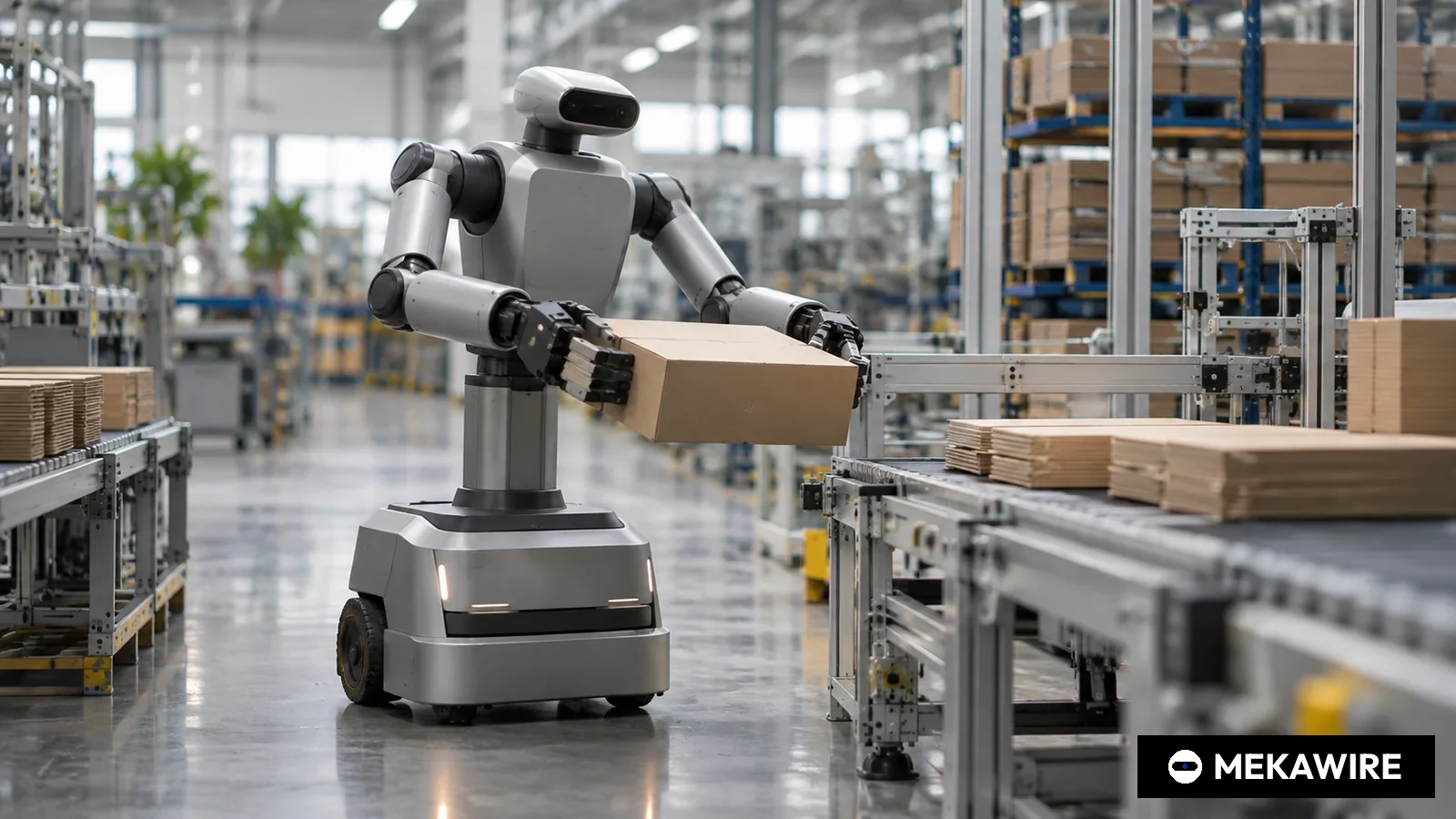
Barcelona-based THEKER has raised US$85 million in a Series A led by CRV, with Samsung, LVMH, Henkel, Mercadona and others joining, according to investor Cathay Innovation. The four-year-old company builds AI-native generalist robots that it says already run in live European production lines, but it has not named customers or disclosed a valuation.
THEKER, a Barcelona robotics company that builds what it calls AI-native generalist robots for factory and warehouse work, has raised US$85 million in a Series A round led by the US venture firm CRV, according to an announcement published on 11 June 2026 by Cathay Innovation, one of the participating investors.
The round drew a mix of venture funds and industrial and retail corporations. Alongside CRV, new investors were Samsung, LVMH, Cathay Innovation, 20VC, Henkel, Korelya, Sonae and Mercadona. Existing backers Inditex, ElevenLabs executive Carles Reina, Itnig (the Factorial founders' vehicle), Kfund, Kibo Ventures and Mission also took part. THEKER did not disclose a valuation, and the announcement gave no euro figure.
The investors described the deal as the largest Series A ever raised by a European robotics company. The announcement also said it was CRV's first investment in Spain, Samsung's first investment in a Spanish company and LVMH's first investment in the Spanish startup ecosystem. That record claim held for roughly six weeks; on 21 July the London humanoid developer Humanoid announced a US$152 million Series A at a US$1.35 billion post-money valuation.
What THEKER sells
According to the release, THEKER builds full-stack robots for industrial production rather than supplying software for other vendors' arms. The company says its systems adapt in real time to changing conditions on a line, including mixed SKUs, irregular shapes and day-to-day variability, without manual reprogramming. It says the robots can be deployed in days and keep learning once they are in production.
THEKER says its robots are already running in live production operations across Europe, aimed at manufacturers, logistics operators and retailers trying to raise throughput, cut downtime and cope with labour shortages. The company has not named customers, published unit counts or released hardware specifications, and its public website states that product details will be unveiled later. Several investors, including Inditex, Mercadona, Sonae, Henkel and LVMH, are themselves large operators of factories, distribution centres or stores.
"We didn't build THEKER to run pilots," co-founder Carla Gómez Cano said in the announcement, adding that the robots are meant to work on arrival and improve every day after. Reid Christian, a general partner at CRV, said the company was tackling the problem of bringing general-purpose AI into production environments where reliability, adaptability and scale matter.
Company background
THEKER was founded in 2022 by robotics and AI engineers Carla Gómez Cano and Jiaqiang Ye Zhu and is headquartered in Barcelona. The investor announcement says the company previously closed what it called the largest seed round in Spanish startup history, though it did not give the amount. The new money will go to deployments with tier-one industrial operators, further work on its proprietary AI and robotics stack, and hiring across software, electronics, mechanical engineering and field deployment.
Where it sits among rivals
Investors are crowding into the idea of a single robot that handles many factory tasks without per-task engineering. In Germany, Sereact raised a US$110 million Series B in April 2026 for AI-driven picking, and RobCo raised US$100 million in a Series C in January for modular robots aimed at smaller manufacturers. Zurich's Flexion raised US$50 million in November 2025 to build software for humanoids, and in the United States Dyna Robotics raised a US$120 million Series A in September 2025 around its own foundation model. THEKER's round is smaller than most of these in absolute terms but large for a company founded in 2022.
- THEKER
- ES
- Series A
- 85,000,000
- No data
- 2026-06-11
- 2022
- Humanoid
- GB
- Series A
- 152,000,000
- 1,350,000,000
- 2026-07-21
- No data
- Sereact
- DE
- Series B
- 110,000,000
- No data
- 2026-04-27
- 2021
- RobCo
- DE
- Series C
- 100,000,000
- No data
- 2026-01-29
- No data
- Flexion
- CH
- Series A
- 50,000,000
- No data
- 2025-11-20
- No data
- Dyna Robotics
- US
- Series A
- 120,000,000
- No data
- 2025-09-15
- 2024
Amounts and valuations as disclosed by each company or its investors on primary pages; — means not disclosed. THEKER's valuation was not disclosed. Humanoid's July 2026 Series A is larger than THEKER's June round, which THEKER's investors had described as Europe's largest robotics Series A at the time.
As of Oct 3, 2026
The technical bet is familiar. Classical industrial automation relies on fixed cells in which every motion is programmed and every part arrives in a known pose. Generalist systems instead pair cameras and learned models so that a robot can recognise an unfamiliar item, choose a grasp and recover from errors on its own, collecting data as it works. The claim that THEKER's robots improve in production implies that each deployment feeds training data back into the company's models, which is where most of the defensibility in this category is expected to sit.
For Europe, the deal adds a Spanish name to a market dominated by German and Swiss automation suppliers and by US and Chinese AI robotics startups. Corporate backers from retail, consumer goods and fashion give THEKER potential early sites, although none of them has publicly committed to a deployment.
Risks and open questions
The main unknown is scale. THEKER has disclosed no customer names, robot counts, revenue or uptime figures, so outsiders cannot yet measure how general its systems are in practice. Hardware cost and service coverage across many sites will matter as much as model quality, and better-funded competitors can outspend a company with US$85 million.
MEKAWIRE analysis
THEKER's round shows that European industrial and retail groups are now willing to buy into generalist robotics early, but the company has yet to put public numbers behind its production claims.
The investor list is the strongest evidence. Henkel, Inditex, LVMH, Mercadona and Sonae run large production and distribution networks, and their participation alongside CRV and Samsung suggests the product has been seen working in real operations. The language of the release, built around deployments rather than pilots, points the same way.
The strongest counter-argument is that strategic investors often take small tickets for optionality, and none has announced a rollout. Without disclosed robot counts, task types or results, the generalist label is a positioning claim rather than a demonstrated capability.
Bull case. If even two or three of the corporate backers turn into multi-site customers, THEKER would have a data flywheel inside some of Europe's busiest supply chains, which would be hard for newer entrants to match. A larger Series B on the back of that would follow quickly.
Bear case. Generalist manipulation remains hard, and per-site integration work could turn THEKER into a services business with thin margins. Larger rivals such as Humanoid, Sereact and well-funded US model developers could commoditise the software layer before THEKER scales.
Signals to watch:
- By 31 December 2026, whether THEKER or any investor names a production customer and the number of robots deployed.
- In the first half of 2027, whether hiring in deployment and field engineering expands beyond Spain, a sign of multi-country rollouts.
- By mid-2027, whether THEKER opens a Series B or a strategic round, and whether a valuation is disclosed.
- Series A
- US$85 million
- THEKER (Barcelona, Spain; founded 2022)
- Full-stack AI-native generalist robots for industrial production
- 11 June 2026
- Not named; robots said to be in live production across Europe
- Not disclosed
- CRV
- Samsung, LVMH, Cathay Innovation, 20VC, Henkel, Korelya, Sonae, Mercadona
- Inditex, Carles Reina, Itnig, Kfund, Kibo Ventures, Mission
Why it matters
The round matters less for its size than for who wrote the cheques. Henkel, Inditex, LVMH, Mercadona and Sonae all run factories, distribution centres or store networks of their own in Europe. For a robotics startup, a strategic investor that also runs plants and warehouses is a route to deployments, data and reference sites, which are scarcer than capital in this category.
It also confirms that Southern Europe can produce a credible AI robotics company. Spain's startup scene has been strong in software, and the release frames this as several firsts for Spain, including CRV's first investment there and Samsung's first in a Spanish company. That should make it easier for other Spanish and Portuguese robotics teams to raise from international funds.
Rival analysis
THEKER competes on two fronts. Against AI-first picking and manipulation specialists such as Sereact (US$110 million Series B, April 2026), it must show that its systems handle more task types per site. Against modular hardware makers such as RobCo (US$100 million Series C, January 2026), it must show that its full-stack approach does not raise integration time or cost.
The humanoid camp, led in Europe by Humanoid (US$152 million Series A at US$1.35 billion post-money, July 2026) and Neura Robotics, pitches a different form factor for the same buyers. THEKER's release does not describe its robots as humanoids, which suggests a more conventional industrial form factor that could be cheaper and faster to certify, though the company has not published hardware details.
Valuation context
No valuation was disclosed, so any comparison is limited to round size. At US$85 million, THEKER's Series A is about 56 percent of Humanoid's US$152 million Series A (85 divided by 152) and below Dyna Robotics' US$120 million Series A in September 2025. It is larger than Flexion's US$50 million Series A in November 2025.
A large Series A for a company founded in 2022 implies investors priced in evidence of production use rather than a lab prototype. The absence of a disclosed valuation, unusual for a round marketed as a record, leaves open whether the price was set at a premium or whether investors prioritised strategic access.
Supply-chain implications
THEKER describes its stack as full-stack and proprietary, and it is hiring in electronics and mechanical engineering, which points to in-house hardware design rather than reliance on a single arm vendor. It has not disclosed suppliers of arms, actuators, sensors or compute.
Samsung's participation is worth watching for components. Samsung is a major supplier of memory, image sensors and other electronics, and its stake gives THEKER a potential route to preferential supply as it scales, although no supply agreement has been announced.
Signals to watch
The first signal is a named customer. Any public deployment at Inditex, Mercadona, Sonae, Henkel or an LVMH maison, with robot counts, would validate the strategic investor thesis.
The second is geography. Hiring for deployment engineers outside Spain, or a second office, would show demand beyond the home market. The third is the next round; a Series B with a disclosed valuation by mid-2027 would let the market benchmark THEKER against Humanoid, Sereact and US model developers.
Analyst view
Thesis: THEKER is one of the better-positioned European generalist robotics companies on distribution, but it is early on proof. Confidence: medium. The investor mix and the release's emphasis on live production are credible signals, and the founders have raised two outsized rounds in four years. Confidence is not high because no customer, robot count, revenue or performance metric has been disclosed, and the company's own website still withholds product details.
We would upgrade to high confidence on a disclosed multi-site deployment with a strategic investor, and downgrade if the next 12 months pass without any named customer.
Questions you should be asking
Which tasks are THEKER's robots performing in production today, and how many units are deployed? Which of the corporate investors are also customers, and under what commercial model? What form factor and hardware suppliers does THEKER use, and how much of the stack is built in house? What valuation did the Series A set, and how much did CRV commit as lead?